From Surf Wiki (app.surf) — the open knowledge base
Orchestral Manoeuvres in the Dark
English band
English band
| Field | Value |
|---|---|
| name | Orchestral Manoeuvres in the Dark |
| image | OMD press 1985.png |
| caption | Founders Paul Humphreys (left) and Andy McCluskey in 1985 |
| image_size | 250 |
| landscape | yes |
| alias | OMD |
| origin | Meols, Merseyside, England |
| genre | |
| discography | Discography |
| years_active | |
| label | |
| spinoffs | |
| website | |
| spinoff_of | |
| current_members | *Andy McCluskey |
| past_members | *Malcolm Holmes |
the band
- Paul Humphreys
- Martin Cooper
- Stuart Kershaw
- Dave Hughes
- Nigel Ipinson
- Michael Douglas
- Graham Weir
- Neil Weir
- Phil Coxon
- Abe Jukes Orchestral Manoeuvres in the Dark (OMD) are an English electronic band formed in Meols, Merseyside in 1978 by Andy McCluskey (vocals, bass guitar) and Paul Humphreys (keyboards, vocals). Regarded as pioneers of electronic music, OMD combined an experimental, minimalist ethos with pop sensibilities, becoming key figures in the emergence of synth-pop; McCluskey and Humphreys also introduced the "synth duo" format to British popular music. In the United States, the band were an early presence in the MTV-driven Second British Invasion.
McCluskey and Humphreys led the Id, a precursor group, from 1977 to 1978 and re-recorded their track "Electricity" as OMD's debut single in 1979. Weathering an "uncool" image and a degree of hostility from music critics, the band achieved popularity throughout Europe with the 1980 anti-war song "Enola Gay", and gained further recognition via Architecture & Morality (1981) and its three hit singles. Although later reappraised, Dazzle Ships (1983) was seen as overly experimental, and eroded European support. OMD embraced a more radio-friendly sound on Junk Culture (1984); this change in direction led to greater success in the US, and spawned hits including "If You Leave" (from the 1986 film Pretty in Pink).
In 1989, Humphreys and longtime group members Martin Cooper (keyboards, saxophone) and Malcolm Holmes (drums) departed to form the spin-off band the Listening Pool, leaving McCluskey as the sole member of OMD. The group returned with a new line-up and explored the dance-pop genre: Sugar Tax (1991) and its initial singles were hits in Europe. OMD then began to flounder amid the guitar-oriented grunge and Britpop movements, eventually disbanding in 1996. McCluskey later founded girl group Atomic Kitten, for whom he served as a principal songwriter and producer, while Humphreys formed the duo Onetwo alongside lead vocalist Claudia Brücken of Propaganda.
In 2006, OMD reformed with McCluskey and Humphreys revisiting the more experimental territory of their early work. The band have achieved 14 top-20 entries on the UK Albums Chart, as well as global sales of 40 million records. Their 20th century output yielded 18 top-40 appearances on the UK Singles Chart, along with four top-40 entries on the US Billboard Hot 100. Described as one of the most influential synth-pop acts in history, OMD have inspired many artists across diverse genres and disciplines. In 2015, the group established their most enduring line-up, with McCluskey and Humphreys being complemented by Cooper and Stuart Kershaw (drums).
History
1975–1979: Roots and early years
Founders Andy McCluskey and Paul Humphreys met at primary school in Meols, England in the early 1960s, and in the mid-1970s, as teenagers, they were involved with various local groups. By 1975, McCluskey had formed Equinox as bassist and lead vocalist, alongside schoolmate Malcolm Holmes on drums, while Humphreys was roadie. During that time, McCluskey and Humphreys discovered their electronic style, inspired by German band Kraftwerk. After Equinox, McCluskey joined Pegasus, and, later, the short-lived Hitlerz Underpantz, alongside Humphreys. McCluskey would usually sing and play bass guitar; roadie and electronics enthusiast Humphreys, who shared McCluskey's love of electronic music, graduated to keyboards.
In September 1977, McCluskey and Humphreys put together the seven-piece (three vocalists, two guitarists, bassist, drummer, and keyboardist) Wirral band the Id, whose line-up included drummer Malcolm Holmes and McCluskey's girlfriend Julia Kneale on vocals. The group began to gig regularly in the Merseyside area, performing original material (largely written by McCluskey and Humphreys). They had quite a following on the scene, and one of their tracks ("Julia's Song") was included on a compilation album of local bands called Street to Street – A Liverpool Album (1979). Meanwhile, Humphreys and McCluskey collaborated on a side project called VCL XI, whose name was adapted from a diagram on the back cover of Kraftwerk's fifth studio album Radio-Activity (1975), reading "VCL 11". This project allowed them to pursue their more obscure electronic experiments.
In August 1978, the Id broke up due to musical differences. Also in August, McCluskey joined Wirral electronic outfit Dalek I Love You as lead vocalist, but quit in September. Later in the month, he rejoined Humphreys and their VCL XI project was renamed Orchestral Manoeuvres in the Dark. The name was gleaned from a list of song lyrics and ideas that were written on McCluskey's bedroom wall; and was chosen so they would not be mistaken for a punk band. Given that OMD intended to play only one gig, the duo considered their moniker to be inconsequential. McCluskey has since expressed regret over choosing "such a very silly name". The contrasting personalities of Humphreys and McCluskey established the band's dynamic, with the former saying that "two Pauls wouldn't get anything done and two Andys would kill each other." They have further described their creative roles as "The Surgeon" (Humphreys) and "The Butcher" (McCluskey). As working class youngsters, OMD had a limited budget, using second-hand "junk-shop" instruments including a left-handed bass guitar (which McCluskey would play upside-down). The pair also created their own devices, with Humphreys "making things out of his aunt's radios cannibalised for the circuit boards". Eventually, they acquired a basic Korg M-500 Micro Preset synthesizer, purchased via McCluskey's mother's mail-order catalogue for £7.76 a week, paid over 36 weeks.
The public phone box they used as a makeshift office during this time became the subject of the song "Red Frame/White Light", and has become a minor tourist attraction after it was decorated by OMD cover artist John Petch.
OMD began to gig regularly as a duo, performing to backing tracks played from a TEAC 4-track tape-recorder christened "Winston" (after the antihero of George Orwell's novel Nineteen Eighty-Four). Their debut performance was in October 1978 at Eric's Club in Liverpool. Finding themselves on the cusp of an electronic new wave in British pop music, they released a one-off single, "Electricity", with independent label Factory Records. The track was supposed to be produced by the Factory Records producer Martin Hannett. However, the A-side was the band's original demo produced by their friend, owner of Winston and soon to be manager, Paul Collister, under the pseudonym Chester Valentino (taken from a nightclub called Valentino's in the nearby city of Chester). The single's sleeve was designed by Peter Saville, whose distinctive graphics contributed to OMD's public image into the 1980s. "Electricity" became a seminal release within the burgeoning synth-pop movement, and led to the band receiving a seven-album recording contract with Dindisc, worth over £250,000.
In 1979, OMD were asked to support Gary Numan on his first major British tour. Humphreys noted, "[Numan] gave us our first big break. He saw us opening for Joy Division and he asked us to go on tour with him... we went from the small clubs to playing huge arenas. Gary was very good to us." Along with Numan, OMD became key figures in the rise of synth-pop. Numan later supported OMD on a 1993 UK arena tour.
1980–1988: Classic line-up
Rather than hire studio time to record their eponymous debut album (1980), McCluskey and Humphreys used their advance payment from Dindisc to build their own Liverpool recording studio, called the Gramophone Suite. They predicted that they would be dropped by the label due to disappointing sales, but would at least own a studio. The album showcased the band's live set at the time, and included some guest drums from former Id drummer Malcolm Holmes and saxophone from former Dalek I Love You member Martin Cooper. It had a raw, poppy, melodic synth-pop sound. Dindisc arranged for the song "Messages" to be re-recorded (produced by Gong bassist Mike Howlett) and released as a single—it gave the band their first hit. Dave Hughes (another Dalek I Love You alumnus), who joined OMD in 1980, is featured in the "Messages" music video. A tour followed; Winston was augmented with live drums from Malcolm Holmes, and Dave Hughes played synthesizers. Hughes left OMD in late 1980.
The band's second studio album, Organisation (a reference to the band which preceded Kraftwerk, founded by Kraftwerk's original members Florian Schneider-Esleben and Ralf Hütter), followed later that year, recorded as a three-piece with Humphreys, McCluskey and Holmes. It was again produced by Howlett, and had a darker, moodier feel largely inspired by the passing of Joy Division lead vocalist and former Factory label-mate Ian Curtis. The album included the anti-war hit single "Enola Gay", named after the plane that dropped an atomic bomb on Hiroshima. The song was intended to be included on the debut studio album, but was left out at the final selection. The tour for this album had a four-piece band line-up, with Martin Cooper recruited for keyboard duties and enlisted as an official group member. The McCluskey/Humphreys/Cooper/Holmes unit came to be regarded as the band's "classic" line-up. In early 1981, readers of Record Mirror voted OMD the fourth-best band and eighth-best live act of 1980; NME and Sounds readers named the group the eighth and 10th best new act of the year, respectively. In Smash Hits, they were voted both the fifth-best band of 1980 and the eighth-hottest new act for 1981.
Howlett then presided over the recording of a further hit single, "Souvenir", co-written by Cooper and Humphreys. It ushered in a lush choral electronic sound. The song also became OMD's biggest UK hit to date. The band's third studio album, Architecture & Morality, was released in the UK and Europe in November 1981, becoming their most commercially successful studio album. The group went into the studio with Richard Manwaring producing. Cooper then temporarily dropped out and was replaced by Mike Douglas, but this change was reversed by the time the album was released and a tour followed. The album's sound saw OMD's original synth-pop sound augmented by the use of the Mellotron (an instrument previously associated with progressive rock bands), adding atmospheric swatches of string, choir, and other sounds to their palette. Two more hit singles, "Joan of Arc" and "Maid of Orleans" (which became the biggest-selling single of 1982 in Germany) were on the album. Both songs were originally titled "Joan of Arc"; the name of the latter single was changed to Maid of Orleans (The Waltz Joan of Arc) at the insistence of the publishers and to avoid confusion. Readers of Smash Hits voted OMD the seventh-best group of 1981, while Record Mirror readers named them the eighth-best band (as well as the 10th-best "new artist") and the third-best live act of the year. The group came close to breaking up in 1982, with McCluskey later saying, "We had never expected the success, we were exhausted."
In 1983, the band lost commercial momentum somewhat, with the release of their more experimental fourth studio album Dazzle Ships, produced by Rhett Davies, perhaps best known for his previous work with Roxy Music and Brian Eno. The record mixed melancholy synth ballads and uptempo synth-pop with musique concrète and short wave radio tape collages. Its relative commercial failure caused a crisis of confidence for Humphreys and McCluskey, and brought about a deliberate move towards the mainstream. Their following studio album, 1984's Junk Culture, was a shift to a more pop-style sound, and the band used digital sampling keyboards such as the Fairlight CMI and the E-mu Emulator. The album was a success, reassuring the group about their new direction. The "Locomotion" single returned them to the top five in the UK. Record Mirror readers named OMD the eighth-best live act of 1984.
In 1985, the band expanded to a sextet with the addition of brothers Graham Weir (guitar, keyboards, trombone) and Neil Weir (keyboards, trumpet, bass guitar), and released their sixth studio album, Crush, produced by Stephen Hague in Paris and New York. Sessions were strained, with Humphreys briefly quitting the group. OMD had been an early presence in the Second British Invasion of the US, but achieved their first Billboard Hot 100 hit with the no. 26 entry "So in Love". This led to some success for Crush, which entered the American Top 40. Later in 1985, the band were asked to write a song for the John Hughes film Pretty in Pink (1986). They offered "Goddess of Love", although the ending of the film was re-shot due to a negative response from test audiences. OMD then wrote "If You Leave" in less than 24 hours,
In September 1986, the same six piece line-up also released their seventh studio album, The Pacific Age, but the band began to see their critical and public popularity wane notably in the UK. The album's first single, "(Forever) Live and Die", was a top 10 hit across Europe and entered the top 20 in both the UK and US. On 18 June 1988, OMD supported Depeche Mode at the Rose Bowl in Pasadena, California where they played to over 60,000 people. They also released the top 20 US hit "Dreaming" and a successful greatest hits album, The Best of OMD. Graham and Neil Weir left the group at the end of the 1988 US tour.
1989–1996: McCluskey-led OMD and disbandment

As OMD appeared poised to consolidate their US success, the band continued to fracture. Humphreys departed in 1989 amid personal and creative dissension with McCluskey. Cooper and Holmes then left OMD to join Humphreys in founding a new band called the Listening Pool. McCluskey recalled, "We were all in agreement that something was wrong. How to fix it was where we disagreed."
Only McCluskey was left to carry on, essentially becoming a solo artist working under the OMD banner. McCluskey's first album from the new OMD was the dance-pop studio album Sugar Tax in May 1991, which charted at No. 3 in the UK. McCluskey recruited Liverpool musicians Raw Unlimited (Lloyd Massett, Stuart Kershaw, Nathalie Loates) as collaborators for the making of Sugar Tax; writing credits carefully distinguished between songs written by OMD (i.e., McCluskey) and songs written by OMD/Kershaw/Massett. This iteration of the group was initially successful, with hits such as "Sailing on the Seven Seas" and "Pandora's Box", with lesser success on fellow chart entries "Call My Name" and "Then You Turn Away". McCluskey's live band was then composed of Nigel Ipinson (keyboards), Phil Coxon (keyboards), and Abe Juckes (drums) from late 1990. Smash Hits readers voted OMD the sixth-best British group of 1991.
The group's next studio album was 1993's Liberator, which ventured further into dance territory. It peaked at No. 14 on the UK Albums Chart. The lead single "Stand Above Me" peaked at no. 21 on the UK Singles Chart, with a follow-up single, "Dream of Me", charting at no. 24. Paul Humphreys was credited as co-writer of the single "Everyday" (a No. 59 UK chart entry). The fifth track from Liberator, "Dream of Me", was built around a sample from "Love's Theme" by Love Unlimited Orchestra, a song written and produced by Barry White. To release the track as an OMD single, however, McCluskey had to agree that the single release would remove the actual "Love's Theme" sample, but still be officially titled "Dream of Me (Based on Love's Theme)", and furthermore would still give a writing credit to White.
Also in 1993, McCluskey made contributions to the Elektric Music album Esperanto, a project by former Kraftwerk member Karl Bartos. McCluskey returned with a rotating cast of musicians for the more organic Universal (1996), which featured two songs co-written by Humphreys as well as a holdover from the Esperanto sessions, co-written by Bartos. The record spawned OMD's first Top 20 hit in five years, "Walking on the Milky Way".
Although both Liberator and Universal produced minor hits, McCluskey retired OMD in late 1996, having faced waning public interest amid the grunge and Britpop movements. A particular source of frustration was the modest commercial response to "Walking on the Milky Way", over which McCluskey said he "sweated blood", considering it "about as good a song as I could write". However, the track was not playlisted by BBC Radio 1, and Woolworths did not stock it. McCluskey said, "I just thought: 'Screw this, I'm not going to bang my head against a brick wall'." A second singles album was released in 1998, along with an EP of remixed material by such acts as Sash! and Moby.
Post-1996, McCluskey decided to focus on songwriting for such Liverpool-based acts as Atomic Kitten and Genie Queen, and trying to develop new Merseyside artists from his Motor Museum recording studio. With McCluskey focusing his talents elsewhere, Humphreys decided to work with his new musical partner Claudia Brücken (of the ZTT bands Propaganda and Act) as Onetwo. He also undertook a US live tour under the banner "Paul Humphreys from OMD".
2006–2012: Reformation and comeback releases

An unexpected request to perform from a German television show led the group to reunite.
A live CD and DVD of the 2007 tour, OMD Live: Architecture & Morality & More, was released in the spring of 2008; it was recorded at the Hammersmith Apollo in London. Also released was a 25th anniversary re-release of Dazzle Ships, including six bonus tracks. To tie-in with the re-release, the band made the brief "Messages 78-08 30th Anniversary Tour", featuring China Crisis as a support act. A cover of Atomic Kitten's 2001 hit, "Whole Again" (which had been co-written by McCluskey), was included on Liverpool – The Number Ones Album (2008), marking OMD's first new studio recording in 12 years.
In June 2009, an orchestral concert with the Royal Liverpool Philharmonic was played in Liverpool; a recording of this concert was released on DVD in December. The band toured arenas in November and December, supporting Simple Minds on their Graffiti Soul Tour. OMD had performed at the Night of the Proms festival in December 2006 in Germany, renewing the experience again in Belgium and the Netherlands that year. They were the headline act at Britain's first Vintage Computer Festival at The National Museum of Computing in June 2010.
McCluskey recalled, "Once we had toured again... there was only one dangerous but logical next step: to be crazy enough to dare to make new music. The process took about three years as we were conscious that a poor album would undermine all of the positive effects that we had achieved in the touring." Pet Shop Boys keyboardist Chris Lowe encouraged their return to the studio, declaring that "the world needs more OMD records". The band's eleventh studio album, History of Modern, was released in September 2010, reaching No. 28 in the UK Albums Chart and being followed by a European tour. Reviews of the album were generally favourable.
On 28 September, OMD performed as a special guest at the "first ever gig" of the Buggles. In March 2011, the band played their first North American tour as the "classic" line-up since 1988. In September, they appeared at the 2011 Electric Picnic festival in Stradbally, Ireland. In November 2011, OMD returned to the studio and started work on their next album, English Electric. On 12 March 2012, the band played a concert in the Philippines at the Araneta Coliseum in Quezon City. In August, OMD performed to South African audiences in Cape Town and Johannesburg.
2013–2019: Return to prominence
In 2013, OMD performed at Coachella, a festival in Indio, California, on 14 and 21 April. "Metroland", the first single from the forthcoming studio album English Electric, was released on 25 March 2013. The album was released in the UK on 8 April, and entered the UK album chart at No. 12 and the German chart at No. 10. Reviews for both the album and their concerts were generally positive. For Record Store Day 2015, a 1000-copy limited edition 10-inch EP of "Julia's Song (Dub Version)" from Junk Culture was made available, which includes an exclusive non-album track titled "10 to 1".
OMD performed a one-off concert at the Royal Albert Hall, London on 9 May 2016 to a sell-out crowd, playing both Architecture & Morality and Dazzle Ships in their entirety, along with other songs from before 1983. The only song post-1983 played was "History of Modern Part 1". The concert was recorded and made available on double CD right after the show, with a triple LP vinyl recording of the concert also being made available. The band collaborated with Gary Barlow, Taron Egerton and Hugh Jackman on the OMD song "Thrill Me", co-written by Barlow and McCluskey for the soundtrack of the 2015 film Eddie the Eagle. Work began in October 2015 on what was to be their thirteenth studio album The Punishment of Luxury, which was released on 1 September 2017 and charted at no. 4 in the UK. OMD toured Europe and North America in support of the album, with Stuart Kershaw replacing Holmes as the band's drummer, due to the latter's health issues.
In 2018, OMD published an official book titled Pretending to See the Future, which is a first-person "autobiography" about the band. It mixed fan-submitted memories with commentary from McCluskey, Humphreys, Cooper, Holmes, and Kershaw. For people who pre-ordered the book on PledgeMusic, they received a limited-edition flexi-disc containing a previously unheard demo of "Messages" from 1978.
As part of OMD's 40th-anniversary celebrations, they embarked on a UK and European tour in 2019. The band won "Group of the Year" and "Live Act of the Year" in the 2019 Classic Pop Reader Awards. A retrospective deluxe box set titled Souvenir was also released. The 40th anniversary collection includes the band's forty singles, including a new release titled "Don't Go". It also contains 22 previously unreleased recordings from the group's archive, selected and mixed by Paul Humphreys. Two audio live shows (one from 2011 and one from 2013) are also included, together with two DVDs bringing together two more live concerts (Drury Lane in 1981 and Sheffield City Hall in 1985) plus Crush – The Movie, and various BBC TV performances from Top of the Pops, The Old Grey Whistle Test and Later... with Jools Holland.
2020–present: Continued acknowledgement
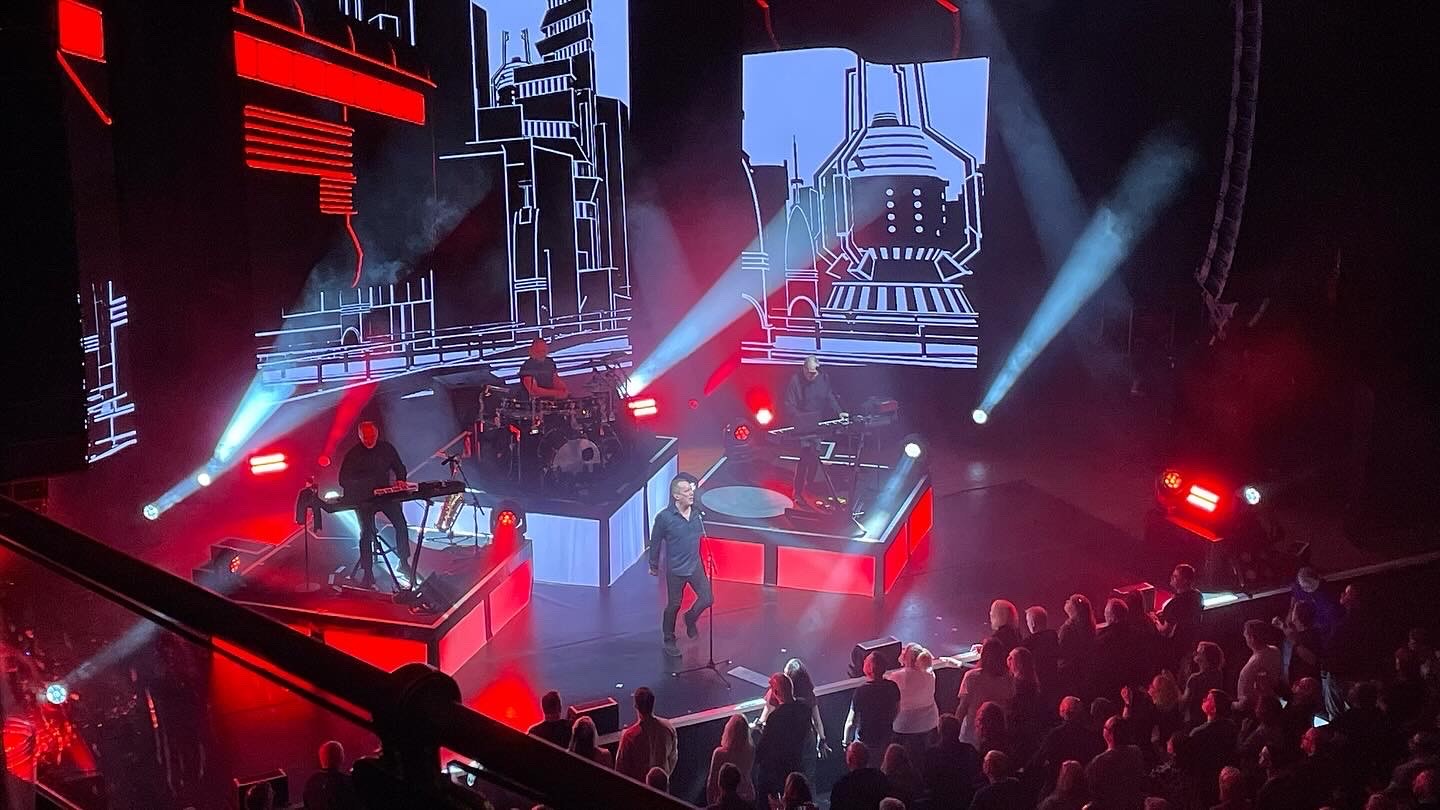
During the COVID-19 lockdown imposed in March 2020, McCluskey "rediscovered the creative power of boredom" and began writing material for OMD's next studio album. In October, the band returned to live performance with a limited-capacity gig at London's indigo at The O2, with proceeds going to their road crew; the event was also streamed online. In 2021, the Souvenir box set was nominated for "Best Historical Album" at the Grammy Awards. Also that year, OMD celebrated the 40th anniversary of 1981's Architecture & Morality with a UK tour, and released a triple-vinyl set of the album's singles containing associated B-sides, demo recordings, and live tracks.
In March 2022, a pair of concerts with a heavy emphasis on the group's more experimental work (rescheduled from September 2020), took place at the Royal Albert Hall, with a live album based on the shows released through the OMD store. Another re-issue of 1983's Dazzle Ships, featuring previously unheard recordings, was announced for a March 2023 release.
OMD's fourteenth studio album, Bauhaus Staircase, was released on 27 October 2023; it was preceded by a single, the title track, on 22 August. The record debuted at no. 2 on the UK Albums Chart, matching the peak achieved by The Best of OMD (1988). McCluskey has said that Bauhaus Staircase is likely to be the band's final album. Their latest 2024 tour runs from March to October including gigs in the UK, South Africa, Canada and the US.
Artistry and image
Early ethos and presentation
Electronic band Kraftwerk served as OMD's primary musical influence: McCluskey credits "Autobahn" (1974) with piquing he and Humphreys' interest in electronic music. Other formative influences included the Velvet Underground, Neu!, Roxy Music, Brian Eno and David Bowie. The pair also drew inspiration from Factory Records label-mates Joy Division, particularly during the making of the goth-inclined Organisation (1980). Disenchanted with the macho guitar rock that was popular among their friends, McCluskey and Humphreys were keen to "slay the rock 'n' roll dragon".
Spin wrote that "OMD set about reinventing punk with different applications of dance beats, keyboards, melodies, and sulks", rejecting the genre's "sonic trappings but not its intellectual freedom". The group found commercial success with a style of synth-pop described as "experimental", "minimal[ist]" and "edgy". Spoons vocalist Gordon Deppe likened OMD to musician Prince in their ability to make a basic chord sequence "sound unique and much more than it really is". He added that the band "pull it off amazingly well, sometimes even borrowing '50s style chord patterns as a basis. But you'd never know it." OMD often eschewed choruses, replacing them with synthesizer lines, and opted for unconventional lyrical subjects such as industrial processes, micronations and telephone boxes; BBC News said the group "were always more intellectual" than "contemporaries like Duran Duran and Eurythmics". Despite the band's experimentation, they employed pop hooks in their music, attaining what AllMusic described as "the enviable position of at once being creative innovators and radio-friendly pop giants". OMD are noted for their inventive use of sampling, initially via analogue technology and later by digital means.
According to the NRC, OMD are "known as the band that managed to wring emotion from synthesizer pop". The Scotsman stated that "their music, even with its occasionally cerebral themes, has always been defined by warmth, heart and soul: the sound of machinery manipulated by a tender human touch." Musician Vince Clarke felt the group were responsible for educating mainstream audiences that electronic music could have emotion. Michael Grace Jr., founder of indie pop outfit My Favorite, said in 2018, "The thing that strikes me now when I return to OMD is how remarkably human they sound. They are a soul band for an automated age. OMD proposed an honest rendering of the tension, fascination, and occasional terror they felt about how ghosts and machines would get along. It was more Philip K. Dick than Steve Jobs."
OMD have been recognised as the first of Britain's many "synth duo" acts. Nostalgie wrote that they became "a precursor of a whole generation of duos operating according to the same principle". Although the two original members enlisted other musicians over time, PopMatters said the band remained, "in essence, the songwriting/recording duo of Andy McCluskey and Paul Humphreys". OMD continues to be termed a "duo" in the media.
OMD were indifferent to celebrity status, and avoided the calculated fashion stylings of many of their 1980s peers. During live performances, McCluskey developed a frenetic dancing style that has been dubbed the "Trainee Teacher Dance"; he explains that it stemmed "from the perception that [OMD] were making boring robotic intellectual music that you couldn't dance to". Journalist Hugo Lindgren noted that the group were perceived as "oddballs, freaks" on the Liverpool scene, OMD weathered an "uncool" image,The linked page features Wilson's introduction. Move to page (i.e. slide) 6 for his comment on OMD:
- and faced hostility from sections of the music press in the 1980s. Critic Andrew Collins asserted, however, that the band would eventually "become cool" to the public.
Record Mirror pondered in 1980 whether McCluskey and Humphreys were emerging as "the Lennon and McCartney of the electronic world". The press began to describe the duo as "the Lennon–McCartney of synth-pop", which the A.V. Club saw as "a weighty mantle that has as much to do with their hailing from Liverpool as anything". The Salt Lake City Weekly remarked that the label "might be a bit hyperbolic, but OMD was indeed ahead of its time". The Scotsman had no reservations about the moniker, labelling OMD a "thoroughly sparkling pop group" with "more hooks than a chain of angling megastores".
Mid-1980s style change

Although retrospectively lauded, the experimental Dazzle Ships (1983) was a critical and commercial disappointment upon release. Facing potential excision from Virgin Records, OMD moved towards a more accessible sound on the black music-influenced Junk Culture (1984); they also donned more vibrant garments on the album's accompanying tour. The band continued to incorporate elements of sonic experimentation, although their sound became increasingly polished on the Stephen Hague-produced studio albums Crush (1985) and The Pacific Age (1986).
The Quietus founder John Doran, who was supportive of the group's reinvention, told how it became "quite popular to see OMD as nose-diving into the effluence after Dazzle Ships". Author Richard Metzger refused to "stick up for anything they recorded" afterwards, while the A.V. Club alleged that McCluskey would "give up" following that album. Conversely, music journalist Ian Peel observed "two brilliant, but very different, bands. Orchestral Manoeuvres in the Dark, the early 80s Factory descendents... and OMD, the late 80s stadium pop act." The Miami New Times asserted that "even their poppiest records of that postexperimental era, such as Junk Culture and Crush, were clever and beautifully arranged." Both of those albums were generally well-reviewed.
Musicians have commented on OMD's post-Dazzle Ships output. Moby remarked, "Their earlier records were just phenomenal... a few years on they were making music for John Hughes movies, and they were good at it and I'm glad that they had success with it, but it wasn't nearly as creatively inspiring." On the other hand, bassist Tony Kanal of No Doubt told how his group experimented with OMD-esque "John Hughes prom-scene movie moment kind of songs", adding that "Junk Culture is great". Angus Andrew of Liars hoped that tentative listeners would uncover "the complexity and mastery in OMD's later pop material", and declared himself a fan of the band's work across "all of their phases".
The group themselves describe Junk Culture as an enjoyable "collection of songs" as opposed to a "deep, conceptual" record, and argue that Crush features some strong material despite its strained recording sessions; Humphreys has named the latter as one of his favourite OMD works. The band concedes, however, that The Pacific Age was a creative misfire. Critic Jessica Bendinger reflected on OMD's stylistic journey by the late 1980s, saying that "their music has been colored by continual exploration... which has run the gamut from Gregorian-chant-inspired anthems of love to a union of Orchestral-Motown." SF Weekly said, "It's hard to think of any 1980s new wave bands that could navigate the genre's spectrum of sound and mood as well as Orchestral Manoeuvres in the Dark."
Subsequent reinventions
The McCluskey-led OMD explored a dance-oriented approach on Sugar Tax (1991) and Liberator (1993); the latter has since drawn criticism from McCluskey. Ian Peel wrote that the band "defied expectations by updating their sound and becoming, if only briefly, relevant in the 90s". The group disbanded shortly after the release of Universal (1996), on which they strained for a more organic and acoustic sound. In reviewing The OMD Singles (1998), AllMusic asserted that the band "covered in a single career that same territory explored by the Human League, Erasure, Yaz[oo], New Order, and beyond."
Since OMD's 2006 reformation, their material has been seen as more akin to their early output. PopMatters wrote that the group's 21st century work represents "one of the more successful second acts in modern pop history". The band are noted for their diverse contributions to the electronic, new wave, experimental, dance and post-punk genres throughout their career. OMD have undertaken regular UK and international gigs since they reformed, staging their own tours and also embracing '80s revival festivals such as the Rewind Festival and Heritage Live.
Legacy and influence

OMD have sold over 40 million records, and are considered one of synth-pop's most influential acts. They were identified by the A.V. Club as "one of the earliest synthesizer-driven bands to break out of the post-punk scene and lead the charge toward the defining sound of the [1980s]." PopMatters noted how OMD's work "gave credibility to ambitious pop" and led to "the emergence of a generation of electronic bands", including Talk Talk, ABC, Blancmange, and the Vince Clarke projects Depeche Mode, Yazoo and Erasure. Clarke recognised OMD as being "ahead of their time", and credited their "really great tunes and ideas" with directly inspiring him to become an electronic musician. The Pet Shop Boys found common ground in their affection for OMD, drawing particular inspiration from "Souvenir" (1981). Lead singer Neil Tennant named the group as "pioneers of electronic music"—a viewpoint shared by multiple outlets.
OMD impacted 1980s peers such as Howard Jones, Tears for Fears, Frankie Goes to Hollywood, A-ha, Men Without Hats, Alphaville, China Crisis, and Duran Duran, for whom "Electricity" (1979) was an early influence. The band became "heroes" to Kim Wilde songwriter/producer, Ricky Wilde. Within rock music, OMD directly inspired ZZ Top's introduction of synthesizers and onstage dancing, and helped foster New Order's emergence as an electronic act from 1983. Physicist and former Dare keyboardist, Brian Cox, recalled being an "obsessive" fan of the group, adding that their music "shaped [his] character". OMD were also influential on U2, whose singer, Bono, adorned his bedroom wall with a poster of their debut album cover; bandmate Adam Clayton later contributed to the group's official 2018 biography.Multiple sources:
- Houghton, pp. 91–92 (Clayton) OMD's impact extended to industrial artists like Nine Inch Nails, Skinny Puppy's Nivek Ogre, Ministry's Al Jourgensen,Jourgensen wrote that he "started doing this music influenced by all the music [then-girlfriend] Shannon was exposing [him] to", citing OMD's "Electricity" as an example.
- and Front Line Assembly's Rhys Fulber, who observed an "amazing" combination of "art, experimentation and pop".
Simple Minds' Jim Kerr said of OMD, "I was more than instantly charmed... they had somehow arrived almost fully formed and with a talent for spitfire hooks that permeated right through their songs." Former Kraftwerk member Karl Bartos lauded the band's "magnificent melodies", likening them to "Italian folk music, the very music [Giacomo] Puccini absorbed". OMD have garnered praise from other 1980s peers including Trevor Horn, Toyah Willcox, the Human League's Philip Oakey, Thompson Twins' Tom Bailey, and Mute Records founder Daniel Miller, while Gary Numan credited the group for "some of the best pop songs ever written". Frontman McCluskey has gained the admiration of musicians such as Paul McCartney, Heaven 17's Martyn Ware, The Teardrop Explodes's David Balfe, and Joy Division's Peter Hook, who labelled him a "really underrated" talent.
OMD are recognised for their influence on dance music in the 1990s and beyond.Multiple sources:
- The band inspired performers including Orbital, Paul van Dyk, Mike "μ-Ziq" Paradinas, David Guetta, and Moby, who cited them as "synth heroes" and a critical factor in his career choice. News outlets reported OMD's direct influence on "80s revivalists" like La Roux, and observed namechecks from popular synth-driven acts such as Robyn and the xx. The group have also inspired rock and pop artists including No Doubt, the Killers, Barenaked Ladies, MGMT, AFI, LCD Soundsystem, the Shins, Low, the Divine Comedy, Sharon Van Etten, Red Hot Chili Peppers' John Frusciante, Belle and Sebastian's Stevie Jackson, and Take That's Gary Barlow. "Electricity" prompted the formation of Nation of Language, as well as the radio career of Steve Lamacq. Singer Anohni said of Architecture & Morality (1981) and Dazzle Ships (1983): "Those records, they really changed me when I was a kid. I'd never heard anything quite like it... this really scary, futuristic landscape." Critic John Earls noted how the "wildly uncommercial" Dazzle Ships went on to be cited by various acts including Arcade Fire and Radiohead; the former band's longtime orchestrator, Owen Pallett, declared it the "best record ever" and one that "saved [their] life". The album has also impacted artists such as Death Cab for Cutie, Saint Etienne, Future Islands, and producer Mark Ronson.
The OMD tribute albums Messages and Pretending to See the Future (both 2001) contain cover versions by acts including White Town, the Faint, Cosmicity, Mahogany and the Acid House Kings. In 2020, Boy George streamed a cover of "The View from Here" (2017), adding that he wished he had written the track. A sample of "Sacred Heart" (1981) features on the 1998 instrumental track "Crabcraft" by Console, and in turn, on "Heirloom" by Björk (who lyricised and renamed "Crabcraft" in 2001). Elsewhere, OMD's songs have been interpreted or sampled by artists such as David Guetta, Moby, MGMT, John Foxx, Hot Chip, Leftfield, Xiu Xiu, Angel Olsen, NOFX and Good Charlotte, as well as by the rappers Kid Cudi and Lushlife. The group's influence extends to alternative metal band Deftones, country duo Sugarland, actor/writer Scott Aukerman, novelist Anna Smaill, filmmaker Noah Baumbach, and musician/producer Steven Wilson, who has worked in varied genres. Wilson dubbed OMD a "wonderful collision of ideas", whose albums "stand up very, very well as experimental pop records with the most enjoyable kind of songwriting". The group were inducted into the Goldmine Hall of Fame in 2014, described as "one of rock's most underrated and underappreciated bands".
Members

Current members
- Andy McCluskey – vocals, bass, keyboards, guitar (1978–1996; 2006–present)
- Paul Humphreys – keyboards, vocals (1978–1989; 2006–present)
- Martin Cooper – keyboards, saxophone (1980–1989; 2006–present)
- Stuart Kershaw – drums (1993; 2015–present)
Former members
- Malcolm Holmes – drums, percussion (1980–1989; 2006–2015)
- Dave Hughes – keyboards (1979–1980)
- Michael Douglas – keyboards (1980–1981)
- Graham Weir – guitar, brass, keyboards (1984–1989)
- Neil Weir – brass, keyboards, bass (1984–1989)
- Phil Coxon – keyboards (1991–1993)
- Nigel Ipinson – keyboards (1991–1993)
- Abe Juckes – drums (1991–1992)
Timeline
ImageSize = width:900 height:auto barincrement:25 PlotArea = left:115 bottom:90 top:5 right:10 Alignbars = justify DateFormat = dd/mm/yyyy Period = from:01/09/1978 till: TimeAxis = orientation:horizontal format:yyyy Legend = orientation:vertical position:bottom columns:4 ScaleMajor = increment:4 start:1979 ScaleMinor = increment:1 start:1979
Colors = id:voc value:red legend:Vocals id:ww value:tan2 legend:Wind_instruments id:bi value:skyblue legend:Brass_instruments id:g value:green legend:Guitars id:key value:purple legend:Keyboards id:b value:blue legend:Bass id:dr value:orange legend:Drums id:pc value:claret legend:Percussion id:lines value:black legend:Studio_release id:bars value:gray(0.95)
BackgroundColors = bars:bars
LineData = at:22/02/1980 color:black layer:back at:23/10/1980 color:black layer:back at:08/11/1981 color:black layer:back at:04/03/1983 color:black layer:back at:30/04/1984 color:black layer:back at:17/06/1985 color:black layer:back at:29/09/1986 color:black layer:back at:07/05/1991 color:black layer:back at:14/06/1993 color:black layer:back at:02/06/1996 color:black layer:back at:20/09/2010 color:black layer:back at:05/04/2013 color:black layer:back at:01/09/2017 color:black layer:back at:27/10/2023 color:black layer:back
PlotData= width:11 textcolor:black align:left anchor:from shift:(10,-4) bar:Andy McCluskey from:start till:01/07/1996 color:voc bar:Andy McCluskey from:start till:01/10/1993 color:b width:7 bar:Andy McCluskey from:01/01/1980 till:10/07/1984 color:g width:5 bar:Andy McCluskey from:start till:01/07/1996 color:key width:3 bar:Andy McCluskey from:01/01/2006 till:end color:voc bar:Andy McCluskey from:01/01/2006 till:end color:b width:7 bar:Andy McCluskey from:01/01/2006 till:end color:key width:3 bar:Martin Cooper from:01/12/1980 till:01/07/1989 color:ww bar:Martin Cooper from:01/04/1983 till:01/07/1989 color:key width:3 bar:Martin Cooper from:01/01/2006 till:end color:key bar:Martin Cooper from:01/01/2006 till:end color:ww width:3 bar:Neil Weir from:10/07/1984 till:31/12/1988 color:bi bar:Neil Weir from:10/07/1984 till:31/12/1988 color:key width:7 bar:Neil Weir from:10/07/1984 till:31/12/1988 color:b width:3 bar:Graham Weir from:10/07/1984 till:31/12/1988 color:g bar:Graham Weir from:10/07/1984 till:31/12/1988 color:bi width:7 bar:Graham Weir from:10/07/1984 till:31/12/1988 color:key width:3 bar:Paul Humphreys from:start till:01/07/1989 color:key bar:Paul Humphreys from:start till:01/07/1989 color:voc width:3 bar:Paul Humphreys from:01/01/2006 till:end color:key bar:Paul Humphreys from:01/01/2006 till:end color:voc width:3 bar:Dave Hughes from:01/01/1979 till:01/01/1980 color:key bar:Michael Douglas from:01/12/1980 till:01/01/1981 color:key bar:Nigel Ipinson from:01/01/1991 till:01/10/1993 color:key bar:Phil Coxon from:01/01/1991 till:01/10/1993 color:key bar:Malcolm Holmes from:01/04/1980 till:01/07/1989 color:dr bar:Malcolm Holmes from:01/04/1980 till:01/07/1989 color:pc width:3 bar:Malcolm Holmes from:01/01/2006 till:01/01/2015 color:dr bar:Malcolm Holmes from:01/01/2006 till:01/01/2015 color:pc width:3 bar:Abe Juckes from:01/01/1991 till:01/01/1993 color:dr bar:Stuart Kershaw from:01/01/1993 till:01/10/1993 color:dr bar:Stuart Kershaw from:01/01/2015 till:end color:dr
Discography
Main article: Orchestral Manoeuvres in the Dark discography
Studio albums
- Orchestral Manoeuvres in the Dark (1980)
- Organisation (1980)
- Architecture & Morality (1981)
- Dazzle Ships (1983)
- Junk Culture (1984)
- Crush (1985)
- The Pacific Age (1986)
- Sugar Tax (1991)
- Liberator (1993)
- Universal (1996)
- History of Modern (2010)
- English Electric (2013)
- The Punishment of Luxury (2017)
- Bauhaus Staircase (2023)
Notes
References
Bibliography
- Houghton, Richard. OMD: Pretending to See the Future (expanded paperback edition). This Day in Music Books. 2019.
- Waller, Johnny; Humphreys, Mike. Orchestral Manoeuvres in the Dark: Messages. Sidgwick & Jackson. 1987.
- West, Mike. Orchestral Manoeuvres in the Dark. Omnibus Press. 1982.
References
- Hanley, James. (24 October 2019). "'It's been a remarkable journey': OMD toast their 40th anniversary".
- Shand, Max. (8 November 2019). "OMD at 40: Making Sense of a Synthpop Legacy".
- Marder, Phill. (13 March 2014). "Goldmine's Hall of Fame Inductees - Volume 43".
- (15 May 2014). "Mad World: An Oral History of New Wave Artists and Songs That Defined the 1980s".
- Taylor, Paul. ''Popular Music Since 1955''. Mansell Pub., 1985. p. 339. {{ISBN. 0-7201-1727-5, {{ISBN. 978-0-7201-1727-1.
- (7 February 2016). "Liverpool: E".
- (7 February 2016). "Liverpool: P Q".
- "Liverpool: H". link2wales.co.uk.
- "OMD | Orchestral Manoeuvres in the Dark | home". Omd.uk.com.
- Lindores, Mark. (1 August 2019). "Classic Album: Architecture & Morality".
- ''Pete Frame's Rock Family Trees'', 1993
- Lindgren, Hugo. (10 May 2013). "The Plot Against Rock". [[The New York Times Company]].
- ''Rock Formations: Categorical Answers to How Band Names Were Formed'', Dave Wilson, 2004, p. 58
- Rexroat, Dee Ann. (13 May 1988). "OMD maneuvering its way to American success". [[The Gazette (Cedar Rapids).
- (13 September 2010). "Orchestral Manoeuvres in the Dark".
- Bray, Elisa. (5 April 2013). "Our Friends Electric: Orchestral Manoeuvres in the Dark". [[The Independent]].
- Earls, John. (February 2020). "OMD Interview: 'Stockhausen or ABBA? Can't We Be Both?'".
- Hiles, Hannah. (9 March 2022). "OMD Singer Champions Unsung North Staffordshire Artist in New Exhibition".
- (21 February 2017). "Paul Humphreys".
- Seaman, Duncan. (17 October 2019). "OMD: 'Our whole raison d'etre is to try to ask musical questions'".
- Wilson, Lois. (30 September 2019). "OMD".
- (5 March 2021). "1981".
- Wright, Jade. (10 October 2014). "Why 80s music group OMD are no museum pieces".
- Grimsditch, Lee. (8 July 2022). "Unassuming telephone box people travel across the world to see".
- Browne, Paul. (15 November 2011). "Electricity".
- Harron, Mary. (6 November 1981). "Rock". [[The Guardian]].
- Mettler, Mike. (17 June 2016). "Gary Barlow didn't just meet his '80s heroes, he made a retro album with them".
- Smyers, Darryl. (18 March 2011). "Q&A: OMD's Paul Humphreys Talks Reformation, The Return of Intelligent Music and Being in Hitler's Underpants".
- Lester, Paul. (20 October 2022). "Things That Dreams Are Made Of: The Birth of Synth-Pop".
- O'Brien, Jon. "Orchestral Manoeuvres in the Dark: ''Live in Berlin''". [[AllMusic]].
- Houghton, pp. 81–82
- Browne, Paul. ''Orchestral Manoeuvres in the Dark'' (2003 remaster). Sleeve notes. [[Virgin Records]].
- Browne, Paul. (22 February 2020). "Orchestral Manoeuvres In The Dark: Strange Directions".
- Kellman, Andy. "Biography: Orchestral Manoeuvres in the Dark". [[AllMusic]].
- Browne, Paul. (26 June 2019). "The New Recruit".
- Porter, Christopher. (28 September 2010). "Synthesized Past: 'History of Modern,' OMD". [[The Washington Post]].
- "Organisation". OMD.
- Wuench, Kevin. (4 November 2016). "Even in the '80s sometimes you pray history doesn't repeat itself". [[Tampa Bay Times]].
- Meagher, John. (15 October 2017). "80s hitmakers OMD – Coming out of the dark". [[Irish Independent]].
- Mansfield, Brian. (4 April 2013). "On the Road Again: Orchestral Manoeuvres in the Dark".
- (10 January 1981). "1980 Poll Results".
- West, p. 26
- (5–18 March 1981). "The Smash Hits Readers' Poll Results".
- "Architecture & Morality". OMD.
- Waller; Humphreys, pp. 92–96
- Browne, Paul. (12 March 2003). "Architecture & Morality Interview: Andy McCluskey". Messages.
- Stanley, Bob. [https://www.theguardian.com/music/2008/mar/07/popandrock1 How to lose 3 million fans in one easy step]. ''[[The Guardian]]''. 7 March 2008. Retrieved 13 June 2013.
- (24 December 1981). "Smash Hits 1981 Poll Winners: Best Group".
- (23 January 1982). "1981 Poll Results".
- (14 April 2020). "Yes. We had never expected the success.".
- (5 January 1985). "Readers Poll Winners: 1984".
- Righi, Len. (14 December 1985). "OMD: British Synth Band Maneuvers Its Way Onto American Radio".
- Waller; Humphreys, pp. 148–149
- (July 1993). "A Discographical History of OMD".
- Riccio, Richard. (23 August 1991). "''Sugar'' Is Sprinkled with Gems". [[Tampa Bay Times.
- Charry, Eric. (2020). "A New and Concise History of Rock and R&B through the Early 1990s". [[Wesleyan University Press]].
- "OMD (Orchestral Manoeuvres In The Dark) - (Forever) Live And Die".
- "(forever) live and die | full Official Chart History | Official Charts Company".
- Fisher, Kyle. (8 April 2013). "OMD, English Electric".
- Pendras, Peter. (4 October 1991). "Former Blasters' guitarist finds his own success". [[North County Times.
- ''Sugar Tax'' liner notes. 1991. Virgin Records.
- (30 October 1981). "The Smash Hits Readers Poll 1991".
- "Liberator".
- ''Liberator'' liner notes. 1993. Virgin Records.
- Henderson, Alex. "Esperanto > Review". [[AllMusic]].
- Alexis Petridis. (23 November 2001). "The power behind pop".
- Schulte, Tom. "The OMD Singles". [[AllMusic]].
- Jeffries, David. "The OMD Remixes". [[AllMusic]].
- (7 April 2001). "Electropop (no. 5: Orchestral Manoeuvres in the Dark)".
- "OMD Gigography". omd.me.uk.
- "OMD News: December 2009".
- "Graffiti Soul Tour". Dream Giver Redux.
- (21 June 2010). "Vintage computers inspire next generation of scientists". BBC News.
- Chattman, Jon. (13 September 2011). "If They Left... and Came Back: OMD Returns with '80s Pop Synth Intact".
- Wilson, P.F.. (21 September 2011). "OMD co-founder Paul Humphreys reflects on the band's resurgence".
- Michaels, Sean. (21 May 2010). "OMD announce first studio album in 14 years". [[The Guardian]].
- (2 November 2010). "Orchestral Manoeuvres in the Dark, Colston Hall, Bristol".
- (8 September 2010). "OMD to support The Buggles on 28.09.10".
- "The Buggles and OMD, Supperclub, London England 28 September 2010". Release Magazine.
- (10 March 2011). "Electric Picnic line-up announced".
- "OMD Blog: Next Album".
- (28 February 2012). "OMD to Perform at The Big Dome March 12".
- (26 June 2012). "OMD to Perform in Cape Town".
- (July–August 2012). "OMD Live in SA". [[South African Express.
- (19 September 2019). "Pete Price chats to Andy McCluskey". [[Radio City Talk]].
- "Coachella Lineup".
- (11 February 2013). "Metroland Pre-Order". Official OMD website.
- (18 March 2013). "OMD debuts new track "Night Café", announces 10-inch EP for Record Store Day".
- "OMD: Live at Royal Albert Hall on PledgeMusic".
- [https://www.allmusic.com/album/fly-songs-inspired-by-the-film-eddie-the-eagle-original-motion-picture-soundtrack-mw0002906947 ''Fly: Songs Inspired by the Film Eddie the Eagle'']. [[AllMusic]]. Retrieved 11 November 2016.
- (22 January 2017). "Exploring OMD's Next Studio Album The Punishment Of Luxury".
- Slingerland, Calum. (15 May 2017). "Orchestral Manoeuvres in the Dark Return with 'The Punishment of Luxury'".
- Jones, Alan. (8 September 2017). "Official Charts Analysis: The Script debut at No.1 on albums chart". [[Music Week]].
- (2017). "The Punishment of Luxury". 100% Records.
- (14 June 2018). "Pretending To See The Future – 40th Anniversary Book".
- (14 June 2018). "OMD to release 40th anniversary book 'Pretending to see the future'".
- "UK & Europe 40th Anniversary Tour – Orchestral Manoeuvres In The Dark".
- Harnell, Steve. "2019 Reader Awards".
- "Souvenir – New Greatest Hits & Deluxe Boxset Announced – Orchestral Manoeuvres In The Dark".
- Marshall, Olivia. (14 November 2020). "OMD discuss their upcoming tour, Covid-19 and Enola Gay".
- Hanley, James. (17 September 2020). "OMD announce special show to support touring crew".
- (24 November 2020). "Grammy Nominations 2021: See the Full List of Nominees Here".
- (2 September 2021). "OMD celebrate 40 years of 'Architecture & Morality' with 12" vinyl singles box set".
- "Orchestral Manoeuvres in the Dark". [[Royal Albert Hall]].
- (5 March 2022). "OMD announce live album from London's Royal Albert Hall".
- Sinclair, Paul. (2 February 2023). "OMD / Dazzle Ships reissue".
- Pearis, Bill. (22 August 2023). "OMD announce new album 'Bauhaus Staircase,' share title track".
- (22 August 2023). "OMD debuts title track off upcoming 14th studio album 'Bauhaus Staircase'".
- Griffiths, George. (3 November 2023). "Taylor Takeover! Taylor Swift dominates the UK's Official Singles and Albums Chart with the biggest opening week of 2023 so far". [[Official Charts Company]].
- Brayden, Kate. (4 April 2023). "OMD's Andy McCluskey: 'I'm really happy that I don't have to pander to a TikTok generation to get my songs heard'".
- "Bauhaus Staircase Tour". OMD.
- Johnston, Maura. (8 March 2018). "For four decades, OMD has cast a wary eye toward the future".
- Maxwell, Dominic. (24 September 2010). "Why OMD Are Embarrassed to be Back".
- Page, Barry. (23 July 2025). "Top 20 Difficult Second Albums".
- Hunter, James. (January 1999). "Orchestral Manoeuvres in the Dark: ''The OMD Singles''".
- Tingen, Paul. (April 1986). "King of Techno Pop".
- Erlewine, Stephen Thomas. "''Liberator'' review". [[AllMusic]].
- Deppe, Gordon. (December 1988). "Songwriting Is Seeing the Mental Picture".
- Ware, Gareth. (4 March 2013). "OMD: Of All the Thing We've Made: 'Dazzle Ships' At 30".
- Awbi, Anita. (19 March 2013). "Andy McCluskey, OMD".
- (20 September 2010). "OMG it's OMD!". [[BBC News]].
- Bergstrom, John. (17 April 2008). "Orchestral Manoeuvres in the Dark: Dazzle Ships Review".
- Raggett, Ned. "''Organisation''". [[AllMusic]].
- Harrison, A Noa. (6 September 2017). "Technology Is the Servant of the Human Beings: The OMD Interview".
- Gray, Martin. (7 April 2023). "OMD – Dazzle Ships: 40th Anniversary Reappraisal".
- Vollaard, Jan. (27 October 2023). "OMD Resumes the Search for the Soul of Electronic Pop".
- (6 August 2018). "Music review: OMD, Kelvingrove Bandstand, Glasgow".
- Shand, Max. (12 October 2020). "Synthpop King Vince Clarke on Erasure's 18th Studio Album, 'The Neon'".
- Earls, John. (November–December 2023). "Final Messages?".
- Kerr, Jim. (28 October 2009). "OMD – Electricity".
- (5 June 2018). "Orchestral Manoeuvres in the Dark: Their Greatest Hits". [[Nostalgie]].
- Bergstrom, John. (6 November 2023). "Orchestral Manoeuvres in the Dark's 'Bauhaus Staircase' Shines".
- Silver, Marc. (13 September 2010). "OMD: The Kings of Synth-Pop Meet the Queen of Soul". [[NPR]].
- Smith, Mat. (25 October 2023). "OMD - Bauhaus Staircase".
- Roy, David. (18 September 2023). "OMD Announce Irish Shows for 2024".
- McCluskey, Andy. (24 November 2010). "The Future, the Past and Forever After". [[Athens Voice]].
- Ryan, Gary. (14 October 2019). "Does Rock 'N' Roll Kill Braincells?! – Andy McCluskey".
- (3 February 2007). "Orchestral Leap in the Dark".
- Morgan, David. (10 July 2015). "Andy McCluskey on Enola Gay, making a comeback and why pop music goes around in circles".
- Ludgate, Simon. (1 March 1980). "Orchestral Manoeuvres in the Dark: OMD".
- Waller; Humphreys, p. 173
- Jackson, Josh. (21 June 2021). "The Best Albums of 1981".
- Hall, Philip. (15 November 1980). "On the Carpettes".
- Hardee, Howard. (14 March 2018). "Live Music Picks: March 15–21".
- Thomson, Graeme. (May 2023). "Radio Waves".
- Waller; Humphreys, pp. 132–133
- Mark, Elliott. (25 March 2015). "''Junk Culture'' – OMD".
- Muretich, James. (4 October 1986). "Pop Develops the Blahs When Teamed with Bowie". [[Calgary Herald]].
- Turner, Luke. (7 August 2023). "Low Culture Podcast: An Orchestral Manoeuvres in the Dark Special!".
- Doran, John. (25 September 2008). "Messages – Greatest Hits".
- Metzger, Richard. (23 February 2016). "Not just for John Hughes films: OMD were a much better group than they get credit for".
- O'Neal, Sean. (26 December 2006). "Permanent Records: Albums from the A.V. Club's Hall of Fame".
- Peel, Ian. "Messages: Greatest Hits".
- Cárdenas, Patricia. (27 August 2019). "Orchestral Manoeuvres in the Dark Pioneered Millennial Pop Music".
- Lindores, Mark. (15 November 2023). "Album by Album – OMD".
- Burke, David. (25 October 2022). "The Lowdown – Orchestral Manoeuvres in the Dark".
- Turner, Luke. (24 September 2013). "Corrupting Sonic DNA: Moby's Favourite Albums".
- Marchese, David. (24 September 2012). "No Doubt Explain OMD, EDM, and Peter Hook Basslines on 'Push and Shove'".
- Turner, Luke. (16 April 2014). "No Barrier Fun: Angus Andrew of Liars' Favourite LPs".
- (29 April 2013). "OMD interview - Andy McCluskey and Paul Humphreys (part 3)". FaceCulture.
- Marsh, Phil. (1994). "Talking with the Listening Pool".
- Bendinger, Jessica. (July 1988). "Orchestral Manoeuvres in the Dark".
- Casagrande, Tim. (21 March 2018). "Three Acts to See This Week: OMD, SSION, and Moon Hooch". [[SF Weekly]].
- Evans, Paul. (2004). "[[The Rolling Stone Album Guide". [[Simon & Schuster]].
- O'Brien, Steve. (3 June 2021). "Top 20 Reunion Albums".
- Zaleski, Annie. (31 August 2017). "OMD examines the complications of progress on the sparkling The Punishment of Luxury".
- (26 July 2015). "Rewind Festival 2015: 80s legends OMD gearing up for headline performance". Reach PLC.
- (12 August 2023). "Soft Cell bring magnetic Soho sleaze to a stately home for Heritage Live". Telegraph Media Group.
- Niasseri, Sassan. (2 November 2019). "OMD in Profile: Back to Orléans".
- Simpson, Dave. (28 October 2019). "OMD review – clap-along electropop sounds even better with age".
- Sherwin, Adam. (16 October 2020). "OMD forced to postpone benefit gig for roadies after Andy McCluskey tests positive for Covid-19".
- Clayton-Lea, Tony. (24 February 2024). "The Guide: Rhiannon Giddens, OMD, Diversity and more events to see, shows to book and ones to catch before they end". [[The Irish Times]].
- Shey, Brittanie. (23 March 2011). "March Madness".
- Turner, Luke. (19 December 2013). "Oh L'Amour: Vince Clarke of Erasure's Favourite Albums".
- Ilic, Vel. (14 September 2023). "Vince Clarke: Game of Drones".
- O'Brien, Jon. (7 March 2024). "Complete Guide – Pet Shop Boys albums".
- Myers, Marc. (2022). "Anatomy of 55 More Songs: The Oral History of Top Hits That Changed Rock, Pop and Soul". [[Grove Press]].
- Lucas, Dan. (19 April 2013). "Pet Shop Boys: Always Fascinating".
- Sexton, Paul. (10 September 2017). "The Script Land Fourth UK No. 1 Album".
- O'Toole, Lucy. (5 September 2019). "Tiny Magnetic Pets set to join Orchestral Manoeuvres in the Dark on tour".
- "BBC Music Day 2017 Ambassadors". [[BBC Music]].
- (14 October 2019). "Seven Tracks: Orchestral Manoeuvres in the Dark".
- (8 December 2019). "Classic Artist: OMD". [[Virgin Radio UK]].
- Murphy, Tom. (12 October 2011). "Howard Jones on performing Human Lib and Dream Into Action in their entirety on this tour".
- (17 May 2020). "OMD's 'Pretending to See the Future'".
- Mitchell, Matt. (6 August 2025). "Falling 'So in Love' with Curtis Mayfield and Orchestral Manoeuvres in the Dark".
- (1 March 2022). "Tears for Fears' "Mad World": The Story Behind the Unexpected Hit". [[Consequence (publication).
- Upchuck, Matt. (19 June 2017). "Brian Nash Interview".
- Page, Barry. (2020). "A-ha: Down to the Tracks". This Day in Music Books.
- Hart, Ron. (5 January 2016). "The 10 Best Reissues of 2015".
- Patania, Matthew. (8 October 2021). "Interview: Canadian New Wave Electro-Pop Pioneers Men Without Hats Release New EP, 'Again (Part 1)'".
- McPherson, Douglas. (September 2019). "Godfathers of Pop: Marian Gold".
- Wilson, PF. (20 July 2022). "Concert Review: China Crisis, Ludlow Garage, Cincinnati, OH".
- Taylor, John. (2012). "In the Pleasure Groove: Love, Death and Duran Duran". [[E. P. Dutton.
- (19 August 2018). "Ahh.. just had a lovely chat with @OfficialOMD Andy McCluskey.".
- Breihan, Tom. (28 July 2021). "ZZ Top's Dusty Hill Dead At 72".
- Simmons, Sylvie. (1–15 July 1982). "Over the Top!".
- Dax, Max. (2 September 2012). "Max Dax interviews Bernard Sumner".
- Houghton, p. 4 (foreword by Brian Cox)
- Olson, Jack. (18 July 1990). "Nine Inch Tales". [[City Pages]].
- Magnotta, Andrew. (14 August 2017). "Orchestral Manoeuvres in the Dark Played Its First Show as a Dare". [[iHeartRadio]].
- Lentini, Liza. (31 March 2023). "5 Albums I Can't Live Without: oGre and cEvin Key of Skinny Puppy".
- Murphy, Tom. (6 October 2016). "Rhys Fulber of Front Line Assembly Brings Live Show to Tri-Lakes Center for the Arts".
- Heck, Jean-Paul. (13 February 2024). "The Men of Orchestral Manoeuvres in the Dark (OMD): 'You Suddenly Find Yourself Between Swift and Sheeran'".
- Ware, Martyn. (4 November 2022). "Andy McCluskey: Show Notes".
- (15 July 2021). "On this day in 1956: Joy Division's Ian Curtis was born".
- Carr, Nigel. (17 March 2024). "Orbital – Interview – Green & Brown Albums Re-Releases and Tour".
- Moayeri, Lily. (21 April 2020). "20 Questions With Paul van Dyk".
- Doran, John. (11 March 2013). "Melancholy Euphoria: A Heterotic Interview & Full Album Stream".
- (October 1998). "David Guetta".
- Houghton, pp. 370–371
- Ranta, Alan. (23 April 2013). "Orchestral Manoeuvres in the Dark".
- Argyrakis, Andy. (25 June 2021). "The Killers' Dave Keuning drops 'A Mild Case of Everything', looks on the 'Mr. Brightside'".
- (12 April 2017). "Kevin Hearn of Barenaked Ladies".
- Fitzmaurice, Larry. (18 February 2018). "MGMT Are Still Perfectly Strange".
- Rosen, Steven. (28 September 2009). "AFI: 'We Wanted to Do Rock but Keep It Interesting'".
- Murphy, James. (22 May 2010). "LCD Soundsystem: ''This Is Happening''".
- Walters, Barry. (6 September 2017). "OMD on the Dawn of Synth Pop".
- (March 2000). "Low: 13 Questions".
- Cummings, Damien. (18 October 2019). "'Being an oddball is part of it': The Divine Comedy's Neil Hannon".
- Ramirez, Ramon. (26 September 2016). "Interview: Sharon Van Etten on taking charge in the studio".
- (March 2001). "?&A: John Frusciante".
- Albert, John. (4 December 2002). "Sons of the City".
- (22 November 2011). "Interview: Stevie Jackson - Belle and Sebastian guitarist".
- Meagher, John. (8 January 2022). "Nation of Language: The Brooklyn band who got their spark from a synth classic".
- Houghton, pp. 69–72
- (3 January 2023). "Video by Anohni". Instagram.
- Turner, Luke. (14 February 2008). "Final Fantasy: Meets Monkey in Toronto, Curates Festival in Europe".
- Jones, Mia. (19 December 2010). "Owen Pallett – Live in Singapore".
- Harward, Randy. (18 August 2011). "Death Cab for Cutie: The Concepts Behind Codes & Keys". [[Salt Lake City Weekly]].
- Stamp, Tony. (6 April 2017). "The Past and Present of Future Islands". [[Radio New Zealand]].
- Travis, Ben. (1 September 2015). "OMD: Watch 'Genetic Engineering' Live from ''Dazzle Ships'' Show in Liverpool".
- Ryzik, Melena. (1 October 2010). "An Admirer of Tight Production, But of Sludge, Too". [[The New York Times]].
- "Messages: Modern Synthpop Artists Cover OMD". [[AllMusic]].
- Raggett, Ned. "Pretending to See the Future: A Tribute to OMD". [[AllMusic]].
- (10 December 2020). "Instagram video by Boy George".
- (1998). "Rocket in the Pocket". Payola Records.
- Pytlik, Mark. (2003). "Björk: Wow and Flutter". [[ECW Press]].
- Anderson, Sarah. (21 March 2011). "SXSW 2011 highlights, featuring Brother, Snoop and Odd Future".
- Hogan, Marc. (2 April 2012). "See MGMT Play 'Alien' New Song, Cover OMD Live in Bogota".
- Evans, Max. (22 April 2013). "Listen: John Foxx & the Maths Remix OMD".
- (25 September 2020). "27 New Songs Out Today".
- (25 May 2010). "One half of Leftfield, Neil Barnes, tells why he can't wait to give Rockness a blast of the coolest sounds down memory lane".
- Foster, Richard. (16 January 2026). "Covers Album of the week: Xiu Xiu's Xiu Mutha Fuckin' Xiu: Vol. 1".
- Cummings, Bill. (9 July 2021). "Angel Olsen announces 'Aisles' EP feat covers of OMD, Billy Idol, Laura Branigan and more".
- Greene, Jo-Ann. "NOFX – 45 or 46 Songs That Weren't Good Enough to Go on Our Other Records". [[AllMusic]].
- (5 November 2001). "'Not Another' Alt Rock Covers Soundtrack".
- Ashurst, Hari. (16 April 2012). "Lushlife: Plateau Vision Album Review".
- Madden, Emma. (11 December 2020). "Deftones Talk 'Ohms' Album of the Year Nod, 'Black Stallion,' Fave Music of 2020".
- Wood, Mikael. (9 October 2010). "In a Big Country".
- Ross, Danny. (30 November 2017). "Scott Aukerman Talks Music And 'Comedy Bang! Bang!'".
- Lowe, Helen. (27 May 2015). "An Interview with Anna Smaill, Author of ''The Chimes''".
- "Greta Gerwig: Mistress America".
- Charlton, Lauretta. (27 March 2015). "Noah Baumbach Shares His Musical Obsessions".
This article was imported from Wikipedia and is available under the Creative Commons Attribution-ShareAlike 4.0 License. Content has been adapted to SurfDoc format. Original contributors can be found on the article history page.
Ask Mako anything about Orchestral Manoeuvres in the Dark — get instant answers, deeper analysis, and related topics.
Research with MakoFree with your Surf account
Create a free account to save articles, ask Mako questions, and organize your research.
Sign up freeThis content may have been generated or modified by AI. CloudSurf Software LLC is not responsible for the accuracy, completeness, or reliability of AI-generated content. Always verify important information from primary sources.
Report