From Surf Wiki (app.surf) — the open knowledge base
Orang Laut
Ethnic group of Southeast Asia

Ethnic group of Southeast Asia
| Field | Value | ||
|---|---|---|---|
| group | Orang Laut | ||
| {{Script | Arab | اورڠ لا{{Jawi-HamzaThreeQuarter}}وت}} | |
| image | [[File:COLLECTIE TROPENMUSEUM Woonschuit van een Oerang-Laoet familie Ka. Toengkal TMnr 10010488.jpg | 300px | ]] |
| caption | An Orang Laut family living in a boat, circa 1914–1921. | ||
| population | 420,000 | ||
| popplace | Malay Peninsula: | ||
| MalaysiaRiau Archipelago: | |||
| IndonesiaSingapore | |||
| langs | Loncong, Orang Seletar, | ||
| Malay (Malaysian, Singaporean, Indonesian) | |||
| rels | Animism, Folk religion, Islam | ||
| related | Orang Kuala, Orang Darat, Orang Seletar, Sama-Bajau, Moken, Urak Lawoi’ people, Malay people |
MalaysiaRiau Archipelago: IndonesiaSingapore Malay (Malaysian, Singaporean, Indonesian)
The Orang Laut are several seafaring ethnic groups and tribes living around Singapore, Peninsular Malaysia and the Indonesian Riau Islands. The Orang Laut are commonly identified as the Orang Seletar from the Straits of Johor, but the term may also refer to any Malayic-speaking people living on coastal islands, including those of the Mergui Archipelago in Myanmar and Thailand, commonly known as Moken.
The population of the tribe in the 21st century is estimated to be 420,000 people.
Etymology
The Malay term orang laut literally means 'sea peoples'. The Orang Laut live and travel in their boats on the sea. They made their living from fishing and collecting sea products. Another Malay term for them, Orang Selat (literally 'Straits people'), was brought into European languages as Celates.
Distribution
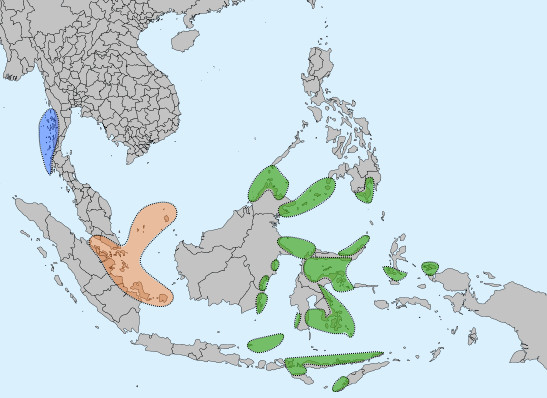
Broadly speaking, the term encompasses the numerous tribes and groups inhabiting the islands and estuaries in the Ria Archipelago, the Pulau Tujuh Islands, the Batam Archipelago, and the coasts and offshore islands of eastern Sumatra, the southern Malay Peninsula and Singapore.
History

Historically, the Orang Laut played major roles in Srivijaya, the Sultanate of Malacca, and the Sultanate of Johor. They patrolled the adjacent sea areas, repelling pirates, directing traders to their employers' ports and maintaining those ports' dominance in the area. In return, the ruler gave the Orang Laut leaders prestigious titles and gifts. The earliest description of the Orang Laut may have been by the 14th century Chinese traveler Wang Dayuan who described the inhabitants of Temasek (present day Singapore) in his work Daoyi Zhilüe.
Popular culture

In the story The Disturber of Traffic by Rudyard Kipling, a character called Fenwick misrenders the Orang Laut as "Orange-Lord" and the narrator character corrects him that they are the "Orang-Laut".
References
References
- Adriaan J. Barnouw. (February 1946). "Cross Currents of Culture in Indonesia". The Far Eastern Quarterly, Vol. 5, No. 2.
- David E. Sopher. (1965). "The Sea Nomads: A Study Based on the Literature of the Maritime Boat People of Southeast Asia". Memoirs of the National Museum.
- "The Malay Peninsula and Archipelago".
- Barbara Watson Andaya. ''Report of Three Residents of Jambi about the Threat of Johorese War Vessels in the Batang Hari River, 11 September 1714''. Jakarta : Arsip Nasional Republik Indonesia. 2013 https://sejarah-nusantara.anri.go.id/media/dasadefined/HartaKarunArticles/HK010/Doc_10_Eng.pdf
- Mary Somers Heidhues. ''Southeast Asia: A Concise History''. London: Hudson and Thames, 2000. Page 27
- Paul Wheatley. (1961). "The Golden Khersonese: Studies in the Historical Geography of the Malay Peninsula before A.D. 1500". [[w:University of Malaya.
This article was imported from Wikipedia and is available under the Creative Commons Attribution-ShareAlike 4.0 License. Content has been adapted to SurfDoc format. Original contributors can be found on the article history page.
Ask Mako anything about Orang Laut — get instant answers, deeper analysis, and related topics.
Research with MakoFree with your Surf account
Create a free account to save articles, ask Mako questions, and organize your research.
Sign up freeThis content may have been generated or modified by AI. CloudSurf Software LLC is not responsible for the accuracy, completeness, or reliability of AI-generated content. Always verify important information from primary sources.
Report