From Surf Wiki (app.surf) — the open knowledge base
Ophiuchus
Constellation straddling the celestial equator
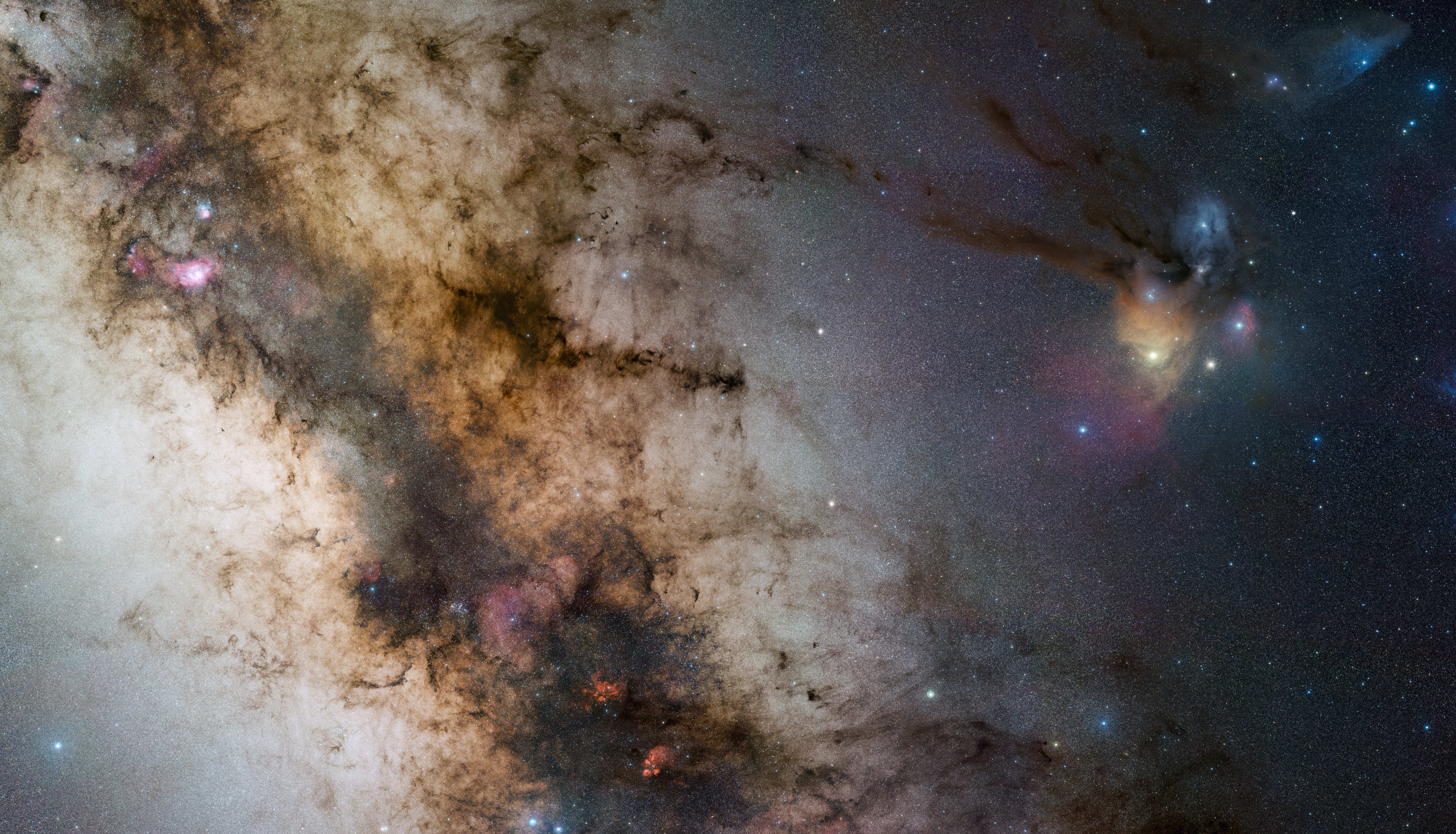
Constellation straddling the celestial equator
| Field | Value |
|---|---|
| name | Ophiuchus |
| abbreviation | Oph |
| genitive | Ophiuchi |
| pronounce | |
| genitive: | |
| symbolism | the serpent-bearer |
| RA | |
| dec | |
| family | Hercules |
| quadrant | SQ3 |
| areatotal | 948 |
| arearank | 11th |
| numbermainstars | 10 |
| numberbfstars | 65 |
| numberbrightstars | 5 |
| numbernearbystars | 11 |
| brighteststarname | α Oph (Rasalhague) |
| starmagnitude | 2.08 |
| neareststarname | Barnard's Star |
| stardistancely | 5.96 |
| stardistancepc | 1.83 |
| numbermessierobjects | 7 |
| meteorshowers | |
| bordering | |
| latmax | 60 |
| latmin | 75 |
| month | July |
genitive: Ophiuchus () is a large constellation straddling the celestial equator. Its name comes from the Ancient Greek (), meaning "serpent-bearer", and it is commonly represented as a man grasping a snake. The serpent is represented by the constellation Serpens. Ophiuchus was one of the 48 constellations listed by the 2nd-century astronomer Ptolemy, and it remains one of the 88 modern constellations. An old alternative name for the constellation was Serpentarius.
Location
Ophiuchus lies between Aquila, Serpens, Scorpius, Sagittarius, and Hercules, northwest of the center of the Milky Way. The southern part lies between Scorpius to the west and Sagittarius to the east. In the Northern Hemisphere, it is best visible in summer. It is opposite of Orion. Ophiuchus is depicted as a man grasping a serpent; the interposition of his body divides the snake constellation Serpens into two parts, Serpens Caput and Serpens Cauda. Ophiuchus straddles the equator with the majority of its area lying in the Southern Hemisphere. Rasalhague, its brightest star, lies near the northern edge of Ophiuchus at about declination. The constellation extends southward to −30° declination. Segments of the ecliptic within Ophiuchus are south of −20° declination (see chart at right).
In contrast to Orion, from November to January (summer in the Southern Hemisphere, winter in the Northern Hemisphere), Ophiuchus is in the daytime sky and thus not visible at most latitudes. However, for much of the polar region north of the Arctic Circle in the Northern Hemisphere's winter months, the Sun is below the horizon even at midday. Stars (and thus parts of Ophiuchus, especially Rasalhague) are then visible at twilight for a few hours around local noon, low in the south. In the Northern Hemisphere's spring and summer months, when Ophiuchus is normally visible in the night sky, the constellation is actually not visible, because the midnight sun obscures the stars at those times and places in the Arctic. In countries close to the equator, Ophiuchus appears overhead in June around midnight and in the October evening sky.
Features
Stars
The brightest stars in Ophiuchus include α Ophiuchi, called Rasalhague ("head of the serpent charmer"), at magnitude 2.07, and η Ophiuchi, known as Sabik ("the preceding one"), at magnitude 2.43. Alpha Ophiuchi is composed of an A-type (bluish-white) giant star and a K-type main sequence star. The primary is a rapid rotator with an inclined axis of rotation. Eta Ophiuchi is a binary system. Other bright stars in the constellation include β Ophiuchi, Cebalrai ("dog of the shepherd") and λ Ophiuchi, or Marfik ("the elbow"). Beta Ophiuchi is an evolved red giant star that is slightly more massive than the Sun. Lambda Ophiuchi is a binary star system with the primary being more massive and luminous than the Sun.{{cite journal | display-authors=1 | journal=Astronomy and Astrophysics
RS Ophiuchi is part of a class called recurrent novae, whose brightness increase at irregular intervals by hundreds of times in a period of just a few days. It is thought to be at the brink of becoming a Type Ia supernova. It erupts around every 15 years and usually has a magnitude of around 5.0 during eruptions, most recently in 2021.
Barnard's Star, one of the nearest stars to the Solar System (the only stars closer are the Alpha Centauri binary star system and Proxima Centauri), lies in Ophiuchus. It is located to the left of β and just north of the V-shaped group of stars in an area that was once occupied by the now-obsolete constellation of Taurus Poniatovii (Poniatowski's Bull). It is thought that an exoplanet orbits around the star,{{cite journal | display-authors = 4 | url-status = live | archive-url = https://web.archive.org/web/20190326185022/https://www.eso.org/public/archives/releases/sciencepapers/eso1837/eso1837a.pdf | archive-date = 2019-03-26 but later studies have refuted this claim. In 1998, an intense flare was observed. The star has also been a target of plans for interstellar travel such as Project Daedalus. In 2005, astronomers using data from the Green Bank Telescope discovered a superbubble so large that it extends beyond the plane of the galaxy. It is called the Ophiuchus Superbubble.
In April 2007, astronomers announced that the Swedish-built Odin satellite had made the first detection of clouds of molecular oxygen in space, following observations in the constellation Ophiuchus. The supernova of 1604 was first observed on 9 October 1604, near θ Ophiuchi. Johannes Kepler saw it first on 16 October and studied it so extensively that the supernova was subsequently called Kepler's Supernova. He published his findings in a book titled De stella nova in pede Serpentarii (On the New Star in Ophiuchus's Foot). Galileo used its brief appearance to counter the Aristotelian dogma that the heavens are changeless. It was a Type Ia supernova and the most recent Milky Way supernova visible to the unaided eye. In 2009 it was announced that GJ 1214, a star in Ophiuchus, undergoes repeated, cyclical dimming with a period of about 1.5 days consistent with the transit of a small orbiting planet. The planet's low density (about 40% that of Earth) suggests that the planet might have a substantial component of low-density gas—possibly hydrogen or steam. The proximity of this star to Earth (42 light years) makes it a feasible target for further observations. The host star emits X-rays which could have removed mass from the exoplanet.{{cite journal | display-authors=1
Image:OphiuchusCC.jpg|The constellation Ophiuchus as it can be seen by naked eye. File:Aratea 10v.jpg|Illustration of Serpens, Ophiuchus and Scorpius in the Leiden Aratea manuscript, around 830 - 840. Image:Stjärnbild på Herkules, 1602 - Skoklosters slott - 102426.tif|Hercules and Ophiuchus, 1602, by Willem Blaeu. File:Kepler De Stella Nova.jpg|Johannes Kepler's 1606 book De Stella Nova in Pede Serpentarii (On the New Star in Ophiuchus's Foot) opened at the page for Ophiuchus. Image:Kepler Drawing of SN 1604.png|Detail showing the stella nova marked "N" in the right foot of Ophiuchus.
Deep-sky objects


Ophiuchus contains several star clusters, such as IC 4665, NGC 6633, M9, M10, M12, M14, M19, M62, and M107, as well as the nebula IC 4603-4604.
M9 is a globular cluster which may have an extra-galactic origin.{{citation | display-authors=1 | last1=Arellano Ferro | first1=A.
The unusual galaxy merger remnant and starburst galaxy NGC 6240 is also in Ophiuchus. At a distance of 400 million light-years, this "butterfly-shaped" galaxy has two supermassive black holes 3,000 light-years apart. Confirmation of the fact that both nuclei contain black holes was obtained by spectra from the Chandra X-ray Observatory. Astronomers estimate that the black holes will merge in another billion years. NGC 6240 also has an unusually high rate of star formation, classifying it as a starburst galaxy. This is likely due to the heat generated by the orbiting black holes and the aftermath of the collision. Both have active galactic nuclei. | display-authors = 4
In 2006, a new nearby star cluster was discovered associated with the 4th magnitude star Mu Ophiuchi. The Mamajek 2 cluster appears to be a poor cluster remnant analogous to the Ursa Major Moving Group, but 7 times more distant (approximately 170 parsecs away). Mamajek 2 appears to have formed in the same star-forming complex as the NGC 2516 cluster roughly 135 million years ago.
Barnard 68 is a large dark nebula, located 410 light-years from Earth. Despite its diameter of 0.4 light-years, Barnard 68 only has twice the mass of the Sun, making it both very diffuse and very cold, with a temperature of about 16 kelvins. Though it is currently stable, Barnard 68 will eventually collapse, inciting the process of star formation. One unusual feature of Barnard 68 is its vibrations, which have a period of 250,000 years. Astronomers speculate that this phenomenon is caused by the shock wave from a supernova. Barnard 68 has blocked thousands of stars visible at other wavelengths and the distribution of dust in Barnard 68 has been mapped.
The space probe Voyager 1, the furthest man-made object from earth, is traveling in the direction of Ophiuchus. It is located between α Herculis, α Ophiuchi and κ Ophiuchi at right ascension 17h 13m and declination +12° 25’ (July 2020).
In November 2022, the USA's NSF NOIRLab (National Optical-Infrared Astronomy Research Laboratory) announced the unambiguous identification of the nearest stellar black hole orbited by a G-type main-sequence star, the system identified as Gaia BH1 at around 1,560 light years from the Sun.
History and mythology
There is no evidence of the constellation preceding the classical era, and in Babylonian astronomy, a "Sitting Gods" constellation seems to have been located in the general area of Ophiuchus. However, Gavin White proposes that Ophiuchus may in fact be remotely descended from this Babylonian constellation, representing Nirah, a serpent-god who was sometimes depicted with his upper half human but with serpents for legs.
The earliest mention of the constellation is in Aratus, informed by the lost catalogue of Eudoxus of Cnidus (4th century BC):
To the ancient Greeks, the constellation represented the god Apollo struggling with a huge snake that guarded the Oracle of Delphi.
Later myths identified Ophiuchus with Laocoön, the Trojan priest of Poseidon, who warned his fellow Trojans about the Trojan Horse and was later slain by a pair of sea serpents sent by the gods to punish him. According to Roman era mythography, the figure represents the healer Asclepius, who learned the secrets of keeping death at bay after observing one serpent bringing another healing herbs. To prevent the entire human race from becoming immortal under Asclepius' care, Jupiter killed him with a bolt of lightning, but later placed his image in the heavens to honor his good works. In medieval Islamic astronomy (Azophi's Uranometry, 10th century), the constellation was known as ''Al-Ḥawwa''', "the snake-charmer".
Aratus describes Ophiuchus as trampling on Scorpius with his feet. This is depicted in Renaissance to Early Modern star charts, beginning with Albrecht Dürer in 1515; in some depictions (such as that of Johannes Kepler in De Stella Nova, 1606), Scorpius also seems to threaten to sting Serpentarius in the foot. This is consistent with Azophi, who already included ψ Oph and ω Oph as the snake-charmer's "left foot", and θ Oph and ο Oph as his "right foot", making Ophiuchus a zodiacal constellation at least as regards his feet. This arrangement has been taken as symbolic in later literature and placed in relation to the words spoken by God to the serpent in the Garden of Eden (Genesis 3:15).
File:Azophi Ophiuchus.jpg|Ophiuchus in a manuscript copy of Azophi's Uranometry, 18th century copy of a manuscript prepared for Ulugh Beg in 1417 (note that as in all pre-modern star charts, the constellation is mirrored, with Serpens Caput on the left and Serpens Cauda on the right). File:Sidney Hall - Urania's Mirror - Taurus Poniatowski, Serpentarius, Scutum Sobiesky, and Serpens.jpg|Ophiuchus holding the serpent, Serpens, as depicted in Urania's Mirror, a set of constellation cards published in London c. 1825. Above the tail of the serpent is the now-obsolete constellation Taurus Poniatovii while below it is Scutum.
Zodiac
Main article: Ophiuchus (astrology)
Ophiuchus is one of the 13 constellations that cross the ecliptic. It has sometimes been suggested as the "13th sign of the zodiac". However, this confuses zodiac or astrological signs with constellations. The signs of the zodiac are a 12-fold division of the ecliptic, so that each sign spans 30° of celestial longitude, approximately the distance the Sun travels in a month, and (in the Western tradition) are aligned with the seasons so that the March equinox always falls on the boundary between Pisces and Aries. Constellations, on the other hand, are unequal in size and are based on the positions of the stars. The constellations of the zodiac have only a loose association with the signs of the zodiac, and do not in general coincide with them. In Western astrology the constellation of Aquarius, for example, largely corresponds to the sign of Pisces. Similarly, the constellation of Ophiuchus occupies most (29 November – 18 December) of the sign of Sagittarius (23 November – 21 December). The differences are due to the fact that the time of year that the Sun passes through a particular zodiac constellation's position has slowly changed (because of the precession of the Earth's rotational axis) over the millennia from when the Babylonians originally developed the zodiac.
Citations
References
- Ridpath, Ian; and Tirion, Wil; (2007) Stars and Planets Guide, Collins, London; , Princeton University Press, Princeton;
References
- "Star Tales – Ophiuchus".
- Dickinson, Terence. (2006). "Nightwatch A practical Guide to Viewing the Universe Revised Fourth Edition: Updated for use Through 2025". Firefly Books.
- Dickinson, Terence. (2006). "Nightwatch A Practical Guide to Viewing the Universe Revised Fourth Edition: Updated for Use Through 2025". Firefly Books.
- Ford, Dominic. "Rasalhague (Star)".
- Chartrand III, Mark R.; (1983) ''Skyguide: A Field Guide for Amateur Astronomers'', p. 170 ({{ISBN. 0-307-13667-1).
- (1991). "Entry for HR 2491". [[Centre de Données astronomiques de Strasbourg.
- (April 1969). "A study of the bright A stars. I. A catalogue of spectral classifications". Astronomical Journal.
- (January 2011). "Establishing α Oph as a Prototype Rotator: Improved Astrometric Orbit". The Astrophysical Journal.
- (2010). "Rotationally Modulated g-modes in the Rapidly Rotating δ Scuti Star Rasalhague (α Ophiuchi)". The Astrophysical Journal.
- (February 2010). "Imaging and Modeling Rapid Rotators: α Cep and α Oph". Revista Mexicana de Astronomía y Astrofísica, Serie de Conferencias.
- (April 2007). "Orbits and System Masses of 14 Visual Double Stars with Early-Type Components". The Astronomical Journal.
- (2006). "A Dictionary of Modern Star Names: A Short Guide to 254 Star Names and Their Derivations". [[Sky Publishing Corporation]].
- Chartrand, at p. 170.
- (1999). "Fundamental parameters of nearby stars from the comparison with evolutionary calculations: masses, radii and effective temperatures". [[Astronomy and Astrophysics]].
- (2008). "Vertical distribution of Galactic disk stars. IV. AMR and AVR from clump giants". Astronomy and Astrophysics.
- (June 2002). "A revised HRD for individual components of binary systems from BaSeL BVRI synthetic photometry. Influence of interstellar extinction and stellar rotation". Astronomy and Astrophysics.
- (23 July 2006). "Star 'soon to become supernova'". [[BBC News]].
- "[vsnet-alert 26131] Outburst of RS Ophiuchi".
- "ATel #14834: Fermi-LAT Gamma-ray Detection of the Recurrent Nova RS Oph".
- (15 July 2021). "Stellar Activity Manifesting at a One-year Alias Explains Barnard b as a False Positive". American Astronomical Society.
- (2006). "Optical Spectroscopy of a Flare on Barnard's Star". [[Publications of the Astronomical Society of the Pacific]].
- (1998). "Photometry of Proxima Centauri and Barnard's star using Hubble Space Telescope fine guidance senso 3". The Astronomical Journal.
- (1976). "Project Daedalus – The mission profile". [[Journal of the British Interplanetary Society]].
- Darling, David. (July 2005). "Daedalus, Project".
- (13 January 2006). "Huge 'Superbubble' of Gas Blowing Out of Milky Way". [[PhysOrg.com]].
- "Molecular Oxygen Detected for the First Time in the Interstellar Medium".
- (2 October 2007). "A Deep ''Chandra'' Observation of Kepler's Supernova Remnant: A Type Ia Event with Circumstellar Interaction". [[The Astrophysical Journal]].
- "Kepler's Supernova: Recently Observed Supernova".
- (December 2009). "A super-Earth transiting a nearby low-mass star". Nature.
- (2010). "Three Possible Origins for the Gas Layer on GJ 1214b". The Astrophysical Journal.
- (31 March 2010). "Asteroid To Hide Naked-Eye Star".
- (31 March 2010). "Asteroid To Hide Bright Star".
- "(824) Anastasia / HIP 81377 event on 2010 Apr 06, 10:21 UT".
- "Ophiuchus, the Serpent Bearer – Constellations – Digital Images of the Sky.".
- (2021). "Isochrone fitting of Galactic globular clusters – III. NGC 288, NGC 362, and NGC 6218 (M12)". Monthly Notices of the Royal Astronomical Society.
- (November 2011). "Young Radio Pulsars in Galactic Globular Clusters". The Astrophysical Journal.
- (1978). "Burnham's Celestial Handbook: An Observer's Guide to the Universe Beyond the Solar System". [[Courier Dover Publications]].
- (November 2001). "Variable Stars in Galactic Globular Clusters". The Astronomical Journal.
- (2006). "300 Astronomical Objects: A Visual Reference to the Universe". Firefly Books.
- Mamajek, Eric E.. (2006). "A New Nearby Candidate Star Cluster in Ophiuchus at d = 170 pc". Astronomical Journal.
- (2009). "Dynamical Evolution and Spectral Characteristics of the Stellar Group Mamajek 2". The Astrophysical Journal.
- "The Dark Cloud B68 at Different Wavelengths". [[European Southern Observatory]].
- Coordinates available at [https://theskylive.com/voyager1-info The Sky Live].
- [https://noirlab.edu/public/news/noirlab2227/ Astronomers Discover Closest Black Hole to Earth Gemini North telescope on Hawai‘i reveals first dormant, stellar-mass black hole in our cosmic backyard], Dr [[Kareem El-Badry]] et al, USA [[National Science Foundation]] NOIRLab ([[National Optical-Infrared Astronomy Research Laboratory]]), 2022-11-04
- White, Gavin; ''Babylonian Star-lore'', Solaria Pubs, 2008, p. 187f
- "ὀφιοῦχος". perseus.tufts.edu.
- translation by Mair, Alexander W.; & Mair, Gilbert R.; Loeb Classical Library, volume 129, William Heinemann, London, 1921 [http://www.theoi.com/Text/AratusPhaenomena.html theoi.com]
- Thompson, Robert. (2007). "Illustrated Guide to Astronomical Wonders: From Novice to Master Observer". O'Reilly Media, Inc..
- Hyginus, ''Astronomica'' 2, 14, Latin Mythography, 2nd century AD
- "Snake-Charmer".
- "Manuscript reproduction".
- [[Edward Walter Maunder. Maunder, Edward Walter]]; ''Astronomy of the Bible'', 1908, p. 164f
- Shapiro, Lee T. [http://spaceplace.nasa.gov/starfinder3/ "Constellations in the zodiac"], in ''The Space Place'' (NASA, last updated 22 July 2011)
- "Ophiuchus, 13th constellation of zodiac". Earth Sky.
- Gleason, Edward. "Why is the vernal equinox called the "First Point of Aries" when the Sun is actually in Pisces on this date? {{!}} Planetarium".
- Campbell, Tina. (2020-07-15). "Has your star sign changed following the discovery of a 'new' Zodiac sign?".
- (2 March 2016). "Ophiuchus – a 13th Zodiac Sign? No!". Astrology Club.
- (16 August 2021). "Born under the sign of Ophiuchus?". EarthSky.org.
- Aitken, Robert G.. (October 1942). "Edmund Halley and Stellar Proper Motions". Astronomical Society of the Pacific Leaflets.
- Redd, Nola Taylor. "Constellations: The Zodiac Constellation Names". space.com.
- (April 2024). "The Initial Mass Function Based on the Full-sky 20 pc Census of ~3600 Stars and Brown Dwarfs". [[The Astrophysical Journal Supplement Series]].
This article was imported from Wikipedia and is available under the Creative Commons Attribution-ShareAlike 4.0 License. Content has been adapted to SurfDoc format. Original contributors can be found on the article history page.
Ask Mako anything about Ophiuchus — get instant answers, deeper analysis, and related topics.
Research with MakoFree with your Surf account
Create a free account to save articles, ask Mako questions, and organize your research.
Sign up freeThis content may have been generated or modified by AI. CloudSurf Software LLC is not responsible for the accuracy, completeness, or reliability of AI-generated content. Always verify important information from primary sources.
Report