From Surf Wiki (app.surf) — the open knowledge base
Open system (systems theory)
Systems with external interactions

Systems with external interactions
An open system is a system that has external interactions. Such interactions can take the form of information, energy, or material transfers into or out of the system boundary, depending on the discipline which defines the concept. An open system is contrasted with the concept of an isolated system which exchanges neither energy, matter, nor information with its environment. An open system is also known as a flow system. A viable open system exchanges energy, matter, and/or information with its surroundings through semi-permeable, regulated, or established boundaries that preserve identity while enabling adaptive flow.
The concept of an open system was formalized within a framework that enabled one to interrelate the theory of the organism, thermodynamics, and evolutionary theory. This concept was expanded upon with the advent of information theory and subsequently systems theory. Today the concept has its applications in the natural and social sciences.
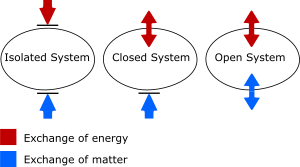
In the natural sciences an open system is one whose border is permeable to both energy and mass. By contrast, a closed system is permeable to energy but not to matter.
The definition of an open system assumes that there are supplies of energy that cannot be depleted; in practice, this energy is supplied from some source in the surrounding environment, which can be treated as infinite for the purposes of study. One type of open system is the radiant energy system, which receives its energy from solar radiation – an energy source that can be regarded as inexhaustible for all practical purposes.
Thermodynamics
Systems engineering
References
References
- Luhmann, Niklas. ''Social Systems''. Stanford: Stanford University Press, 1995; pp. 6-7
- [http://www.maxwellian.demon.co.uk/faq/glossary.html Glossary] {{Webarchive. link. (2007-08-17 Maxwell Demon, 1998.)
- Axelos, K. ([2006] 1984). "The World: Being Becoming Totality," from ''Systematique ouverte'' (Trans. Gerald Moore, Les Editions de Minuit: Paris). ''Environment and Planning D: Society and Space,'' Vol. 24, 643-651.
- Althusser, L. ([2005] 1969). ''For Marx.'' London: Verso Books, Ch. 3: "Contradiction and Overdetermination," [http://www.marxists.org/reference/archive/althusser/1962/overdetermination.htm].
- RSA Animate - David Harvey, The Crises of Capitalism: [https://www.youtube.com/watch?v=26o22Y33h9s].
This article was imported from Wikipedia and is available under the Creative Commons Attribution-ShareAlike 4.0 License. Content has been adapted to SurfDoc format. Original contributors can be found on the article history page.
Ask Mako anything about Open system (systems theory) — get instant answers, deeper analysis, and related topics.
Research with MakoFree with your Surf account
Create a free account to save articles, ask Mako questions, and organize your research.
Sign up freeThis content may have been generated or modified by AI. CloudSurf Software LLC is not responsible for the accuracy, completeness, or reliability of AI-generated content. Always verify important information from primary sources.
Report
Social sciences
In the social sciences an open system is a process that exchanges material, energy, people, capital and information with its environment. French/Greek philosopher Kostas Axelos argued that seeing the "world system" as inherently open (though unified) would solve many of the problems in the social sciences, including that of praxis (the relation of knowledge to practice), so that various social scientific disciplines would work together rather than create monopolies whereby the world appears only sociological, political, historical, or psychological. Axelos argues that theorizing a closed system contributes to making it closed, and is thus a conservative approach. The Althusserian concept of overdetermination (drawing on Sigmund Freud) posits that there are always multiple causes in every event.
David Harvey uses this to argue that when systems such as capitalism enter a phase of crisis, it can happen through one of a number of elements, such as gender roles, the relation to nature/the environment, or crises in accumulation. Looking at the crisis in accumulation, Harvey argues that phenomena such as foreign direct investment, privatization of state-owned resources, and accumulation by dispossession act as necessary outlets when capital has overaccumulated too much in private hands and cannot circulate effectively in the marketplace. He cites the forcible displacement of Mexican and Indian peasants since the 1970s and the 1997 Asian financial crisis, involving "hedge fund raising" of national currencies, as examples of this.Harvey, D. (2005). The New Imperialism. New York: Oxford University Press USA, Ch. 3: "Accumulation by Dispossession," 137-182.
Structural functionalists such as Talcott Parsons and neofunctionalists such as Niklas Luhmann have incorporated system theory to describe society and its components.
The sociology of religion finds both open and closed systems within the field of religion. | editor1-last = Henderson | editor1-first = Ian H. | editor2-last = Oegema | editor2-first = Gerbern S. | editor3-last = Parks Ricker | editor3-first = Sara | publication-date = 2006 | access-date = 11 June 2021 | publication-date = 1971 | access-date = 11 June 2021