From Surf Wiki (app.surf) — the open knowledge base
Open front unrounded vowel
Vowel sound represented by ⟨a⟩ in IPA
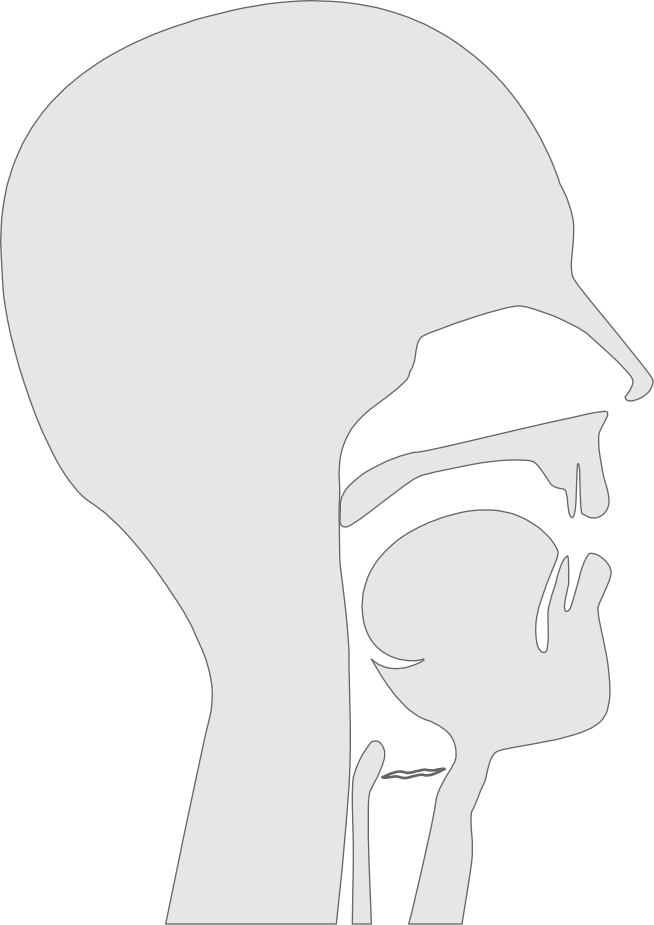
Vowel sound represented by ⟨a⟩ in IPA
| Field | Value |
|---|---|
| ipa symbol | a |
| ipa number | 304 |
| decimal1 | 97 |
| x-sampa | a |
| braille | a |
| above | Open front unrounded vowel |
| sound | Open front unrounded vowel.ogg |
| imagefile | IPA Unicode 0x0061.svg |
|x-sampa=a
The open front unrounded vowel, or low front unrounded vowel, is a type of vowel sound used in some spoken languages. It is one of the eight primary cardinal vowels, not directly intended to correspond to a vowel sound of a specific language but rather to serve as a fundamental reference point in a phonetic measuring system.
The symbol in the International Phonetic Alphabet (IPA) that represents this sound is , a double-story lowercase a. In the IPA vowel chart it is positioned at the lower-left corner. However, the accuracy of the quadrilateral vowel chart is disputed, and the sound has been analyzed acoustically as extra-open at a position where the front/back distinction has lost its significance. There are also differing interpretations of the exact quality of the vowel: the classic sound recording of by Daniel Jones is slightly more front but not quite as open as that by John Wells.
In practice, the symbol is often used to represent an open central unrounded vowel. This is the usual practice, for example, in the historical study of the English language. The loss of separate symbols for open and near-open front vowels is usually considered unproblematic, because the perceptual difference between the two is quite small, and very few languages contrast the two. If there is a need to specify the backness of the vowel as fully front one can use the symbol , which denotes a lowered near-open front unrounded vowel, or with the IPA "advanced" diacritic.
Features
This subsumes central open (central low) vowels because the tongue does not have as much flexibility in positioning as it does in the mid and close (high) vowels; the difference between an open front vowel and an open back vowel is similar to the difference between a close front and a close central vowel, or a close central and a close back vowel.
Occurrence
Many languages have some form of an unrounded open vowel. For languages that have only a single open vowel, the symbol for this vowel may be used because it is the only open vowel whose symbol is part of the basic Latin alphabet. Whenever marked as such, the vowel is closer to a central than to a front . However, there may not actually be much of a difference. (See Vowel#Acoustics.)
| Language | Word | IPA | Meaning | Notes |
|---|---|---|---|---|
| Afrikaans | Standard | dak | 'roof' | |
| Arabic | Standard | أنا (*anā*) | 'I' 1st person singular pronoun | |
| Azerbaijani | Standard | səs | 'sound' | |
| Bulgarian | най (*nay*) | 'most' | ||
| Catalan | Majorcan | sac | 'bag' | |
| Many dialects | raig | 'ray' | Allophone of in contact with palatal consonants. It can be higher (). See Catalan phonology | |
| Chinese | Mandarin | 安 (ān) | 'safe' | |
| Dutch | Standard | aas | 'bait' | |
| Utrecht | bad | 'bath' | Corresponds to in Northern Standard Dutch. See Dutch phonology | |
| English | Australian | *hat* | 'hat' | |
| California | Less open in other North American varieties. See English phonology and Canadian Shift | |||
| Canadian | ||||
| Some Central Ohioan speakers | ||||
| Some Texan speakers | ||||
| Northern Suburbs of Johannesburg | Closer in General South African English. See South African English phonology | |||
| Received Pronunciation | Closer in Conservative Received Pronunciation. See English phonology | |||
| Scouse | ||||
| East Anglian | *bra* | 'bra' | Realized as central by middle-class speakers. | |
| Inland Northern American | Less front [ ~ ] in other American dialects. See Northern Cities Vowel Shift | |||
| New Zealand | Varies between open near-front , open central , near-open near-front and near-open central . May be transcribed in IPA with . See New Zealand English phonology | |||
| French | Conservative Parisian | patte | 'paw' | |
| Quebec | arrêt | 'stopping' | Contrasts with . See Quebec French phonology | |
| German | Altbayern accent | Wassermassen | 'water masses' | |
| Many Austrian accents | nah | 'near' | Less front in other accents. See Standard German phonology | |
| Hindustani | Hindi | बाप(baap) | 'father', 'dad' | |
| Urdu | باپ(baap) | |||
| Igbo | ákụ | 'kernel' | ||
| Khmer | បាត់ (km) | 'to disappear' | See Khmer phonology | |
| បាត (km) | 'bottom' | |||
| Kurdish | Palewani (Southern) | گهن (*gen*) | 'bad' | |
| Limburgish | Many dialects | baas | 'boss' | |
| Low German | Daag / Dag | 'day' | Backness may vary among dialects. | |
| Luxembourgish | Kap | 'cap' | Near-front; sometimes fronted and raised to . See Luxembourgish phonology | |
| Malay | Standard | رق (*rak*) | 'shelf' | |
| Norwegian | Stavangersk | hatt | 'hat' | |
| Trondheimsk | lær | 'leather' | ||
| Polish | jajo | 'egg' | Allophone of between palatal or palatalized consonants. See Polish phonology | |
| Spanish | Eastern Andalusian | las madres | 'the mothers' | |
| Murcian | ||||
| Swedish | Central Standard | bank | 'bank' | |
| Turkish | kâğıt | 'paper' | Only occurs with â (a with "circumflex"), which is not originally in the Turkish alphabet. Also described as central . | |
| West Frisian | Aastersk | kaaks | 'ship's biscuit' |
Notes
References
- {{citation
- {{citation |doi-access=free
- {{cite thesis
- {{citation |author-link=Charles Boberg
- {{citation
- {{citation |orig-year=First published 1981
- {{citation |orig-year=First published 2003
- {{citation |orig-year=First published 2012
- {{citation |orig-year=First published 1962
- {{citation
- {{citation |doi-access=free
- {{citation |editor-last=Schneider |editor-first=Edgar W. |editor2-last=Burridge |editor2-first=Kate |editor3-last=Kortmann |editor3-first=Bernd |editor4-last=Mesthrie |editor4-first=Rajend |editor5-last=Upton |editor5-first=Clive
- {{citation |access-date=2014-06-06 |archive-date=2017-10-11 |archive-url=https://web.archive.org/web/20171011044945/http://gep.ruhosting.nl/carlos/gussenhoven_aarts.pdf |url-status=dead
- {{citation |access-date=2014-06-06 |archive-date=2016-03-04 |archive-url=https://web.archive.org/web/20160304034049/http://gep.ruhosting.nl/carlos/weert.pdf |url-status=dead
- {{citation
- {{citation |doi-access=free
- {{citation
- {{citation |editor-last=Dziubalska-Kolaczyk |editor-first=Katarzyna
- {{cite thesis
- {{citation |doi-access=free
- {{citation
- {{cite thesis
- {{citation
- {{citation
- {{citation
- {{citation
- {{citation
- {{citation |editor-last=Schneider |editor-first=Edgar W. |editor2-last=Burridge |editor2-first=Kate |editor3-last=Kortmann |editor3-first=Bernd |editor4-last=Mesthrie |editor4-first=Rajend |editor5-last=Upton |editor5-first=Clive
- {{citation |editor-last=Schneider |editor-first=Edgar W. |editor2-last=Burridge |editor2-first=Kate |editor3-last=Kortmann |editor3-first=Bernd |editor4-last=Mesthrie |editor4-first=Rajend |editor5-last=Upton |editor5-first=Clive
- {{citation |editor-last1=Munske |editor-first1=Horst Haider |editor-last2=Århammar |editor-first2=Hans |chapter-url=https://books.google.com/books?id=0nx-GUm-0OIC
- {{citation
- {{citation
- {{citation |doi-access=free
- {{citation
- {{citation |author-link=John Christopher Wells
- {{cite web |archive-url=https://web.archive.org/web/20170415194042/http://www.taalportaal.org/taalportaal/topic/pid/topic-14610909940908011 |archive-date=15 April 2017 |url-status=live |access-date=16 April 2017
- {{citation |url-access=registration
References
- {{Vowel terminology
- John Coleman: [http://www.phon.ox.ac.uk/jcoleman/CardinalVowels.htm Cardinal vowels]
- [[Geoff Lindsey]] (2013) [http://englishspeechservices.com/blog/the-vowel-space/ The vowel space], Speech Talk
- Keith Johnson: [http://linguistics.berkeley.edu/~kjohnson/ling110/Lecture_Slides/3_Vowels/Vowels.pdf Vowels in the languages of the world] {{Webarchive. link. (2016-03-04 (PDF), p. 9)
- {{Harvcoltxt. Thomas. 2004. LOT/{{sc2. THOUGHT merger have {{sc2. TRAP shifted toward {{IPA. [a], but this retraction is not yet as common as in some non-Southern regions (e.g., California and Canada), though it is increasing in parts of the Midwest on the margins of the South (e.g., central Ohio).
- "Case Studies – Received Pronunciation Phonology – RP Vowel Sounds". British Library.
- Watson, Kevin. (2007). "Liverpool English". Journal of the International Phonetic Association.
- W. Labov, S. Ash and C. Boberg. (1997). "A national map of the regional dialects of American English". Department of Linguistics, University of Pennsylvania.
This article was imported from Wikipedia and is available under the Creative Commons Attribution-ShareAlike 4.0 License. Content has been adapted to SurfDoc format. Original contributors can be found on the article history page.
Ask Mako anything about Open front unrounded vowel — get instant answers, deeper analysis, and related topics.
Research with MakoFree with your Surf account
Create a free account to save articles, ask Mako questions, and organize your research.
Sign up freeThis content may have been generated or modified by AI. CloudSurf Software LLC is not responsible for the accuracy, completeness, or reliability of AI-generated content. Always verify important information from primary sources.
Report