From Surf Wiki (app.surf) — the open knowledge base
OODA loop
Observe–orient–decide–act cycle
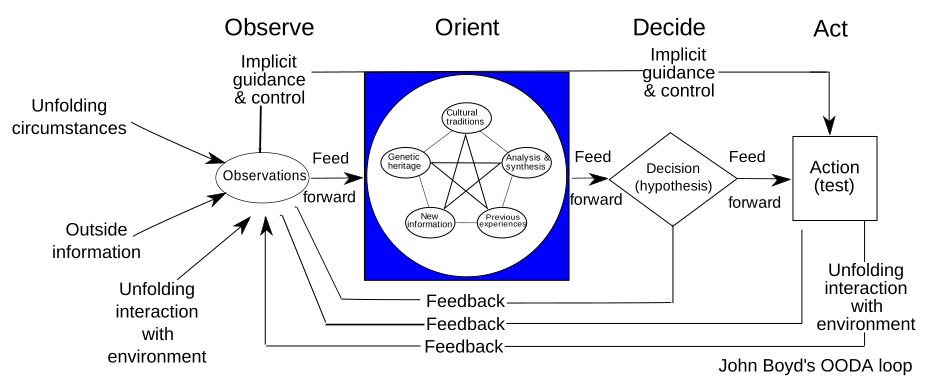
Observe–orient–decide–act cycle
The OODA loop (observe, orient, decide, act loop) is a decision-making model developed by United States Air Force Colonel John Boyd in the early 1970s. He applied the concept to the combat operations process, often at the operational level during military campaigns. It is often applied to understand commercial operations and learning processes. The approach explains how agility can overcome raw power in dealing with human opponents.
The OODA loop
As can be seen from the diagram, the OODA loop includes continuous collection of feedback and observations. This enables late commitment, which is an important element of agility. This is in contrast to the PDCA (plan–do–check–act) cycle which requires early commitment.
Use in law and business
The OODA loop has become an important concept in litigation, business, law enforcement, management education, military strategy and cyber security, and cyberwarfare. According to Boyd, decision-making occurs in an iterative cycle of "observe, orient, decide, act". An entity (whether an individual or an organization) that can process this cycle quickly, observing and reacting to unfolding events more rapidly and/or more effectively than an opponent, can thereby get inside the opponent's decision cycle and gain the advantage.
Jamie Dimon, chairman and CEO of JPMorgan Chase, has said he uses the OODA loop in scenario evaluation.
Criticism
Some scholars are critical of the concept. Aviation historian Michael Hankins, for example, writes that "the OODA loop is vague enough that its defenders and attackers can each see what they want to see in it. For some, the OODA concept's flexibility is its strength, but for others it becomes so generalized as to lose its usefulness." He concludes that "The OODA loop is merely one way among a myriad of ways of describing intuitive processes of learning and decision making that most people experience daily. It is not incorrect, but neither is it unique or especially profound."
References
Bibliography
- A supposed five-slide set by Boyd.
- PDF of the dissertation version.
References
- McKay, Brett & Kate. (2020-11-06). "The Tao of Boyd: How to Master the OODA Loop".
- (15 February 2012). "The OODA loop, reaction time, and decision making". PoliceOne.com.
- (November 2022). "Rethinking reflective practice: John Boyd's OODA loop as an alternative to Kolb". The International Journal of Management Education.
- (2024). "Sustainability in Business Education, Research and Practices". Springer.
- Clarke, Richard. (2019). "The Fifth Domain: Defending Our Country, Our Companies, and Ourselves in the Age of Cyber Threats". Penguin Press.
- Pringle, Eleanor. (4 April 2024). "Jamie Dimon says he runs JPMorgan with a military tactic in mind named the 'OODA loop'".
- Pringle, Eleanor. (29 October 2024). "Jamie Dimon says World War III may have already begun".
- "Jamie Dimon's Letter to Shareholders, Annual Report 2023 | JPMorganChase".
- Hankins, Michael W.. (2021). "Flying Camelot: The F-15, the F-16, and the Weaponization of Fighter Pilot Nostalgia". Cornell University Press.
This article was imported from Wikipedia and is available under the Creative Commons Attribution-ShareAlike 4.0 License. Content has been adapted to SurfDoc format. Original contributors can be found on the article history page.
Ask Mako anything about OODA loop — get instant answers, deeper analysis, and related topics.
Research with MakoFree with your Surf account
Create a free account to save articles, ask Mako questions, and organize your research.
Sign up freeThis content may have been generated or modified by AI. CloudSurf Software LLC is not responsible for the accuracy, completeness, or reliability of AI-generated content. Always verify important information from primary sources.
Report