From Surf Wiki (app.surf) — the open knowledge base
One-man band
Musician who plays various instruments
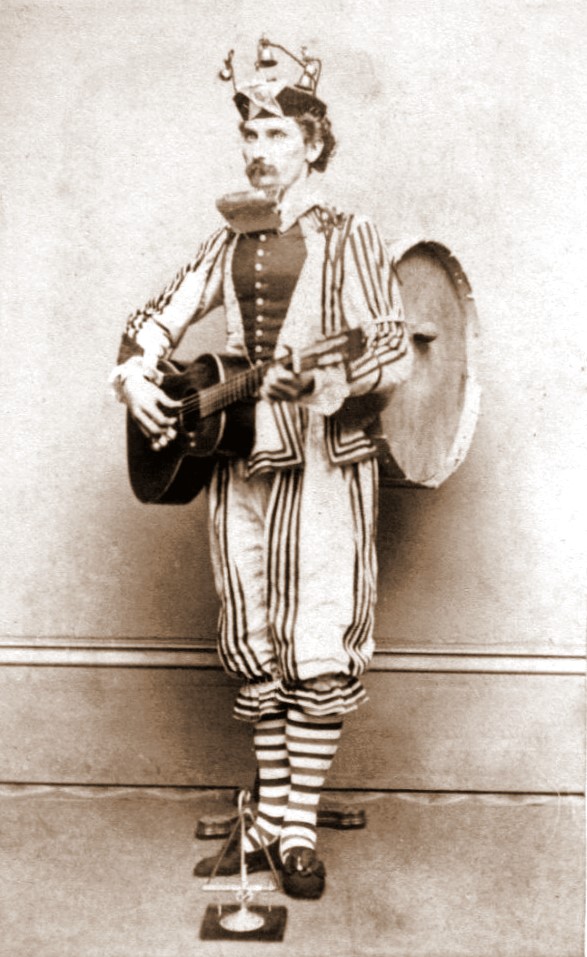
Musician who plays various instruments

A one-man band is a musician who plays a number of instruments simultaneously using their hands, feet, limbs, and various mechanical or electronic contraptions. One-man bands also often sing while they perform.
The simplest type of "one-man band" is a singer accompanying themselves on acoustic guitar and playing a harmonica mounted in a metal "harp rack" below the mouth. This approach is often taken by buskers and folk music singer-guitarists. More complicated setups may include wind instruments strapped around the neck, a large bass drum mounted on the musician's back with a beater which is connected to a foot pedal, cymbals strapped between the knees or triggered by a pedal mechanism, tambourines and maracas tied to the limbs, and a stringed instrument strapped over the shoulders (e.g., a banjo, ukulele or guitar).
Since the development of Musical Instrument Digital Interface (MIDI) in the 1980s, musicians have also incorporated chest-mounted MIDI drum pads, foot-mounted electronic drum triggers, and electronic pedal keyboards into their set-ups. In the 2000s and 2010s, the availability of affordable digital looping pedals has enabled singer-musicians to record a riff or chord progression and then solo or sing over it.
History and meanings
Live instruments

The earliest known records of multiple musical instruments being played at the same time date from the 13th century, and were the pipe and tabor. The pipe was a simple three-holed flute that could be played with one hand; the tabor is more commonly known today as a snare drum. This type of playing can still be heard in parts of rural France, in England and Spain. An Elizabethan-era woodcut shows a clown playing the pipe and tabor. An 1820s watercolour painting shows a one-man band with a rhythm-making stick, panpipes around his neck and a bass drum and tambourine beside him. Henry Mayhew's history of London street life in the 1840s and 1850s described a blind street performer who played bells, the violin and accordions.
Guitarist Jim Garner played guitar with his hands and triangle with his feet, and Will Blankenship of the Blankenship family of North Carolina played harmonica, autoharp and triangle in shows during the 1930s. In the 1940s, entertainer and clown Benny Dougal used a crude "stump fiddle" (a single string stretched on a stick) with a footpedal-operated pair of cymbals. Blues singers such as "Daddy Stovepipe" (Johnny Watson) would sing, play guitar, and stomp their feet for rhythm, or used a foot pedal to play bass drum or cymbal.
One of the earliest modern exponents of multiple instruments was Jesse Fuller. Fuller developed a foot-operated bass instrument which he called the "footdella", which had six bass strings which were struck by hammers. In "one-man-band" shows, Fuller would use his "footdella", a footpedal-operated "sock" (hi-hat cymbal), a homemade neck harness (for a harmonica, kazoo and microphone), and a 12-string guitar. Fate Norris, of the Skillet Lickers, a hillbilly string band of the 1920s and early 1930s developed a geared mechanical contraption with footpedals that enabled him to play guitar, bells, bass fiddle, fiddle, autoharp and mouth harp.
Joe Barrick, who was born in Oklahoma in 1922, wanted a way of accompanying himself on fiddle, so he built a contraption with a guitar neck on a board with footpedals to operate the notes. Subsequent versions of this "piatar" also had bass guitar and banjo necks and a snare drum which are played by foot-operated hammers. To change notes on the guitar-family instruments, a foot treadle operates a mechanical fretting device. Two notable one-man blues bands active in Memphis in the 1950s were Doctor Ross and Joe Hill Louis, playing guitar, harmonica and bass drum/high-hat.


:"The one-man band exists, in all its uniqueness and independence, as a most elusive yet persistent musical tradition. As a category of musicianship it transcends cultural and geographic boundaries, spans stylistic limits, and defies conventional notions of technique and instrumentation. Defined simply as a single musician playing more than one instrument at the same time, it is an ensemble limited only by the mechanical capabilities and imaginative inventiveness of its creator, and despite its generally accepted status as an isolated novelty, it is a phenomenon with some identifiable historical continuity."
Studio recording
The term "one-man band" is also colloquially used to describe a performer who plays every instrument on a recorded song one at a time, and then mixes them together in a multitrack studio. While this approach to recording is more common in electronica genres such as techno and acid house than R&B and rock music, some R&B and rock performers such as Joe Hill Louis, Stevie Wonder, Prince, Lenny Kravitz, Paul McCartney, Elliott Smith, Kevin Parker, Kabir Suman, Dave Edmunds, John Fogerty, Emitt Rhodes, Todd Rundgren, Pete Townshend, Steve Winwood, Roy Wood, Nik Kershaw, Dave Grohl (Foo Fighters), and Les Fradkin have made records in which they play every instrument (one after the other). Mike Oldfield was noted for using this recording technique during the recording of his 1973 album Tubular Bells. Other examples of a one-man band in the recording studio are Trent Reznor for Nine Inch Nails, jazz piano player Keith Jarrett for his album No End, Peter Tägtgren for Pain (musical project), Chris Carrabba for the first two albums released by Dashboard Confessional, Varg Vikernes for Burzum and Billy Corgan for The Smashing Pumpkins since 2009.
Nash the Slash (1948–2014) played all instruments on his recordings. He also played solo concerts from 1975 to 2012, using synchronized drum machines and synthesizers as he plays either an electric violin or electric mandolin. Some artists record and mixed their music in a multitrack studio and synchronize it with video multitrack video playing on all instruments, creating a one-man band illusion.
One-man bands in this context have become more common in extreme metal, especially black metal, where a number of bands apart from Burzum consist of only one member. Such artists include Nargaroth, Xasthur, Falkenbach, Arckanum, Nortt, Horde, and others. While most of these bands do not play live, some such as Nargaroth hire additional musicians for live performances.
"One-woman band" is not used very often in the vernacular, but women have increasingly had a presence as musicians in most forms of music. Edith Crash who creates "dark and haunting, drawn-out melodies".
Notice to all one-man bands and supporters of one-man bands. Adding you or your friends to this list does not make you cool. When you meet the Biography and Discography standards of Wikipedia regarding notability (e.g., there is an article about your band in a newspaper or magazine or a review of your recording or DVD in a magazine), you can be part of the definition of the word. Until then keep practicing and try to keep the band together! : ) --
Live looping
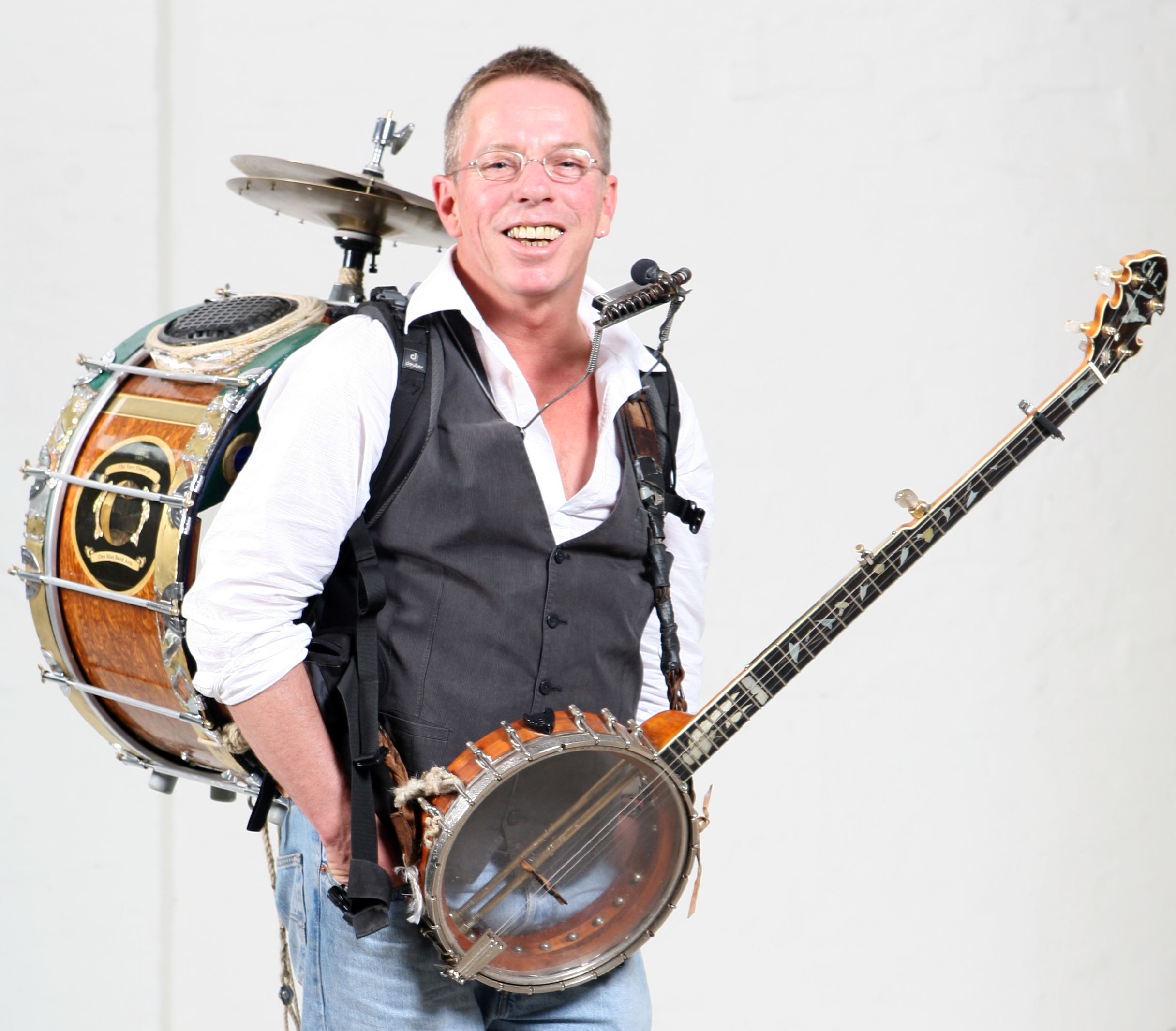
Main article: Live looping
In the 2000s, as digital looping pedals became widely available, performers have been able to use a mixture of previously recorded music, delay effects, and looping devices in live performances of everything from beatboxing to classical violin. Live looping performers create layered looped accompaniment for musical solos that are sung or played later in the song. Using this technology, a simultaneous combination of various instruments and vocals, or one instrument played in different ways, can be created over the course of one musical piece which rivals the sounds of studio recording. Notable artists who incorporate this technique live include Ed Sheeran, Keller Williams, That 1 Guy, Zach Deputy, and KT Tunstall. Rick Walker is another looper and multi-instrumentalist who has organized looping festivals, including a long-running annual one in Santa Cruz, California, and others in various countries. Live looping can be sung along prerecorded sounds.
Developments

Since the development of Musical Instrument Digital Interface (MIDI) in the 1980s, musicians have also incorporated chest-mounted MIDI drum pads, foot-mounted electronic drum triggers. Some "one-man bands" use organ-style pedal keyboards to perform basslines. A small number of MIDI enthusiasts use custom-made MIDI controllers connected to different parts of their bodies to trigger music on synthesizers. Custom-made MIDI controllers range from wind-operated controllers to small triggers mounted on the arms or feet. At a certain point, the use of body MIDI controllers may come to resemble performance art, because the musical sounds are triggered by the performer assuming certain poses or dancing. One of the pioneers of this performance art is McRorie Live Electronic, who uses drum sensors on his shoes, tom sensors on his chest, separate rhythm and bass keyboards and vocal lead instruments.
References
References
- (2024-12-12). "Pipe and Tabor – The home of The Taborers Society".
- Henry Mayhew, London Labor and the London Poor, ([[Dover Publications]], New York, 1968), vol. 3, p. 161. Reprint of 1861-62 edition published by Griffin, Bohn and Company.
- (2021-08-04). "Sound Inventions: Selected Articles from Experimental Musical Instruments". CRC Press.
- (2021-08-04). "Sound Inventions: Selected Articles from Experimental Musical Instruments". CRC Press.
- (2018-07-26). "The Long Lineage of One-Man Bands".
- Rammel, Hal. (1990). "Joe Barrick's one-man band".
- Pragatiprava. (17 October 2016). "A Musical Mind".
- (18 May 2017). "Joshua Tree Music Festival 2017 – Higher Purpose in the High Desert".
- "Your Guide to the 2016 Echo Park Rising Festival: LAist".
- "Loop.pooL: Rick Walker's musical biography".
- (2016-02-12). "1st Y2K16 MEXICO INTERNATIONAL LIVE LOOPING FESTIVAL – livelooping".
- "McPromo".
This article was imported from Wikipedia and is available under the Creative Commons Attribution-ShareAlike 4.0 License. Content has been adapted to SurfDoc format. Original contributors can be found on the article history page.
Ask Mako anything about One-man band — get instant answers, deeper analysis, and related topics.
Research with MakoFree with your Surf account
Create a free account to save articles, ask Mako questions, and organize your research.
Sign up freeThis content may have been generated or modified by AI. CloudSurf Software LLC is not responsible for the accuracy, completeness, or reliability of AI-generated content. Always verify important information from primary sources.
Report