From Surf Wiki (app.surf) — the open knowledge base
On Crimes and Punishments
1764 treatise by Cesare Beccaria
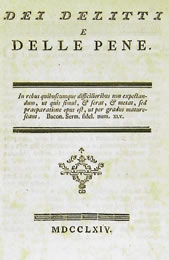
1764 treatise by Cesare Beccaria
On Crimes and Punishments ( ) is a treatise written by Cesare Beccaria in 1764.
The treatise condemned torture and the death penalty and was a founding work in the field of penology.
History
Beccaria and the two brothers Pietro and Alessandro Verri started an important cultural reformist movement centered around their journal Il Caffè ('The Coffee House'), which ran from the summer of 1764 for about two years, and was inspired by Addison and Steele's literary magazine The Spectator and other such journals. Il Caffè represented an entirely new cultural moment in Northern Italy. With their Enlightenment rhetoric and their balance between topics of socio-political and literary interest, the anonymous contributors held the interest of the educated classes in Italy, introducing recent thought such as that of Voltaire and Denis Diderot.
On Crimes and Punishments marked the high point of the Milan Enlightenment. In it, Beccaria put forth some of the first modern arguments against the death penalty. It was also the first full work of penology, advocating reform of the criminal law system. The book was the first full-scale work to tackle criminal reform and to suggest that criminal justice should conform to rational principles. It is a less theoretical work than the writings of Hugo Grotius, Samuel von Pufendorf and other comparable thinkers, and as much a work of advocacy as of theory. In this essay, Beccaria reflected on the convictions of the Il Caffè group, who sought to cause reform through Enlightenment discourse. In 1765, André Morellet produced a French translation of On Crimes and Punishments. His translation was widely criticized for the liberties he took with the text.
Morellet believed that the Italian text of Beccaria required some clarification. He, therefore, omitted parts and sometimes added to them. However, he mainly changed the structure of the essay by moving, merging, or splitting chapters. These interventions were known to experts, but because Beccaria himself had indicated in a letter to Morellet that he fully agreed with him, it was assumed that these adaptations also had Beccaria's consent in substance. The differences are so great, however, that the book from the hands of Morellet became quite another book than the book that Beccaria wrote.
Principles
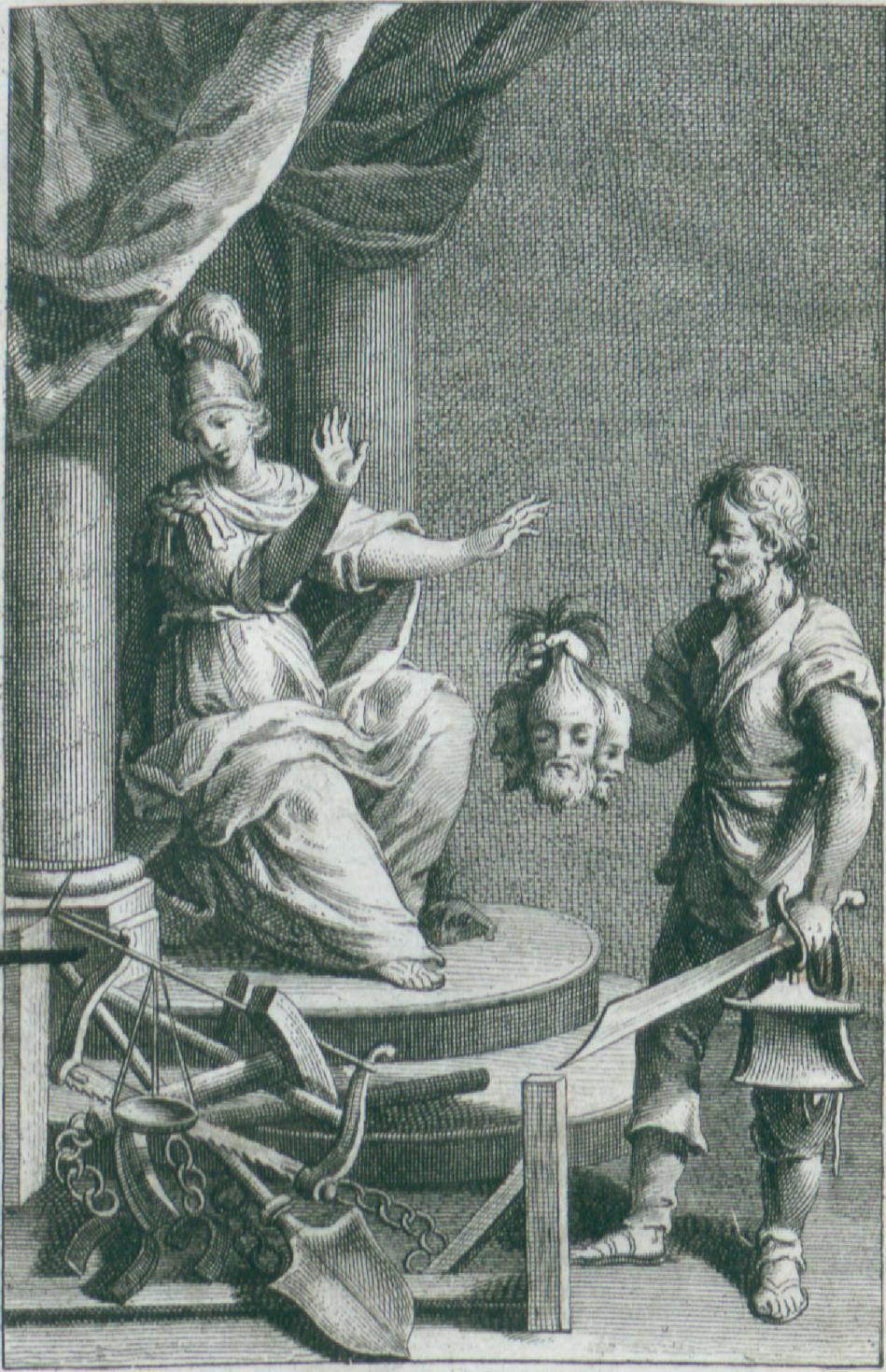
On Crimes and Punishments was the first critical analysis of capital punishment that demanded its abolition. Beccaria described the death penalty as: Beccaria cited Montesquieu, who stated that "every punishment which does not arise from absolute necessity is tyrannical".
Regarding the "Proportion between Crimes and Punishment", Beccaria stated that:
Beccaria also argued against torture, believing it was cruel and unnecessary.
Style
The book's serious message is put across in a clear and animated style, particularly upon a deep sense of humanity and urgency at unjust suffering. This humane sentiment is what makes Beccaria appeal for rationality in the laws.
Influence

Within eighteen months, the book passed through six editions. It was translated into French in 1766 and published with an anonymous commentary by Voltaire. An English translation appeared in 1767, and it was translated into several other languages. The book was read by all the luminaries of the day, including, in the United States, by John Adams and Thomas Jefferson.
The book's principles influenced thinking on criminal justice and punishment of offenders, leading to reforms in Europe, especially in France and at the court of Catherine II of Russia. In England, Beccaria's ideas fed into the writings on punishment of Sir William Blackstone (selectively), and more wholeheartedly those of William Eden (Lord Auckland) and Jeremy Bentham. The reforms he had advocated led to the abolition of the death penalty in the Grand Duchy of Tuscany, the first state in the world to take this measure.
Thomas Jefferson, in his Commonplace Book, copied a passage from Beccaria related to the issue of the right to bear arms: "Laws that forbid the carrying of arms ... disarm only those who are neither inclined nor determined to commit crimes ... Such laws make things worse for the assaulted and better for the assailants; they serve rather to encourage than to prevent homicides, for an unarmed man may be attacked with greater confidence than an armed man." His only notation on this passage was "False idee di utilità" ("false ideas of utility").
References
References
- (1986). "On Crimes And Punishments". Hackett.
- "Over misdaden en straffen door Cesare Beccaria, (1738–1794) · Bibliotheek · Boom uitgevers den Haag".
- Franklin E. Zimring. (24 September 2004). "The Contradictions of American Capital Punishment". Oxford University Press.
- Beccaria, ch. 2 "Of the Right to Punish"
- Beccaria, ch. 6, "Of the Proportion between Crimes and Punishment"
- (1785). "An Essay on Crimes and Punishment translated from the Italian with a Commentary attributed to Mons. Voltaire, Translated from the French". E. Newbery.
- (1785). "An Essay on Crimes and Punishment translated from the Italian with a Commentary attributed to Mons. Voltaire, Translated from the French". E. Newbery.
- (1765). "Dei delitti e delle pene".
- (1766). "Dei delitti e delle pene, Edizione sesta di nuovo corretta ed accresciuta".
- (1766). "Traité des délits et des peines. Traduit de l'italien, d'après la troisieme edition revue, corrigée & augmentée par l'auteur. Avec des additions de l'auteur qui n'ont pas encore paru en italien. Nouvelle édition plus correcte que les précédentes".
- (1774). "Tratado de los delitos y de las penas, Traducido del Italiano por D. Juan Antonio de las Casas". Por Joachin Ibarra, Impressor de Camera de S.M..
- "Adams' Argument for the Defense: 3–4 December 1770".
- "Laws that forbid the carrying of arms...(Spurious Quotation)".
- Draper, Anthony J.. (2000). "Cesare Beccaria's influence on English discussions of punishment, 1764–1789". History of European Ideas.
- "Laws that forbid the carrying of arms... (Spurious Quotation)".
- Halbrook, S. P.. (1989). "A Right to Bear Arms: State and Federal Bills of Rights and Constitutional Guarantees". Greenwood Press.
- Halbrook, S. P.. (2008). "The Founders' Second Amendment: Origins of the Right to Bear Arms". Ivan R. Dee.
This article was imported from Wikipedia and is available under the Creative Commons Attribution-ShareAlike 4.0 License. Content has been adapted to SurfDoc format. Original contributors can be found on the article history page.
Ask Mako anything about On Crimes and Punishments — get instant answers, deeper analysis, and related topics.
Research with MakoFree with your Surf account
Create a free account to save articles, ask Mako questions, and organize your research.
Sign up freeThis content may have been generated or modified by AI. CloudSurf Software LLC is not responsible for the accuracy, completeness, or reliability of AI-generated content. Always verify important information from primary sources.
Report