From Surf Wiki (app.surf) — the open knowledge base
Oloid
Three-dimensional curved geometric object
Three-dimensional curved geometric object
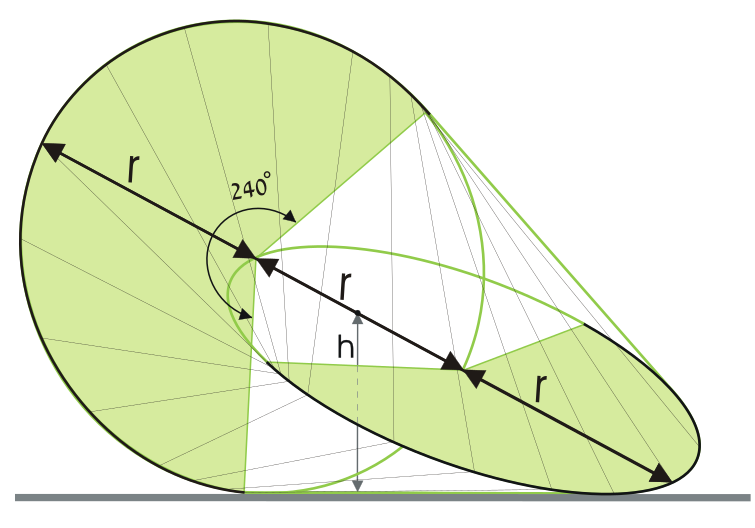
An oloid is a three-dimensional curved geometric object that was discovered by Paul Schatz in 1929. It is the convex hull of a skeletal frame made by placing two linked congruent circles in perpendicular planes, so that the center of each circle lies on the edge of the other circle. The distance between the circle centers equals the radius of the circles. One third of each circle's perimeter lies inside the convex hull, so the same shape may be also formed as the convex hull of the two remaining circular arcs each spanning an angle of 4π/3.
Surface area and volume
The surface area of an oloid is given by{{citation : A = 4\pi r^2, exactly the same as the surface area of a sphere with the same radius. In closed form, the enclosed volume is : V = \frac{2}{3} \left(2 E\left(\frac{3}{4}\right) + K\left(\frac{3}{4}\right)\right)r^3, where K and E denote the complete elliptic integrals of the first and second kind respectively. A numerical calculation gives : V \approx 3.0524184684,r^3.
Kinetics
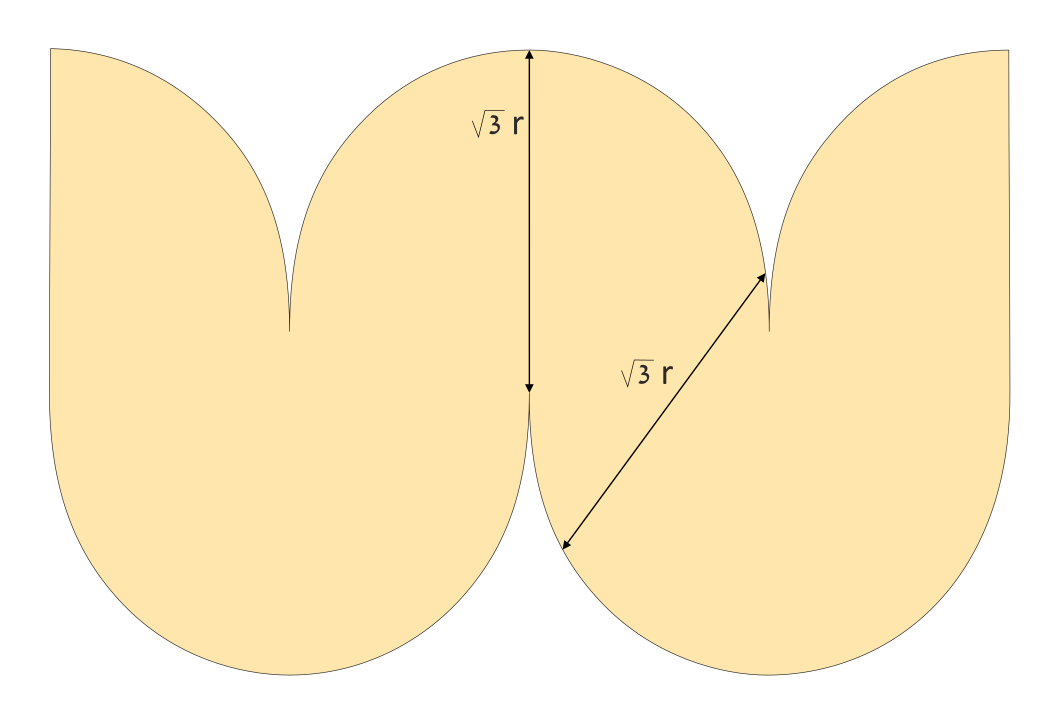
The surface of the oloid is a developable surface, meaning that patches of the surface can be flattened into a plane. While rolling, it develops its entire surface: every point of the surface of the oloid touches the plane on which it is rolling, at some point during the rolling movement, making it a developable roller. Unlike most axial symmetric objects (cylinder, sphere etc.), while rolling on a flat surface, its center of mass performs a meandering motion rather than a linear one. In each rolling cycle, the distance between the oloid's center of mass and the rolling surface has two minima and two maxima. The difference between the maximum and the minimum height is given by :\Delta h=r\left(\frac{\sqrt{2}}{2}-{3}\frac{\sqrt{3}}{8}\right)\approx 0.0576r, where r is the oloid's circular arcs radius. Since this difference is fairly small, the oloid's rolling motion is relatively smooth.
At each point during this rolling motion, the oloid touches the plane in a line segment. The length of this segment stays unchanged throughout the motion, and is given by:{{citation | access-date = 6 November 2013 | archive-url = https://web.archive.org/web/20131228151322/http://w3.uniroma1.it/dsg/enoc2011/proceedings/pdf/Kuleshov_et_al_6pages.pdf | archive-date = 28 December 2013 | url-status = dead :l = \sqrt{3} r.

In popular culture
In 1979, modern dancer Alan Boeding designed his "Circle Walker" sculpture from two crosswise semicircles, forming a skeletal version of the sphericon, a shape with a similar rolling motion to the oloid. He began dancing with a scaled-up version of the sculpture in 1980 as part of an MFA program in sculpture at Indiana University, and after he joined the MOMIX dance company in 1984 the piece became incorporated into the company's performances. The company's later piece "Dream Catcher" is based around another Boeding sculpture whose linked teardrop shapes incorporate the skeleton and rolling motion of the oloid.
References
Literature
Tobias Langscheid, Tilo Richter (Ed.): Oloid – Form of the Future. With contributions by Dirk Böttcher, Andreas Chiquet, Heinrich Frontzek a.o., niggli Verlag 2023, ISBN 978-3-7212-1025-5
References
- {{Cite OEIS
- A. T. Stewart, [https://pubs.aip.org/aapt/ajp/article-abstract/34/2/166/235236/Two-Circle-Roller?redirectedFrom=fulltext Two-Circle Roller], ''American Journal of Physics'', 1966, vol. 34, issue 2, pp. 166, 167
- (January 1991). "Trefoil Knots without Tritangent Planes". Bulletin of the London Mathematical Society.
- (2020). "Optimizing Morton's Tritangentless Knots for Rolling". Bridges 2020 Conference Proceedings.
- Green, Judith. (May 2, 1991). "hits and misses at Momix: it's not quite dance, but it's sometimes art". San Jose Mercury News.
- Boeding, Alan. (April 27, 1988). "Circle dancing". The Christian Science Monitor.
- Anderson, Jack. (February 8, 2001). "Leaping Lizards and Odd Denizens of the Desert". The New York Times.
This article was imported from Wikipedia and is available under the Creative Commons Attribution-ShareAlike 4.0 License. Content has been adapted to SurfDoc format. Original contributors can be found on the article history page.
Ask Mako anything about Oloid — get instant answers, deeper analysis, and related topics.
Research with MakoFree with your Surf account
Create a free account to save articles, ask Mako questions, and organize your research.
Sign up freeThis content may have been generated or modified by AI. CloudSurf Software LLC is not responsible for the accuracy, completeness, or reliability of AI-generated content. Always verify important information from primary sources.
Report