From Surf Wiki (app.surf) — the open knowledge base
Olivine
Mineral of magnesium iron silicate

Mineral of magnesium iron silicate
| Field | Value |
|---|---|
| name | Olivine |
| category | Nesosilicate |
| Olivine group | |
| Olivine series | |
| boxbgcolor | #95bf5d |
| image | Olivine-gem7-10a.jpg |
| formula | |
| IMAsymbol | Ol |
| strunz | 9.AC.05 |
| color | Yellow to yellow-green |
| habit | Massive to granular |
| system | Orthorhombic |
| symmetry | Pbnm (no. 62) |
| cleavage | Poor |
| fracture | Conchoidal |
| tenacity | brittle |
| mohs | 6.5–7.0 |
| luster | Vitreous |
| refractive | nα = 1.630–1.650 |
| nβ = 1.650–1.670 | |
| nγ = 1.670–1.690 | |
| opticalprop | Biaxial (+) |
| birefringence | δ = 0.040 |
| streak | colorless or white |
| density | 3.2–4.5 |
| diaphaneity | Transparent to translucent |
| references | {{cite book |
| last | Klein |
| first | Cornelis |
| author2 | C. S. Hurlburt |
| title | Manual of Mineralogy |
| edition | 20th |
| publisher | John Wiley & Sons |
| year | 1985 |
| location | New York |
| isbn | 978-0-471-80580-9 |
| url | https://archive.org/details/manualofmineralo00klei |
Olivine group Olivine series nβ = 1.650–1.670 nγ = 1.670–1.690
The mineral olivine () is a magnesium iron silicate with the chemical formula . It is a type of nesosilicate or orthosilicate. The primary component of the Earth's upper mantle, it is a common mineral in Earth's subsurface, but weathers quickly on the surface. Olivine has many uses, such as the gemstone peridot (or chrysolite), as well as industrial applications like metalworking processes.
The ratio of magnesium to iron varies between the two endmembers of the solid solution series: forsterite (Mg-endmember: ) and fayalite (Fe-endmember: ). Compositions of olivine are commonly expressed as molar percentages of forsterite (Fo) and/or fayalite (Fa) (e.g., Fo70Fa30, or just Fo70 with Fa30 implied). Forsterite's melting temperature is unusually high at atmospheric pressure, almost 1900 C, while fayalite's is much lower – about 1200 C. Melting temperature varies smoothly between the two endmembers, as do other properties. Olivine incorporates only minor amounts of elements other than oxygen (O), silicon (Si), magnesium (Mg) and iron (Fe). Manganese (Mn) and nickel (Ni) commonly are the additional elements present in highest concentrations.
Olivine gives its name to the group of minerals with a related structure (the olivine group) – which includes tephroite (Mn2SiO4), monticellite (CaMgSiO4), larnite (Ca2SiO4) and kirschsteinite (CaFeSiO4) (commonly also spelled kirschteinite).
Olivine's crystal structure incorporates aspects of the orthorhombic P Bravais lattice, which arise from each silica (SiO4) unit being joined by metal divalent cations with each oxygen in SiO4 bound to three metal ions. It has a spinel-like structure similar to magnetite but uses one quadrivalent and two divalent cations M22+ M4+O4 instead of two trivalent and one divalent cations.
Identification and paragenesis
Olivine is named for its typically olive-green color, though it may alter to a reddish color from the oxidation of iron.
Translucent olivine is sometimes used as a gemstone called peridot (péridot, the French word for olivine). It is also called chrysolite (or chrysolithe, from the Greek words for gold and stone), though this name is now rarely used in the English language. Some of the finest gem-quality olivine has been obtained from a body of mantle rocks on Zabargad Island in the Red Sea.
Olivine occurs in both mafic and ultramafic igneous rocks and as a primary mineral in certain metamorphic rocks. Mg-rich olivine crystallizes from magma that is rich in magnesium and low in silica. That magma crystallizes to mafic rocks such as gabbro and basalt. Ultramafic rocks usually contain substantial olivine, and those with an olivine content of over 40% are described as peridotites. Dunite has an olivine content of over 90% and is likely a cumulate formed by olivine crystallizing and settling out of magma or a vein mineral lining magma conduits. Olivine and high pressure structural variants constitute over 50% of the Earth's upper mantle, and olivine is one of the Earth's most common minerals by volume. The metamorphism of impure dolomite or other sedimentary rocks with high magnesium and low silica content also produces Mg-rich olivine, or forsterite.
Fe-rich olivine fayalite is relatively much less common, but it occurs in igneous rocks in small amounts in rare granites and rhyolites, and extremely Fe-rich olivine can exist stably with quartz and tridymite. In contrast, Mg-rich olivine does not occur stably with silica minerals, as it would react with them to form orthopyroxene ().
Mg-rich olivine is stable to pressures equivalent to a depth of about 410 km within Earth. Because it is thought to be the most abundant mineral in Earth's mantle at shallower depths, the properties of olivine have a dominant influence upon the rheology of that part of Earth and hence upon the solid flow that drives plate tectonics. Experiments have documented that olivine at high pressures (12 GPa, the pressure at depths of about 360 km) can contain at least as much as about 8900 parts per million (weight) of water, and that such water content drastically reduces the resistance of olivine to solid flow. Moreover, because olivine is so abundant, more water may be dissolved in olivine of the mantle than is contained in Earth's oceans.
Olivine pine forest (a plant community) is unique to Norway. It is rare and found on dry olivine ridges in the fjord districts of Sunnmøre and Nordfjord.
File:Papakolea Beach sand high mag 052915.jpg|Olivine grains that eroded from lava on Papakolea Beach, Hawaii File:Peridot in basalt.jpg|Light green olivine crystals in peridotite xenoliths in basalt from Arizona File:Lunar Olivine Basalt 15555 from Apollo 15 in National Museum of Natural History.jpg|Olivine basalt from the Moon, collected in 1971 by the crew of Apollo 15 File:Forsterite-158776.jpg|Bright green olivine from Pakistan, showing chisel termination and silky luster File:Lava - Olivine - Azores.jpg|Olivine in lava from the Azores
Extraterrestrial occurrences

Mg-rich olivine has also been discovered in meteorites, on the Moon and Mars, falling into infant stars, as well as on asteroid 25143 Itokawa. Such meteorites include chondrites, collections of debris from the early Solar System; and pallasites, mixes of iron-nickel and olivine. The rare A-type asteroids are suspected to have a surface dominated by olivine.
The spectral signature of olivine has been seen in the dust disks around young stars. The tails of comets (which formed from the dust disk around the young Sun) often have the spectral signature of olivine, and the presence of olivine was verified in samples of a comet from the Stardust spacecraft in 2006. Comet-like (magnesium-rich) olivine has also been detected in the planetesimal belt around the star Beta Pictoris.
Crystal structure
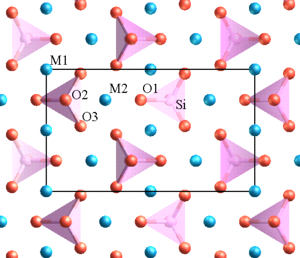
Minerals in the olivine group crystallize in the orthorhombic system (space group Pbnm) with isolated silicate tetrahedra, meaning that olivine is a nesosilicate. The structure can be described as a hexagonal, close-packed array of oxygen ions with half of the octahedral sites occupied with magnesium or iron ions and one-eighth of the tetrahedral sites occupied by silicon ions.
There are three distinct oxygen sites (marked O1, O2 and O3 in the figure), two distinct metal sites (M1 and M2) and only one distinct silicon site. O1, O2, M2 and Si all lie on mirror planes, while M1 exists on an inversion center. O3 lies in a general position.
High-pressure polymorphs
At the high temperatures and pressures found at depth within the Earth the olivine structure is no longer stable. Below depths of about 410 km olivine undergoes an exothermic phase transition to the sorosilicate, wadsleyite and, at about 520 km depth, wadsleyite transforms exothermically into ringwoodite, which has the spinel structure. At a depth of about 660 km, ringwoodite decomposes into silicate perovskite () and ferropericlase () in an endothermic reaction. These phase transitions lead to a discontinuous increase in the density of the Earth's mantle that can be observed by seismic methods. They are also thought to influence the dynamics of mantle convection in that the exothermic transitions reinforce flow across the phase boundary, whereas the endothermic reaction hampers it.
The pressure at which these phase transitions occur depends on temperature and iron content.{{cite book
Weathering
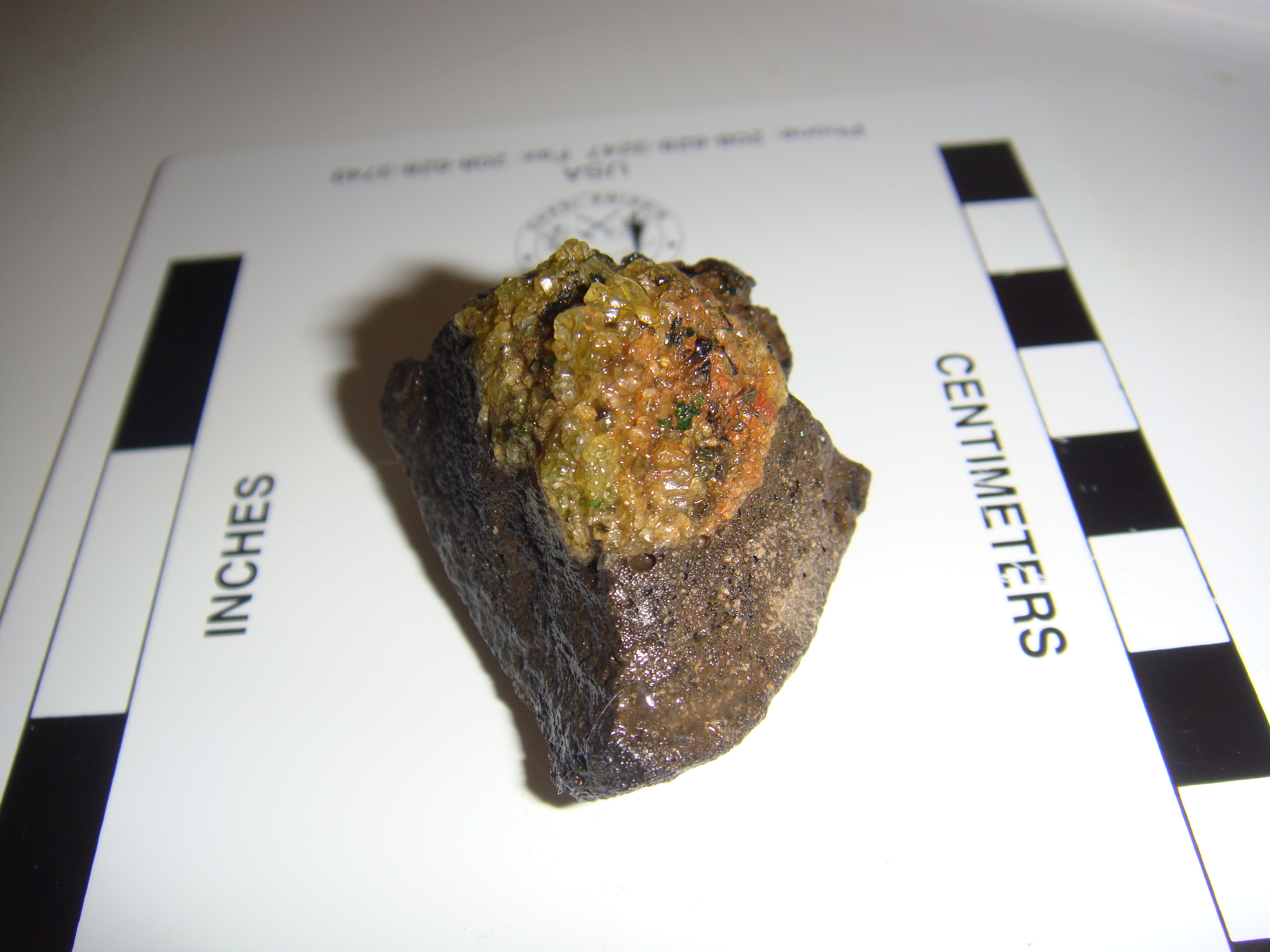
Olivine is one of the less stable common minerals on the surface according to the Goldich dissolution series. It alters into iddingsite (a combination of clay minerals, iron oxides and ferrihydrite) readily in the presence of water. Artificially increasing the weathering rate of olivine, e.g. by dispersing fine-grained olivine on beaches, has been proposed as a cheap way to sequester CO2. The presence of iddingsite on Mars would suggest that liquid water once existed there, and might enable scientists to determine when there was last liquid water on the planet.
Because of its rapid weathering, olivine is rarely found in sedimentary rock.
Mining
Norway

Norway is the main source of olivine in Europe, particularly in an area stretching from Åheim to Tafjord, and from Hornindal to Flemsøy in the Sunnmøre district. There is also olivine in Stad Municipality. About 50% of the world's olivine for industrial use is produced in Norway. At Svarthammaren in Norddal Municipality (now Fjord Municipality), olivine was mined from around 1920 to 1979, with a daily output up to 600 MT. Olivine was also obtained from the construction site of the hydro power stations in Tafjord. At Robbervika in Norddal municipality an open-pit mine has been in operation since 1984. The characteristic red color is reflected in several local names with "red" such as Raudbergvik (Red rock bay) or Raudnakken (Red ridge).
Hans Strøm in 1766 described the olivine's typical red color on the surface and the blue color within. Strøm wrote that in Norddal district large quantities of olivine were broken from the bedrock and used as sharpening stones.
Kallskaret near Tafjord is a nature reserve with olivine.
Applications
Olivine is used as a substitute for dolomite in steel works.
The aluminium foundry industry uses olivine sand to cast objects in aluminium. Olivine sand requires less water than silica sands while still holding the mold together during handling and pouring of the metal. Less water means less gas (steam) to vent from the mold as metal is poured into the mold.
In Finland, olivine is marketed as an ideal rock for sauna stoves because of its comparatively high density and resistance to weathering under repeated heating and cooling.
Gem-quality olivine is used as a gemstone called peridot.
Experimental uses
Removal of atmospheric CO2 via reaction with crushed olivine has been considered. The end-products of the very slow reaction are silicon dioxide, magnesium carbonate, and iron oxides. A public benefit corporation, Project Vesta, is investigating this approach on beaches which increase the agitation and surface area of crushed olivine through wave action.
Another experimental use for olivine is in making carbon-neutral or carbon-negative cement.
References
References
- Warr, L.N.. (2021). "IMA–CNMNC approved mineral symbols". Mineralogical Magazine.
- Mick R. Smith. (1999). "Stone: Building Stone, Rock Fill and Armourstone in Construction". Geological Society of London.
- Jessica Elzea Kogel. (2006). "Industrial Minerals & Rocks: Commodities, Markets, and Uses". SME.
- "Olivine". Science.smith.edu.
- "University of Minnesota's Mineral Pages: Olivine". Geo.umn.edu.
- [http://webmineral.com/data/Olivine.shtml Olivine] {{webarchive. link. (2014-12-09. Webmineral.com Retrieved on 2012-06-16.)
- [http://www.mindat.org/min-2983.html Olivine] {{webarchive. link. (2008-02-02. Mindat.org Retrieved on 2012-06-16.)
- Garlick, Sarah. (2014). "Pocket Guide to the Rocks & Minerals of North America". [[National Geographic Society]].
- Ernst, W. G. ''Earth Materials''. Englewood Cliffs, NJ: Prentice-Hall, 1969. p. 65
- [http://www.mindat.org/loc-6423.html St. John's Island peridot information and history] at [[Mindat.org]]
- (Spring 1981). "Zabargad: The ancient peridot island in the Red Sea". Gems & Gemology.
- (2009). "Principles of igneous and metamorphic petrology". Cambridge University Press.
- (1998). "Mineralogy and composition of the upper mantle". Reviews in Mineralogy.
- (2006). "Olivine hydration in the deep upper mantle: Effects of temperature and silica activity". Geophysical Research Letters.
- (2009). "Olivinfuruskog og rødlistearter i Bjørkedalen, Volda: naturverdi og forvaltningsmuligheter". NINA Rapport.
- [http://www.farlang.com/art/gemstone-meteorites Fukang and other Pallasites] {{webarchive. link. (2008-12-21. Farlang.com (2008-04-30). Retrieved on 2012-06-16.)
- Meyer, C.. (2003). "Mare Basalt Volcanism". [[NASA]].
- [http://www.psrd.hawaii.edu/Nov03/olivine.html Pretty Green Mineral....] {{webarchive. link. (2007-05-04[http://deepimpact.umd.edu/gallery/313_635_F3.html Mission Update 2006...] {{webarchive). link. (2010-06-05 UMD Deep Impact Website, University of Maryland Ball Aerospace & Technology Corp. retrieved June 1, 2010)
- (2003). "Discovery of Olivine in the Nili Fossae Region of Mars". Science.
- [http://www.nasa.gov/mission_pages/spitzer/news/spitzer20110526.html Spitzer Sees Crystal Rain...] {{webarchive. link. (2011-05-29 NASA Website)
- [http://www.spaceflightnow.com/news/n1011/16hayabusa/ Japan says Hayabusa brought back asteroid grains...] {{webarchive. link. (2010-11-18 retrieved November 18, 2010)
- (January 2014). "Olivine-dominated asteroids: Mineralogy and origin". Icarus.
- [http://stardust.jpl.nasa.gov/news/status/060313.html Press Release 06-091] {{webarchive. link. (2006-08-28. Jet Propulsion Laboratory Stardust website, retrieved May 30, 2006.)
- (2012). "Comet-like mineralogy of olivine crystals in an extrasolar proto-Kuiper belt". Nature.
- Christensen, U.R.. (1995). "Effects of phase transitions on mantle convection". Annu. Rev. Earth Planet. Sci..
- (2003). "A Study of Olivine Alteration to Iddingsite Using Raman Spectroscopy". Lunar and Planetary Science.
- (2001). "CO2 Mineral Sequestration Studies in US".
- "Olivine against climate change and ocean acidification".
- (2000). "Noble Gases in Iddingsite from the Lafayette meteorite: Evidence for Liquid water on Mars in the last few hundred million years". Meteoritics and Planetary Science.
- (October 2009). "Dissolution of olivine during natural weathering". Geochimica et Cosmochimica Acta.
- Furseth, Astor (1987): ''Norddal i 150 år''. Valldal: Norddal kommune.
- [[Geological Survey of Norway]]. ''[https://geo.ngu.no/kart/mineralressurser/ Kart over mineralressurser] {{webarchive. link. (2017-10-14''. Accessed 9.12.2012.)
- "Olivin".
- Gjelsvik, T. (1951). ''[http://www.ngu.no/FileArchive/NGUPublikasjoner/NGUnr_179_Gjelsvik.pdf Oversikt over bergartene i Sunnmøre og tilgrensende deler av Nordfjord] {{webarchive. link. (2017-11-10''. Norge geologiske undersøkelser, report 179.)
- Strøm, Hans: ''Physisk og Oeconomisk Beskrivelse over Fogderiet Søndmør beliggende i Bergen Stift i Norge.'' Published in Sorø, Denmark, 1766.
- (28 September 2014). "Kallskaret".
- ''Mineralressurser i Norge ; Mineralstatistikk og bergverksberetning 2006.'' Trondheim: Bergvesenet med bergmesteren for Svalbard. 2007.
- Ammen, C. W.. (1980). "The Metal Caster's Bible". TAB.
- "The olivine stone".
- (2000). "CO2 Mineral Sequestration Studies in US". Technology.
- (2006). "Enhanced Weathering: An Effective and Cheap Tool to Sequester CO2". Climatic Change.
- Delbert, Caroline. (2020-06-11). "How This Strange Green Sand Could Reverse Climate Change".
- "Carbon capture and storage in low-carbon concrete using products derived from olivine".
This article was imported from Wikipedia and is available under the Creative Commons Attribution-ShareAlike 4.0 License. Content has been adapted to SurfDoc format. Original contributors can be found on the article history page.
Ask Mako anything about Olivine — get instant answers, deeper analysis, and related topics.
Research with MakoFree with your Surf account
Create a free account to save articles, ask Mako questions, and organize your research.
Sign up freeThis content may have been generated or modified by AI. CloudSurf Software LLC is not responsible for the accuracy, completeness, or reliability of AI-generated content. Always verify important information from primary sources.
Report