From Surf Wiki (app.surf) — the open knowledge base
Olive skin
Light tan or brownish human skin tone

Light tan or brownish human skin tone
.jpg)
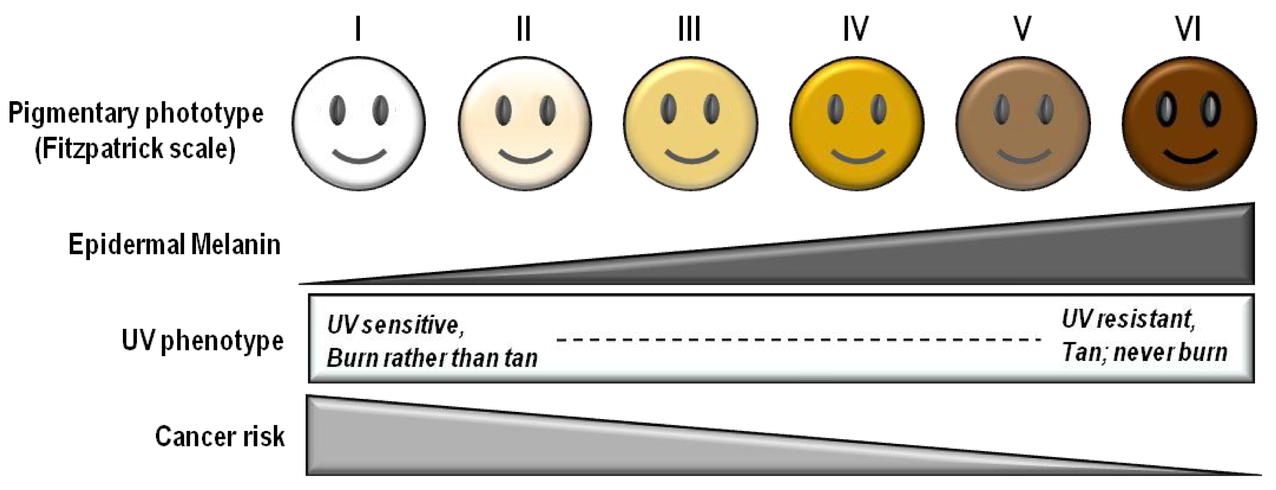
Olive is a human skin tone, roughly corresponding to Types III, IV, and V on the Fitzpatrick scale of pigmentation. The term describes lighter brown tones with greenish, yellowish, or golden undertones.
People with olive skin can sometimes become paler if their sun exposure is limited. However, olive skin still tans more easily than light skin does, and generally still retains notable greenish or yellowish undertones.
History
The Oxford English Dictionary indicates that the term "olive" has been used to describe skin color since at least the 17th century. The earliest recorded instance occurs in the writings of the English traveller Thomas Coryat, who said of the Mughal Emperor Jahangir, "Hee is of complexion neither white nor blacke, but of a middle betwixt the[m]: I know not how to expresse it with a more expressiue & significant ephitheton then Oliue: an Oliue colour his face presenteth[.]"
Geographic distribution

Type III pigmentation is frequent among populations from the Mediterranean region and West Asia, as well as East Asia, Central Asia, and parts of the Americas. It can also be found sporadically in Northern Europe, giving groups such as the "Black Irish" and "Black Dutch" their distinctive coloration. This skin type sometimes burns and tans gradually, but always tans.
Type IV pigmentation occurs in the same regions, as well as South Asia and Austronesia.
Type V pigmentation is found among some populations in Southwest Asia It is frequent in the indigenous peoples of the Americas, and in South Asia. This skin type very rarely burns and tans quite easily.

References
References
- (2013). "Handbook of Vitamin D in Human Health: Prevention, Treatment and Toxicity". [[Wageningen Academic Publishers]].
- (2013). "Viva Training in ENT: Preparation for the FRCS (ORL-HNS)". Oxford University Press.
- (2001). "Dermatologic and Cosmetic Procedures in Office Practice". Elsevier Health Sciences.
- (2015). "The Essential Guide to Primary Care Procedures". Lippincott Williams & Wilkins.
- (Sep 1988). "Your True Colors". Ski.
- (1997). "Woman's Face: Skin Care and Makeup". Knopf.
- (8 August 2008). "Reinvent Yourself with Color Me Beautiful: Four Seasons of Color, Makeup, and Style". Taylor Trade Publications.
- (1983). "Redbook". Redbook Publishing Company.
- (1 April 1993). "Beauty Basics". Berkley Publishing Group.
- (2007). "Make-Up". New Holland Publishers.
- (11 October 2005). "In Style: Getting Gorgeous: The Step-By-Step Guide to Your Best Hair, Makeup and Skin". Time Incorporated.
- (2006). "The Beauty Buyble: The Best Beauty Products of 2007". Regan Books.
- (1979). "The Portrait Painter's Problem Book". Watson-Guptill Publications.
- (2008). "Dark Deception: Discover the Truths About the Benefits of Sunlight Exposure". Thomas Nelson Inc.
- (2013). "Idiot's Guides: Making Natural Beauty Products". Penguin.
- (2013). "Jemma Kidd Make-Up Masterclass". Aurum Press.
- {{cite OED. olive. 6637861479
- Coryat, Thomas. (1616). "Traveller for the English Wits". W. Jaggard and Henry Featherston.
- (18 March 2022). "Who were the Black Irish, and what is their story?".
- (2023). "Olive Skin Countries 2023".
- (2017). "State of the art in Blepharoplasty: From Surgery to the Avoidance of Complications". Springer.
- (1991). "Super Skin: A Leading Dermatologist's Guide to the Latest Breakthrough's in Skin Care". Crown Publishing.
- (13 May 2008). "The Fitzpatrick Skin Type Classification Scale". Skin Inc..
- Gates, Clifford E.. (1922). "The Polynesians: Caucasians of the Pacific". The Scientific Monthly.
- (2012). "Practical Guide to Chemical Peels, Microdermabrasion & Topical Products". Lippincott Williams & Wilkins.
- (2012). "Standard Esthetics: Advanced". Nelson.
- (2006). "Solar Ultraviolet Radiation—Global burden of disease from solar UV radiation". World Health Organization, Public Health and the Environment.
This article was imported from Wikipedia and is available under the Creative Commons Attribution-ShareAlike 4.0 License. Content has been adapted to SurfDoc format. Original contributors can be found on the article history page.
Ask Mako anything about Olive skin — get instant answers, deeper analysis, and related topics.
Research with MakoFree with your Surf account
Create a free account to save articles, ask Mako questions, and organize your research.
Sign up freeThis content may have been generated or modified by AI. CloudSurf Software LLC is not responsible for the accuracy, completeness, or reliability of AI-generated content. Always verify important information from primary sources.
Report