From Surf Wiki (app.surf) — the open knowledge base
Olga Tokarczuk
Polish writer and activist (born 1962)

Polish writer and activist (born 1962)
| Field | Value | |
|---|---|---|
| image | Olga Tokarczuk-9739.jpg | |
| caption | Tokarczuk in 2019 | |
| birth_name | Olga Nawoja Tokarczuk | |
| birth_date | ||
| birth_place | Sulechów, Poland | |
| occupation | ||
| language | Polish | |
| education | University of Warsaw (MA) | |
| period | Contemporary | |
| years_active | 1989–present | |
| genres | ||
| movement | Magic realism | |
| notableworks | {{Plainlist | |
| awards | {{Plainlist | |
| signature | Olga Tokarczuk signature.svg |
- Primeval and Other Times (1996)
- Flights (2007)
- Drive Your Plow Over the Bones of the Dead (2009)
- The Books of Jacob (2014)
- Nike Award (2008, 2015)
- Vilenica Prize (2013)
- Brückepreis (2015)
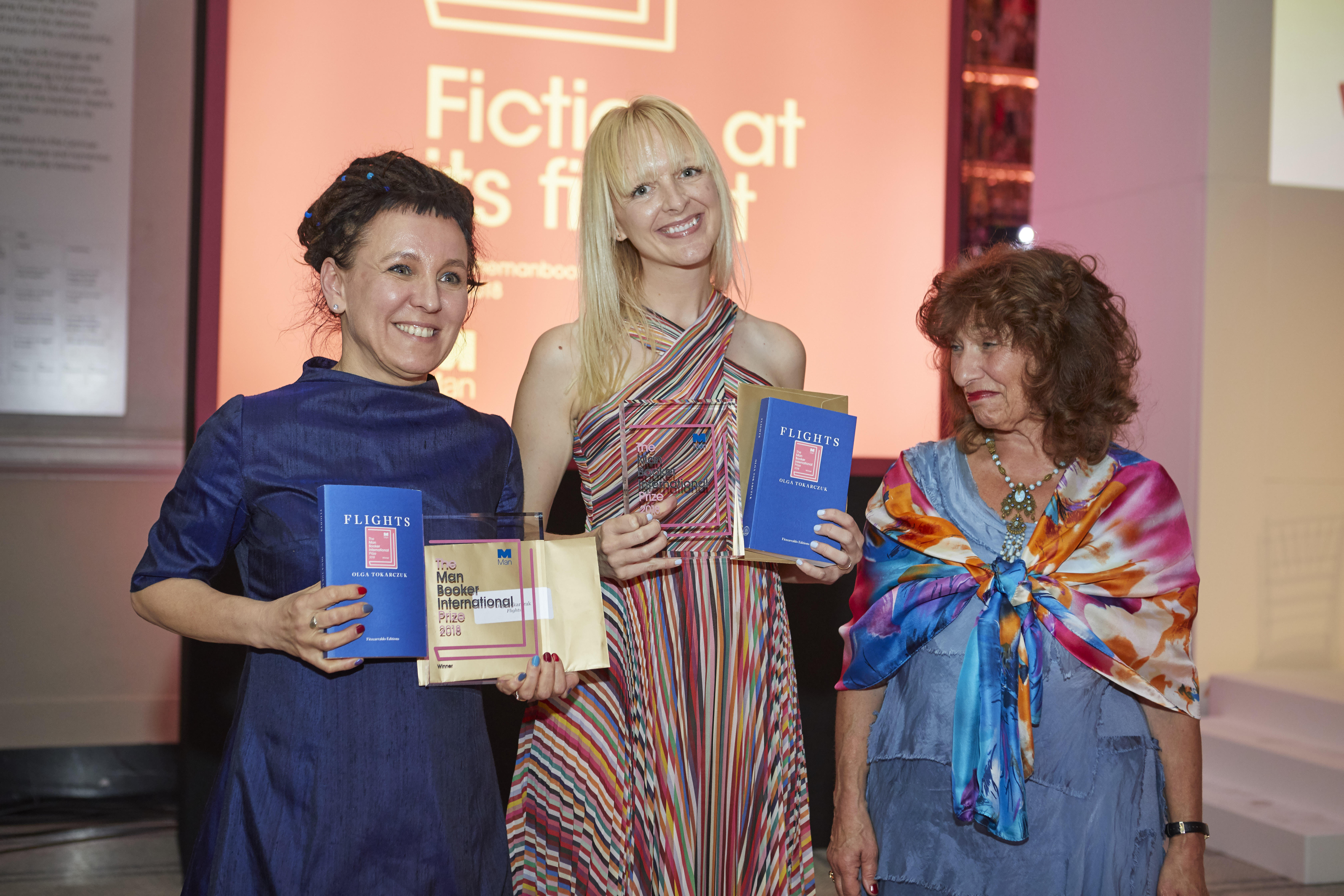
- The Man Booker International Prize (2018)
- Jan Michalski Prize (2018)
- Nobel Prize in Literature (2018)
- Prix Laure Bataillon (2019)
Olga Nawoja Tokarczuk (; born 29 January 1962) is a Polish writer, activist, and public intellectual. She is one of the most critically acclaimed and successful Polish authors of her generation. In 2019, she was awarded the 2018 Nobel Prize in Literature for "a narrative imagination that with encyclopedic passion represents the crossing of boundaries as a form of life". For her novel Flights, Tokarczuk was awarded the 2018 Man Booker International Prize. Her works include Primeval and Other Times, Drive Your Plow Over the Bones of the Dead, and The Books of Jacob.
Tokarczuk is noted for the mythical tone of her writing. A clinical psychologist from the University of Warsaw, she has published a collection of poems, several novels, and books of shorter prose works. For Flights and The Books of Jacob, she won the Nike Award, Poland's top literary prize, among other accolades; she won the Nike audience award five times. In 2015, she received the German-Polish Bridge Prize for her contribution to mutual understanding between European nations.
Her works have been translated into almost 40 languages, making her one of the most translated contemporary Polish writers. The Books of Jacob, regarded as her magnum opus, was released in the UK in November 2021 after seven years of translation work, followed by release in the US in February 2022. In March, it was shortlisted for the 2022 International Booker Prize.
Biography
Early life, and education
Olga Tokarczuk was born in Sulechów near Zielona Góra, in western Poland. She is the daughter of two teachers, Wanda Słabowska and Józef Tokarczuk, and has a sister. Her parents were resettled from former Polish eastern regions after World War II; one of her grandmothers was of Ukrainian origin. The family lived in the countryside in Klenica, 11 miles from Zielona Góra, where her parents taught at the People's University and her father ran a school library where she found her love of literature. Her father was a member of the Polish United Workers' Party. As a child, Tokarczuk liked Henryk Sienkiewicz's novel In Desert and Wilderness and fairy tales, among others. Her family later moved to Kietrz in Opolian Silesia, where she graduated from the C.K. Norwid high school. In 1979, she debuted with two short stories published in the youth scouting magazine Na Przełaj (No. 39, under the pseudonym Natasza Borodin).
Tokarczuk went on to study clinical psychology at the University of Warsaw in 1980, and during her studies, she volunteered in an asylum for adolescents with behavioral problems. After graduation in 1985, she moved to Wrocław and later Wałbrzych, where she worked as a psychotherapist in 1986–89 and teachers' trainer in 1989–96. In the meantime, she published poems and reviews in the press and a book of poetry in 1989. Her works were awarded at Walbrzych Literary Paths (1988, 1990). Tokarczuk quit to concentrate on literature. She said she felt "more neurotic than my clients". She did odd jobs in London for a while, improving her English, and had literary scholarships in the United States (1996) and in Berlin (2001/02).
Inspiration and family
Tokarczuk considers herself a disciple of Carl Jung and cites his psychology as an inspiration for her writing.
Since 1998, she has lived between Krajanów and Wrocław, in Lower Silesia. Her home in Krajanów near Nowa Ruda is in the Sudetes mountains at the multicultural Polish-Czech borderland. The locale has influenced her literary work; the novel House of Day, House of Night touches on life in the region, and the action of Drive Your Plow Over the Bones of the Dead takes place in the picturesque Kłodzko Valley. In 1998, together with her first husband, Tokarczuk founded the Ruta publishing house, which operated until 2004. She was an organizer of the International Short Story Festival, which was inaugurated in Wrocław in 2004. As a guest lecturer, she conducted prose workshops at universities in Kraków and Opole. Tokarczuk joined the editorial team of Krytyka Polityczna (Eng. ed. Political Critique), a magazine as well as a large pan-regional network of institutions and activists, and currently serves on the board of trustees of its academic and research unit, the Institute for Advance Study in Warsaw.
In 2009, Tokarczuk received a literary scholarship from the Netherlands Academy of Arts and Sciences, and during her stay at the NIAS campus in Wassenaar, she wrote Drive Your Plow Over the Bones of the Dead, which was published that year.
Roman Fingas, a fellow psychologist, was Tokarczuk's first husband. They married when she was 23 and later divorced; their son Zbigniew was born in 1986. Grzegorz Zygadło is her second husband. She is a vegetarian.
Literary career
Early works
Tokarczuk's first book, the poetry collection Miasta w lustrach (Cities in Mirrors), was published in 1989. Her debut novel, Podróż ludzi księgi (The Journey of the Book-People), was published in 1993. A parable on two lovers' quest for the "secret of the Book"—a metaphor for the meaning of life—it is set in the 17th century and portrays an expedition to a monastery in the Pyrenees on the trail of a book that reveals the mystery of life, ending with an ironic twist. It was well received by critics and won the Polish Publisher's Prize for best debut.
Tokarczuk's next novel, E.E. (1995), plays with the conventions of the modernist psychological novel, and takes its title from the initials of its protagonist, the adolescent Erna Eltzner, who develops psychic abilities. Growing up in a wealthy German-Polish family in the 1920s in Wrocław, at that time a German city named Breslau, she allegedly becomes a medium, a fact her mother begins to take advantage of by organizing spiritual sessions. Tokarczuk introduces the characters of scientists, the psychiatrist-patient relationship, and despite elements of spiritualism, occultism, and gnosticism, she represents psychological realism and cognitive scepticism. Katarzyna Kantner, a literary scholar who defended her PhD thesis on Tokarczuk's work, points to Jung's doctoral dissertation On the Psychology and Pathology of So-Called Occult Phenomena as an inspiration.
''Primeval and Other Times''
Tokarczuk's third novel, Primeval and Other Times (Prawiek i inne czasy, Eng. 2010), was published in 1996 and was highly successful. It is set in the fictitious village of Primeval at the very heart of Poland, which is populated by eccentric, archetypical characters. The village, a microcosm of Europe, is guarded by four archangels, from whose perspective the book chronicles its inhabitants' lives over eight decades, beginning in the year World War I broke out. The book presents the creation of a myth emerging before the reader's eyes. "This is Primeval: an enclosed snow globe, a world in itself, which it may or may not be possible to ever leave. [...] And yet, as much as the town of Primeval is devastated, over and over, by history, there is also a counter dream, full of creaturely magic and wonder." Translated into many languages, with an English version by Antonia Lloyd-Jones, Primeval and Other Times established Tokarczuk's reputation as one of the most important representatives of Polish literature in her generation.
After Primeval and Other Times, her work began drifting away from the novel genre toward shorter prose texts and essays. Tokarczuk's next book, Szafa (The Wardrobe, 1997) was a collection of three novella-type stories.
''House of Day, House of Night'' and other works
House of Day, House of Night (Dom dzienny, dom nocny, 1998, Eng. 2003) is what Tokarczuk calls a "constellation novel", a patchwork of loosely connected, disparate stories, sketches, and essays about life past and present in her adopted home in Krajanów, which allow various interpretations and enable communication at a deeper, psychological level. Her goal is to make those images, fragments of narrative and motif, merge only on entering the reader's consciousness. While some, at least those unfamiliar with Central European history, have called it Tokarczuk's most "difficult" book, it was her first to be published in English and was shortlisted for the International Dublin Literary Award in 2004.{{Cite web|last=Marsden|first=Philip|author-link=Philip Marsden|date=2002-10-20|title=Poles apart
.jpg)
House of Day, House of Night was followed by a collection of short stories, Gra na wielu bębenkach (Playing on Many Drums, 2001) and a book-length nonfiction essay, Lalka i perła (The Doll and the Pearl, 2000), about Bolesław Prus's classic novel The Doll. She also published a volume with three modern Christmas tales, together with Jerzy Pilch and Andrzej Stasiuk (Opowieści wigilijne, 2000). Ostatnie historie (The Last Stories, 2004) is an exploration of death from the perspectives of three generations, while the novel Anna in the Tombs of the World (2006) was a contribution to the Canongate Myth Series by Polish publisher Znak.
''Flights''
Tokarczuk's novel Flights (Bieguni, 2007, Eng. 2018) returns to the patchwork approach of essay and fiction, the major theme of which is modern-day nomads. The book explores how a person moves through time and space as well as the psychology of traveling. Flights received both the jury and the readers' prize of the 2008 Nike Awards, and then the 2018 Man Booker International Prize (translation by Jennifer Croft). The novel landed on the short list for the U.S. National Book Award in the "Translated Literature" category; a panel of judges wrote:
''Drive Your Plow Over the Bones of The Dead''
In 2009, Tokarczuk published the existential, noir thriller novel Drive Your Plow Over the Bones of the Dead (Prowadź swój pług przez kości umarłych, Eng. 2019), an acid social satire that is not a conventional crime story. The main character and narrator is Janina Duszejko, a woman in her 60s living in a rural area in the Polish Kłodzko Valley, eccentric in perception of others through astrology and fond of the poetry of William Blake, from whose work the book's title is taken. She decides to investigate the murders of members of the local hunting club and initially explains them as having been caused by wild animals taking revenge on hunters. The novel was a bestseller in Poland. It was the basis of the crime film Spoor (2017), directed by Agnieszka Holland, which won the Alfred Bauer Prize (Silver Bear) at the 67th Berlin International Film Festival. The English translation by Antonia Lloyd-Jones earned Tokarczuk a second nomination for the Man Booker International Prize. In 2022, a stage version of the novel was produced by the British theatre company Complicité.
.jpg)
''The Books of Jacob''
The epic novel The Books of Jacob (2014, English translation 2021 by Jennifer Croft) is a journey over seven borders, five languages, and three major religions. Beginning in 1752 at the historical eastern Galicia region, now western Ukraine, it revolves around the controversial 18th-century Polish-Jewish religious leader and mystic Jacob Frank, among other historical figures, and ends near mid-20th-century Korolówka, Poland, where a family of local Jews had hidden from the Holocaust. Frank, who founded the Frankist sect fighting for the rights and emancipation of the Jews, encouraged his followers to transgress moral boundaries, even promoting orgiastic rites. The Frankists were persecuted in the Jewish community, especially after Frank led his followers to be baptised by the Roman Catholic church. The church later imprisoned him for heresy for more than a decade, only for Frank to declare that he was the messiah. Through third-person accounts, the action takes place in present-day Turkey, Greece, Austria, and Germany, capturing regional spirit, climate, and interesting customs. The Jan Michalski Prize jury wrote:
In the historical and ideological divides of Polish literature, the book has been characterized as anti-Sienkiewicz. It was soon acclaimed by critics and readers, but its reception was hostile in some Polish nationalist circles and Tokarczuk was targeted by an online harassment campaign.
''The Empusium''
In 2022, she published The Empusium: A Health Resort Horror Story. Inspired by Thomas Mann's The Magic Mountain and the horror genre, it deals with themes such as misogyny and humanity's limited understanding of the world. It was translated into English in 2024 by Antonia Lloyd-Jones.
Literary Heights Festival

Since its foundation in 2015, Tokarczuk has co-hosted the Literary Heights Festival, which has included events in her village. The festival has a rich program of cultural events, such as educational sessions and workshops, debates, concerts, film screenings, and exhibitions.
Olga Tokarczuk Foundation
In November 2019, Tokarczuk established an eponymous foundation with a planned wide range of literature-related activities to create a progressive intellectual and artistic centre. It was declared that Polish poet Tymoteusz Karpowicz's villa in Wrocław would be its future seat. Tokarczuk allocated 10% of her Nobel prize money to the body and Agnieszka Holland and Ireneusz Grin have joined the Foundation Council. The foundation started operation in October 2020, implementing educational programs, organizing writing contests and public debates, and funding scholarships for young aspiring writers and international residencies.
Views
Tokarczuk is a leftist and a feminist. She has been criticized by some Polish nationalist groups as unpatriotic, anti-Christian, and a promoter of eco-terrorism. She has denied the allegations, calling herself as a "true patriot" and saying that her critics are xenophobic and damage Poland's international reputation. A vocal critic of antisemitism in Poland, Tokarczuk has said, "There's no Polish culture without Jewish culture". She has often denounced Poland for having "committed horrendous acts as colonizers, as a national majority that suppressed the minority [Jews], as slaveowners, and as the murderers of Jews". Her many public denunciations of Polish antisemitism have earned her animosity from some members of the Polish nationalist right.
In 2015, after the publication of The Books of Jacob, Tokarczuk was criticized by the Nowa Ruda Patriots association, which demanded that the town's council revoke her honorary citizenship of Nowa Ruda because, the association claimed, she had tarnished the good name of the Polish nation. Senator Waldemar Bonkowski of the Law and Justice party agreed, calling Tokarczuk's literary output and public statements in "absolute contradiction to the assumptions of the Polish historical politics".
In 2020, Tokarczuk was a signatory, along with other prominent writers such as Margaret Atwood, John Banville, and J. M. Coetzee, of an open letter to President of the European Commission Ursula von der Leyen urging the European Union "to take immediate steps to defend core European values—equality, non-discrimination, respect for minorities—which are being blatantly violated in Poland" and appealing to the Polish government to stop targeting sexual minorities and withdraw support for organizations promoting homophobia.
Awards and recognition
Tokarczuk is a laureate of numerous literary awards in and outside Poland. Her works have become the subject of several dozen academic papers and theses.
Her first recognition, in 2004, was for the English translation (by Antonia Lloyd-Jones) of her 1998 novel House of Day, House of Night, which was shortlisted for the International Dublin Literary Award.
Five of Tokarczuk's books were finalists for the Nike Award, the most important Polish literary accolade, and two of them won the prize*: Flights* in 2008 and The Books of Jacob in 2015.
In 2010, Tokarczuk received the Silver Medal for Merit to Culture – Gloria Artis. In 2013, she was awarded the Slovene Vilenica Prize.
She received the 2015 Brückepreis, the 20th edition of the award granted by the "Europa-City Zgorzelec/Görlitz". The prize is a joint undertaking of the German and Polish border twin cities aimed at advancing mutual, regional, and European peace, understanding, and cooperation among people of different nationalities, cultures, and viewpoints. Particularly appreciated by the jury was Tokarczuk's creation of literary bridges connecting people, generations, and cultures, especially residents of the border territories of Poland, Germany, and the Czech Republic, who have had different existential and historical experiences. Also stressed was Tokarczuk's "rediscovery" and elucidation of the complex multinational and multicultural past of Lower Silesia, an area of great political conflict. Attending the award ceremony in Görlitz, Tokarczuk was impressed by the positive and pragmatic attitude of the mayor of the German town toward the refugee and migrant crisis, which she contrasted with the ideological uproar surrounding the issue in Poland.
For The Books of Jacob, Tokarczuk was awarded the 2016 Kulturhuset Stadsteatern International Literary Prize in Stockholm. The novel's French translation was recognized as the 2018 "Best European novel" by France's cultural magazine Transfuge. It also won the 2018 Swiss Jan Michalski Prize and the 2019 French Prix Laure Bataillon for the best foreign-language book translated in the previous year.
In 2018, Flights (English translation by Jennifer Croft) was awarded the Man Booker International Prize. A year later, Drive Your Plow Over the Bones of the Dead (translation by Antonia Lloyd-Jones) was shortlisted for the 2019 Man Booker International Prize.
In 2019, Tokarczuk was awarded the 2018 Nobel Prize in Literature for "a narrative imagination that with encyclopedic passion represents the crossing of boundaries as a form of life".
In 2020, she received the title of an Honorary Citizen of Warsaw as a recognition of her literary achievements.
In 2021, Tokarczuk received the titles of a Doctor Honoris Causa from the University of Warsaw, University of Wrocław, and then from the Kraków's Jagiellonian University. She also became Honorary Citizen of Kraków.
She was elected a Royal Society of Literature International Writer in November 2021.
In March 2022, The Books of Jacob (translated by Jennifer Croft) was longlisted for the 2022 International Booker Prize, subsequently being shortlisted in April. She was awarded honorary degrees by Sofia University in 2022 and Tel Aviv University in 2023.
In September 2024, the Europese Literatuurprijs was awarded to The Empusium.
In September 2025, Tokarczuk was appointed Vice President of PEN International.
Nobel Prize in Literature
Main article: 2018 Nobel Prize in Literature

In 2019, Tokarczuk was awarded the 2018 Nobel Prize in Literature for "a narrative imagination that with encyclopedic passion represents the crossing of boundaries as a form of life". The award had been postponed due to controversy within the Swedish Academy, the body that chooses the laureates for the annual Nobel Prize in Literature.
The choice of Tokarczuk was generally well received. "The Swedish Academy has made many mistakes in recent years", Claire Armitstead wrote in The Guardian, "but in the Polish writer Olga Tokarczuk, it has found not only a fine winner but a culturally important one." In Poland, reaction was divided.
Tokarczuk delivered her Nobel Lecture, The Tender Narrator, at the Swedish Academy on 7 December 2019. In it she spoke about her belief in the power of literature in a world of information overload and divisive narratives.
At the award ceremony in Stockholm on 10 December 2019, Per Wästberg of the Swedish Academy said of Tokarczuk:
Bibliography
Novels
Short fiction
;Collections
;StoriesShort stories unless otherwise noted.
| Title | Year | First published | Reprinted/collected | Notes | ||||
|---|---|---|---|---|---|---|---|---|
| Yente | 2021 |
Poetry
;Collections
Nonfiction
Children's books
Notes
References
References
- "Stowarzyszenie Kulturalne Góry Babel". Krajowy Rejestr Sądowy.
- (10 October 2019). "Nobelove ceny za literatúru sú známe: Laureátom za rok 2018 je Olga Tokarczuková, za rok 2019 Peter Handke".
- Flood, Alison. (2018-05-22). "Olga Tokarczuk's 'extraordinary' Flights wins Man Booker International prize".
- Jasińska, Joanna. (2020-10-04). "Translators from across the globe discuss works of Nobel Prize winner Olga Tokarczuk". [[Polish Press Agency.
- Flood, Alison. (2021-02-26). "Olga Tokarczuk's magnum opus finally gets English release – after seven years of translation".
- Garner, Dwight. (2022-01-24). "'The Books of Jacob,' a Nobel Prize Winner's Sophisticated and Overwhelming Novel". The New York Times.
- "The Books of Jacob {{!}} The Booker Prizes".
- Szałagan, Alicja. (2019-10-10). "Olga Tokarczuk – Polscy pisarze i badacze literatury przełomu XX i XXI wieku". [[Polish Academy of Sciences.
- «Всесвіт», 2009, No. 11–12. — С. 181
- "Лауреат Нобелівської премії з літератури за 2018: що відомо про українське походження Токарчук – Lifestyle 24".
- (25 September 2011). "Ольга ТОКАРЧУК: "Коли бачу вулицю Бандери, у мене мороз по шкірі"".
- (11 December 2019). ""Gazeta Polska" o Tokarczuk. "Gdyby jej ojciec był w Solidarności Walczącej..."".
- Czernecka, Gabriela. (2020-12-10). "Nie uważa się za idealną żonę i matkę. Kim prywatnie jest Olga Tokarczuk?".
- (2019-10-11). "Sąsiedzi Olgi Tokarczuk: Jesteśmy dumni". Fakt.pl.
- Kantner, Katarzyna. (2015). "Podmiotowość 'mediumiczna': 'E.E.' Olgi Tokarczuk jako powieść psychologiczna". Ruch Literacki.
- Unuk, Jana. "Vilenica Prize Winner 2013: Olga Tokarczuk". [[Vilenica International Literary Festival]].
- (20 April 2018). "Olga Tokarczuk: 'I was very naive. I thought Poland would be able to discuss the dark areas of our history'". [[The Guardian]].
- "About Krytyka Polityczna". [[Krytyka Polityczna]].
- Wiącek, Elżbieta. (2009). "The Works of Olga Tokarczuk: Postmodern aesthetics, myths, archetypes, and the feminist touch". Poland Under Feminist Eyes.
- (10 July 2019). ""Księgi Jakubowe" z najważniejszym francuskim wyróżnieniem dla przekładu literackiego". [[TVN24]].
- (14 September 2018). "Rewriting Poland". Boston Review.
- Eberhart, Katie. (27 November 2010). "Primeval and Other Times: Olga Tokarczuk". TS.
- Tracey. (2019-01-21). "Staff Picks: Primeval and Other Times and Flights".
- "Primeval and Other Times". Twisted Spoon Press.
- Franklin, Ruth. (29 July 2019). "Olga Tokarczuk's Novels Against Nationalism".
- (2003). "International Who's Who of Authors and Writers 2004". Europa Publications.
- (10 October 2019). "Olga Tokarczuk wins Man Booker Prize 2018: Other novels by the Polish author". [[The Indian Express]].
- (22 May 2008). "Vilenica 2008 Prize Winner". [[Vilenica International Literary Festival]].
- Kassabova, Kapka. (2017-06-03). "Flights by Olga Tokarczuk review – the ways of wanderers".
- Wood, James. (2018-09-24). ""Flights," a Novel That Never Settles Down".
- Sehgal, Parul. (2018-08-14). "Fables Leap Back and Forth Through Time in 'Flights'". [[The New York Times]].
- "Olga Tokarczuk {{!}} Author".
- (14 May 2019). "Fiction Book Review: Drive Your Plow over the Bones of the Dead by Olga Tokarczuk, trans. from the Polish by Antonia Lloyd-Jones".
- Perry, Sarah. (21 September 2018). "Drive Your Plow Over the Bones of the Dead by Olga Tokarczuk – the entire cosmic catastrophe".
- (13 August 2019). "Drive Your Plow Over the Bones of the Dead". Book Marks.
- (20 February 2010). "Bestsellery 2009". Rzeczpospolita.
- (18 February 2017). "Prizes of the International Jury". Berlinale.
- Baudrier, Aurélie. (2018-11-21). "Jan Michalski Prize – Edition 2018". Fondation Jan Michalski.
- Rachid Chehab, Milena. (4 October 2015). "Nagroda Nike 2015 dla Olgi Tokarczuk. ''Księgi Jakubowe'' książką roku!". Gazeta Wyborcza.
- Jałoszewski, Mariusz. (15 October 2015). "Internetowy lincz na Oldze Tokarczuk. Zabić pisarkę". Gazeta Wyborcza.
- (24 September 2024). "the Classics: Olga Tokarczuk in Conversation with Translator Antonia Lloyd-Jones On Her New Book “The Empusium”". Literary Hub.
- Cummins, Anthony. (2024-10-05). "Nobel prize winner Olga Tokarczuk: ‘We live with violence and misogyny like some sort of constant illness’". The Guardian.
- Kunzru, Hari. (2024-09-25). "Book Review: ‘The Empusium,’ by Olga Tokarczuk".
- Rubsam, Robert. (2024-09-24). "Has Olga Tokarczuk Been Struck by the Nobel Curse?".
- Waalkes, Bekah. (2024-10-03). "The Enlightenment Is Just One Side of the Story".
- "The Olga Tokarczuk Foundation in the Karpowicz Villa". Wrocław.pl.
- Palacz, Andrzej. (2020-10-05). "Fundacja Olgi Tokarczuk rusza z działalnością. Pierwsze projekty w ramach Jesieni we Wrocławiu Mieście Literatury".
- Wodecka, Dorota. (10 October 2015). "Olga Tokarczuk, laureatka Nike 2015: Ludzie, nie bójcie się!". [[Gazeta Wyborcza]].
- Armitstead, Claire. (2019-10-10). "Olga Tokarczuk: the dreadlocked feminist winner the Nobel needed".
- Shotter, James. (2020-02-14). "Nobel laureate Olga Tokarczuk: why populist nostalgia will pass".
- Connolly, Kate. (2017-02-16). "Agnieszka Holland: Pokot reflects divided nature of Polish society". The Guardian.
- Piekarska, Magda. (15 December 2015). "Nowa polityka historyczna wg PiS. Żądają odebrania Tokarczuk obywatelstwa Nowej Rudy". Gazeta Wyborcza.
- Czapliński, Przemysław. (15 October 2015). "Czapliński: list otwarty do senatora Waldemara Bonkowskiego". [[Krytyka Polityczna]].
- (21 October 2019). "The Nobels In Literature: Olga Tokarczuk and Peter Handke". [[New English Review]].
- "LGBT+ Community in Poland: a Letter of Solidarity and Protest".
- "'Stop targeting sexual minorities': Stars sign letter supporting Poland's LGBT+ rights".
- "Olga Tokarczuk at the Jagiellonian University".
- Doyle, Martin. (10 October 2019). "Nobel Prize in Literature: Olga Tokarczuk and Peter Handke win awards". [[The Irish Times]].
- Kowalczyk, Janusz R.. (2015). "Nike 2015 dla Olgi Tokarczuk".
- Pawłowski, Roman. (5 October 2008). "Nike 2008 dla Olgi Tokarczuk — "Bieguni" książką roku". [[Gazeta Wyborcza]].
- "Gloria Artis dla Olgi Tokarczuk". [[Ministry of Culture and National Heritage of the Republic of Poland]].
- (6 December 2015). "Międzynarodowa Nagroda Mostu dla Olgi Tokarczuk". [[Wydawnictwo Literackie]].
- Piekarska, Magda. (10 December 2015). "Olga Tokarczuk: To ja jestem patriotką, a nie nacjonalista palący kukłę Żyda". Gazeta Wyborcza.
- (3 December 2015). "Nagroda Mostu dla Olgi Tokarczuk". ZINFO.
- "Bridge Award". Zgorzelec [[City council]].
- "Kulturhuset Stadsteaterns första internationella litteraturpris tilldelas romanen Jakobsböckerna".
- (9 July 2019). "Prestigious award for Olga Tokarczuk and her translator into French". The Polish Book Institute.
- Codrea-Rado, Anna. (22 May 2018). "Olga Tokarczuk of Poland Wins Man Booker International Prize". The New York Times.
- Marshall, Alex. (9 April 2019). "Women Dominate Shortlist for Booker International Prize". The New York Times.
- {{Nobelprize
- (21 June 2020). "Olga Tokarczuk honorową obywatelką stolicy". [[Ringier Axel Springer Media AG.
- (18 February 2022). "Doktorat honoris causa UW dla Olgi Tokarczuk".
- "Uniwersytet Wrocławski nadał tytuł doktora honoris causa noblistce Oldze Tokarczuk". Wrocław City Hall.
- (7 October 2021). "Uniwersytet Jagielloński przyzna tytuł doktora honoris causa Oldze Tokarczuk". [[Jagiellonian University]].
- (8 October 2021). "Honorowe obywatelstwo Miasta Krakowa dla Olgi Tokarczuk".
- (30 November 2021). "Inaugural RSL International Writers Announced".
- "The 2022 International Booker Prize {{!}} Longlist announcement".
- Knight, Lucy. (7 April 2022). "International Booker prize shortlist delivers 'awe and exhilaration'". The Guardian.
- Nadezhda Filipova. (10 June 2022). "Nobel-winning Polish Author Olga Tokarczuk Awarded Honorary Doctor's Degree by Sofia University".
- Vesela Krasteva. (8 June 2022). "Nobel Prize winner Olga Tokarczuk to visit Sofia".
- "IAS Guest Olga Tokarczuk bestowed an honorary degree by Tel Aviv University".
- "'The Empusium' wins European Literature Prize 2024".
- (3 September 2025). "Nobel Laureate Olga Tokarczuk joins PEN International leadership as Vice President".
- "All Nobel Prizes in Literature". Nobel Foundation.
- (10 October 2019). "Nobelove ceny za literatúru získali Olga Tokarczuková a Peter Handke". Pravda.
- (10 October 2019). "Olga Tokarczuk and Peter Handke Awarded Nobel Prizes in Literature". [[The New York Times]].
- Flood, Alison. (10 October 2019). "Olga Tokarczuk and Peter Handke win Nobel prizes in literature". [[The Guardian]].
- (10 October 2019). "Olga Tokarczuk: the dreadlocked feminist winner the Nobel needed".
- Marc Santora. (10 October 2019). "For Poland, Nobel Prize in Literature Is Cause for Conflict as Much as Congratulation".
- [https://www.nobelprize.org/prizes/literature/2018/tokarczuk/lecture/ Nobel lecture] nobelprize.org
- [https://www.theguardian.com/commentisfree/2019/dec/13/the-guardian-view-on-nobel-winner-olga-tokarczuk-light-amid-the-dark The Guardian view on Nobel winner Olga Tokarczuk: light amid the dark] The Guardian 13 December 2019
- "Award Ceremony speech". nobelprize.org.
This article was imported from Wikipedia and is available under the Creative Commons Attribution-ShareAlike 4.0 License. Content has been adapted to SurfDoc format. Original contributors can be found on the article history page.
Ask Mako anything about Olga Tokarczuk — get instant answers, deeper analysis, and related topics.
Research with MakoFree with your Surf account
Create a free account to save articles, ask Mako questions, and organize your research.
Sign up freeThis content may have been generated or modified by AI. CloudSurf Software LLC is not responsible for the accuracy, completeness, or reliability of AI-generated content. Always verify important information from primary sources.
Report