From Surf Wiki (app.surf) — the open knowledge base
Okinawan language
Northern Ryukyuan language
Northern Ryukyuan language
| Field | Value | |
|---|---|---|
| name | Okinawan | |
| nativename | {{plainlist | |
| pronunciation | ||
| states | Japan | |
| region | Southern Okinawa Islands | |
| speakers | million | |
| date | 2020 | |
| ref | ||
| familycolor | altaic | |
| fam1 | Japonic | |
| fam2 | Ryukyuan | |
| fam3 | Northern | |
| iso3 | ryu | |
| glotto | cent2126 | |
| glottorefname | Central Okinawan | |
| lingua | {{Plainlist | |
| script | {{plainlist | |
| map | Boundaries of the Okinawan Languages.svg | |
| mapcaption |
- 沖縄口
- ウチナーグチ
- ryu
- 45-CAC-ai
- 45-CAC-aj
- 45-CAC-ak}}
- Japanese
- Okinawan Okinawan (沖縄口, ウチナーグチ, ryu, ), or more precisely Central Okinawan, is a Northern Ryukyuan language spoken primarily in the southern half of the island of Okinawa, as well as in the surrounding islands of Kerama, Kumejima, Tonaki, Aguni and a number of smaller peripheral islands. Central Okinawan distinguishes itself from the speech of Northern Okinawa, which is classified independently as the Kunigami language. Both languages are listed by UNESCO as endangered.
Though Okinawan encompasses a number of local dialects, the Shuri–Naha variant is generally recognized as the de facto standard, as it had been used as the official language of the Ryukyu Kingdom since the reign of King Shō Shin (1477–1526). Moreover, as the former capital of Shuri was built around the royal palace, the language used by the royal court became the regional and literary standard, which thus flourished in songs and poems written during that era.
Today, most Okinawans speak Okinawan Japanese, although a number of people still speak the Okinawan language, most often the elderly. Within Japan, Okinawan is often not seen as a language unto itself but is referred to as the Okinawan dialect, or more specifically the Central and Southern Okinawan dialects. Okinawan speakers are undergoing language shift as they switch to Japanese, since language use in Okinawa today is far from stable. Okinawans are assimilating and accenting standard Japanese due to the similarity of the two languages, the standardized and centralized education system, the media, business and social contact with mainlanders and previous attempts from Japan to suppress the native languages. Okinawan is still kept alive in popular music, tourist shows and in theaters featuring a local drama called ryu, which depict local customs and manners.
History
Pre-Ryukyu Kingdom
Okinawan is a Japonic language, derived from Proto-Japonic and is therefore related to Japanese. The split between Old Japanese and the Ryukyuan languages has been estimated to have occurred as early as the 1st century AD to as late as the 12th century AD. Chinese and Japanese characters were first introduced by a Japanese missionary in 1265.
Ryukyu Kingdom era
Pre-Satsuma
ja was a much more popular writing system than kanji; thus, Okinawan poems were commonly written solely in ja or with little kanji. Okinawan became the official language under King Shō Shin. The Omoro Sōshi, a compilation of ancient Ryukyuan poems, was written in an early form of Okinawan, known as Old Okinawan.
Post-Satsuma to annexation
After Ryukyu became a vassal of Satsuma Domain, kanji gained more prominence in poetry; however, official Ryukyuan documents were written in Classical Chinese. During this time, the language gradually evolved into Modern Okinawan.
In 1609, the Ryukyu Kingdom was colonized by the Satsuma Domain in the south of Japan. However, Satsuma did not fully invade the Ryukyu in fear of colliding with China, which had a stronger trading relationship with the Ryukyu at the time.
Japanese annexation to end of World War II
When Ryukyu was annexed by Japan in 1879, the majority of people on Okinawa Island spoke Okinawan. Within 10 years, the Japanese government began an assimilation policy of Japanization, where Ryukyuan languages were gradually suppressed. The education system was the heart of Japanization, where Okinawan children were taught Japanese and punished for speaking their native language, being told that their language was just a "dialect".
Language shift to Japanese in Ryukyu/Okinawa began in 1879 when the Japanese government annexed Ryukyu and established Okinawa Prefecture. The prefectural office mainly consisted of people from Kagoshima Prefecture where the Satsuma Domain used to be. This caused the modernization of Okinawa as well as language shift to Japanese. As a result, Japanese became the standard language for administration, education, media, and literature.
In 1902, the National Language Research Council began the linguistic unification of Japan to Standard Japanese. This caused the linguistic stigmatization of many local varieties in Japan including Okinawan. As the discrimination accelerated, Okinawans themselves started to abandon their languages and shifted to Standard Japanese.
American occupation
Under American administration, there was an attempt to revive and standardize Okinawan, but this proved difficult and was shelved in favor of Japanese. General Douglas MacArthur attempted to promote Okinawan languages and culture through education. Multiple English words were introduced.
Return to Japan to present day
After Okinawa's reversion to Japanese sovereignty, Japanese continued to be the dominant language used, and the majority of the youngest generations only speak Okinawan Japanese. There have been attempts to revive Okinawan by notable people such as Byron Fija and Seijin Noborikawa, but few native Okinawans know the language.
Outside of Japan
The Okinawan language is still spoken by communities of Okinawan immigrants in Brazil. The first immigrants from the island of Okinawa to Brazil landed in the Port of Santos in 1908 drawn by the hint of work and farmable land. Once in a new country and far from their homeland, they found themselves in a place where there was no prohibition of their language, allowing them to willingly speak, celebrate and preserve their speech and culture, up to the present day. Currently the Okinawan-Japanese centers and communities in the State of São Paulo are a world reference to this language helping it to stay alive. Courses in Okinawan language and literature are offered at the University of Hawaiʻi at Mānoa and books in Uchinaaguchi have been published in Hawaii.
Classification
Okinawan is sometimes grouped with Kunigami as the Okinawan languages; however, not all linguists accept this grouping, some claiming that Kunigami is a dialect of Okinawan. Okinawan is also grouped with Amami (or the Amami languages) as the Northern Ryukyuan languages.
Dialect of the Japanese language
Since the creation of Okinawa Prefecture, Okinawan has been labeled a dialect of Japanese as part of a policy of assimilation. Later, Japanese linguists, such as Tōjō Misao, who studied the Ryukyuan languages argued that they are indeed dialects. This is due to the misconception that Japan is a homogeneous state (one people, one language, one nation), and classifying the Ryukyuan languages as such would discredit this assumption. The present-day official stance of the Japanese government remains that Okinawan is a dialect, and it is common within the Japanese population for it to be called 沖縄方言 or 沖縄弁, which means "Okinawa dialect (of Japanese)". The policy of assimilation, coupled with increased interaction between Japan and Okinawa through media and economics, has led to the development of Okinawan Japanese, which is a dialect of Japanese influenced by the Okinawan and Kunigami languages. Japanese and Okinawan only share 60% of the same vocabulary, despite both being Japonic languages.
Dialects of the Ryukyuan language
Okinawan linguist Seizen Nakasone states that the Ryukyuan languages are in fact groupings of similar dialects. As each community has its own distinct dialect, there is no "one language". Nakasone attributes this diversity to the isolation caused by immobility, citing the story of his mother who wanted to visit the town of Nago but never made the 25 km trip before she died of old age.
The contemporary dialects in Ryukyuan language are divided into three large groups: Amami-Okinawa dialects, Miyako-Yaeyama dialects, and the Yonaguni dialect. All of them are mutually unintelligible. Amami is located in the Kagoshima prefecture but it belongs to the Ryukyuan group linguistically. The Yonaguni dialect is very different in phonetics from the other groups but it comes closest to the Yaeyama dialect lexically.
Its own distinct language
Outside Japan, Okinawan is considered a separate language from Japanese. This was first proposed by Basil Hall Chamberlain, who compared the relationship between Okinawan and Japanese to that of the Romance languages. UNESCO has marked it as an endangered language.
Sociolinguistics
UNESCO listed six Okinawan language varieties as endangered languages in 2009. The endangerment of Okinawan is largely due to the shift to Standard Japanese. Throughout history, Okinawan languages have been treated as dialects of Standard Japanese. For instance, in the 20th century, many schools used "dialect tags" to punish the students who spoke in Okinawan. Consequently, many of the remaining speakers today are choosing not to transmit their languages to younger generations due to the stigmatization of the languages in the past.
There have been several revitalization efforts made to reverse this language shift. However, Okinawan is still poorly taught in formal institutions due to the lack of support from the Okinawan Education Council: education in Okinawa is conducted exclusively in Japanese, and children do not study Okinawan as their second language at school. As a result, at least two generations of Okinawans have grown up without any proficiency in their local languages both at home and school.
Okinawan vocabulary is about 39% lexically similar with Japanese and The Okinawan language is only 71% lexically similar to, or cognate with, standard Japanese. Even the southernmost Japanese dialect (Kagoshima dialect) is only 72% cognate with the northernmost Ryukyuan language (Amami). The Kagoshima dialect of Japanese, however, is 80% lexically similar to Standard Japanese.
Phonology
Vowels
| Front | Central | Back | Close | Close-Mid | Open |
|---|
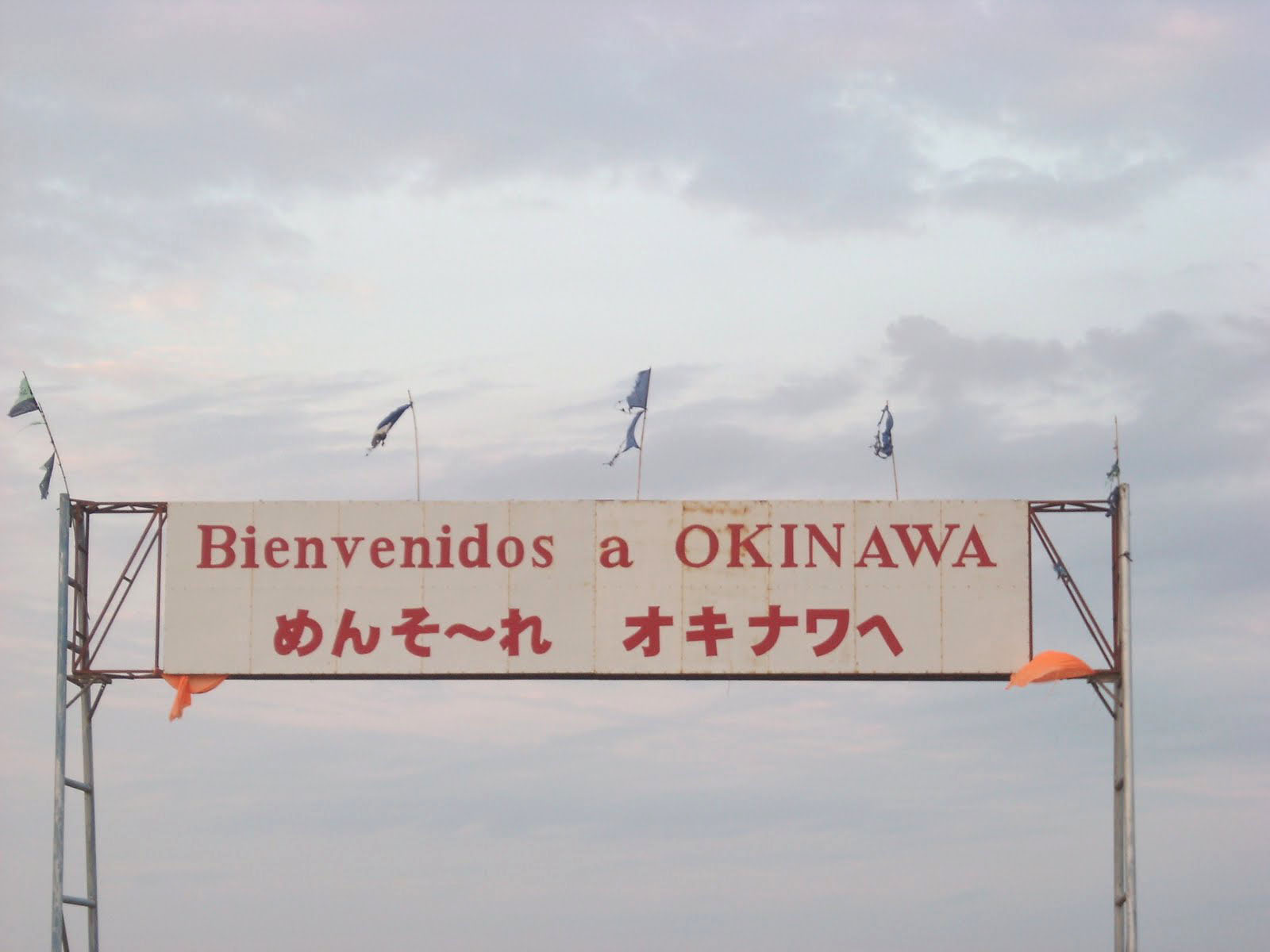
The Okinawan language has five vowels, all of which may be long or short, though the short vowels and are quite rare, as they occur only in a few native Okinawan words with heavy syllables with the pattern or , such as mensōrē "welcome" or tonfā. The close back vowels and are truly rounded, rather than the compressed vowels of standard Japanese.
Consonants
The Okinawan language counts some 20 distinctive segments shown in the chart below, with major allophones presented in parentheses.
| Labial | Alveolar | Alveolo- | |||||||||
|---|---|---|---|---|---|---|---|---|---|---|---|
| palatal | Palatal | Labio- | |||||||||
| velar | Velar | Uvular/ | |||||||||
| Glottal | Nasal | Plosive | Fricative | Flap | Approximant | ||||||
| () | () | ||||||||||
| () | () | () |
The only consonant that can occur as a syllable coda is the archiphoneme . Many analyses treat it as an additional phoneme , the moraic nasal, though it never contrasts with or .
The consonant system of the Okinawan language is fairly similar to that of standard Japanese, but it does present a few differences on the phonemic and allophonic level. Namely, Okinawan retains the labialized consonants and which were lost in Late Middle Japanese (though they are retained in a handful of Modern Japanese dialects), possesses a glottal stop , features a voiceless bilabial fricative distinct from the aspirate , and has two distinctive affricates which arose from a number of different sound processes. Additionally, Okinawan lacks the major allophones and found in Japanese, having historically fronted the vowel to after the alveolars , consequently merging tsu into chi, su into shi, and both dzu and zu into ji. It also lacks as a distinctive phoneme, having merged it into .
Bilabial and glottal fricatives
The bilabial fricative has sometimes been transcribed as the cluster , since, like Japanese, allophonically labializes into before the high vowel , and does not occur before the rounded vowel . This suggests that an overlap between and exists, and so the contrast in front of other vowels can be denoted through labialization. However, this analysis fails to take account of the fact that Okinawan has not fully undergone the diachronic change → → as in Japanese, and that the suggested clusterization and labialization into is unmotivated. Consequently, the existence of must be regarded as independent of , even though the two overlap. Barring a few words that resulted from the former change, the aspirate also arose from the odd lenition of and , as well as words loaned from other dialects. Before the glide and the high vowel , it is pronounced closer to , as in Japanese.
Palatalization
The plosive consonants and historically palatalized and affricated into before and occasionally following the glide and the high vowel : → chiri "fog", and → chura- "beautiful". This change preceded vowel raising, so that instances where arose from did not trigger palatalization: → kī "hair". Their voiced counterparts and underwent the same effect, becoming under such conditions: → nnaji "eel", and → nukujiri "saw"; but → kagin "seasoning".
Both and may or may not also allophonically affricate before the mid vowel , though this pronunciation is increasingly rare. Similarly, the fricative consonant palatalizes into before the glide and the vowel , including when historically derives from : → shikē "world". It may also palatalize before the vowel , especially so in the context of topicalization: dushi → dusē or dushē "(topic) friend".
In general, sequences containing the palatal consonant are relatively rare and tend to exhibit depalatalization. For example, tends to merge with ( myāku → nāku "Miyako"); has merged into and ( → rū ~ dū "dragon"); and has mostly become ( shui → sui "Shuri").
Flapping and fortition
The voiced plosive and the flap tend to merge, with the first becoming a flap in word-medial position, and the second sometimes becoming a plosive in word-initial position. For example, rū "dragon" may be strengthened into dū, and hashidu "door" conversely flaps into hashiru. The two sounds do, however, still remain distinct in a number of words and verbal constructions.
Glottal stop
Okinawan also features a distinctive glottal stop that historically arose from a process of glottalization of word-initial vowels. Hence, all vowels in Okinawan are predictably glottalized at the beginning of words ( → ami "rain"), save for a few exceptions. High vowel loss or assimilation following this process created a contrast with glottalized approximants and nasal consonants. Compare → wa "pig" to wa "I", or → nni "rice plant" to → nni "chest".
Moraic nasal{{anchor|Moraic nasal}}
The moraic nasal has been posited in most descriptions of Okinawan phonology. Like Japanese, (transcribed using the small capital ) occupies a full mora and its precise place of articulation will vary depending on the following consonant. Before other labial consonants, it will be pronounced closer to a syllabic bilabial nasal , as in nma "horse". Before velar and labiovelar consonants, it will be pronounced as a syllabic velar nasal , as in bingata, a method of dying clothes. And before alveolar and alveolo-palatal consonants, it becomes a syllabic alveolar nasal , as in kanda "vine". In some varieties, it instead becomes a syllabic uvular nasal . Elsewhere, its exact realization remains unspecified, and it may vary depending on the first sound of the next word or morpheme. In isolation and at the end of utterances, it is realized as a velar nasal .
Correspondences with Japanese
| Japanese | Okinawan | Notes |
|---|---|---|
| also occurs | ||
| also occurs | ||
| , also occurs | ||
| , also occurs | ||
| ; formerly distinguished as | ||
| also occurs | ||
| ; formerly distinguished as | ||
| and have merged | ||
| Moraic also occurs | ||
| ~ | also occurs, but rarely | |
| ~ | ||
| Moraic also occurs | ||
| is unaffected | ||
| Tends to become medially |
Orthography

The Okinawan language was historically written using an admixture of kanji and hiragana. The traditional script of Okinawa is called 古文書. Before the Satsuma Invasion in 1609, Man'yōgana was used like in Japanese. The hiragana syllabary is believed to have first been introduced from mainland Japan to the Ryukyu Kingdom some time during the reign of king Shunten in the early thirteenth century. It is likely that Okinawans were already in contact with hanzi (Chinese characters) due to extensive trade between the Ryukyu Kingdom and China, Japan and Korea. However, hiragana gained more widespread acceptance throughout the Ryukyu Islands, and most documents and letters were exclusively transcribed using this script, in contrast to in Japan where writing solely in hiragana was considered "women's script". The Omoro Sōshi (おもろさうし), a sixteenth-century compilation of songs and poetry, and a few preserved writs of appointments dating from the same century were written solely in Hiragana. Kanji were gradually adopted due to the growing influence of mainland Japan and to the linguistic affinity between the Okinawan and Japanese languages. However, it was mainly limited to affairs of high importance and to documents sent towards the mainland. The oldest inscription of Okinawan exemplifying its use along with Hiragana can be found on a stone stele at the Tamaudun mausoleum, dating back to 1501.
After the invasion of Okinawa by the Shimazu clan of Satsuma in 1609, Okinawan ceased to be used in official affairs. It was replaced by standard Japanese writing and a form of Classical Chinese writing known as kanbun. Despite this change, Okinawan still continued to prosper in local literature up until the nineteenth century. Following the Meiji Restoration, the Japanese government abolished the domain system and formally annexed the Ryukyu Islands to Japan as the Okinawa Prefecture in 1879. To promote national unity, the government then introduced standard education and opened Japanese-language schools based on the Tokyo dialect. Students were discouraged and chastised for speaking or even writing in the local "dialect", notably through the use of "dialect cards" (方言札). As a result, Okinawan gradually ceased to be written entirely until the American takeover in 1945.

Since then, Japanese and American scholars have variously transcribed the regional language using a number of ad hoc romanization schemes or the katakana syllabary to demarcate its foreign nature with standard Japanese. Proponents of Okinawan tend to be more traditionalist and continue to write the language using hiragana and kanji. In any case, no standard or consensus concerning spelling issues has ever been formalized, so discrepancies between modern literary works are common.
Tana family documents (田名家文書), which are letters of rank appointment issued by the Shuri Royal Government, are written in 候文(Japanese Epistolary style). However, after the Satsuma invasion, Japanese culture was banned as part of the policy of exoticizing Ryukyu, and under the policy of Haneji Ōji Chōshū, documents within Ryukyu also began to be written in classical Chinese.
Comparison of official documents of Tana family documents in 1523 and 1647.
| [[File:田名家文書.png | thumb | Tana family documents in 1523]] | [[File:田名家文書_康熙10年.png | thumb | Tana family documents in 1647]] |
|---|
Syllabary
Technically, they are not syllables, but rather morae. Each mora in Okinawan consists of one or two kana characters. If there are two, then the first kana is followed by a smaller version of the second kana. In each cell of the table below, the top row is the kana (hiragana to the left, katakana to the right of the dot), the middle row in rōmaji (Hepburn romanization), and the bottom row in IPA.
| long vowel | double consonant |
|---|---|
| 〜(あ、い、う、え、お)・ー | |
| ~(a, i, u, e, o) | |
| ~ | っ・ッ |
| (Any consonant) | |
|- ! h | は・ハ ha
| ひ・ヒ hi
| | へ・ヘ he
| ほ・ホ ho
| ひゃ・ヒャ hya
| | ひゅ・ヒュ hyu
| | ひょ・ヒョ hyo
|- ! f | ふぁ・ファ fa
| ふぃ・フィ fi
| ふ・フ fu/hu
| ふぇ・フェ fe
| ふぉ・フォ fo
| | | | | |- ! b | ば・バ ba
| び・ビ bi
| ぶ・ブ bu
| べ・ベ be
| ぼ・ボ bo
| | | | | |- ! p | ぱ・パ pa
| ぴ・ピ pi
| ぷ・プ pu
| ぺ・ペ pe
| ぽ・ポ po
| | | | | |- ! m | ま・マ ma
| み・ミ mi
| む・ム mu
| め・メ me
| も・モ mo
| みゃ・ミャ mya
| | みゅ・ミュ myu
| | みょ・ミョ myo
|- ! r | ら・ラ ra
| り・リ ri
| る・ル ru
| れ・レ re
| ろ・ロ ro
| りゃ・リャ rya
| | りゅ・リュ ryu
| | りょ・リョ ryo
|}
Grammar
Okinawan follows a subject–object–verb word order and makes large use of particles as in Japanese. Okinawan retains a number of Japonic grammatical features also found in Old Japanese but lost (or highly restricted) in Modern Japanese, such as a distinction between the terminal form (終止形) and the attributive form (連体形), the genitive function of が ga (lost in the Shuri dialect), the nominative function of ぬ nu (cf. Japanese: の no), as well as honorific/plain distribution of ga and nu in nominative use.
| 書ちゅん "to write" | Shuri | Classical Japanese | Irrealis | 未然形 | Continuative | 連用形 | Terminal | 終止形 | Attributive | 連体形 | Realis | 已然形 | Imperative | 命令形 |
|---|---|---|---|---|---|---|---|---|---|---|---|---|---|---|
| 書か | kaka- | 書か | kaka- | |||||||||||
| 書ち | kachi- | 書き | kaki- | |||||||||||
| 書ちゅん | kachun | 書く | kaku | |||||||||||
| 書ちゅる | kachuru | 書く | kaku | |||||||||||
| 書き | kaki- | 書け | kake- | |||||||||||
| 書き | kaki | 書け | kake |
One etymology given for the -un and -uru endings is the continuative form suffixed with uri ("to be; to exist", cf. Classical Japanese: 居り wori): -un developed from the terminal form uri; -uru developed from the attributive form uru, i.e.:
- kachuru derives from kachi-uru;
- kachun derives from kachi-uri; and
- yumun ("to read", cf. Japanese: 読む yomu) derives from yumi + uri.
A similar etymology is given for the terminal -san and attributive -saru endings for adjectives: the stem suffixed with さ sa (nominalises adjectives, i.e. high → height, hot → heat), suffixed with ari ("to be; to exist; to have", cf. Classical Japanese: 有り ari), i.e.:
- takasan ("high; tall", cf. Japanese: 高い takai) derives from taka-sa-ari;
- achisan ("hot; warm", cf. Japanese: 暑い atsui) derives from atsu-sa-ari; and
- yutasaru ("good; pleasant", cf. Japanese: 豊かな yutakana "abundant; plentiful") derives from yuta-sa-aru.
Parts of speech
| Nature of the part of speech in a sentence | Part of speech | Noun (名詞) | Pronoun (代名詞) | Adverb (副詞) | Prenominal adjective (連体詞) | Conjunction (接続詞) | Interjection / exclamation (感動詞) | Verb (動詞) | Adjective (形容詞) | Existential-identificative verb (存在動詞) | Adjectival verb (形容動詞) | Auxiliary Verb (助動詞) | Particle (助詞) | Prefix (接頭語) | Suffix (接尾語) |
|---|---|---|---|---|---|---|---|---|---|---|---|---|---|---|---|
| Independent | No conjugation | Can become a subject | |||||||||||||
| Cannot become a subject | Other words come after | Modifies | Modifies a declinable word | ||||||||||||
| Modifies a substantive | |||||||||||||||
| Connects | |||||||||||||||
| Other words may not come after | |||||||||||||||
| Conjugates | Declinable word | Shows movements | Conclusive form ends in "ん" | ||||||||||||
| Shows the property or state | Conclusive form ends in "さん" | ||||||||||||||
| Shows existence or decision of a certain thing | "やん" attaches to a substantive such as a noun | ||||||||||||||
| Shows state of existence of events | "やん" attaches to the word that shows state | ||||||||||||||
| Dependent | Conjugates | Makes up for the meanings of conjugated words | Conclusive form ends in "ん" | ||||||||||||
| No conjugation | Attaches to other words and shows the relationship between words | ||||||||||||||
| Attaches to the head of a word and adds meaning or makes a new word | |||||||||||||||
| Attaches to the end of a word and adds meaning or makes a new word |
N
Nouns (名詞)
Nouns are classified as independent, non-conjugating part of speech that can become a subject of a sentence
ProN
Pronouns (代名詞)
Pronouns are classified the same as nouns, except that pronouns are more broad.
| Singular | Plural | Personal | colspan=3 | Demonstrative | rowspan=2 | Personal | colspan=3 | Demonstrative | Thing | Place | Direction | Thing | Place | Direction | 1st person | 2nd person | 3rd person | Proximal | Medial | Distal | Indefinite |
|---|
Adv
Adverbs (副詞)
Adverbs are classified as an independent, non-conjugating part of speech that cannot become a subject of a sentence and modifies a declinable word (用言; verbs, adverbs, adjectives) that comes after the adverb. There are two main categories to adverbs and several subcategories within each category, as shown in the table below.
| Adverbs showing state or condition | Okinawan | Japanese | English | Example | va=middle | Time}} | va=middle | Quantity}} | va=middle | Degree}} | va=middle | Situation}} | Adverbs showing judgement | Okinawan | Japanese | English | Example | va=middle | Assumption}} | va=middle | Supposition}} | va=middle | Wish}} | va=middle | Doubt}} | va=middle | Denial or negation}} | va=middle | Decision}} | va=middle | Others}} |
|---|---|---|---|---|---|---|---|---|---|---|---|---|---|---|---|---|---|---|---|---|---|---|---|---|---|---|---|---|---|---|---|
| ひっちー | {{Plainlist | Always | |||||||||||||||||||||||||||||
| まーるけーてぃ | たまに | Occasionally | |||||||||||||||||||||||||||||
| ちゃーき | 直ぐ | Already | |||||||||||||||||||||||||||||
| やがてぃ | やがて | Shortly | |||||||||||||||||||||||||||||
| 未だ | まだ | Yet | |||||||||||||||||||||||||||||
| ちゃー | いつも | Always | |||||||||||||||||||||||||||||
| ちゅてーや | {{Plainlist | A little | |||||||||||||||||||||||||||||
| あっとぅむす | 急に | Suddenly | |||||||||||||||||||||||||||||
| まるひーじーや | 普段は | Normally | |||||||||||||||||||||||||||||
| いっとぅちゃー | しばらくは | A little while | |||||||||||||||||||||||||||||
| いふぃ | 少し | A little | |||||||||||||||||||||||||||||
| ちゃっさきー | 沢山 | Many, a lot of | |||||||||||||||||||||||||||||
| はてぃるか | 随分 | A lot | |||||||||||||||||||||||||||||
| ぐゎさない | わんさか | Abundant | |||||||||||||||||||||||||||||
| {{Plainlist | 一杯 | A lot | |||||||||||||||||||||||||||||
| ゆっかりうっさ | 随分 | A lot | |||||||||||||||||||||||||||||
| うすまさ | 恐ろしく | Extremely, a lot of | |||||||||||||||||||||||||||||
| まんたきー | 一杯 | Full, a lot | |||||||||||||||||||||||||||||
| なーふぃん | もっと | More | |||||||||||||||||||||||||||||
| 軽ってんぐゎ | 少しだけ | A little | |||||||||||||||||||||||||||||
| でーじな | 大変 | Very | |||||||||||||||||||||||||||||
| じまま | 随分 | Fairly, quite | |||||||||||||||||||||||||||||
| よねー | そんなには | Not too much | |||||||||||||||||||||||||||||
| いーるく | 良く | Often | |||||||||||||||||||||||||||||
| にりるか | うんざりするほど | To a sickening degree | |||||||||||||||||||||||||||||
| わじるか | 怒るほど | To the extent someone gets irritated | |||||||||||||||||||||||||||||
| あいゆか | とても | Very | |||||||||||||||||||||||||||||
| ゆくん | 余計 | Even more | |||||||||||||||||||||||||||||
| たった | 余計 | Even more | |||||||||||||||||||||||||||||
| ちゅふぁーら | 一杯 | Full, enough | |||||||||||||||||||||||||||||
| あんすかー | それほどは | Not so... | |||||||||||||||||||||||||||||
| 散ん散んとぅ | 散り散りに | Dispersed, scattered | |||||||||||||||||||||||||||||
| 早く | 早く | Quickly | |||||||||||||||||||||||||||||
| ようんなー | ゆっくり | Slowly | |||||||||||||||||||||||||||||
| なんくる | 自ずと | Naturally | |||||||||||||||||||||||||||||
| ゆったいくゎったい | どんぶらこと | Adverb for something heavy floating down on water | |||||||||||||||||||||||||||||
| なぐりなぐりとぅ | なごりなごりと | Reluctantly, Nostalgically | |||||||||||||||||||||||||||||
| しんじんとぅ | しみじみと | Nostalgically | |||||||||||||||||||||||||||||
| 次第次第 | 次第に | Gradually | |||||||||||||||||||||||||||||
| ちゅらーさ | 残らず | Completely | |||||||||||||||||||||||||||||
| どぅく | あまりにも | Too much, excessively | |||||||||||||||||||||||||||||
| だんだんだんだん | 段々 | Gradually | |||||||||||||||||||||||||||||
| 次第に | 次第に | Gradually | |||||||||||||||||||||||||||||
| どぅくだら | ひどく | Badly | |||||||||||||||||||||||||||||
| まっすぐ | まっすぐ | Straight | |||||||||||||||||||||||||||||
| まっとうば | 正しく | Correctly | |||||||||||||||||||||||||||||
| だってぃどぅ | ちゃんと | Properly | |||||||||||||||||||||||||||||
| だてん | きちんと | Neatly | |||||||||||||||||||||||||||||
| さっぱっとぅ | さっぱり | Freshly | |||||||||||||||||||||||||||||
| しかっとぅ | しっかり | Carefully | |||||||||||||||||||||||||||||
| うかっとぅお | うかつには | Thoughtlessly, carelessly | |||||||||||||||||||||||||||||
| たった | 余計 | Even more | |||||||||||||||||||||||||||||
| むし | もし | If | |||||||||||||||||||||||||||||
| たとぅい | 例え | Even if | |||||||||||||||||||||||||||||
| 例れー | 例えば | For example, if you compare | |||||||||||||||||||||||||||||
| いやりん | きっと(いかにも) | Indeed, surely | |||||||||||||||||||||||||||||
| まさか | まさか | No way, no idea, unlikely, it is impossible that... | |||||||||||||||||||||||||||||
| むしや | もしや | By chance | |||||||||||||||||||||||||||||
| むしか | もしや | Perhaps | |||||||||||||||||||||||||||||
| まさか | まさか | No way, no idea, unlikely, it is impossible that... | |||||||||||||||||||||||||||||
| あたまに | ほんとに | Really (intensifier) | |||||||||||||||||||||||||||||
| どうでぃん | どうか | Please | |||||||||||||||||||||||||||||
| たんでぃ | どうぞ | Please | |||||||||||||||||||||||||||||
| 必じ | 必ず | Always, have to | |||||||||||||||||||||||||||||
| 如何しん | どうしても | Have to, at any cost | |||||||||||||||||||||||||||||
| 如何し | どうやって | How | |||||||||||||||||||||||||||||
| みったい | 一体 | Really | |||||||||||||||||||||||||||||
| あんすか | そんなに | So much, really | |||||||||||||||||||||||||||||
| 何んち | 何故 | Why | |||||||||||||||||||||||||||||
| あちらん | 一向に | Completely, at all | |||||||||||||||||||||||||||||
| じょーい | 絶対 | Definitely | |||||||||||||||||||||||||||||
| ちゃっさん | 度を超して | Go too far | |||||||||||||||||||||||||||||
| いふぃん | 少しも | At all | |||||||||||||||||||||||||||||
| 如何ん | どうすることも | Cannot do anything | |||||||||||||||||||||||||||||
| じゅんに | 本当に | Really, truly | |||||||||||||||||||||||||||||
| 必じ | 必ず | Definitely | |||||||||||||||||||||||||||||
| うん如おりー | そのような事 | Such a thing | |||||||||||||||||||||||||||||
| いちゃんだん | むやみに | Recklessly | |||||||||||||||||||||||||||||
| うったてぃ | わざと | On purpose | |||||||||||||||||||||||||||||
| なー | もう | Already |
PreA
Prenominal adjectives (連体詞)
| Okinawan | Japanese | English |
|---|---|---|
| good |
Conj
Conjunctions (接続詞)
| Okinawan | Japanese | English | |
|---|---|---|---|
| "For that reason" | |||
| {{Plainlist | "And then" | ||
| "So" | |||
| {{Plainlist | "But" |
Inter
Interjections and exclamations (感動詞)
| Okinawan | Japanese | English | Notes | |
|---|---|---|---|---|
| あい | おや | Oh / wow | 驚きの気持ちを表す | |
| あきさみよー | あらまあ | Oh dear | Expression of dismay, concern, or worry | |
| あきとーなー | おやまあ | Oh dear | 失敗した時や驚いた時などに発する | |
| うー | はい | Yes | Honorific "yes" | |
| {{Plainlist | いいえ | No | 目上の人に対して用いる | |
| だー | {{Plainlist | Hey | ||
| とー | {{Plainlist | All right | Expression of pleasure, joy, or permission | |
| とーとー | {{Plainlist | |||
| はっさみよー | おやまあ | Oh dear | 呆れ返った時などに発する語 | |
| んちゃ | {{Plainlist | Sure enough, As I expected |
V
Verbs (動詞)
Verbs are classified as an independent, conjugating part of speech that shows movements. The conclusive form ends in ん.
Adj
Adjectives (形容詞)
Adjectives are classified as an independent, conjugating part of speech that shows property or state. The conclusive form ends in さん.
(存在動詞)
存在動詞 are classified as an independent, conjugating part of speech that shows existence or decision of a certain thing. やん attaches to a substantive.
AdjV
Adjectival verbs (形容動詞)
Adjectival verbs are classified as an independent, conjugating part of speech that shows the state of existence of events. やん attaches to words that shows state.
AuxV
Auxiliary verbs (助動詞)
| Okinawan | Japanese | English | Example | ||
|---|---|---|---|---|---|
| {{Plainlist | |||||
| {{Plainlist | |||||
| want to | |||||
| be able to | |||||
| {{Plainlist | {{Plainlist |
Part
Particles (助詞)
| Case markers (格助詞) | Okinawan | Japanese | Notes/English | Example | Adverbial Particles (副助詞) | Okinawan | Japanese | Notes/English | Example | Binding particles (係助詞) | Okinawan | Japanese | Notes/English | Example | Sentence-ending particles (終助詞) | Okinawan | Japanese | Notes/English | Example | Interjectory Particles (間投助詞) | Okinawan | Japanese | Notes/English | Example | Conjunctive particles (接続助詞) | ||
|---|---|---|---|---|---|---|---|---|---|---|---|---|---|---|---|---|---|---|---|---|---|---|---|---|---|---|---|
| Attaches to a substantive and marks the relationship between other words. | |||||||||||||||||||||||||||
| {{Plainlist | が | Nominative case. | |||||||||||||||||||||||||
| Normally ぬ, but が is used for pronouns and names. | |||||||||||||||||||||||||||
| ぬ | の | Genitive case; possessor. | |||||||||||||||||||||||||
| Ø (Archaic: ) | を | Accusative case. | |||||||||||||||||||||||||
| Modern Okinawan does not use a direct object particle, like casual Japanese speech. "yu" exists mainly in old literary composition. | |||||||||||||||||||||||||||
| っし | で | Instrumental case; the means by which something is achieved. | |||||||||||||||||||||||||
| さーに | |||||||||||||||||||||||||||
| なかい・んかい | へ・ | Dative case; indirect object, benefactor, goal of motion. 手段・方法 | |||||||||||||||||||||||||
| をぅとーてぃ・をぅてぃ | }}-- | Locative case; marks the location where an action takes place, usually pertaining to an animate subject. Derives from the participle form of the verb をぅん wun "to be, to exist". | |||||||||||||||||||||||||
| やか | より | "as much as"; upper limit | |||||||||||||||||||||||||
| から | から | Ablative case; source, cause. 起点 | |||||||||||||||||||||||||
| なーりー | }}-- | 場所・位置 | |||||||||||||||||||||||||
| んじ | で | 場所 | |||||||||||||||||||||||||
| ん | }}-- | 所属等 | |||||||||||||||||||||||||
| ぬ→「〜している」「〜である」「〜い・しい」pp459. | |||||||||||||||||||||||||||
| とぅ | と | 相手 | |||||||||||||||||||||||||
| んでぃ | と | Quotative. | |||||||||||||||||||||||||
| に | 時・場所等 | ||||||||||||||||||||||||||
| びけー | だけ | ||||||||||||||||||||||||||
| びけーん | ばかり | "only; limit" | |||||||||||||||||||||||||
| だき | だけ | ||||||||||||||||||||||||||
| までぃ | まで | "up to, until, as far as" | |||||||||||||||||||||||||
| くれー | ぐらい | "around, about, approximately" | |||||||||||||||||||||||||
| ふどぅ | ほど | ||||||||||||||||||||||||||
| あたい | ぐらい等 | as much as; upper limit. | |||||||||||||||||||||||||
| んちょーん | さえ | ||||||||||||||||||||||||||
| うっさ | だけ等 | ||||||||||||||||||||||||||
| うっぴ | だけ等 | ||||||||||||||||||||||||||
| うひ | だけ等 | ||||||||||||||||||||||||||
| さく | ほど、だけ | ||||||||||||||||||||||||||
| や | は | Topic particle for long vowels, proper nouns, or names. | |||||||||||||||||||||||||
| あー | |||||||||||||||||||||||||||
| えー | |||||||||||||||||||||||||||
| おー | |||||||||||||||||||||||||||
| のー | |||||||||||||||||||||||||||
| ん | も | "Also" | |||||||||||||||||||||||||
| やてぃん | でも | "even, also in" | |||||||||||||||||||||||||
| がん | でも | ||||||||||||||||||||||||||
| ぬん | でも | ||||||||||||||||||||||||||
| しか | しか | ||||||||||||||||||||||||||
| てぃらむん | たるもの | ||||||||||||||||||||||||||
| とぅか | {{Plainlist | ||||||||||||||||||||||||||
| どぅ | {{Plainlist | ||||||||||||||||||||||||||
| る | {{Plainlist | ||||||||||||||||||||||||||
| が | か | Final interrogatory particle | |||||||||||||||||||||||||
| み | か | Final interrogatory particle | |||||||||||||||||||||||||
| に | }}-- | 可否疑問 | |||||||||||||||||||||||||
| い | }}-- | 強調疑問 | |||||||||||||||||||||||||
| がやー | かな | ||||||||||||||||||||||||||
| さに | だろう | ||||||||||||||||||||||||||
| なー | の | Final particle expressing 問いかけ・念押し | |||||||||||||||||||||||||
| ばー | }}-- | 軽い疑問 | |||||||||||||||||||||||||
| どー | {{Plainlist | ||||||||||||||||||||||||||
| よ | よ | ||||||||||||||||||||||||||
| ふー | }}-- | 軽く言う | |||||||||||||||||||||||||
| な | な | Prohibitive | |||||||||||||||||||||||||
| え | }}-- | 命令 | |||||||||||||||||||||||||
| さ | さ | ||||||||||||||||||||||||||
| でむね | }}-- | 断定 | |||||||||||||||||||||||||
| せー | }}-- | 断定 | |||||||||||||||||||||||||
| てー | ね等 | ||||||||||||||||||||||||||
| {{Plainlist | {{Plainlist | ||||||||||||||||||||||||||
| {{Plainlist | {{Plainlist | ||||||||||||||||||||||||||
| なー | ね等 | ||||||||||||||||||||||||||
| さり | ねえ等 | ||||||||||||||||||||||||||
| ひゃー | }}-- | 意外、軽蔑 |
Pre
Prefixes (接頭語)
Suf
Suffixes (接尾語)
Others
Copula
| Okinawan | Past tense | Japanese | |
|---|---|---|---|
| {{Plainlist |
Question words (疑問詞)
| Okinawan | Japanese | English | |
|---|---|---|---|
| "How much" | |||
| "When" | |||
| "Which" | |||
| "Who" | |||
| "Who" (plural) | |||
| "How" (in what way) | |||
| {{Plainlist | "How much" | ||
| {{Plainlist | "How" | ||
| {{Plainlist | "What kind" | ||
| "What" | |||
| "Why" | |||
| "Where" |
Syntax
The basic word order is subject–object–verb.
Okinawan is a marked nominative language (with the accusative being unmarked) that also shows minor active–stative variation in intransitive verbs relating to existence or emergence. In existence or emergence verbs, the subject may be optionally unmarked (except for pronouns and proper names, which must be marked with ga), and marked human subjects cannot use ga anymore, but rather always with the often-inanimate marker nu.
Example
Sample text in Standard Okinawan (Shuri-Naha dialect)
In Kanji
人間ー誰ん生まりやぎーなー自由やい、また、胴大切に思ゆる肝とぅ胴守らんでぃる肝ー、誰やてぃんゆぬ如授かとーるむんやん。人間ー元からいー矩ぬ備わとーくとぅ、互ーに兄弟やんでぃる考ーさーに事に当たらんだれーならん。(without ruby characters)
ーんまりやぎーなーやい、また、にゆるとぅらんでぃるー、やてぃんゆぬかとーるむんやん。ーからいーぬわとーくとぅ、ーにやんでぃるーさーににたらんだれーならん。(with ruby characters)
Transliteration
Ninjinoo taa n 'nmariyagiinaa jiyu yai, mata, duu teeshichi ni umuyuru chimu tu duu mamurandiru chimoo, taa yatin yunugutu sajakatooru mun yan. Ninjinoo muutu kara iika ni nu sunawatookutu, tagee ni choodeeyandiru kangeesaa ni kutu ni atarandaree naran. (UDHR Article 1)
Notes
References
- {{citation |editor-last = Lewis |editor-first = M. Paul |orig-date = first published 1951 by SIL
References
- {{e27
- '''45-CAC-ai''' comprises most of Central Okinawa, including [[Shuri, Okinawa. Shuri]] ([[Naha, Okinawa. Naha]]), [[Ginowan, Okinawa. Ginowan]] and [[Nishihara, Okinawa. Nishihara]]; '''45-CAC-aj''' comprises the southern tip of Okinawa Island, including [[Itoman, Okinawa. Itoman]], Mabuni and Takamine; '''45-CAC-ak''' encompasses the region west of Okinawa Island, including the [[Kerama Islands]], [[Kumejima, Okinawa. Kumejima]] and [[Aguni, Okinawa. Aguni]]
- Hung, Eva and Judy Wakabayashi. ''Asian Translation Traditions''. 2014. Routledge. Pg 18.
- Heinrich, P. (2004). "Language Planning and Language Ideology in the Ryūkyū Islands". ''Language Policy'', 3(2)
- (19 May 2012). "Okinawans push to preserve unique language". The Japan Times Online.
- (4 February 2018). "A little corner of Brazil that is forever Okinawa". BBC News.
- "Okinawan Princess: Da Legend of Hajichi Tattoos".
- Heinrich, P., Miyara, S., & Shimoji, M. (Eds.). (2015). ''Handbook of the Ryukyuan Languages''. Walter de Gruyter GmbH & Co KG. Pp 598.
- Heinrich, Patrick. ''The Making of Monolingual Japan''. 2012. Pp 85–87.
- (29 November 2014). "In Okinawa, saving the local languages is about more than words — it's about identity, too". Washington Post.
- Nakasone, Seizen. ''Festschrift''. 1962. Pp. 619.
- Shibatani, Mayoshi (2008): The Languages of Japan. Cambridge University Press. {{ISBN. 978-0521369183. p. 194.
- "Central Okinawan".
- UNESCO. (2009). "Interactive atlas of the world's languages in danger".
- Heinrich, Patrick. (2005). "Language loss and revitalization in the Ryukyu Islands". The Asia-Pacific Journal: Japan Focus.
- Shuhei, Miyairi. (2024). "Linguistic Comparison in Vocabulary for Japanese to Understand Okinawan".
- 沖縄語辞典 (''Okinawan dictionary''). "前書き" (Preface). 国立国語研究所 1998.
- 高良, 倉吉. (1992). "琉球王国史の基礎的研究". 九州大学.
- "国指定重要文化財 (昭48.6.6) - だ - 田名家文書 - 沖縄県".
- Shimoji, Michinori. (2018). "The Cambridge Handbook of Japanese Linguistics". Cambridge University Press.
This article was imported from Wikipedia and is available under the Creative Commons Attribution-ShareAlike 4.0 License. Content has been adapted to SurfDoc format. Original contributors can be found on the article history page.
Ask Mako anything about Okinawan language — get instant answers, deeper analysis, and related topics.
Research with MakoFree with your Surf account
Create a free account to save articles, ask Mako questions, and organize your research.
Sign up freeThis content may have been generated or modified by AI. CloudSurf Software LLC is not responsible for the accuracy, completeness, or reliability of AI-generated content. Always verify important information from primary sources.
Report