From Surf Wiki (app.surf) — the open knowledge base
Oil campaign of World War II
Allied aerial bombing campaign (1940–45)
Allied aerial bombing campaign (1940–45)
| Field | Value | ||
|---|---|---|---|
| conflict | Oil campaign | ||
| partof | the strategic bombing during World War II | ||
| image | File:The Sandman a B-24 Liberator, piloted by Robert Sternfels.jpg | ||
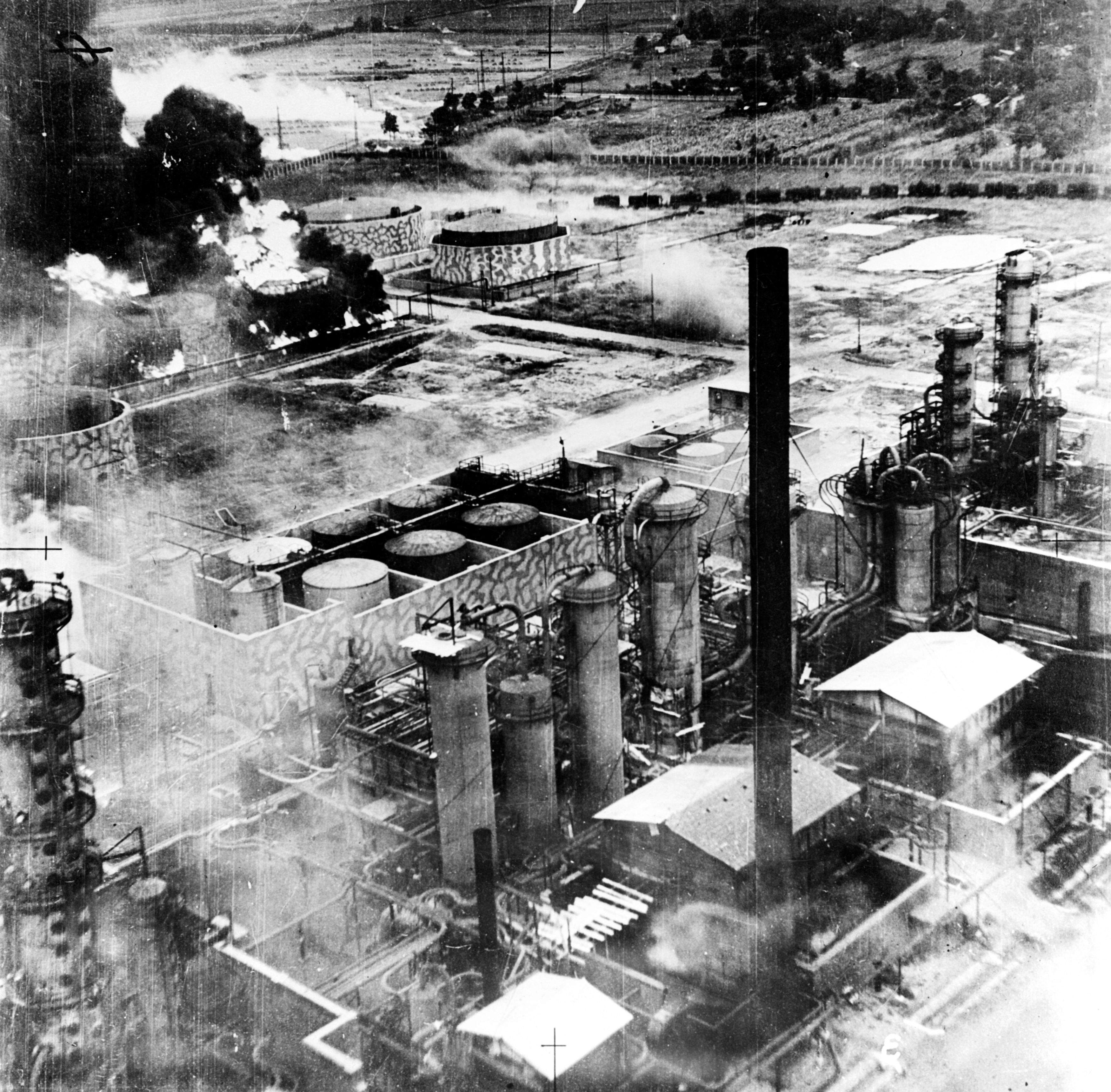
| caption | The Sandman, a B-24 Liberator, emerges from smoke over the Astra Română refinery, Ploiești, during Operation Tidal Wave (1 August 1943) | ||
| date | 15 May 1940 – 26 April 1945 | ||
| place | European theatre of World War II | ||
| result | Allied victory | ||
| combatant1 | |||
| combatant2 | {{unbulleted list | Nazi Germany | Kingdom of Romania |
| (until 1944)</small>}} {{flagcountry | Kingdom of Hungary (1920–46) | name | Kingdom of Hungary}} |
| commander1 | |||
| commander2 | Carl Krauch | ||
| Ion Antonescu | |||
| Paul Pleiger | |||
| strength1 | USA 8th Air Force | ||
| USA 15th Air Force | |||
| UK RAF Bomber Command | |||
| strength2 | See Defence of the Reich | ||
| casualties1 | US: 5,400 aircraft lost |
(until 1944)}} Kingdom of Hungary (1920–46)
- UK Richard Peirse (1940 – 1941 (Dec))
- USA Carl Spaatz (1942 (May) – 1945)
- UK Arthur Harris (1942 (Feb) – 1945) Ion Antonescu Paul Pleiger USA 15th Air Force UK RAF Bomber Command The Allied oil campaign of World War II was an aerial bombing campaign conducted by the RAF and the USAAF against facilities supplying Nazi Germany with petroleum, oil, and lubrication (POL) products. It formed part of the immense Allied strategic bombing effort during the war. The targets in Germany and in Axis-controlled Europe included refineries, synthetic-fuel factories, storage depots and other POL-infrastructure.
Before the war, Britain had identified Germany's reliance on oil and oil products for its war machine, and the strategic bombing started with RAF attacks on Germany in 1940. After the US entered the war (December 1941), it carried out daytime "precision bombing" attacks – such as Operation Tidal Wave against refineries in Romania in 1943.{{cite video | access-date = 21 February 2012
During the war the effort expended against POL targets varied, with relative priority moving between the other objectives within the Allied Combined Bomber Offensive such as to defeating the German V-weapon attacks, the destruction of the German air force, or to attacking transport links in preparation for the invasion of western Europe in 1944.
Campaign strategy
The British had identified the importance of Germany's fuel supplies before the war in their "Western Air Plan 5(c)". The focus of British bombing during 1940 changed repeatedly in response to directives from the Air Ministry. At the start of June, oil targets were made a priority of night bombing with attacks on other war industry to be made on dark nights (when the oil targets could not be located) but with the proviso that "indiscriminate action" should be avoided. On 20 June oil targets were made third priority below the German aircraft industry and lines of communication between Germany and the armies at the front. Following a brief period when German shipping was given priority, oil targets were made secondary priority in mid July under a policy of concentrated attack with five oil refineries listed for attention. Sir Charles Portal was sceptical of the likelihood of success, saying that only a few targets could be located by average crews under moonlit conditions.
The RAF viewed Axis oil as a "vital centre", and in February 1941, the British Air Staff expected that RAF Bomber Command would, by destruction of half of a list of 17 targets, reduce Axis oil production capacity by 80%.{{cite web |access-date=2009-03-22 |url-status=dead |archive-url=http://webarchive.nationalarchives.gov.uk/20070706011932/http://www.raf.mod.uk/bombercommand/jul44.html |archive-date=6 July 2007 January–April 1941 , May–August 1941
Ploiești oilfield
Although the Butt Report of August 1941 identified the poor accuracy and performance of RAF bombing at the time, The first US bombing of a European target was of the Ploiești refineries in Romania on 12 June 1942 and the oil campaign continued at a lower priority until 1944. Priority fell with the need for attacks on German V-weapon targets ("Operation Crossbow") in France and then the attacks on lines of communication in preparation for the invasion of France (described as the "Transportation Plan").
In March 1944 the "Plan for Completion of Combined Bomber Offensive" was put forward which found favour with the British Ministry of Economic Warfare. The plan proposed attacking "fourteen synthetic plants of [Brabag ] and thirteen refineries" of Nazi Germany. The plan estimated Axis oil production could be reduced by 50% by bombing—33% below the amount Nazi Germany needed—but also included 4 additional priorities: first oil, then fighter and ball bearing production, rubber production, and bomber output. The damage caused by the 12 and 28 May trial bombings of oil targets, as well as the confirmation of the oil facilities' importance and vulnerability from Ultra intercepts and other intelligence reports, would result in the oil targets becoming the highest priority on 3 September 1944.
In June 1944, in response to Air Ministry query on resources, Bomber Command staff estimated it would take 32,000 tons of bombs to destroy 10 oil targets in the Ruhr. Air Chief Marshal Arthur Harris agreed to divert spare effort to oil targets. They were deemed to be of such importance that one raid was staged that consisted only of bomb carrying fighters, to rest the bomber crews and surprise the defenders.
In late summer 1944 the Allies began using reconnaissance photo information to time bombing with the resumption of production at a facility. Even with the weather limitations: "This was the big breakthrough ... a plant would be wounded ... by successive attacks on its electrical grid—its nervous system—and on its gas and water mains." (author Donald Miller). However, due to bad fall and winter weather, a "far greater tonnage" was expended on Transportation Plan targets than oil targets. The benzol (oil) plant at Linz in Austria was bombed on 16 October 1944.
In January 1945, the priority of oil targets was lowered.
To prevent oil supplies from Romania reaching Germany, the RAF had extended its aerial mining activities to the Danube.
Post-war
Despite the RAF and Harris claims regarding the great importance of oil targets, Harris had opposed assigning the highest priority to oil targets but acknowledged post-war that the campaign was "a complete success" with the qualifier: "I still do not think that it was reasonable, at that time, to expect that the [oil] campaign would succeed; what the Allied strategists did was to bet on an outsider, and it happened to win the race."
Joint Chiefs of Staff Directive 1067 prohibited German post-war production of oil through July 1947, and the United States Army made post-war provisions to rehabilitate and use petroleum installations where needed, as well as to dispose of unneeded captured equipment. After inspections of various plants by the "European technology mission" (Plan for Examination of Oil Industry of Axis Europe) and a report in March 1946, the United States Bureau of Mines employed seven Operation Paperclip synthetic fuel scientists in a Fischer–Tropsch chemical plant in Louisiana, Missouri. In October 1975, Texas A&M University began the German Document Retrieval Project and completed a report on 28 April 1977. The report identified final investigations of the German plants and interrogations of German scientists by the British Intelligence Objectives Sub-Committee, the US Field Information Agency (Technical), and the Combined Intelligence Objectives Sub-Committee.
Opinions on outcome
Despite its successes, by the spring of 1944 the Combined Bomber Offensive had failed to dislocate the German economy or inflict severe disruptions in the production of vital items; the oil campaign missions were the first targeted attacks to accomplish these goals. The US strategic bombing survey (USSBS) identified "catastrophic" damage. German industry in and of itself was not significantly affected by attacks on oil targets, as coal was its primary source of energy, but in its analysis of strategic bombing as a whole the USSBS identified the consequences of the breakdown of transportation resulting from attacks against transportation targets as "probably greater than any other single factor" in the final collapse of the German economy.
Several prominent German military officers, however, described the oil campaign as critical to the defeat of Nazi Germany. Adolf Galland, wrote in his book "the most important of the combined factors which brought about the collapse of Germany", and the Luftwaffe's wartime leader, Hermann Göring, described it as "the utmost in deadliness". Albert Speer, writing in his memoir, said that "It meant the end of German armaments production." It has been stated to have been "effective immediately, and decisive within less than a year". Luftwaffe Field Marshal Erhard Milch, referring to the consequences of the oil campaign, claimed that "The British left us with deep and bleeding wounds, but the Americans stabbed us in the heart."
Statistics
The following statistics are from the British Bombing Survey Unit. Figures are for the oil campaign in the last year of the war.
Number of attacks by the RAF and USAAF against oil targets:
| Month | USAAF | ||
|---|---|---|---|
| Eighth Air Force | USAAF | ||
| Fifteenth Air Force | RAF | ||
| Bomber Command | |||
| May 1944 | 11 | 10 | 0 |
| June 1944 | 20 | 32 | 10 |
| July 1944 | 9 | 36 | 20 |
| August 1944 | 33 | 23 | 20 |
| September 1944 | 23 | 8 | 14 |
| October 1944 | 18 | 10 | 10 |
| November 1944 | 32 | 19 | 22 |
| December 1944 | 7 | 33 | 15 |
| January 1945 | 17 | 5 | 23 |
| February 1945 | 20 | 20 | 24 |
| March 1945 | 36 | 24 | 33 |
| April 1945 | 7 | 1 | 9 |
| Total | 233 | 221 | 200 |
Short tons dropped on oil targets:
| Month | USAAF | ||
|---|---|---|---|
| Eighth Air Force | USAAF | ||
| Fifteenth Air Force | RAF | ||
| Bomber Command | |||
| May 1944 | 2,883 | 1,540 | 0 |
| June 1944 | 3,689 | 5,653 | 4,562 |
| July 1944 | 5,379 | 9,313 | 3,829 |
| August 1944 | 7,116 | 3,997 | 1,856 |
| September 1944 | 7,495 | 1,829 | 4,488 |
| October 1944 | 4,462 | 2,515 | 4,088 |
| November 1944 | 15,884 | 4,168 | 16,029 |
| December 1944 | 2,937 | 6,226 | 5,772 |
| January 1945 | 3,537 | 2,023 | 10,114 |
| February 1945 | 1,616 | 4,362 | 15,749 |
| March 1945 | 9,550 | 6,628 | 21,211 |
| April 1945 | 1,949 | 124 | 5,993 |
| Total | 66,497 | 48,378 | 93,691 |
The efficiency of the bombing was lacking. Working from German records for certain sites, the USSBS determined that on average 87% of Allied bombs fell outside the factory perimeter and that only a few percent struck plant or equipment inside the boundary. The USAAF could put 26% of their bombing within the factories in good bombing conditions, 12% when using a mix of visual and instruments but only 5% when it had to use instrument-only bombing techniques; and 80% of their tonnage was delivered under partly or fully instrument conditions. The RAF bombing by night with Pathfinder techniques averaged 16% inside the factory.
Bomber Command's efforts against oil were more efficient in some regards – although delivering a smaller total tonnage than the USAAF 8th and 15th Air Forces together, it delivered more tonnage in fewer attacks than the 8th AF which was also operating from bases in eastern England. The USSBS believed that Bomber Command's heavy bombs4000 lb Blockbuster bombswere more effective than an equivalent weight of smaller bombs. Both RAF and USAAF dropped a large number of bombs on oil targets that failed to explode: 19% and 12% respectively.
Notes
References
Bibliography
References
- Duga, James. (2002-04-09). "Ploesti". Brassey's.
- Stout, Jay A. (November 2003). "Fortress Ploiesti: The Campaign to Destroy Hitler's Oil Supply".
- Cox, Sebastian. (1998-03-31). "The Strategic Air War Against Germany, 1939–1945". Psychology Press.
- Western Axis Subcommittee. (c. 1943). "Estimated Refinery Output in Axis Europe – 1943". Enemy Oil Committee.
- Hastings, 2013
- Tedder, Arthur. (1966). "With Prejudice". Little, Brown & Company.
- US Secretary. (January 1943). "Casablanca Conference: Papers and Minutes of Meetings". Office of the Combined Chiefs of Staff.
- Williamson, Charles C.. (5 March 1944). "Plan for Completion of Combined Bomber Offensive". HQ, U.S.S.T.A.F.
- Spaatz, Carl. (5 March 1944). "[memo to Eisenhower for the] Plan for Completion of Combined Bomber Offensive". Office of the Commanding General, HQ U.S.S.T.A.F.
- Turner, Mark. (6 March 1944). "letter ("Dear General Curtis")". [[Ministry of Economic Warfare]].
- Turner, Smith D.. (6 March 1944). "letter ("Dear General Curtis")". [[United States Foreign Service.
- Eisenhower, David. (1991). "Eisenhower: At War 1943–1945". Wings Books.
- D'Olier, Franklin. (30 September 1945). "The Attack on Oil". [[Air University (United States Air Force).
- (1996). "Piercing the Fog: Intelligence and Army Air Forces Operations in World War II". Air Force Historical Studies Office.
- Miller 2006
- Mets, David R.. (1988). "Master of Airpower: General Carl A. Spaatz". Random House Publishing.
- Mitcham, Samuel W.. (2007). "Eagles of the Third Reich". Stackpole.
- Thompson, H.L.. (1956). "NEW ZEALANDERS WITH THE ROYAL AIR FORCE (VOL. II)".
- Taylor, Frederick. (2005). "Dresden, Tuesday, February 13, 1945". Bloomsbury.
- Office of the Chief [[Quartermaster Corps (United States Army), U.S. Army [[European Theater of Operations]]. "Quartermaster POL Plan for Continental Operation".
- (10 February 1945). "tbd".
- Schroeder, W. C.. (August 1946). "Report on Investigations by Fuels and Lubricants Teams at the I.G. Farbenindustrie, A. G., Works, Ludwigshafen and Oppau". [[US Bureau of Mines]], Office of Synthetic Liquid Fuels.
- Schubert, Paul. "German Synthetic Fuels Scientists". Primary Documents – Presentations "Fischer–Tropsch Process and Product Development During World War II – 2001".
- (20 September 1977). "Department of Energy".
- Levine, Alan J.. (1992). "The Strategic Bombing of Germany, 1940–1945". Praeger.
- Galland, Adolf. (1968). "The First and the Last: The Rise and Fall of the German Fighter Forces, 1938–1945". Ballantine Books.
- Gurney, Gene (Major, USAF). (1962). "The War in the Air: a pictorial history of World War II Air Forces in combat". Bonanza Books.
- Speer, Albert. (1970). "Inside the Third Reich". Macmillan.
- (1990). "Operations analysis in the U.S. Army Eighth Air Force in World War II". American Mathematical Soc..
- Henderson, Horace Edward. (August 2001). "The Greatest Blunders of World War II: How Errors Mistakes and Blunders Determined Victory or Defeat". iUniverse.
- Hall 2005
- Hall 1998 p157
This article was imported from Wikipedia and is available under the Creative Commons Attribution-ShareAlike 4.0 License. Content has been adapted to SurfDoc format. Original contributors can be found on the article history page.
Ask Mako anything about Oil campaign of World War II — get instant answers, deeper analysis, and related topics.
Research with MakoFree with your Surf account
Create a free account to save articles, ask Mako questions, and organize your research.
Sign up freeThis content may have been generated or modified by AI. CloudSurf Software LLC is not responsible for the accuracy, completeness, or reliability of AI-generated content. Always verify important information from primary sources.
Report