From Surf Wiki (app.surf) — the open knowledge base
Office for Budget Responsibility
British public body advising the Treasury
British public body advising the Treasury
| Field | Value |
|---|---|
| name | Office for Budget Responsibility |
| formation | May 2010 |
| purpose | To provide independent and authoritative analysis of the UK’s public finances |
| region_served | United Kingdom |
| leader_title | Chair |
| leader_name | Vacant |
| website | |
| staff | 54 (2024/25) |
| logo | Office for Budget Responsibility logo.jpeg |
| abbreviation | OBR |
| type | Non-departmental public body |
The Office for Budget Responsibility (OBR) is a non-departmental public body funded by the UK Treasury that provides independent economic forecasts and independent analysis of the public finances.
It was formally created in May 2010 following the general election by the Cameron-Clegg coalition government and was placed on a statutory footing in 2011. It is one of a growing number of official independent fiscal watchdogs around the world.
Functions
The OBR examines and reports on the sustainability of the public finances and provides analysis and forecasts on the economy at the time of the UK Government's Budget and Spring Statements.
The functions and responsibilities of the OBR are contained within the 2011 Act. It has four main duties:
Forecasts of the economy and public finances
The OBR produces five-year forecasts for the economy and public finances twice a year. The forecasts accompany the Chancellor's Budget Statement and Spring Statement and they incorporate the impact of any tax and spending measures announced by the Chancellor. Details of the forecasts are set out in the Economic and fiscal outlook (EFO) publications. The annual Forecast evaluation report (FER) published each autumn, examines how the EFO forecasts compare to subsequent outturns. The OBR has published material describing its approach to forecasting the economy and public finances, and the macroeconomic model it uses.
Evaluation of the Government’s performance against its fiscal targets
The OBR uses its public finance forecasts to assess the Government's performance against its fiscal targets. The Government has set itself two medium-term fiscal targets: first, a fiscal mandate for the cyclically-adjusted current budget to be in surplus by 2029-30, and second, a supplementary target to have public sector net debt, defined as public sector net financial liabilities, falling as a share of GDP in 2029-30. These are both until 2029-30 becomes the third year of the forecast, as which point the target becomes a rolling target to be assessed in the third year of the forecast. In the Economic and fiscal outlook, the OBR assesses whether the Government has a greater than 50 per cent probability of hitting these targets under current policy. Given the uncertainty inherent in all fiscal forecasts, the OBR also tests how robust this judgement is by using historical evidence, sensitivity analysis and alternative scenarios.
Scrutiny of the Government’s policy costings
The OBR conducts scrutiny and analysis of HM Treasury’s costing of tax and welfare spending measures. During the run-up to the Budget and the Spring Statement, the OBR subjects the Government's draft costings of tax and spending measures to detailed challenge and scrutiny. These are then stated in the EFO and the Treasury's policy costing documents with the OBR stating whether it endorses the costings that the Government finally publishes as reasonable central estimates. The OBR also assigns each certified costing with an uncertainty rating based on data quality, modelling and behavioural response. In March 2014, the OBR has published a briefing paper describing its role in policy costings and how they fit into the forecast process.
The OBR and the September 2022 mini-budget
In 2022, the OBR was notably not asked for a fiscal forecast by the short-lived Truss ministry prior to announcement of its ultimately controversial mini-budget by the then Chancellor of the Exchequer Kwasi Kwarteng which contained a large amount of tax cuts. The mini-budget ultimately had negative effect on the British economy dramatically decreasing the market value of the pound and forcing the Truss-led government to do a u-turn on most of the announcements made in the mini-budget with Kwarteng sacked and replaced by Jeremy Hunt as Chancellor. The decision of the Truss ministry to ignore the OBR and pursue large tax cuts was and remains widely derided by the political establishment and some figures in the British media. The mini-budget ultimately triggered the start of a government crisis which saw Truss forced to resign and replaced by Rishi Sunak as Prime Minister after just 49 days in office.
Assess the long-term sustainability of the public finances
The OBR also assesses the long-term sustainability of the public finances. Its annual Fiscal sustainability report sets out long-term projections for different categories of spending, revenue and financial transactions and assesses whether they imply a sustainable path for public sector debt. The Fiscal sustainability report also analyses the health of the public sector's balance sheet using both conventional National Accounts measures and the Whole of Government Accounts as prepared using commercial accounting principles.
In October 2015 the UK Parliament approved a revised Charter for Budget Responsibility that required the OBR to produce a fiscal risks report at least once every two years and the Government to respond to it formally within a year of publication. In July 2017, OBR published a review of risks from the economy and financial system, to tax revenues, public spending and the balance sheet, and included a fiscal stress test.
Additional functions
Devolved tax and spending forecasts
In addition to these core responsibilities, the Government asked the OBR to forecast the Scottish receipts for four taxes that were devolved to the Scottish Government from April 2015 onwards; the Scottish rate of income tax, stamp duty land tax, landfill tax and the aggregates levy. Following the passing of the Scotland Act 2016, the OBR also forecast Scottish air passenger duty and aspects of Scottish social security that will be devolved. The OBR has published these forecasts since March 2012 alongside UK revenue forecasts. The OBR has a reciprocal statutory duty of cooperation with the Scottish Fiscal Commission in the production of forecasts of devolved Scottish taxes and welfare expenditure. In a Command Paper published with the Wales Bill 2014, the Government requested that the OBR produced forecasts for Welsh devolved taxes. Since December 2014, the OBR has been forecasting the Welsh rate of income tax, stamp-duty land tax, landfill tax and aggregates levy. From April 2019 the OBR is providing the Welsh Government with independent scrutiny of its forecasts.
Welfare spending analysis
In March 2014, the Charter for Budget Responsibility was modified to include a new cap on welfare expenditure alongside the Government's fiscal mandate. The March 2014 welfare cap puts a limit on the amount that the government could spend on certain social security benefits in the years 2015-16 to 2018-19. The welfare cap was adjusted in December 2015 and restructured in January 2017. The current cap is set against the OBR's November 2017 forecast for welfare cap spending in 2022-23 with adjustments made by HM Treasury in March and October 2018. The cap is preceded by a "pathway" with a growing margin of error to 3 per cent in the target year. The OBR is charged with formally assessing spending against the welfare cap and margin at the first Budget or fiscal update of each new Parliament and monitoring spending against the pathway and margin at each Budget and fiscal update before the formal assessment of the cap.
As part of this function, the OBR is required to produce a forecast for welfare spending in scope of the cap in its Economic and fiscal outlook. The welfare cap means that if spending exceeds a certain limit, then policy action must be taken, or the cap level must change, and Parliamentary approval must be obtained. The OBR is required to assess whether welfare spending above the cap is caused by movements in the forecast or by discretionary policy changes. The OBR is also tasked with producing an annual report on trends in welfare spending.
Briefing material
The OBR undertakes a variety of research projects through the year. It publishes briefing material to inform the public about its work, and provides a same-day briefing on the public finances statistics. The Budget Responsibility Committee members and OBR staff also give talks and presentations at external events. Robert Chote has discussed the role of the OBR, and the difference that it made after its first three years in existence, in a lecture entitled Britain's fiscal watchdog: a view from the kennel on 9 May 2013. Its activities are summarised each year in its Annual Reports.
History
Establishment
The Conservative Party had previously set-up a shadow OBR organisation in opposition in December 2009. Upon entering office following the 2010 general election, Chancellor George Osborne announced the formation of the body in his first official speech. He criticised the economic and fiscal forecasts of the previous Labour government, and announced that the OBR would be responsible for publishing these independently of government in future. The objective underpinning its creation was to provide an independent assessment of national public finances before the coalition Government's emergency budget in June 2010, which outlined the size and pace of the fiscal consolidation plan inherited from the outgoing administration. The role of the Office is to advise whether the declared policy of the Government is likely to meet its targets
The OBR was initially chaired by Sir Alan Budd who, along with Geoffrey Dicks and Graham Parker, formed the Budget Responsibility Committee. Budd had been a founding member of the MPC; Dicks was chief economist at Novus Capital and former chief economist of the Royal Bank of Scotland; and Parker headed up the Treasury’s public sector finances team. The remainder of the initial team comprised eight staff seconded from the Treasury. The initial team provided recommendations to the Chancellor on the role of the permanent OBR.
The OBR produced its first forecast for public finances shortly before the June 2010 budget with the second at the June budget incorporating the impact of newly announced measures. Colin Talbot, Chair of Public Policy and Management at Manchester Business School and Treasury adviser on public spending, questioned the credibility of the new organisation. He said that the body could not be set up in time to judge the forecasts in the June 2010 United Kingdom budget. In his opinion, the OBR would not be sufficiently independent of politicians or the Executive to remove the politics from economic decision-making.
In July 2010 it was announced that Budd would not continue in the role after his initial 3-month contract expired. The Financial Times reported "His departure was expected and Sir Alan had let it be known privately that he had never intended to serve as chairman of the OBR for anything other than a short period. His contract spanned the emergency Budget, leaving enough time thereafter to advise on the legislation needed to establish the OBR on a permanent basis." Speculation on his successor had included Rachel Lomax, John Gieve, Andrew Dilnot, Robert Chote, Michael Scholar and Ruth Lea.
In September 2010, Chancellor George Osborne announced that Robert Chote had been appointed as the new Chairman of the Budget Responsibility Committee (BRC). The two other members of the BRC were Prof. Sir Stephen Nickell, a former member of the Bank of England Monetary Policy Committee and Graham Parker CBE, who formerly headed up the Treasury's public sector finances team. Oversight Board was also created comprising the three BRC members plus two external members Kate Barker and Lord Terry Burns acting as non-Executive Directors.
The OBR was placed on a statutory footing by the Budget Responsibility and National Audit Act 2011.
Reviews of the OBR
The OBR has been reviewed a number of times since it was established in 2010:
- Kevin Page, former Parliamentary Budget Officer for Canada, reviewed the OBR in its first External review in April 2014. The Review concludes that the OBR has “laudably achieved the core duties of its mandate” and “has succeeded in reducing perceptions of bias in fiscal and economic forecasting”.
- In June 2015, the Chancellor to the Exchequer asked Sir Dave Ramsden, Chief Economic Adviser to HM Treasury at the time, to carry out a review of the OBR. The review, published in September 2015, reflected the findings in the External review led by Kevin Page in summer 2014 and made a number of recommendations that would strengthen its existing work and provide deeper and broader scrutiny of its management of the public finances.
- According to the International Monetary Fund’s Fiscal Transparency Evaluation for the UK, the depth and breadth of the economic and fiscal analysis published by the OBR “can be considered as best-practice, and could be used as a benchmark by other advanced countries”. “While it is still relatively early in its track record, the OBR’s forecasting record indicates a lower degree of bias than under the Treasury forecasting regime.”
- European Fiscal Board of the European Commission argued in its 2018 Annual Report that the OBR has retained “a high degree of public trust in its ability to provide objective assessments of the macroeconomic outlook and public finances”.
Executive leadership and non-executive board changes
Chote, Nickell and Parker were reappointed for their second terms in September 2015, November 2013 and October 2014 respectively.
In January 2017, Prof. Sir Charles Bean, former Deputy Governor for Monetary Policy at the Bank of England, replaced Nickell as the economy expert on the BRC. And in September 2018, former OBR Chief of Staff Andy King replaced Parker as the fiscal expert on the committee. In January 2022, David Miles, former external member of the Bank of England Monetary Policy Committee and Chief UK Economist at Morgan Stanley, replaced Bean as the economy expert on the BRC.
Sir Christopher Kelly replaced Kate Barker as non-executive member of the OBR and Oversight Board chair in June 2017. The following year in June 2018, Bronwyn Curtis OBE joined as a non-executive member and Audit sub-Committee chair, replacing Lord Terry Burns.
In October 2020, Robert Chote was succeeded by Richard Hughes. Hughes resigned in December 2025 over the OBR's leaking of the 2025 budget.
Controversies
November 2025 budget leak
On 26 November 025, the OBR accidentally released its 2025 budget report prior to the budget speech. An internal investigation into the leak, led by the OBR’s Chief of Staff Laura Gardiner, was published on 1 December 2025. It described the leak as, "the worst failure in the 15 year history of the OBR," and that "ultimate responsibility" for the leak lay with "the leadership of the OBR." As a result Richard Hughes immediately resigned as OBR Chair.
In the days between the leak and Hughes' resignation, Hughes had accused the Chancellor of the Exchequer Rachel Reeves of overstating the size of the "fiscal shortfall" or "black hole" which her budget sought to address.
The leak came a matter of days after a report published by the centre-right think tank the Centre for Policy Studies showed that "out of 54 medium-term [OBR] forecasts from 1990 to 2019, actual managed expenditure was always above what was forecast."
Organisational structure
Budget Responsibility Committee
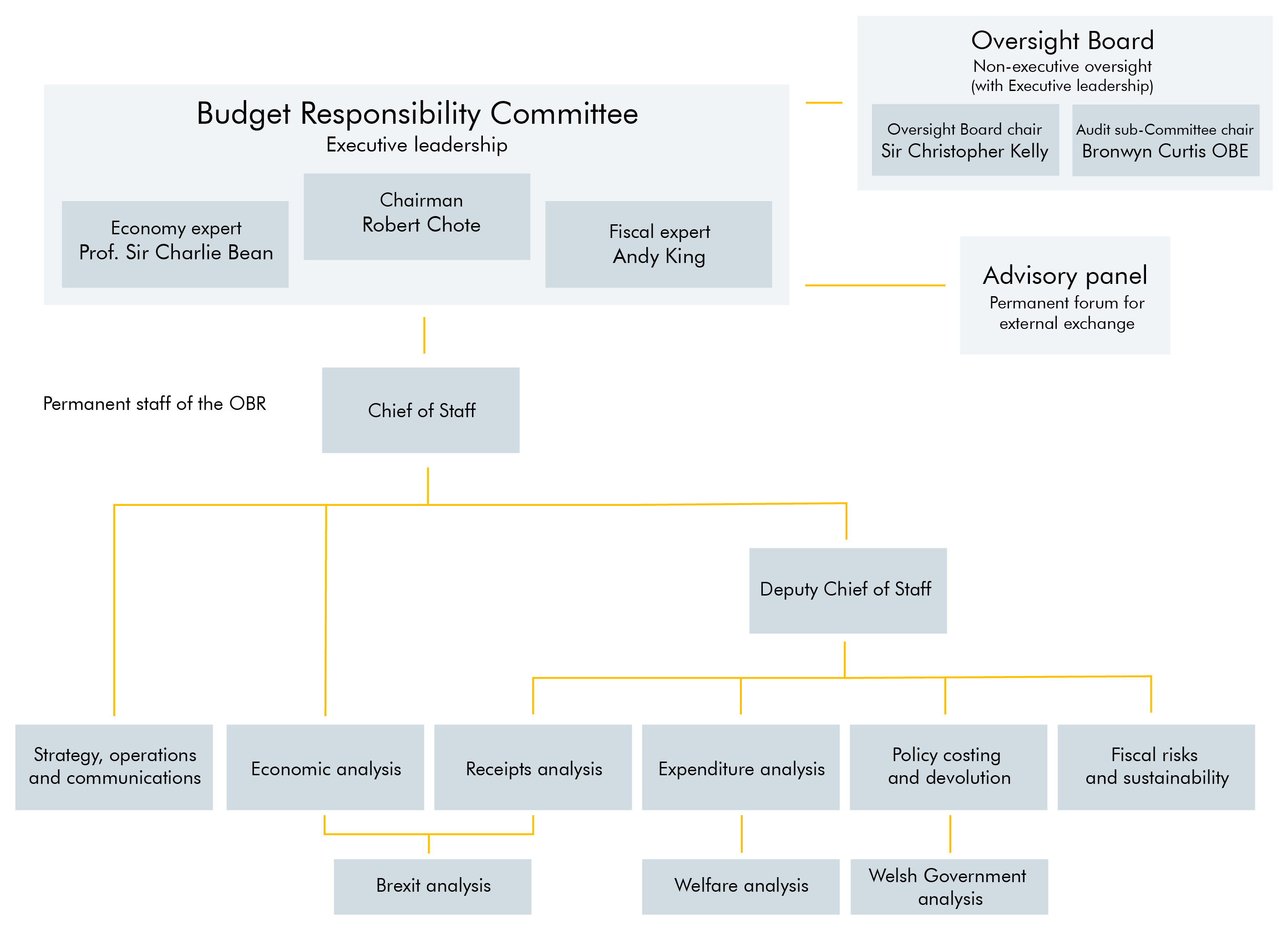
The three members of the Budget Responsibility Committee (BRC) who are appointed by the Chancellor of the Exchequer following an appointment hearing at the Treasury Select Committee, lead the OBR. They have executive responsibility for carrying out the core functions of the OBR, including responsibility for the judgements reached in its forecasts. They are:
- Chairman (vacant)
- Prof. David Miles CBE
- Tom Josephs
List of previous chairmen
- Sir Alan Budd (2010)
- Sir Robert Chote (2010–2020)
- Richard Hughes (2020-2025)
Oversight Board
The OBR's Oversight Board ensures that effective arrangements are in place to provide assurance on risk management, governance and internal control. It consists of the three members of the BRC plus two non-executive members, Dame Susan Rice and Baroness Sarah Hogg.
Advisory Panel
The OBR's Advisory Panel of economic and fiscal experts meets regularly to advise the OBR on its work programme and analytical methods. Currently members come from the Bank of England, the Institute for Fiscal Studies, academia, and other bodies.
Permanent staff of the OBR
The BRC are supported in their work by the OBR’s permanent staff of 52 civil servants, led by Laura Gardiner. The staff work in teams covering:
- Strategy, operations and communications
- Economic analysis
- Receipts analysis
- Expenditure analysis
- Policy costing and devolution
- Fiscal risks and sustainability
International engagement
The OBR was a member of the EU Independent Fiscal Institutions Network set up by the EU in September 2015 before withdrawing after Brexit.
It also takes part in the OECD network of Parliamentary Budget Offices and Independent Fiscal Institutions.
References
References
- "OBR Annual report and accounts 2024-25".
- "Office for Budget Responsibility: What is the OBR and what does it do?". BBC News.
- "What we do". OBR.
- "The Budget Responsibility and National Audit Act 2011 (Commencement No.1) Order 2011 SI 2011/8".
- "Economic and fiscal outlook".
- "Forecast evaluation report".
- "The economy forecast".
- "Tax by tax, spend by spend".
- "OBR macroeconomic model".
- "Charter for Budget Responsibility, autumn 2016 update". HM Treasury.
- "Policy costings uncertainty ratings database".
- (March 2014). "Briefing Paper No. 6: Policy costings and our forecasts". OBR.
- (24 September 2023). "The inside story of the mini-budget disaster". BBC News.
- (22 September 2022). "Blocking OBR forecasts undermines the credibility of Liz Truss's economic plans".
- "Fiscal sustainability report". OBR.
- "Fiscal risks report - July 2017".
- (2012). "Scotland Act 2012".
- "Scotland Act 2016". UK Parliament.
- "Scottish tax forecasts".
- "The agreement between the Scottish government and the United Kingdom government on the Scottish government's fiscal framework".
- (March 2014). "Wales Bill: Financial Empowerment and Accountability".
- (March 2014). "Charter of Budget Responsibility March 2014 update". [[HM Treasury]].
- ''[https://assets.publishing.service.gov.uk/government/uploads/system/uploads/attachment_data/file/467082/PU1855_OBR_charter_final_web_Oct_2015.pdf Charter for Budget Responsibility: autumn 2015 update]'', HM Treasury, October 2015
- "Welfare trends report".
- "Forecast process and papers". OBR.
- "Monthly public finances release". OBR.
- "Annual Report". OBR.
- (8 December 2009). "Conservatives launch Office for Budget Responsibility". BBC.
- (2010-05-17). "George Osborne promises spending cuts plan next week". BBC News.
- (17 May 2010). "Mixed reaction to Office for Budget Responsibility". Public Finance.
- (17 May 2010). "Speech by the Chancellor of the Exchequer, the Rt Hon George Osborne MP, on the OBR and spending announcements". [[HM Treasury]].
- (June 2010). "Budget Forecast: June 2010". [[HM Treasury]].
- Chris Giles. (July 8, 2010). "Late OBR changes shrank job loss figure". Financial Times.
- [https://www.telegraph.co.uk/finance/economics/7873605/Sir-Alan-Budd-to-leave-the-Office-for-Budget-Responsibility.html Sir Alan Budd to leave the Office for Budget Responsibility], ''Daily Telegraph'', 6 July 2010
- [https://www.theguardian.com/business/2010/jul/06/alan-budd-quits-government-spending-watchdog Alan Budd quits as government spending watchdog], ''Guardian'', 6 July 2010
- "Make informed decisions with the FT". Financial Times.
- (7 July 2010). "How about Sir Michael Scholar for the OBR?". The Daily Telegraph.
- Martin, Iain. (6 July 2010). "Ruth Lea in at the OBR PDQ?". The Wall Street Journal.
- "External review of the Office for Budget Responsibility".
- "HM Treasury review of the Office for Budget Responsibility".
- "Fiscal Transparency Evaluation for the United Kingdom".
- "2018 European Fiscal Board Annual Report".
- "Chancellor backs Robert Chote as Chair of Office for Budget Responsibility".
- "Re-appointment of Professor Stephen Nickell to the Budget Responsibility Committee".
- "Graham Parker letter of reappointment".
- "Charlie Bean to join UK fiscal watchdog".
- "Andy King and Bronwyn Curtis OBE appointed to the OBR".
- "The appointment of Professor David Miles to the Budget Responsibility Committee of the Office for Budget Responsibility".
- "Sir Christopher Kelly appointed as a non-executive member of the Office for Budget Responsibility".
- "Richard Hughes".
- "Resignation of Richard Hughes as Chair of OBR". Office for Budget Responsibility.
- (27 November 2025). "OBR leak - why does it matter and what is the Office for Budget Responsibility?".
- "MSN".
- (26 November 2025). "UK Budget OBR leak: How was the OBR forecast leaked? What was in the leaked report?".
- (26 November 2025). "OBR calls in cyber expert over botched release of Budget analysis".
- "Head of UK fiscal watchdog quits after Budget leak". The Financial times Ltd.
- "Rachel Reeves faces calls to quit over £30bn ‘black hole’ claim".
- "Britain's broken budgets". Centre for Policy Studies.
- "Prof. David Miles CBE".
- "Who we are".
- (23 March 2011). "OBR names expert advisory panel". OBR.
- (May 2014). "Office for Budget Responsibility and HM Treasury Framework Document". OBR.
- (March 2017). "Memorandum of Understanding between Office for Budget Responsibility, HM Treasury, Department for Work and Pensions and HM Revenue & Customs". OBR.
- (10 September 2024). "Budget Responsibility Act 2024".
- "Office for Budget Responsibility and HM Treasury: Framework Document".
- "Scottish Fiscal Commission Act 2016".
- "Memorandum of Understanding between the Scottish Fiscal Commission and the Office for Budget Responsibility".
- "Memorandum of Understanding: between the Welsh Government and the Office for Budget Responsibility".
- "Corporation Tax (Northern Ireland) Act 2015".
- "OECD Network of Parliamentary Budget Officials and Independent Fiscal Institutions (PBO-IFIs)".
This article was imported from Wikipedia and is available under the Creative Commons Attribution-ShareAlike 4.0 License. Content has been adapted to SurfDoc format. Original contributors can be found on the article history page.
Ask Mako anything about Office for Budget Responsibility — get instant answers, deeper analysis, and related topics.
Research with MakoFree with your Surf account
Create a free account to save articles, ask Mako questions, and organize your research.
Sign up freeThis content may have been generated or modified by AI. CloudSurf Software LLC is not responsible for the accuracy, completeness, or reliability of AI-generated content. Always verify important information from primary sources.
Report