From Surf Wiki (app.surf) — the open knowledge base
Obsidian
Naturally occurring volcanic glass

Naturally occurring volcanic glass
| Field | Value |
|---|---|
| name | Obsidian |
| category | Volcanic glass |
| boxbgcolor | #dddddd |
| image | Lipari-Obsidienne (5).jpg |
| color | usually black; sometimes green or brown; rarely yellow, orange, red or blue |
| fracture | Conchoidal |
| mohs | 5–6 |
| luster | Vitreous |
| other | Texture: Smooth; glassy |
| opticalprop | Translucent |
| gravity | c. 2.4 |
| melt | 700 - |
| references |
Obsidian ( ) is a naturally occurring volcanic glass formed when lava extruded from a volcano cools rapidly with minimal crystal growth. It is an igneous rock. Produced from felsic lava, obsidian is rich in the lighter elements such as silicon, oxygen, aluminium, sodium, and potassium. It is commonly found within the margins of rhyolitic lava flows known as obsidian flows. These flows have a high content of silica, giving them a high viscosity. The high viscosity inhibits the diffusion of atoms through the lava, which inhibits the first step (nucleation) in the formation of mineral crystals. Together with rapid cooling, this results in a natural glass forming from the lava.
Obsidian is hard, brittle, and amorphous; it therefore fractures with sharp edges. In the past, it was used to manufacture cutting and piercing tools, and it has been used experimentally as surgical scalpel blades.
Origin and properties
The Natural History by the Roman writer Pliny the Elder includes a few sentences about a volcanic glass called obsidian (lapis obsidianus), discovered in Ethiopia by Obsidius, a Roman explorer.
Obsidian is formed from quickly cooled lava. Extrusive formation of obsidian may occur when felsic lava cools rapidly at the edges of a felsic lava flow or volcanic dome, or when lava cools during sudden contact with water or air. Intrusive formation of obsidian may occur when felsic lava cools along the edges of a dike.
Tektites were once thought by many to be obsidian produced by lunar volcanic eruptions, though few scientists now adhere to this hypothesis.
Obsidian is mineral-like, but not a true mineral because, as a glass, it is not crystalline; in addition, its composition is too variable to be classified as a mineral. It is sometimes classified as a mineraloid. Though obsidian is usually dark in color, similar to mafic rocks such as basalt, the composition of obsidian is extremely felsic. Obsidian consists mainly of SiO2 (silicon dioxide), usually 70% by weight or more; the remainder consists of variable amounts of other oxides, mostly oxides of aluminium, iron, potassium, sodium and calcium. Crystalline rocks with a similar composition include granite and rhyolite. Because obsidian is metastable at the Earth's surface (over time the glass devitrifies, becoming fine-grained mineral crystals), obsidian older than Miocene in age is rare. Exceptionally old obsidians include a Cretaceous welded tuff and a partially devitrified Ordovician perlite. This transformation of obsidian is accelerated by the presence of water. Although newly formed obsidian has a low water content, typically less than 1% water by weight, it becomes progressively hydrated when exposed to groundwater, forming perlite.
Pure obsidian is usually dark in appearance, though the color varies depending on the impurities present. Iron and other transition elements may give the obsidian a dark brown to black color. Most black obsidians contain nanoinclusions of magnetite, an iron oxide. Very few samples of obsidian are nearly colorless. In some stones, the inclusion of small, white, radially clustered crystals (spherulites) of the mineral cristobalite in the black glass produce a blotchy or snowflake pattern (snowflake obsidian). Obsidian may contain patterns of gas bubbles remaining from the lava flow, aligned along layers created as the molten rock was flowing before being cooled. These bubbles can produce interesting effects such as a golden sheen (sheen obsidian). An iridescent, rainbow-like sheen (fire obsidian) is caused by inclusions of magnetite nanoparticles creating thin-film interference. Colorful, striped obsidian (rainbow obsidian) from Mexico contains oriented nanorods of hedenbergite, which cause the rainbow striping effects by thin-film interference.
Occurrence
Obsidian is found near volcanoes in locations which have undergone rhyolitic eruptions. It can be found in Argentina, Armenia, Azerbaijan, Australia, Canada, Chile, Georgia, Ecuador, El Salvador, Greece, Guatemala, Hungary, Iceland, Indonesia, Italy, Japan, Kenya, Mexico, New Zealand, Papua New Guinea, Peru, Russia, Scotland, the Canary Islands, Turkey and the United States. Obsidian flows which are so large that they can be hiked on are found within the calderas of Newberry Volcano (Big Obsidian Flow, 700 acres) and Medicine Lake Volcano in the Cascade Range of western North America, and at Inyo Craters east of the Sierra Nevada in California. Yellowstone National Park has a mountainside containing obsidian located between Mammoth Hot Springs and the Norris Geyser Basin, and deposits can be found in many other western U.S. states including Arizona, Colorado, New Mexico, Texas, Utah, and Washington, Oregon and Idaho.
There are four major deposit areas in the central Mediterranean: Lipari, Pantelleria, Palmarola and Monte Arci (Sardinia).
Ancient sources in the Aegean were Milos and Gyali.
Acıgöl town and the Göllü Dağ volcano were the most important sources in central Anatolia, one of the more important source areas in the prehistoric Near East.
Prehistoric and historical use
prehistoric_use_anchor
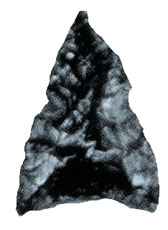
The first known archaeological evidence of usage was in Kariandusi (Kenya) and other sites of the Acheulian age (beginning 1.5 million years BP) dated 700,000 BC, although only very few objects have been found at these sites relative to the Neolithic. Manufacture of obsidian bladelets at Lipari had reached a high level of sophistication by the late Neolithic, and was traded as far as Sicily, the southern Po river valley, and Croatia. Obsidian bladelets were used in ritual circumcisions and cutting of umbilical cords of newborns. Anatolian sources of obsidian are known to have been the material used in the Levant and modern-day Iraqi Kurdistan from a time beginning sometime about 12,500 BC. Obsidian artifacts are common at Tell Brak, one of the earliest Mesopotamian urban centers, dating to the late fifth millennium BC. Obsidian was valued in Stone Age cultures because, like flint, it could be fractured to produce sharp blades or arrowheads in a process called knapping. Like all glass and some other naturally occurring rocks, obsidian breaks with a characteristic conchoidal fracture. It was also polished to create early mirrors. Modern archaeologists have developed a relative dating system, obsidian hydration dating, to calculate the age of obsidian artifacts.
Europe

Obsidian artifacts first appeared in the European continent in Central Europe in the Middle Paleolithic and had become common by the Upper Paleolithic, although there are exceptions to this. Obsidian played an important role in the transmission of Neolithic knowledge and experiences. The material was mainly used for production of chipped tools which were very sharp due to its nature. Artifacts made of obsidian can be found in many Neolithic cultures across Europe. The source of obsidian for cultures inhabiting the territory of and around Greece was the island of Milos; the Starčevo–Körös–Criș culture obtained obsidian from sources in Hungary and Slovakia, while the Cardium-Impresso cultural complex acquired obsidian from the island outcrops of the central Mediterranean. Through trade, these artifacts ended up in lands thousands of kilometers away from the original source; this indicates that they were a highly valued commodity. X-ray fluorescence techniques have also allowed obsidian in Greece to be identified as coming from Milos, Nisyros or Gyali, islands in the Aegean Sea. John Dee had a mirror, made of obsidian, which was brought from Mexico to Europe between 1527 and 1530 after Hernando Cortés's conquest of the region.
Middle East and Asia

In the Ubaid in the 5th millennium BC, blades were manufactured from obsidian extracted from outcrops located in modern-day Turkey. Ancient Egyptians used obsidian imported from the eastern Mediterranean and southern Red Sea regions. Obsidian scalpels older than 2100 BC have been found in a Bronze Age settlement in Turkey. In the eastern Mediterranean area the material was used to make tools, mirrors and decorative objects.
The use of obsidian tools was present in Japan near areas of volcanic activity. Obsidian was mined during the Jōmon period.
Obsidian has also been found in Gilat, a site in the western Negev in Israel. Eight obsidian artifacts dating to the Chalcolithic Age found at this site were traced to obsidian sources in Anatolia. Neutron activation analysis (NAA) on the obsidian found at this site helped to reveal trade routes and exchange networks previously unknown.
Americas
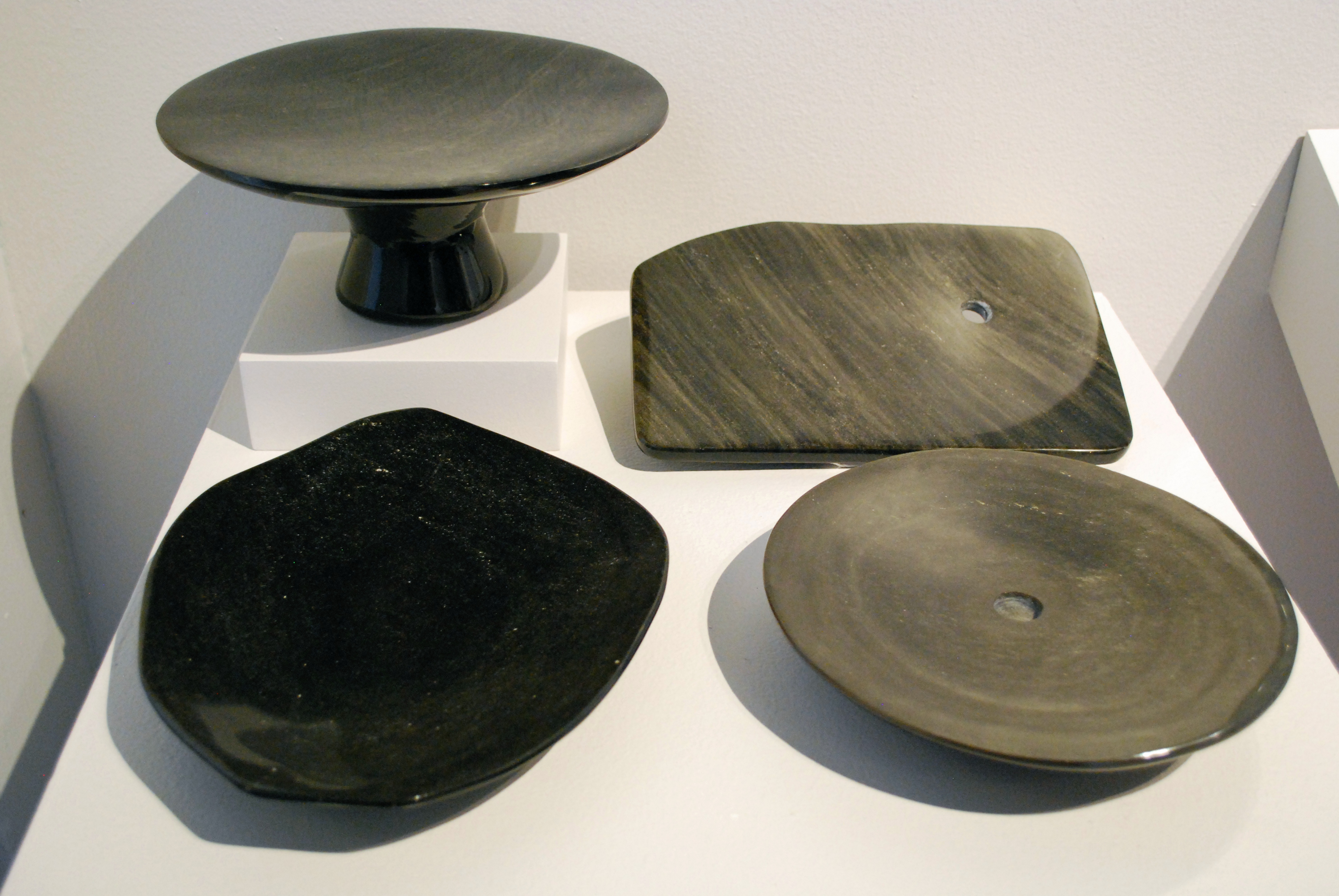
Indigenous people traded obsidian throughout the Americas. Each volcano and in some cases each volcanic eruption produces a distinguishable type of obsidian allowing archaeologists to use methods such as non-destructive energy dispersive X-ray fluorescence to select minor element compositions from both the artifact and geological sample to trace the origins of a particular artifact. Obsidian cores and blades were traded far inland from the coast. A particularly distant examples of traded obsidian are pieces from the Yellowstone Region found at Hopewell sites, such as Hopewell Culture National Historical Park, Ohio, over 1500 miles away.

Obsidian tools found in Mission Santa Clara has shown the existence of exchange networks between various tribes in California. Lithic analysis helps to understand pre-Hispanic groups in Mesoamerica. A careful analysis of obsidian in a culture or place can be of considerable use to reconstruct commerce, production, and distribution, and thereby understand economic, social and political aspects of a civilization. For example, the coastal Chumash sites in California indicate considerable trade with the distant site of Casa Diablo Hot Springs in the Sierra Nevada. Obsidian in California comes from 5 major locations all around the state, and when Mission Santa Clara was built, the tribes took their obsidian tools with them and from the analysis of the obsidian tools it showed that all 5 major location of obsidian were present.. While in Mesoamerica, at the Maya city of Yaxchilán, even warfare implications have been studied linked with obsidian use and its debris. Green Pachuca obsidian was highly prized: it has been argued Teotihuacan monopolized the Pachuca deposit to control and influence Obsidian trade in Central Mexico during the Classic Period, and the Mexica of Tenochtitlan (the capital of the Aztec Empire), favored Pachuca obsidian for ritual deposits after rising to power. A scraper made from Pachuca obsidian has even been found at Spiro Mounds in Oklahoma.

Pre-Columbian Mesoamericans' use of obsidian was extensive and sophisticated; including carved and worked obsidian for tools and decorative objects. Mesoamericans made use of a variety of weapons using obsidian, such as macuahuitl, a type of sword with obsidian blades lining a wooden shaft, or the tepoztopilli, a polearm with a leaf or spade shaped wooden head lined with blades in a similar manner. Spanish sources describe these weapons as being able to kill and inflict terrible injuries.
Obsidian mirrors were used by some Aztec priests to conjure visions and make prophecies. They were connected with Tezcatlipoca, god of obsidian and sorcery, whose name can be translated from the Nahuatl language as 'Smoking Mirror'.
In Chile obsidian tools from Chaitén Volcano have been found as far away as in Chan-Chan 400 km north of the volcano, and also in sites 400 km south of it.
Oceania
The Lapita culture, active across a large area of the Pacific Ocean around 1000 BC, made widespread use of obsidian tools and engaged in long distance obsidian trading. The complexity of the production technique for these tools, and the care taken in their storage, may indicate that beyond their practical use they were associated with prestige or high status.
Obsidian was also used on Rapa Nui (Easter Island) for edged tools such as Mataia and the pupils of the eyes of their Moai (statues), which were encircled by rings of bird bone. Obsidian was used to inscribe the Rongorongo glyphs.
Current use
Obsidian can be used to make extremely sharp knives, and obsidian blades are a type of glass knife made using naturally occurring obsidian instead of manufactured glass. Obsidian is used by some surgeons for scalpel blades, although this is not approved by the US Food and Drug Administration (FDA) for use on humans. Well-crafted obsidian blades, like any glass knife, can have a cutting edge many times sharper than high-quality steel surgical scalpels: the cutting edge of the blade is only about three nanometers thick. All metal knives have a jagged, irregular blade when viewed under a strong enough microscope; however, obsidian blades are still smooth, even when examined under an electron microscope. One study found that obsidian incisions produced fewer inflammatory cells and less granulation tissue in a group of rats after seven days but the differences disappeared after twenty-one days. Don Crabtree has produced surgical obsidian blades and written articles on the subject. Obsidian scalpels may be purchased for surgical use on research animals.
The major disadvantage of obsidian blades is their brittleness compared to those made of metal, thus limiting the surgical applications for obsidian blades to a variety of specialized uses where this is not a concern.

Obsidian is also used for ornamental purposes and as a gemstone. It presents a different appearance depending on how it is cut: in one direction it is jet black, while in another it is glistening gray. "Apache tears" are small rounded obsidian nuggets often embedded within a grayish-white perlite matrix.
Plinths for audio turntables have been made of obsidian since the 1970s, such as the grayish-black SH-10B3 plinth by Technics.
References
References
- King, Hobart M.. "Obsidian". Geology.com.
- Peter Roger Stuart Moorey. (1999). "Ancient Mesopotamian Materials and Industries: the archaeological evidence". Eisenbrauns.
- (January 1975). "Chemical and physical properties of obsidian: a naturally occurring [sic] glass". Journal of Non-Crystalline Solids.
- {{Mindat
- {{cite Dictionary.com. obsidian
- Rafferty, John P.. (2012). "Rocks". Britannica Educational Pub. in association with Rosen Educational Services.
- (1995). "Petrology : the study of igneous, sedimentary, metamorphic rocks". Wm. C. Brown.
- (1992). "Mechanics of pre-industrial technology: an introduction to the mechanics of ancient and traditional material culture". Cambridge University Press.
- ''[[Dictionary of Greek and Roman Biography and Mythology]]'', [https://archive.org/stream/dictionaryofgree03smituoft#page/2/mode/2up vol. III, p. 2 ("Obsidius")].
- [http://www.encyclopedia.com/doc/1O27-obsidian.html obsidian]. The Concise Oxford Dictionary of English Etymology. Oxford University Press (1996). Retrieved November 20, 2011.
- D Harper. [http://www.etymonline.com/index.php?allowed_in_frame=0&search=obsidian&searchmode=none obsidian]. Etymology online. June 17, 2012
- 0816071055.
- 1441957030
- (2004). "The Handy Geology Answer Book". Visible Ink Press.
- (2004). "Physics Methods in Archaeometry". IOS Press.
- (1938). "The Mono Craters, California". Geographical Review.
- (December 1, 2011). "New investigations of the Göllüdağ obsidian lava flows system: a multi-disciplinary approach". Journal of Archaeological Science.
- (1978). "The Tektite Problem". Munn & Company.
- (2016). "Under desert skies : how Tucson mapped the way to the Moon and planets". Sentinel Peak.
- (2012). "Handbook of Soil Sciences: Properties and Processes". CRC Press.
- Liritzis, I.. (2014). "Obsidian Hydration Dating". Springer.
- Shackley, M.S.. (2022). "Obsidian: Geology and Archaeology in the North American Southwest". University of Arizona Press.
- (October 1, 1961). "Devitrification of Natural Glass". GSA Bulletin.
- "Perlite – Mineral Deposit Profiles". B.C. Geological Survey.
- (2013). "Nanomineralogy of Gemstones: From Genesis to Discovery". Mineralogical Magazine.
- Nadin, E.. (2007). "The secret lives of minerals". Engineering & Science.
- (November 25, 1998). "Fission track dating of obsidian source samples from the Willaumez Peninsula, Papua New Guinea and eastern Australia". Records of the Australian Museum.
- Forest Service information page [http://www.fs.usda.gov/r06/deschutes/recreation]
- [http://www.obsidianlab.com/image_maps/image_maps.html#wa Washington Obsidian Source Map] {{webarchive. link. (August 21, 2015 . Obsidianlab.com. Retrieved November 20, 2011.)
- [http://www.sourcecatalog.com/or/s_or.html Oregon Obsidian Sources]. Sourcecatalog.com (November 15, 2011). Retrieved 2011-11-20.
- Fink, Jonathan H.. (1983). "Structure and emplacement of a rhyolitic obsidian flow: Little Glass Mountain, Medicine Lake Highland, northern California". Geological Society of America Bulletin.
- 0521119901.
- 3447033959.
- 3447062177.
- 1575060426.
- (April 18, 1985). "Ancient trade routes for obsidian". New Scientist.
- (1979). "Early technologies". Undena Publications.
- (1994). "Society, Culture, and Technology in Africa Import.". Univ Museum Pubns.
- 0521215927
- National Museum of Kenya. [http://www.museums.or.ke/content/blogcategory/21/27/ Kariandusi] {{webarchive. link. (October 24, 2007 . Retrieved June 30, 2012)
- (April 20, 2019). "Lipari (Aeolian islands) obsidian in the late Neolithic. Artifacts, supply, and function". [[Open Archaeology]].
- (August 2018). "Obsidian in the Tavoliere, Southeastern Italy — A regional study". Journal of Archaeological Science: Reports.
- (2008). "Archaeological Chemistry". Royal Society of Chemistry.
- (January 2, 2015). "Early Mesopotamian urbanism: a new view from the north". Antiquity.
- (2003). "The Quality and Value In Neolithic Europe: An Alternative View on Obsidian Artifacts". South Eastern Europe Proceedings of the ESF Workshop, Sofia.
- (April 1, 2020). "John Dee's spirit mirror – The British Library".
- John Noble Wilford. (April 5, 2010). "In Syria, a Prologue for Cities". The New York Times.
- Jo Marchant. "Scalpels and skulls point to Bronze Age brain surgery". New Scientist.
- George Robert Rapp. (2002). "Archaeomineralogy". Springer.
- "Obsidian | Oki Islands UNESCO Global Geopark".
- (2007). "Archaeological obsidian studies in Hokkaido, Japan: Retrospect and prospects". Indo-Pacific Prehistory Association Bulletin.
- (1996). "New Evidence on Prehistoric Trade Routes: The Obsidian Evidence from Gilat, Israel". Journal of Field Archaeology.
- (December 1, 2012). "Obsidian Sources of Northern Baja California: The Known and the Unknown". Faculty Publications.
- (March 1, 2016). "Economic growth in Mesoamerica: Obsidian consumption in the coastal lowlands". Journal of Anthropological Archaeology.
- "Hopewell Culture Obsidian".
- Hogan, CM. (2008). "Morro Creek".
- Panich, L. M. (2016). Beyond the colonial curtain: Investigating indigenous use of obsidian in Spanish California through the PXRF analysis of artifacts from Mission Santa Clara. Journal of Archaeological Science: Reports, 5, 521–530. https://doi.org/10.1016/j.jasrep.2016.01.008
- Brokmann, Carlos. (2000). "Tipología y análisis de la obsidiana de Yaxchilán, Chiapas". INAH.
- (1967). "The Obsidian Industry of Teotihuacan". American Antiquity.
- (2025). "Compositional analysis of obsidian artifacts from the Templo Mayor of Tenochtitlan, capital of the Mexica (Aztec) Empire". PNAS.
- (2002). "Mesoamerican Origin for an Obsidian Scraper from the Precolumbian Southeastern United States". Cambridge University Press.
- "Narrative of Some Things of New Spain and of the Great City of Temestitan, México (Chapter 4)".
- (2005). "Geoarqueología del sitio arcaico Chan-Chan 18, costa de Valdivia: Discriminación de ambientes de ocupación humana y su relación con la transgresión marina del Holoceno Medio". Revista Geológica de Chile.
- Naranjo, José A. (2004). "Holocene tephrochronology of the southernmost part (42°30'–45°S) of the Andean Southern Volcanic Zone". Revista Geológica de Chile.
- Specht, Jim. (2018). "The Oxford Handbook of Prehistoric Oceania". Oxford University Press.
- Eric Kjellgren; JoAnne Van Tilburg; Adrienne Lois Kaeppler (2001). Splendid Isolation: Art of Easter Island. Metropolitan Museum of Art. pp. 39–. {{ISBN. 978-1-58839-011-0.
- Shadbolt, Peter. (April 2, 2015). "CNN Health: How Stone Age blades are still cutting it in modern surgery". CNN.
- Buck, BA. (March 1982). "Ancient Technology in Contemporary Surgery". The Western Journal of Medicine.
- Haviland, W.A.. (2010). "Anthropology: The Human Challenge". Cengage Learning.
- (October 1993). "A comparison of obsidian and surgical steel scalpel wound healing in rats.". Plastic and Reconstructive Surgery.
- Fine Science Tools (FST). "FST product catalog". FST.
- Fine Science Tools – "[https://www.finescience.com/en-US/Products/Scalpels-Blades/Micro-Knives/Obsidian-Scalpels Obsidian Scalpels]"
- Manutchehr-Danai, Mohsen. (March 9, 2013). "Dictionary of Gems and Gemology". Springer Science & Business Media.
This article was imported from Wikipedia and is available under the Creative Commons Attribution-ShareAlike 4.0 License. Content has been adapted to SurfDoc format. Original contributors can be found on the article history page.
Ask Mako anything about Obsidian — get instant answers, deeper analysis, and related topics.
Research with MakoFree with your Surf account
Create a free account to save articles, ask Mako questions, and organize your research.
Sign up freeThis content may have been generated or modified by AI. CloudSurf Software LLC is not responsible for the accuracy, completeness, or reliability of AI-generated content. Always verify important information from primary sources.
Report