From Surf Wiki (app.surf) — the open knowledge base
Oberheim Polyphonic Synthesizer
Polyphonic analogue synthesizer
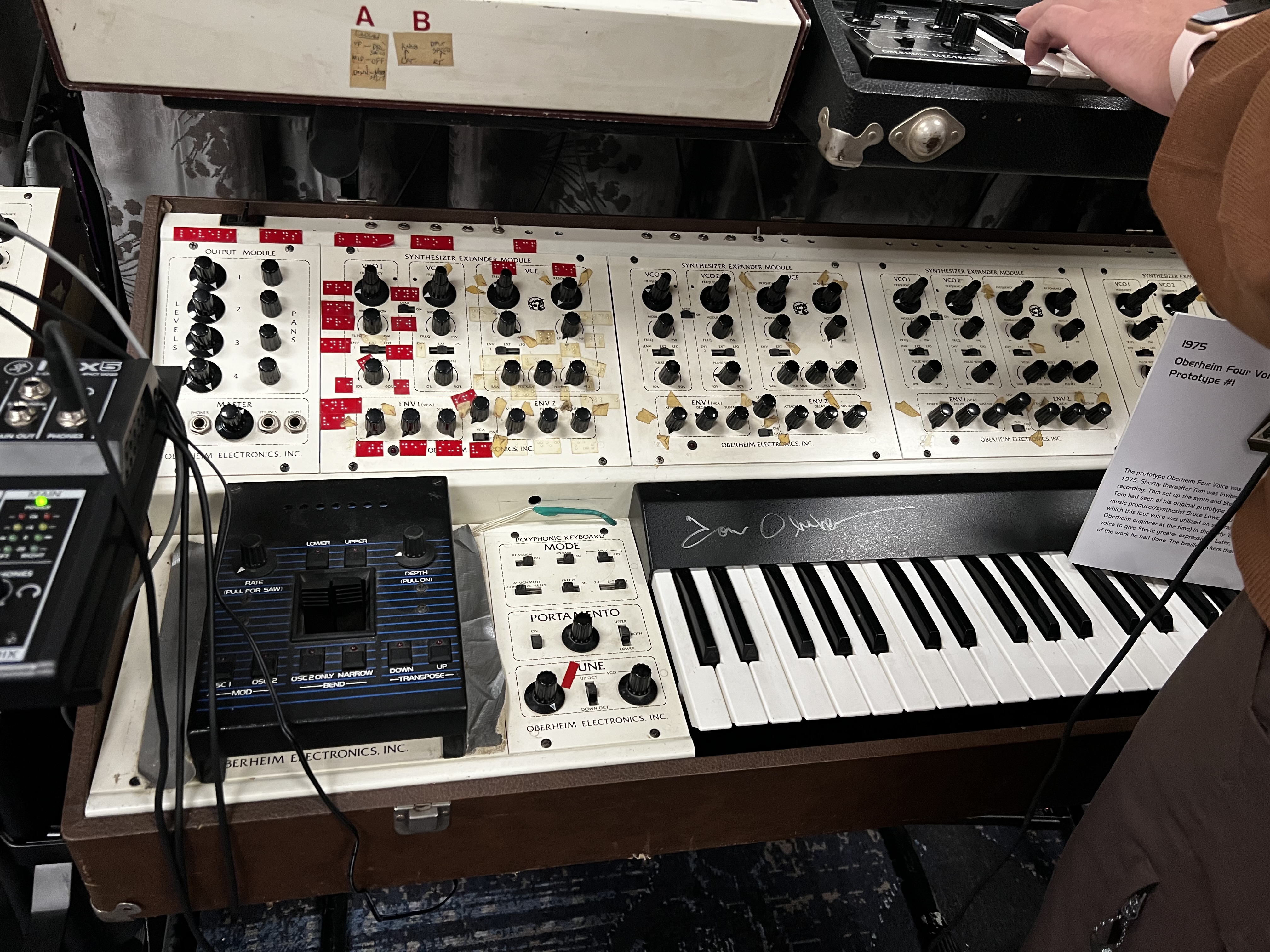
Polyphonic analogue synthesizer
| Field | Value | |
|---|---|---|
| image | Oberheim 4 voice.jpg | |
| image_caption | Four Voice (FVS-1) | |
| synth_name | Polyphonic Synthesizer | |
| synth_manufacturer | Oberheim Electronics | |
| dates | 1975–79 | |
| synthesis_type | Analog Subtractive | |
| polyphony | 4 voice (FVS), 8 voice (EVS) | |
| timbrality | Multitimbral | |
| oscillator | 2 VCOs per voice with sawtooth or variable-pulse waveforms | |
| filter | Low, band, high, notch filter w/ resonance | |
| attenuator | 2 x ADR envelopes | |
| lfo | 1 with triangle wave | |
| keyboard | 49-key | |
| velocity | No | |
| aftertouch | No | |
| memory | 16 patches with PSP-1 programmer | |
| ext_control | CV/Gate | |
| fx | None | |
| price | Four Voice: US$4,295 ($5,690 with programmer) | |
| Eight Voice: US$7,790 ($10,185 with programmer) |
image = Oberheim 4 voice.jpg| image_caption = Four Voice (FVS-1)| synth_name = Polyphonic Synthesizer| synth_manufacturer = Oberheim Electronics| dates = 1975–79| synthesis_type = Analog Subtractive| polyphony = 4 voice (FVS), 8 voice (EVS)| timbrality = Multitimbral| oscillator = 2 VCOs per voice with sawtooth or variable-pulse waveforms| filter = Low, band, high, notch filter w/ resonance| attenuator = 2 x ADR envelopes| lfo = 1 with triangle wave| keyboard = 49-key| velocity = No| aftertouch = No| memory = 16 patches with PSP-1 programmer| ext_control = CV/Gate| fx = None| price = Four Voice: US$4,295 ($5,690 with programmer) Eight Voice: US$7,790 ($10,185 with programmer)|
The Oberheim Polyphonic Synthesizer is a series of analog music synthesizers that was produced from 1975 to 1979 by Oberheim Electronics. Developed by Tom Oberheim, they were the first production synthesizers capable of playing chords.
Background
After Oberheim introduced the DS-2 digital music sequencer, Tom Oberheim recognized that customers wanted to play one synthesizer while the DS-2 played a sequence on another, or layer the sound of one synthesizer with another. To address this need, he introduced the Synthesizer Expander Module (SEM), a semi-modular analog synthesizer module, in 1974. The SEM featured two VCOs and a two-pole voltage-controlled filter that could operate as a low-pass, high-pass, band-pass, or band-reject filter, giving it a different sound from the Moog and ARP four-pole low-pass ladder filters popular at the time.
Specification
In late 1975, after Norlin canceled several large Maestro orders, Oberheim developed a series of polyphonic synthesizers by combining multiple SEMs with a digitally-scanned keyboard developed by Dave Rossum and a two-channel sequencer. By packaging two or four SEMs, each capable of generating one voice (or note), together under keyboard control, he was able to create synthesizers that could play two or four notes simultaneously. These synthesizer models were logically named the Oberheim Oberheim Two Voice (TVS) and Four Voice (FVS).
In 1976, Oberheim introduced the Polyphonic Synthesizer Programmer (PSP-1), an optional module which made possible the storage and recall of most of the SEM's parameters, as well as the ability to glide from one note or chord to another using portamento.
In 1977, the Oberheim Eight Voice (EVS), available with either a single or dual manual keyboard, was added to the series.
The SEM, Two Voice, Four Voice, and Eight Voice were eventually replaced by a series of microprocessor-controlled synthesizers, beginning with the OB-1 and culminating in the OB-X and OB-Xa, which were fully programmable and significantly more compact than their predecessors, which Oberheim discontinued production of in 1979.
Despite their maintenance cost and rarity, Oberheim Polyphonic Synthesizers are still adored by many musicians today for their characteristic sonic 'thickness' and 'depth' caused in part by the random variance between each SEM module.
Notable users
- 808 State
- Akiko Yano
- Bill Payne (Little Feat)
- Blue Weaver (Bee Gees)
- Bob James
- The Brothers Johnson
- Chick Corea
- Christine McVie (Fleetwood Mac)
- Christopher Franke
- Dave Greenfield (The Stranglers)
- Dave Grusin
- Dee Palmer (Jethro Tull)
- Dennis DeYoung (Styx)
- Depeche Mode
- Edgar Froese (Tangerine Dream)
- Eagles
- Gary Wright
- Geddy Lee (Rush)
- George Duke
- Herbie Hancock
- Hideki Matsutake (Yellow Magic Orchestra)
- Jan Hammer
- Jean-Michel Jarre
- Jimmy Jam and Terry Lewis
- Joe Zawinul (Weather Report)
- John Carpenter
- Larry Dunn (Earth, Wind & Fire)
- Laza Ristovski
- Lyle Mays (Pat Metheny Group)
- Michael McDonald (The Doobie Brothers)
- Patrick Moraz
- Paul Kantner (Jefferson Starship)
- Pete Namlook
- Philip Oakey (The Human League)
- Pink Floyd
- Prince
- Rick Davies (Supertramp)
- Rose Royce
- Rufus
- Ryuichi Sakamoto
- Steve Porcaro (Toto)
- Stevie Wonder
- The Shamen
- Tim Simenon (Bomb the Bass)
- Trent Reznor (Nine Inch Nails)
- Vangelis
- Vince Clarke
Software emulations
GForce Software collaborated with Tom Oberheim and former Oberheim engineer Marcus Ryle to develop the GForce Oberheim OB-E, a software synthesizer emulation of the Eight Voice, and the GForce Oberheim SEM emulation of the SEM. The GForce Oberheim OB-E is the first software instrument ever to receive Tom Oberheim's personal endorsement.
References
References
- Moog, Bob. (1993). "Vintage Synthesizers: Oberheim SEM Module". Miller Freeman Books.
- Colbeck, Julian. (1996). "Keyfax Omnibus Edition". MixBooks.
- Vail, Mark. (2014). "The Synthesizer". [[Oxford University Press]].
- Reid, Gordon. (June 2021). "GForce Software OB-E".
- (4 August 2010). "Oberheim SEM-based Instruments".
- Kovarsky, Jerry. (27 June 2023). "In celebration of Bill Payne: the unsung keyboard master".
- Jenkins, Mark. (2007). "Analog Synthesizers". Focal Press.
- Forrest, Peter. (1996). "The A-Z of Analogue Synthesizers Part Two: N-Z". Susurreal.
- "Oberheim Four Voice".
- (2014). "Equinoxe". Disques Dreyfus/BMG/Sony/Warner.
- Tingen, Paul. (July 2016). "John Carpenter: Film Director & Composer".
- Grow, Kory. (15 September 2020). "Excerpt: Trent Reznor Geeks Out On His Love oO Synths In New Book".
- Clewes, Richard. (November 1997). "VANGELIS: Recording At Nemo Studios".
This article was imported from Wikipedia and is available under the Creative Commons Attribution-ShareAlike 4.0 License. Content has been adapted to SurfDoc format. Original contributors can be found on the article history page.
Ask Mako anything about Oberheim Polyphonic Synthesizer — get instant answers, deeper analysis, and related topics.
Research with MakoFree with your Surf account
Create a free account to save articles, ask Mako questions, and organize your research.
Sign up freeThis content may have been generated or modified by AI. CloudSurf Software LLC is not responsible for the accuracy, completeness, or reliability of AI-generated content. Always verify important information from primary sources.
Report