From Surf Wiki (app.surf) — the open knowledge base
Obelisk of Theodosius

| Field | Value |
|---|---|
| name | Obelisk of Theodosius |
| image | File:Obelisk of Theodosius I.jpg |
| caption | The obelisk of Theodosius I in Istanbul |
| location | Hippodrome of Constantinople (today Sultanahmet Square, Istanbul, Turkey) |
| height | 18.54 m |
| With pedestal: 25.6 m | |
| built | 18th dynasty |
| coordinates | |
| locmapin | Istanbul |
With pedestal: 25.6 m
The Obelisk of Theodosius (, ) is the Ancient Egyptian obelisk of Pharaoh Thutmose III (1479–1425 BC), first erected during the 18th dynasty of Egypt. It was re-erected in the Hippodrome of Constantinople (known today as At Meydanı or Sultanahmet Meydanı, in the modern city of Istanbul, Turkey) by the Roman emperor Theodosius I in the 4th century AD.
History
The obelisk was first erected during the 18th dynasty by Pharaoh Thutmose III (1479–1425 BC) to the south of the seventh pylon of the great temple of Karnak. The Roman emperor Constantius II (337–361 AD) had it and another obelisk transported along the river Nile to Alexandria to commemorate his ventennalia or 20 years on the throne in 357. The other obelisk was erected on the spina of the Circus Maximus in Rome in the autumn of that year, and is now known as the Lateran Obelisk. The obelisk that would become the obelisk of Theodosius remained in Alexandria until 390; when Theodosius I (379–395 AD) had it transported to Constantinople and put up on the spina of the Hippodrome there.
Description
Obelisk
The Obelisk of Theodosius is of red granite from Aswan and was originally 30m tall, like the Lateran Obelisk. The lower part was damaged in antiquity, probably during its transport or re-erection, and so the obelisk is today only 18.54m (or 19.6m) high, or 25.6m if the base is included. Between the four corners of the obelisk and the pedestal are four bronze cubes, used in its transportation and re-erection.
Each of its four faces has a single central column of inscription, celebrating Thutmose III's victory over the Mitanni which took place on the banks of the Euphrates in about 1450 BC. Image:Istanbul.Hippodrome010.jpg|Bottom of the inscription (south face). Image:Istanbul - Ippodromo - Obelisco - Foto G. Dall'Orto 25-5-2006.jpg|Top of the inscription (south face). Image:Istanbul Obelisk of Theodosius.JPG Image:Istanbul Obelisk of Theodosius2.JPG File:Obelisk of Theodosius 220.jpg|Obelisk of Theodosius Hieropglyphs
Pedestal
The marble pedestal had bas-reliefs dating to the time of the obelisk's re-erection in Constantinople. On one face Theodosius I is shown offering the crown of victory to the winner in the chariot races, framed between arches and Corinthian columns, with happy spectators, musicians and dancers assisting in the ceremony. In the bottom right of this scene is the water organ of Ctesibius and on the left another instrument.
Image:Istanbul.Hippodrome007.jpg|The emperor and his court (south face). Image:Istanbul.Hippodrome008.jpg|The chariot race (south face). Image:Hippodrome Constantinople2007005part.jpg|Submission of the barbarians (west face). File:Obelisk of Theodosius 9627.jpg|Obelisk of Theodosius Homage vanquished enemies File:Obelisk of Theodosius 1242.jpg|Obelisk of Theodosius Homage vanquished enemies File:Obelisk of Theodosius 1241.jpg|Obelisk of Theodosius Homage vanquished enemies File:Obelisk of Theodosius 3237.jpg|Obelisk of Theodosius Organ amidst musicians File:Obelisk of Theodosius 3241.jpg|Obelisk of Theodosius Organ amidst musicians File:Obelisk of Theodosius 3239.jpg|Obelisk of Theodosius Musicians
There are obvious traces of major damage to the pedestal and energetic restoration of it. Missing pieces have been replaced, at the pedestal's bottom corners, by cubes of porphyry resting on the bronze cubes already mentioned – the bronze and porphyry cubes are of identical form and dimensions. There is also a vertical gash up one of the obelisk's faces, which looks like a canal from above. These repairs to the base may be linked to the cracking of the obelisk itself after its suffering a serious accident (perhaps an earthquake) at an unknown date in antiquity. Image:Hipodrom B19-27.jpg|The emperor and his court, bronze and porphyry cubes, gash (north face). Image:Istanbul.Hippodrome003.jpg|Transport of the obelisk. Traces of a vertical gash (north face). File:Obelisk of Theodosius 1234.jpg|Obelisk of Theodosius Erecting the obelisk
Inscriptions
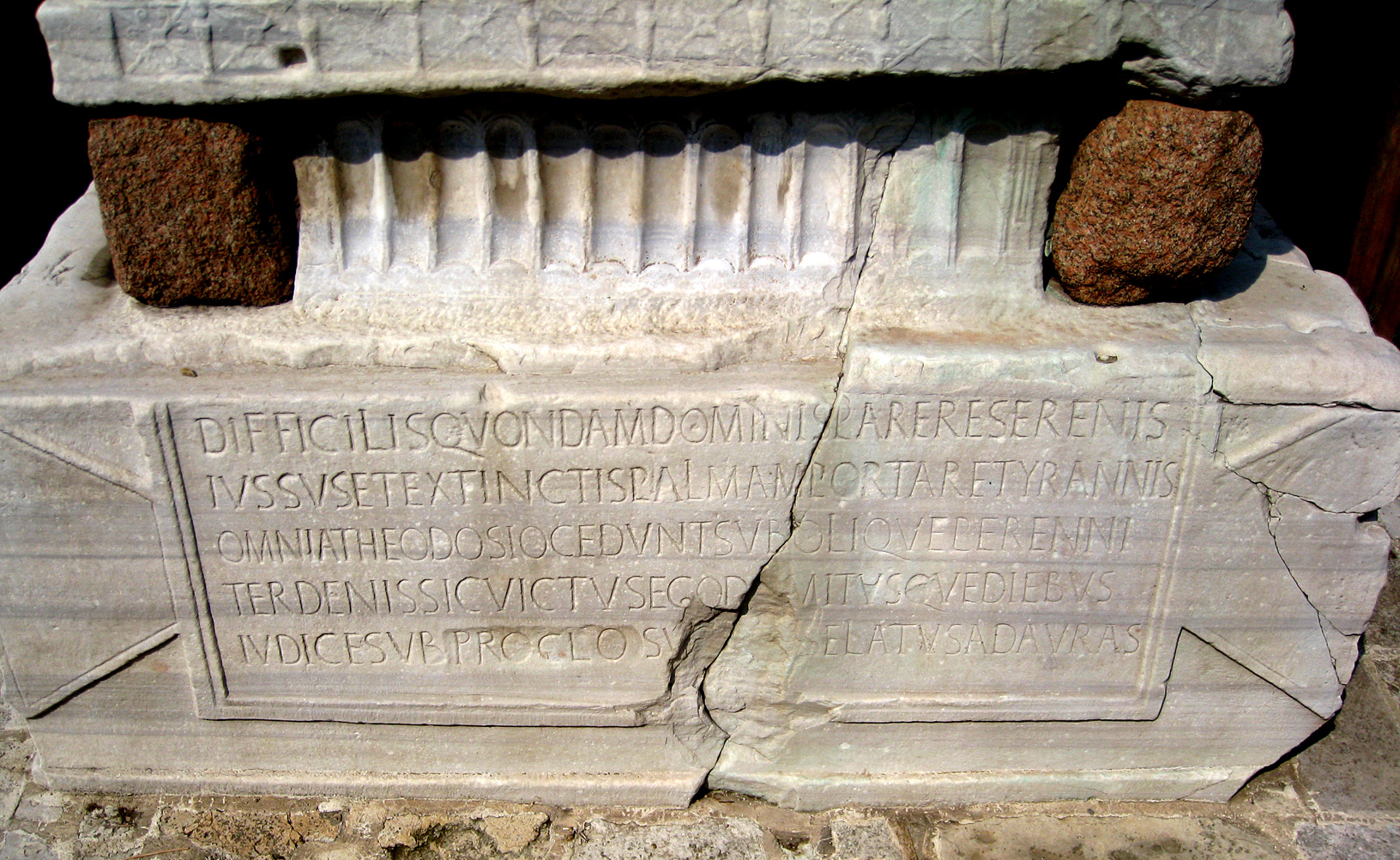
The pedestal's east face bears an inscription in five Latin hexameters. This is slightly broken at the bottom but it was transcribed in full by travelers in the 16th century. It reads:
::; DIFFICILIS QVONDAM DOMINIS PARERE SERENIS ::; IVSSVS ET EXTINCTIS PALMAM PORTARE TYRANNIS ::; OMNIA THEODOSIO CEDVNT SVBOLIQVE PERENNI ::; TER DENIS SIC VICTVS EGO DOMITVSQVE DIEBVS ::; IVDICE SVB PROCLO SVPERAS ELATVS AD AVRAS
Translation:
:"Formerly reluctant, I was ordered to obey the serene lords and carry the palm of extinct tyrants. Everything yields to Theodosius and his everlasting offspring. So conquered and vanquished in three times ten days, I was raised to the lofty sky while Proculus was judge."

On the west face the same idea is repeated in two elegiac couplets rendered in Byzantine Greek, though this time it reports that the re-erection took 32 days (TPIAKONTA ΔYΩ, last line) not 30: ::; KIONA TETPAΠΛEYPON AEI XΘONI KEIMENON AXΘOC ::; MOYNOC ANACTHCAI ΘEYΔOCIOC BACIΛEYC ::; TOΛMHCAC ΠPOKΛOC EΠEKEKΛETO KAI TOCOC ECTH ::; KIΩN HEΛIOIC EN TPIAKONTA ΔΥΩ :: kiona tetrapleuron aei chthoni keimenon achthos :: mounos anastēsai Theudosios basileus :: tolmēsas Proklos epekekleto kai tosos estē :: kiōn ēeliois en triakonta duō Translation: :"The four-sided column, forever lying heavily on the ground, the emperor Theodosius as the only one dared to erect. He called on Proclus; and thus the column stood in two and thirty days."
References
Bibliography
- Labib Habachi, The Obelisks of Egypt, skyscrapers of the past, American University in Cairo Press, 1985,
- "Obelisk of Theodosius", in volume 3 of Alexander Kazhdan (ed.), The Oxford Dictionary of Byzantium, 3 volumes, Oxford University Press, 1991,
- Jean-Pierre Sodini, "Images sculptées et propagande impériale du IVe au VIe siècles : recherches récentes sur les colonnes honorifiques et les reliefs politiques à Byzance", Byzance et les images, La Documentation Française, Paris, 1994, , pp. 43–94.
- Bente Kiilerich, The Obelisk Base in Constantinople: Court Art and Imperial Ideology, Rome, 1998 (ActaIRN vol. X; Giorgio Bretschneider)
- E. A. Wallis Budge, Cleopatra's Needles and Other Egyptian Obelisks, The Religious Tract Society, London, 1926 ()
- Linda Safran, "Points of View: The Theodosian Obelisk Base in Context." Greek, Roman, and Byzantine Studies 34, no. 4 (Winter 1993), pp. 409–435.
References
- [[Obelisk of Theodosius#LH. Labib Habachi]], ''[[iarchive:obelisksofegypts0000haba. The Obelisks of Egypt, skyscrapers of the past]]'', American University in Cairo Press, 1985, p. 145–151
- [[#WB. E.A. Wallis Budge]], ''Cleopatra's Needles and Other Egyptian Obelisks,'' The Religious Tract Society, London, 1926, reprinted 1990, p.160-165.
- Kiilerich, Bente. (2001-10-01). "The Obelisk Base in Constantinople: Court Art and Imperial Ideology". American Journal of Archaeology.
This article was imported from Wikipedia and is available under the Creative Commons Attribution-ShareAlike 4.0 License. Content has been adapted to SurfDoc format. Original contributors can be found on the article history page.
Ask Mako anything about Obelisk of Theodosius — get instant answers, deeper analysis, and related topics.
Research with MakoFree with your Surf account
Create a free account to save articles, ask Mako questions, and organize your research.
Sign up freeThis content may have been generated or modified by AI. CloudSurf Software LLC is not responsible for the accuracy, completeness, or reliability of AI-generated content. Always verify important information from primary sources.
Report