From Surf Wiki (app.surf) — the open knowledge base
Nyasvizh
Town in Minsk Region, Belarus
Town in Minsk Region, Belarus
| Field | Value |
|---|---|
| settlement_type | Town |
| name | Nyasvizh |
| native_name | be |
| ru | |
| image_skyline | Belarus-Niasvizh-Panorama.jpg |
| image_flag | Flag of Niasvizh, Belarus.svg |
| image_shield | Coat of Arms of Niasviž, Belarus.svg |
| flag_size | 150 |
| shield_size | 75 |
| pushpin_map | Belarus |
| subdivision_type | Country |
| subdivision_name | Belarus |
| subdivision_type1 | Region |
| subdivision_name1 | Minsk Region |
| subdivision_type2 | District |
| subdivision_name2 | Nyasvizh District |
| established_title | First mentioned |
| established_date | 1223 |
| established_title2 | Town rights since |
| established_date2 | 1586 |
| population_as_of | 2025 |
| population_footnotes | |
| population_total | 15,909 |
| timezone | MSK |
| utc_offset | +3 |
| coordinates | |
| postal_code_type | Postal code |
| postal_code | 222603, 222620 |
| area_code | +375 1770 |
| website |
ru Nyasvizh or Nesvizh is a town in Minsk Region, Belarus. It serves as the administrative centre of Nyasvizh District. Nyasvizh is the site of Nesvizh Castle, a World Heritage Site. In 2009, its population was 14,300. As of 2025, it has a population of 15,909.
History
Historical affiliations
Chorągiew królewska króla Zygmunta III Wazy.svg Polish–Lithuanian Commonwealth 1569–1793
Flag of Russia.svg Russian Empire 1793–1812
Herb Pogon Litewska.jpg Lithuanian Provisional Governing Commission 1812
Flag of Russia.svg Russian Empire 1812–1917
Socialist red flag.svg Bolsheviks 1917–1918
Flag of Germany (1867–1918).svg German Empire, 1918–1919
Flag of the Byelorussian Soviet Socialist Republic (1919–1927).svg SSR Byelorussia, 1919
Flag of the Lithuanian-Byelorussian SSR.svg LitBel, 1919
Flag of Poland (1928–1980).svg Poland, 1919–1939
Flag of the USSR (1936-1955).svg USSR (BSSR), 1939–1941
Nazi Germany (occupation), 1941–1944
Soviet Union USSR (BSSR), 1944–1991
Belarus, 1991–present
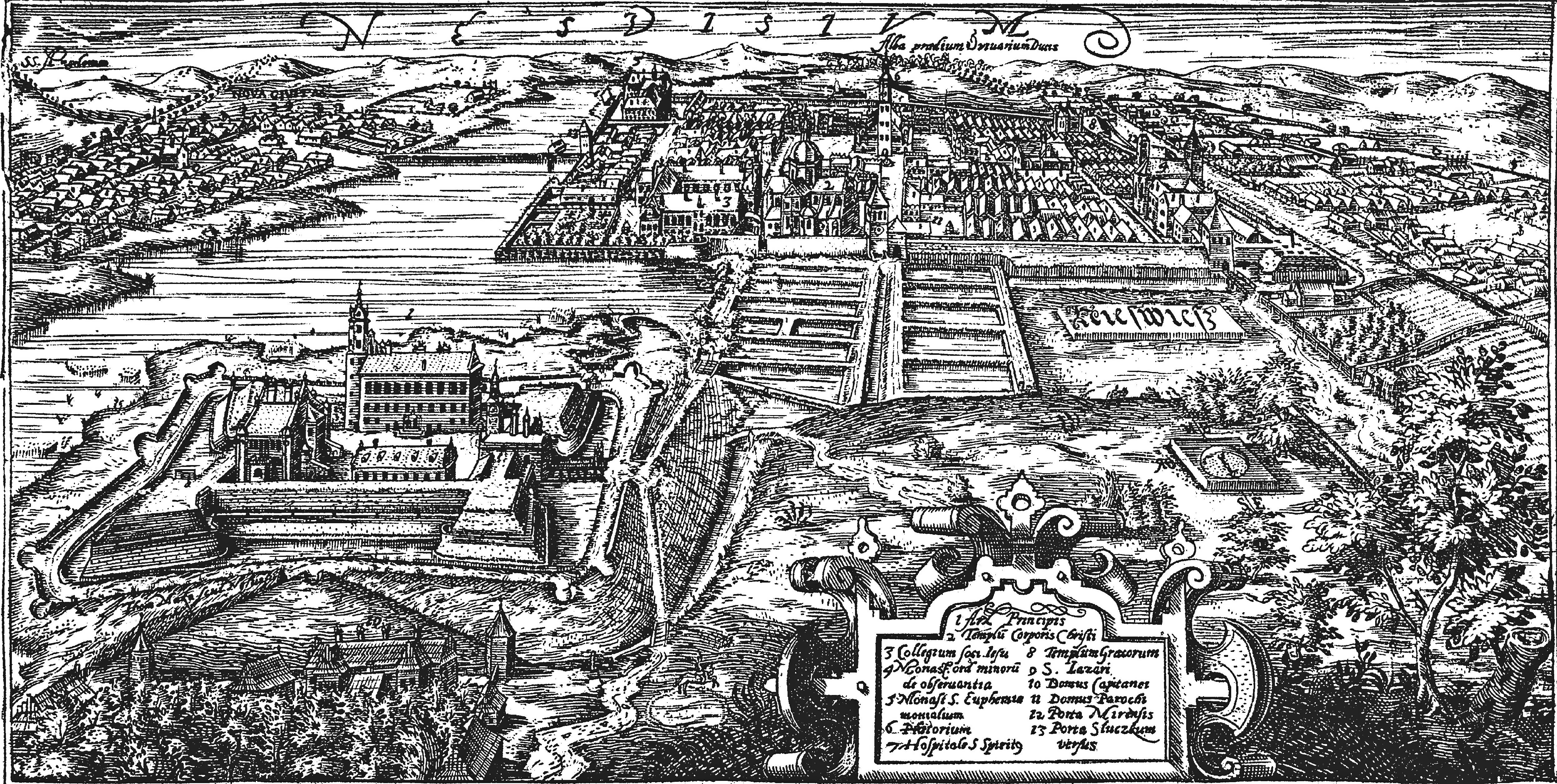
Nesvizh was first documented in 1223. It was part of the Grand Duchy of Lithuania until 1793, but the Grand Duchy was part of the Polish–Lithuanian Commonwealth since 1569. In the 15th century, while still a minor town, it belonged to the Kiszka family and later to the Radziwiłł family, and remained the family's seat until 1813.
In 1561 or 1562 Maciej Kawęczyński founded the print works of the Polish Brethren. The first Belarusian language book printed in Latin script, a catechism by Symon Budny, was published in Nesvizh in 1562. The Nieśwież Bible (Biblia nieświeska), one of the oldest Polish translations of the Bible, also by Budny, was completed there in 1571 and published in 1572.
Nesvizh Castle was erected in 1583, and between 1584 and 1598 the Benedictines and Jesuit religious orders founded monasteries and a college. At the request of Mikołaj "the Orphan" Radziwiłł Nieśwież was granted Magdeburg town rights by King Stephen Báthory in 1586. Two epidemics affected the city early in the 17th century which led to the establishment of a pharmacy in 1627.
During the Great Northern War of 1700–21, the city was significantly damaged by Swedish troops. It was rebuilt in the 1720s by Michał "Rybeńko" Radziwiłł. In the aftermath of the war, in the 1740s and 1750s he founded a Pas slucki factory which was later moved to Sluck. He introduced a military school, several textile factories and restored the Corpus Christi Church and opened a print works. Michał's wife, Franciszka Urszula Radziwiłłowa, founded the Nieśwież Radziwiłł Theatre, including a choir and a ballet school.
_(2).jpg)
Between 1764 and 1768 the city was occupied by Russian troops, and in 1772, at the First Partition of Lithuania-Poland, the library, which comprised circa 10,000 volumes, along with paintings and other art objects, was seized and transferred to St. Petersburg. Some books from the library were passed to the Russian Academy of Sciences.
After the Second partition of Lithuania-Poland in 1793, Nieśwież was annexed by Russia, and renamed Nesvizh. In 1906, the Polish Society "Oświata" ("Education") in Nesvizh was established, but its activities were hampered by the Russian administration, before banning it at the start of 1910. In 1912 the Russian authorities also liquidated the Roman Catholic Charity Society in Nesvizh.
After the fall of tsarist Russia, fighting broke out for control over the city and surrounding region. The city came under Soviet rule in early 1919 (Polish–Soviet War), the unsuccessful Nieśwież uprising by Polish residents took place during March 14–19, 1919.
.jpg)
Following the Soviet invasion of Poland at the start of World War II in September 1939, it was part of the Byelorussian Soviet Socialist Republic from 1939 to 1941, then was occupied from 1941 to 1944 by the Germans in accordance with Operation Barbarossa. The town was re-occupied by the Soviets during Operation Bagration in 1944. Nyasvizh's status as part of the Byelorussian Soviet Socialist Republic was solidified in accordance with the Potsdam Agreement.

The Jews of Nesvizh
The Jewish population in 1900 stood at 4,687, and approx. 4,500 on the eve of the German invasion, Operation Barbarossa. With the occupation from June 27, 1941, a Judenrat was established. On October 30, 4,000 of the town's Jews were murdered and the rest confined to a ghetto. On July 20, 1942, the ghetto was surrounded by Belarusian police and the German commander announced that the ghetto's population would be liquidated with the exception of 30 essential skilled workers. The ghetto's underground organization, based on a Soviet-era Zionist group, called an uprising armed only with one machine gun, small arms but mostly knives. Most of the Jews were killed. A few escaped to nearby forests and joined partisan units, such as the Zhukov Jewish partisan unit.
Demographics
| 1897| 8400 | 1921|6840 | 1931| 7357 | 1959| 6700 | 1970| 9008 | 1979| 11979 | 1989| 14039 | 2006| 13883 | 2018| 15808 | 2023| 15907 | 2024| 15968 | 2025| 15909
Main sights
- Nesvizh Castle, the family complex of the Radziwiłł family, is a World Heritage Site.
- The Corpus Christi Church, built between 1587 and 1593, is one of the earliest Jesuit churches in the world and one of the first baroque buildings in the Polish–Lithuanian Commonwealth. It came to influence the later architecture of present-day Belarus, Poland and of Lithuania. It contains the tombs of the Radziwiłł family.
- Slutsk Gate, a city gate constructed around 1700. Its name refers to the city of Slutsk.
- Baroque Town Hall and cloth hall
- Baroque Benedictine monastery
- Baroque Craftsman House from 1721, formerly known as the Gdansk House, named after the city of Gdańsk File:Замак-палац у Нясьвіжы знутры.jpg|Nesvizh Castle courtyard File:Нясвіж Касцёл Божага Цела.JPG|Corpus Christi Church File:Nyasvizh SluckGate 001 4603.jpg|Slutsk Gate File:Niasviž Town Hall 2023-07-03 6301.jpg|Town Hall and cloth hall File:Нясвіж. Вежа-званіца былога касцёла і кляштара бенедыктынак (2).jpg|Benedictine monastery File:Нясвіж. Дом рамесніка 2.jpg|Gdańsk House
International relations
Nyasvizh is twinned with:
- ISR Carmel, Israel
- RUS Gatchinsky District, Russia
- ARM Goris, Armenia
- AZE İsmayıllı, Azerbaijan
- RUS Reutov, Russia
- ITA Rosolini, Italy
- TUR Silivri, Turkey
- SRB Zemun (Belgrade), Serbia
Notable people
- Karol Stanisław Radziwiłł (1734–1790), Polish nobleman and politician
- Michael Goleniewski (1922–1993), Polish spy
- Piotr Jaroszewicz (1909–1992), Polish politician
- Jacob S. Raisin (1878–1946), Belarusian-American rabbi
- Max Raisin (1881–1957), Belarusian-American rabbi
- Michał Vituška (1907–1945), Belarusian leader of the Black Cats
Notes
References
References
- "Численность населения на 1 января 2025 г. и среднегодовая численность населения за 2024 год по Республике Беларусь в разрезе областей, районов, городов, поселков городского типа".
- "Region information on the official website of the Nesvizh Regional Executive Committee (in Russian)".
- Józef Łukaszewicz, ''Dzieje kościołów wyznania helweckiego w Litwie'', t. 2, Poznań 1822, p. 180-181
- (December 2017). "Minsk celebrates 440th anniversary of first Belarusian book printed in Cyrillic alphabet". Ministry of Foreign Affairs of the [[Republic of Belarus]].
- (2006). "Энцыклапедыя "Вялікае княства Літоўскае" (том 2)". Беларуская Энцыклапедыя.
- Maciej Rysiewicz. (14 March 2019). "Powstanie w Nieświeżu – z cyklu "Droga do niepodległości"".
- . (1923). "Skorowidz miejscowości Rzeczypospolitej Polskiej. Tom VII. Część I". *Główny Urząd Statystyczny*.
- "Jewish Gen Town Locator".
- Shalom Cholawski, '''Nesvizh''' in the [[Encyclopedia of the Holocaust]], vol. 3, pp.1043-1044
- [link](https://web.archive.org/web/20200918203113/http://mbc.cyfrowemazowsze.pl/dlibra/plain-content?id=14478. — Warszawa: Główny Urząd Statystyczny, 1933. — S. 1-5.)
- Беларуская Савецкая Энцыклапедыя: у 12 т. / гал. рэд. П. У. Броўка. — Т. 12: БССР. — Мн.: Беларуская Савецкая Энцыклапедыя, 1975. — С. 697.
- "Всесоюзная перепись населения 1970 г. Численность городского населения союзных республик (кроме РСФСР), их территориальных единиц, городских поселений и городских районов по полу".
- "Всесоюзная перепись населения 1979 г. Численность городского населения союзных республик (кроме РСФСР), их территориальных единиц, городских поселений и городских районов по полу".
- "Всесоюзная перепись населения 1989 г. Численность городского населения союзных республик, их территориальных единиц, городских поселений и городских районов по полу".
- Статистический ежегодник Минской области. — Мінск: Национальный статистический комитет Республики Беларусь, 2018. — С. 45-48.
- Статистический ежегодник Минской области. — Мінск: Национальный статистический комитет Республики Беларусь, 2013. — С. 44-48.
- "Численность населения на 1 января 2023 г. и среднегодовая численность населения за 2022 год по Республике Беларусь в разрезе областей, районов, городов, поселков городского типа".
- "Численность населения на 1 января 2024 г. и среднегодовая численность населения за 2023 год по Республике Беларусь в разрезе областей, районов, городов, поселков городского типа".
- "Города-партнёры". Nyasvizh.
This article was imported from Wikipedia and is available under the Creative Commons Attribution-ShareAlike 4.0 License. Content has been adapted to SurfDoc format. Original contributors can be found on the article history page.
Ask Mako anything about Nyasvizh — get instant answers, deeper analysis, and related topics.
Research with MakoFree with your Surf account
Create a free account to save articles, ask Mako questions, and organize your research.
Sign up freeThis content may have been generated or modified by AI. CloudSurf Software LLC is not responsible for the accuracy, completeness, or reliability of AI-generated content. Always verify important information from primary sources.
Report