From Surf Wiki (app.surf) — the open knowledge base
Nueva Vizcaya
Province in Cagayan Valley, Philippines
Province in Cagayan Valley, Philippines
| Field | Value |
|---|---|
| name | Nueva Vizcaya |
| named_for | Biscay, Spain |
| settlement_type | |
| image_skyline | {{Photomontage |
| photo1a | Sta. Fe, Nueva Vizcaya (4458904289).jpg |
| photo2a | Dupax del Sur Church.jpg |
| photo2b | BayombongCapitolioNuevaVizcayajf9903_10.JPG |
| photo3a | Villaverde,NEjf5678 01.JPG |
| photo3b | Bayombong,NuevaVizcayajf0212 04.JPG |
| photo4a | Ph mtpulag.jpg |
| size | 250 |
| spacing | 2 |
| color | transparent |
| border | 0 |
| image_caption | (from top: left to right) Santa Fe, Dupax del Sur Church, Nueva Vizcaya Provincial Capitol, Villaverde Municipal Hall, Downtown Bayombong and Mount Pulag. |
| image_flag | |
| flag_size | 120x80px |
| image_seal | Nueva Vizcaya Seal.svg |
| seal_size | 100x80px |
| nicknames | Citrus Capital of the Philippines |
| Watershed Haven of Cagayan Valley | |
| anthem | Vizcaya Hymn |
| image_map | |
| map_caption | Location in the Philippines |
| mapframe | yes |
| mapframe-zoom | 7 |
| coordinates | |
| subdivision_type | Country |
| subdivision_name | |
| subdivision_type1 | Region |
| subdivision_name1 | |
| established_title | Founded |
| established_date | 1839 |
| seat_type | Capital |
| and largest municipality | |
| seat | Bayombong |
| government_type | |
| leader_title | Governor |
| leader_name | Jose V. Gambito (PFP) |
| leader_title1 | Vice Governor |
| leader_name1 | Eufemia A. Dacayo (Aksyon) |
| leader_title2 | Representative |
| leader_name2 | Timothy Joseph Cayton (Aksyon) |
| leader_title3 | Legislature |
| leader_name3 | Nueva Vizcaya Provincial Board |
| area_footnotes | |
| area_total_km2 | 4813.88 |
| area_rank | 31st out of 82 |
| elevation_max_m | 2,928 |
| elevation_max_point | Mount Pulag |
| population_footnotes | |
| population_total | |
| population_as_of | |
| population_rank | 59th out of 82 |
| population_density_km2 | auto |
| population_density_rank | 68th out of 82 |
| population_demonym | |
| demographics_type1 | Divisions |
| demographics1_title1 | Independent cities |
| demographics1_info1 | 0 |
| demographics1_title2 | Component cities |
| demographics1_info2 | 0 |
| demographics1_title3 | Municipalities |
| demographics1_info3 | {{Collapsible list |
| titlestyle | font-weight:normal;text-align:left;background-color:WhiteSmoke; |
| title | 15 |
| demographics1_title4 | Barangays |
| demographics1_info4 | 275 |
| demographics1_title5 | Districts |
| demographics1_info5 | Legislative district of Nueva Vizcaya |
| timezone | PHT |
| utc_offset | +8 |
| postal_code_type | ZIP code |
| postal_code | |
| area_code_type | |
| area_code | |
| iso_code | |
| blank_name_sec1 | Spoken languages |
| blank_info_sec1 | |
| website |
the Philippine province
Watershed Haven of Cagayan Valley | mapframe-zoom = 7 and largest municipality |
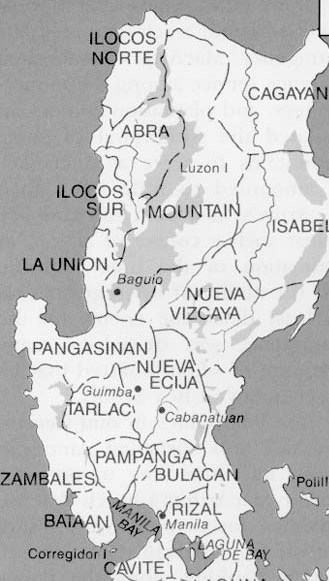
Nueva Vizcaya, officially the Province of Nueva Vizcaya, is a landlocked province in the Philippines located in the Cagayan Valley region in Luzon. Its capital and largest town is Bayombong. It is bordered by Benguet to the west, Ifugao to the north, Isabela to the northeast, Quirino to the east, Aurora to the southeast, Nueva Ecija to the south, and Pangasinan to the southwest. Quirino province was created from Nueva Vizcaya in 1966.
Etymology
The name Nueva Vizcaya is derived from the name of the province of Biscay (called Vizcaya in Spanish and Bizkaia in Basque) during the Spanish colonial period. This can be seen in the right part of the seal, a representation of the heraldry of Vizcaya in Spain.
History
Spanish colonial era
The areas of present-day Nueva Vizcaya used to be part of the vast Provincia de Cagayan. Organized religion in Nueva Vizcaya dates back to the year 1607, when the Dominican Order arrived in the province. It was not until 1609, however, that the first settlement of a religious order was established in the southern half of the province. In 1702, a convent was erected in Burubur at the foot of the Caraballo Mountains in Santa Clara, which is now a barangay in the town of Aritao. It was on this site that the first mass in Nueva Vizcaya was celebrated and the first baptism of a Christian convert was held.
Spanish conquest of Nueva Vizcaya was slow and difficult, and expeditions had to be sent recurrently due to the natives' refusal to accept Spanish sovereignty. In some of these expeditions, services of some local chieftains were used, the most famous of which was that commanded by Mariano Oscariz, in 1847–1848, which carried him clear through the province across to Palanan on the eastern coast of Luzon.
In 1818, Nueva Ecija annexed the towns of Palanan from Isabela, as well as Cagayan, Nueva Vizcaya, Quirino, Baler, Casiguran, Infanta (formerly called Binangonan de Lampon) and Polillo Islands from Tayabas, and part of Rizal.
In 1839, upon the advice of the alcalde mayor of Cagayan, Luis Lardizabal, then-Governor General of the Philippines created the politico-military province of Nueva Vizcaya. The order was approved by a Royal Decree on April 10, 1841. The name Nueva Vizcaya was named after Biscay, Spain, the hometown of Lardizabal. The original province covered the areas of present-day Nueva Vizcaya, Quirino, Ifugao, Apayao, Kalinga, and Benguet, Batanes, a large portion of Isabela, as well as north Aurora.
Civil government was established in the province by the Philippine Commission in 1902 during the American Colonial Period of the Philippines.
The territories of Nueva Vizcaya were greatly reduced when Nueva Vizcaya ceded a big portion of its north-eastern territory, including Camarag, its first capital, now Echague, to form the province of Isabela in May 1856.
American colonial era
In 1908, the northwestern territory of Nueva Vizcaya was annexed to the newly organized sub-province of Ifugao. The survey executed by the Bureau of Lands in 1914 further caused the diminution of its area and reduced again upon the enactment of the Administrative Code of 1917. Northern areas of present-day Aurora (composed of present towns of Dilasag & part of Casiguran) were annexed to Tayabas (now Quezon) in 1905. In 1918, the area of modern Aurora north of Baler (composed of Dinalungan, Dipaculao, & Maria Aurora, besides Casiguran & Dilasag) was transferred to the authority of Nueva Vizcaya but returned to Tayabas in 1946.
The province of Nueva Vizcaya was also included in the 12th district of the Philippine Senate during the American period. The district included Mountain Province (present-day Apayao, Kalinga, Mountain Province, and Benguet), Cotabato (undivided), Agusan (undivided), Davao (undivided), Zamboanga (undivided), and Sulu (undivided). The province was included in the district because of its ethnic compatibility with Mountain Province and other indigenous domains in the Cordilleras and Mindanao.

Japanese occupation

During the Pacific War of the Second World War, the Japanese captured Nueva Vizcaya and established a "comfort station" in the province, where Filipino "comfort women" were enslaved, routinely gang-raped, and murdered under Japanese control. The Dalton Pass was the scene of a major battle between the Empire of Japan, the Commonwealth of the Philippines and American forces, with the Allies winning on May 31, 1945.
Philippine Independence
In 1971, with the passage of Republic Act No. 6394, Quirino, which was then a sub-province of Nueva Vizcaya, was separated from its mother province and made into a regular province.
Geography
Surrounded by North Luzon's three large mountain ranges, Nueva Vizcaya is generally mountainous, varying from steep mountains to rolling hills, with some valleys and plains. It is bordered on the west by the Cordillera mountains, on the east by the Sierra Madre mountains, and on the south by the Caraballo Mountains. The province (and the entire Cagayan Valley) are separated from the Central Luzon plains by the Caraballo Mountains.
The province has a total land area of 3,975.67 km2. The southernmost province in the Cagayan Valley region, Nueva Vizcaya lies approximately 268 km north of Metro Manila and can be reached by land via the Cagayan Valley Road (Maharlika Highway).
Administrative divisions
Nueva Vizcaya comprises 15 municipalities, with Bayombong as the provincial capital and major educational center, Bambang (the agricultural hub) and Solano (the financial district) as the major commercial centers, and Kayapa as the summer capital and "vegetable bowl" of the province. All municipalities are encompassed by a lone legislative district, but are separated into two districts for purposes of representation in its provincial board. The 1st District comprises the municipalities of Ambaguio, Bagabag, Bayombong, Diadi, Quezon, Solano and Villaverde, while the 2nd District is composed of the municipalities of Alfonso Castañeda, Aritao, Bambang, Dupax del Norte, Dupax del Sur, Kayapa, Kasibu and Santa Fe.
Geographically, the western half of Nueva Vizcaya is part of the main Cordilleras, while its eastern half is part of the Caraballos, the meeting point of the Cordilleras and the Sierra Madre. There have been grassroot moves to reunify Nueva Vizcaya with the Cordillera Region due to cultural and geographical harmony, however, none have been introduced in Congress.
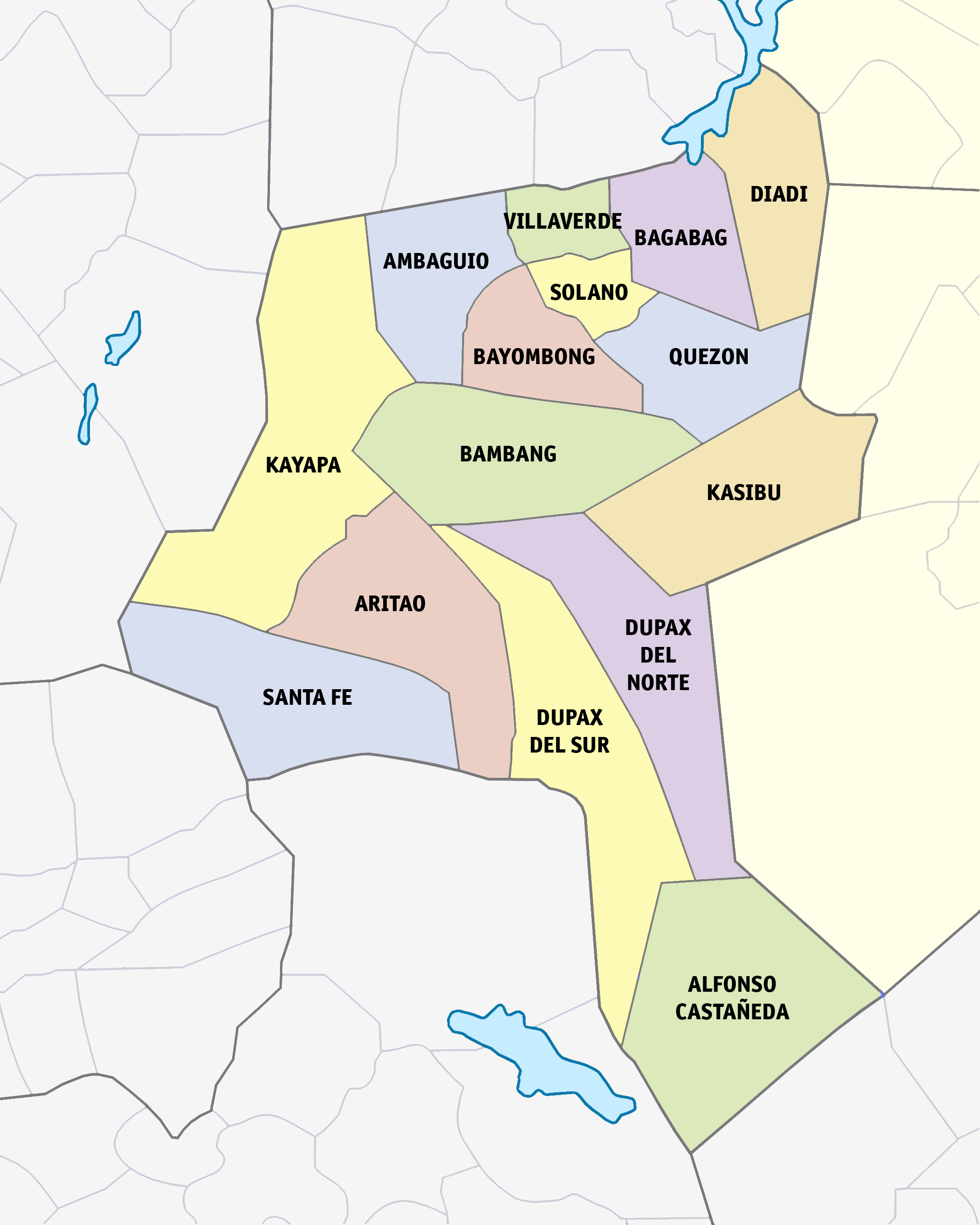
| Municipality | Population | Area | Density(2024) | Barangay | (2024) | (2020) | km2 | sqmi | /km2 | /sqmi | Total | 530,106 | 497,432 | 4,813.88 | 4,813.88 km2 | {{sigfig | 497,432/4,813.88 | 2}} PD/km2 | 275 |
|---|---|---|---|---|---|---|---|---|---|---|---|---|---|---|---|---|---|---|---|
| Alfonso Castañeda | 8,539 | 849.83 km2 | {{sigfig | 8,933/849.83 | 2}} PD/km2 | 6 | |||||||||||||
| Ambaguio | 15,472 | 156.26 km2 | {{sigfig | 16,401/156.26 | 2}} PD/km2 | 8 | |||||||||||||
| Aritao | 42,197 | 265.60 km2 | {{sigfig | 45,000/265.60 | 2}} PD/km2 | 22 | |||||||||||||
| Bagabag | 37,985 | 183.90 km2 | {{sigfig | 39,138/183.90 | 2}} PD/km2 | 17 | |||||||||||||
| Bambang | 55,789 | 345.00 km2 | {{sigfig | 60,146/345.00 | 2}} PD/km2 | 25 | |||||||||||||
| Bayombong | † | 67,714 | 163.36 km2 | {{sigfig | 72,890/163.36 | 2}} PD/km2 | 25 | ||||||||||||
| Diadi | 19,236 | 181.20 km2 | {{sigfig | 20,438/181.20 | 2}} PD/km2 | 19 | |||||||||||||
| Dupax del Norte | 33,295 | 347.30 km2 | {{sigfig | 35,509/347.30 | 2}} PD/km2 | 15 | |||||||||||||
| Dupax del Sur | 21,224 | 374.70 km2 | {{sigfig | 22,388/374.70 | 2}} PD/km2 | 19 | |||||||||||||
| Kasibu | 41,776 | 318.80 km2 | {{sigfig | 46,845/318.80 | 2}} PD/km2 | 30 | |||||||||||||
| Kayapa | 26,469 | 740.20 km2 | {{sigfig | 27,865/740.20 | 2}} PD/km2 | 30 | |||||||||||||
| Quezon | 24,055 | 266.62 km2 | {{sigfig | 25,306/266.62 | 2}} PD/km2 | 12 | |||||||||||||
| Santa Fe (Imugan) | 18,276 | 399.81 km2 | {{sigfig | 18,950/399.81 | 2}} PD/km2 | 16 | |||||||||||||
| Solano | 65,287 | 139.80 km2 | {{sigfig | 69,296/139.80 | 2}} PD/km2 | 22 | |||||||||||||
| Villaverde (Ibung) | 20,118 | 81.50 km2 | {{sigfig | 21,001/81.50 | 2}} PD/km2 | 9 | |||||||||||||
| Provincial capital | Municipality |
Barangays
Main article: List of barangays in Nueva Vizcaya
The 15 municipalities of the province comprise a total of 275 barangays, with Roxas in Solano, Nueva Vizcaya as the most populous in 2010, and Santa Rosa in Santa Fe, Nueva Vizcaya as the least.
Demographics

The population of Nueva Vizcaya in the 2024 census was 530,106 people, with a density of {{sigfig|530,106/3,975.67|2}} PD/km2.
Nueva Vizcaya is home to about 18 indigenous peoples, which includes the major tribes of the Ifugao (Quezon, Bagabag, Kasibu), Gaddang (Solano and Bayombong), Isinai (Dupax del Sur and Bambang), Dumagat (Aritao), Kalanguya (Santa Fe), and the Bugkalot (Alfonso Castañeda and Dupax del Norte). Indigenous peoples' groups have filed for ancestral domain titles covering parts of the province.
The Ilokano population in the province are not indigenous as they were part of the labor force initially needed by the Spanish administration to work on the tobacco plantations beginning in the 1700s, and later immigrants with skills construct churches and other structures needed for development. Indigenous tribes were not cooperative with the Spaniards. After several insurrections by the locals, Spanish officials chose to import trained labor from established settlements in the coastal regions of Pangasinan and Ilocos. So, it was deliberated in the Spanish Congress the need for in migration of labor. After it was voted by a majority and approved by the king, Ilocanos started to migrate and were given homestead. Thus, the start of the migration of Ilocanos in the province.
Every last week of May, these ethnolinguistic groups gather to celebrate the Ammungan festival (formerly Panagyaman festival), a week-long affair culminating on May 24, the province's foundation day.
Since Nueva Vizcaya's birth as a province, traces of the culture and customs of its early settlers—the Igorots [Ilongots (Bugkalot), Ifugaos, Isinais, Kalanguya], Gaddangs, and the Pangasinans—can still be seen. The influx of civilization and the infusion of modern technology to the life stream of the province induced immigration from adjacent provinces. The province was pushed to be included in the Cordillera Autonomous Region because the province is technically within the Cordillera, however, it did not came to be due to the failure to enact an autonomous Cordillera by the national government. Today, questions linger on the exclusion of Nueva Vizcaya despite the province being culturally and geographically linked to the Cordilleras. The province also has the largest Igorot population outside the Cordillera region. Tagalogs live along the border of Nueva Ecija and in the capital, Bayombong.
Languages
Nueva Vizcaya province possesses one of the most diverse array of indigenous languages in Luzon, a testimony to its cultural and geographic linkages with the Cordillera mountain range. The indigenous languages of the province listed by the Komisyon ng Wikang Filipino are the Bugkalut language, Ibaloy language, Ifugaw language, Iguwak language, Irungdungan language, Isinay language, Kalanguya language, and Kankanaey language. During the later part of the Spanish regime, people from Ilocos region migrated to the province through the recommendation of Spanish officials in the province. It was deliberated in the Spanish court in Spain and with a majority vote and approval of the king of Spain, Ilocanos were allowed to migrate to the province. Thus, the importation of the Ilocano language and culture started, becoming the lingua franca of the province. Ilocano accents were affected by the native languages of the peoples whom Ilocanos intermingled with. Remarkably, the economy of the province started to grow because of the industry of the Ilocanos as well as through their innate talent in entrepreneurship and in other industries including agriculture. As Nueva Vizcaya was part of Provincia de Cagayan which is the predecessor of Cagayan Valley, a few residents speak Ibanag, which was the lingua franca of Provincia de Cagayan before it was replaced by Ilocano.
Religion
Roman Catholics are about 63% of the population of the province. Other faiths are divided among Aglipayan Church, Iglesia ni Cristo which form about 5–6% of the province population, The Church of Jesus Christ of Latter-day Saints, Jehovah's Witnesses, Baptist, Methodist, Pentecostals, Seventh-day Adventist and other Evangelical Christians which forms about 17%–20% of the province's population as well as Muslims and indigenous Cordilleran religions.
Economy

Agriculture is the main industry in the province, together with rice, corn, fruits and vegetables as major crops.
There is a mining industry in the province such as the Didipio mine in the municipality of Kasibu, which added to the provincial income. However, mining activities have also been alleged to have dried up water sources, polluted the environment, and endangered livelihoods of farmers and fisherfolk. According to the Mines and Geosciences Bureau, deposits of metallic minerals discovered in the province are copper, gold, molybdenum and pyrite. Non-metallic deposits include red clay, white clay and limestone, with sand and gravel being the most abundant deposits in the province.
Government
Nueva Vizcaya has one congressional district, although there has been a longtime proposal to divide the province into two congressional districts.
| Position | Provincial Official | Provincial Governor | Provincial Vice Governor | District Representative (Lone District of Nueva Vizcaya) | Provincial Board Members |
|---|---|---|---|---|---|
| Atty. Jose V. Gambito | |||||
| Eufemia A. Dacayo | |||||
| Rep. Timothy Joseph Cayton | |||||
| Patricio Dumlao Jr. | |||||
| Byron Sevillena | |||||
| Delbert Tidang | |||||
| Eunice Gambol | |||||
| Atty. Primo Percival Marcos | |||||
| Roland Carub | |||||
| Pablo Kindot | |||||
| Atty. Edgardo C. Balgos | |||||
| Florante S. Gerdan | |||||
| Elma Pinao-an Lejao | |||||
| Eufemia Dacayo | |||||
| Victor Gines Jr. | |||||
| Marizel Reyes | |||||
| Samuel Balinhawang |
Culture
Main article: Ammungan Festival
Every May, the province holds the Ammungan Festival, a five-day festival in celebration for its founding anniversary. The word "Ammungan" is a Gaddang word meaning "gathering" symbolizing the unity of the different ethnolinguistic groups in the province. The festival showcase different shows including cultural showcase, beauty pageant, agri-trade fair, tourism expo, dance competitions and a concerts.
Education
Nueva Vizcaya has the following education institutions, among others.
- Saint Catherine's School (Bambang)
- Saint Jerome's Academy
- Nueva Vizcaya State University, with campuses in Bayombong and Bambang.
- Saint Mary's University (Bayombong)
- Muir Woods Academy, Inc. (Bayombong)
- Philippine Science High School – Cagayan Valley Campus (Bayombong)
- Aldersgate College (Solano)
- Sierra College (Bayombong)
- PLT College, Inc. (Bayombong)
- JARS Academy (Bayombong)
- Our Lady of Peace and Good Voyage Institue of Technology Inc (‘’Bayombong’’)
- King's Colleges of the Philippines (Bambang)
- Saint Mary's School of Dupax
- Saint Teresitas's Academy of Aritao
- Dupax del Norte National High School
- Dupax del Sur National High School
- Ganao National High School
- Saint Catherine of Siena
- Saint Louis School (Solano)
- Solano High School (Solano)
- Nueva Vizcaya General Comprehensive High School (Bayombong)
- Northern Luzon Technical Institute (Bayombong)
- Nueva Vizcaya Caregiver Academy (Solano)
- Nueva Vizcaya Institute (Aritao)
- Solano Institute of Technology (Solano)
- Vizcaya Institute of Computer Science (Bayombong)
- Aurora Christian School (Bambang)
Notable personalities
- Carlos Padilla - (Dupax del Norte) - Governor and Congressman of Nueva Vizcaya. (2016–2022 and 1987–1992, 1995–2004, 2007–2016)
- Edith Tiempo – (Bayombong) – National Artist for Literature
- John Castriciones – (Bayombong) – Secretary of Agrarian Reform (2017–2021)
- Danilo Lim – (Solano) – Army officer, coup-plotter and Chairman of the Metropolitan Manila Development Authority (2017–2021)
- Vicente Danao – (Bayombong) – Chief of the Philippine National Police (2022)
- Leonardo B. Perez – (Bayombong) – Senator (1967–1972) and Chairman of the Commission on Elections (1973–1980)
- Romeo A. Brawner – (Solano) – Chairman of the Commission on Elections (2008)
- Roy V. Aragon – (Dupax del Norte) – Author
- Jimboy Martin – (Solano) – Actor/Rapper – PBB 737 winner
- Hillarie Parungao – (Solano) – Philippine representative and Top 10 semifinalist at the Miss World 2015 pageant
- Marites Vitug – (Solano) – investigative journalist
- Xyza Cruz Bacani – (Bambang) – International street photographer first recognized by New York Times magazine in 2015.
- Stacey Sevilleja – (Bagabag) – member of the Pinoy pop group Bini
Notes
References
References
- "List of Provinces". National Statistical Coordination Board.
- "History of the Philippines". Project Gutenberg.
- "Who We Are: Nueva Ecija".
- "Provincial Profile".
- (1995). "Fast Facts about Philippine Provinces". Tahanan Books.
- "Aurora, Philippines – History".
- "Philippine Survivor Recounts Her Struggle As A 'Comfort Woman' For Wartime Japan". NPR.
- (2008). "The Other Empire: Literary Views of Japan from the Philippines, Singapore, and Malaysia". The University of the Philippines Press.
- "Women made to be Comfort Women – Philippines".
- "Brief History of Quirino".
- (17 July 2025). "Table B - Population and PGR by Region, Province/HUC, and City/Municipality".
- "Dipaculao Egongot ICCA, Philippines".
- Ebreo, Ben Moses. (May 1, 2017). "IP tribe pushes domain claim". Manila Standard.
- (July 14, 2014). "Nueva Vizcaya mounts Ammungan fest, celebrates diversity". [[Philippine Daily Inquirer]].
- "Municipal Profile {{!}} Santa Fe, Nueva Vizcaya".
- (16 July 2020). "Sta. Fe – Nueva Vizcaya, Philippines".
- "MAP: Catholicism in the Philippines".
- "MAP: Iglesia ni Cristo in the Philippines".
- "Archived copy".
- [http://psa.gov.ph/sites/default/files/attachments/hsd/specialrelease/Nueva%20Vizcaya_Statistical%20Tables.xls Nueva Vizcaya Statistical Tables] psa.gov.ph {{Webarchive. link. (January 27, 2018)
- (October 17, 2013). "OceanaGold inks deal". The Standard Business.
- (September 13, 2013). "OceanaGold to invest $20m". The Standard.
- Umil, Anne Marxze. (March 7, 2020). "Highlights of complaints submitted to UN human rights body".
- (October 5, 2014). "Investigating mining pollution and plunder in Nueva Vizcaya".
- Dullana, Raymon. (March 6, 2018). "Nueva Vizcaya officials vow to block renewal of OceanaGold mining permit".
- "Mines and Geosciences Bureau; Mines Sector".
- (February 19, 2020). "Legislative Branch – Nueva Vizcaya, Philippines".
- "Nueva Vizcaya presents 5th 'Ammungan ' Festival".
- (13 May 2019). "Nueva Vizcaya's Ammungan Festival to showcase local products". Manila Standard.
- (May 27, 2024). "Nueva Vizcaya holds 15th Ammungan festival". ABS-CBN News.
- "Senate honors the "Legend of the North"".
- "Order of National Artists: Edith L. Tiempo".
- "PROFILE: John Castriciones {{!}} Candidate for Senator – 2022 elections".
- (January 6, 2021). "Danny Lim: The West Pointer who rebelled against a system, then embraced it".
- (October 25, 2013). "Danao takes over from Dela Rosa". Edge Davao.
- "Senate Resolution No. 36". Senate of the Republic of the Philippines.
- "Hillarie Danielle Parungao is Miss World Philippines 2015". Manila Standard.
- Viloria, Angelica. (October–December 2012). "Dañguilan-Vitug launches book in NV". [[Saint Mary's University (Philippines).
- (28 October 2024). "Stacey Sevilleja on Growing with BINI: 'A Good Heart Will Always Win'". Vogue Philippines.
This article was imported from Wikipedia and is available under the Creative Commons Attribution-ShareAlike 4.0 License. Content has been adapted to SurfDoc format. Original contributors can be found on the article history page.
Ask Mako anything about Nueva Vizcaya — get instant answers, deeper analysis, and related topics.
Research with MakoFree with your Surf account
Create a free account to save articles, ask Mako questions, and organize your research.
Sign up freeThis content may have been generated or modified by AI. CloudSurf Software LLC is not responsible for the accuracy, completeness, or reliability of AI-generated content. Always verify important information from primary sources.
Report