From Surf Wiki (app.surf) — the open knowledge base
Nucleoprotein
Type of protein
Type of protein
Nucleoproteins are proteins conjugated with nucleic acids (either DNA or RNA). Typical nucleoproteins include ribosomes, nucleosomes and viral nucleocapsid proteins.
Structures

Nucleoproteins tend to be positively charged, facilitating interaction with the negatively charged nucleic acid chains. The tertiary structures and biological functions of many nucleoproteins are understood. Important techniques for determining the structures of nucleoproteins include X-ray diffraction, nuclear magnetic resonance and cryo-electron microscopy.
Viruses
Virus genomes (either DNA or RNA) are extremely tightly packed into the viral capsid. Many viruses are therefore little more than an organised collection of nucleoproteins with their binding sites pointing inwards. Structurally characterised viral nucleoproteins include influenza, rabies, Ebola, Bunyamwera, Schmallenberg, Hazara, Crimean-Congo hemorrhagic fever, and Lassa.
Deoxyribonucleoproteins
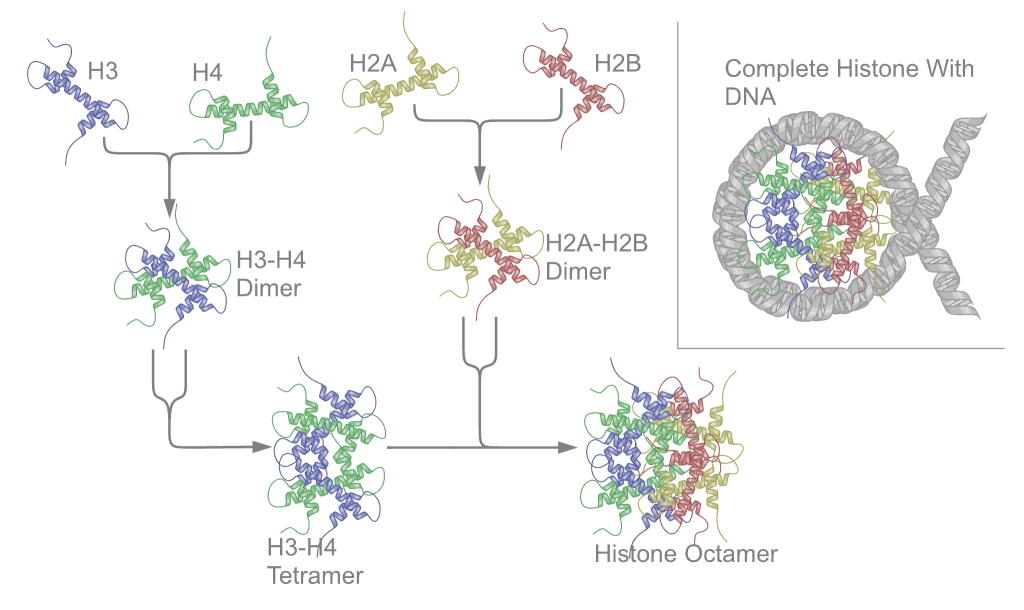
A deoxyribonucleoprotein (DNP) is a complex of DNA and protein. The prototypical examples are nucleosomes, complexes in which genomic DNA is wrapped around clusters of eight histone proteins in eukaryotic cell nuclei to form chromatin. Protamines replace histones during spermatogenesis.
Functions
The most widespread deoxyribonucleoproteins are nucleosomes, in which the component is nuclear DNA. The proteins combined with DNA are histones and protamines; the resulting nucleoproteins are located in chromosomes. Thus, the entire chromosome, i.e. chromatin in eukaryotes consists of such nucleoproteins.
In eukaryotic cells, DNA is associated with about an equal mass of histone proteins in a highly condensed nucleoprotein complex called chromatin. Deoxyribonucleoproteins in this kind of complex interact to generate a multiprotein regulatory complex in which the intervening DNA is looped or wound. The deoxyribonucleoproteins participate in regulating DNA replication and transcription.
Deoxyribonucleoproteins are also involved in homologous recombination, a process for repairing DNA that appears to be nearly universal. A central intermediate step in this process is the interaction of multiple copies of a recombinase protein with single-stranded DNA to form a DNP filament. Recombinases employed in this process are produced by archaea (RadA recombinase), by bacteria (RecA recombinase) and by eukaryotes from yeast to humans (Rad51 and Dmc1 recombinases).
Ribonucleoproteins
Main article: Heterogeneous ribonucleoprotein particle
Anti-RNP antibodies
Anti-RNP antibodies are autoantibodies associated with mixed connective tissue disease and are also detected in nearly 40% of Lupus erythematosus patients. Two types of anti-RNP antibodies are closely related to Sjögren's syndrome: SS-A (Ro) and SS-B (La). Autoantibodies against snRNP are called Anti-Smith antibodies and are specific for SLE. The presence of a significant level of anti-U1-RNP also serves a possible indicator of MCTD when detected in conjunction with several other factors.
Functions
The ribonucleoproteins play a role of protection. mRNAs never occur as free RNA molecules in the cell. They always associate with ribonucleoproteins and function as ribonucleoprotein complexes.
In the same way, the genomes of negative-strand RNA viruses never exist as free RNA molecule. The ribonucleoproteins protect their genomes from RNase. Nucleoproteins are often the major antigens for viruses because they have strain-specific and group-specific antigenic determinants.
References
References
- {{MeshName. Nucleoproteins
- Graeme K. Hunter G. K. (2000): Vital Forces. The discovery of the molecular basis of life. Academic Press, London 2000, {{ISBN. 0-12-361811-8.
- Nelson D. L., Cox M. M. (2013): Lehninger Biochemie. Springer, {{ISBN. 978-3-540-68637-8.
- (March 2003). "Forces and Pressures in DNA Packaging and Release from Viral Capsids". Biophysical Journal.
- (2005). "Forces during Bacteriophage DNA Packaging and Ejection". Biophysical Journal.
- (2009-05-27). "Structure and sequence analysis of influenza A virus nucleoprotein". Science in China Series C: Life Sciences.
- (2006-07-21). "Crystal Structure of the Rabies Virus Nucleoprotein-RNA Complex". Science.
- (2013-06-01). "Nucleocapsid protein structures from orthobunyaviruses reveal insight into ribonucleoprotein architecture and RNA polymerization". Nucleic Acids Research.
- (2015-01-01). "The crystal structure of the Hazara virus nucleocapsid protein". BMC Structural Biology.
- (2012-10-15). "Structure, Function, and Evolution of the Crimean-Congo Hemorrhagic Fever Virus Nucleocapsid Protein". Journal of Virology.
- (2010). "Cap binding and immune evasion revealed by Lassa nucleoprotein structure". Nature.
- {{MeshName. Deoxyribonucleoproteins
- Nelson D. L., Michael M. Cox M. M. (2013): Lehninger Principles of Biochemistry. W. H. Freeman, {{ISBN. 978-1-4641-0962-1.
- Lodish, Harvey. "Molecular Cell Biology".
- Echols, Harrison. (1990). "Nucleoprotein structures initiating DNA replication, transcription, and site-specific recombination". The Journal of Biological Chemistry.
- (1998). "RadA protein is an archaeal RecA protein homolog that catalyzes DNA strand exchange". Genes Dev..
- (2000). "The importance of repairing stalled replication forks". Nature.
- (2018). "Spontaneous self-segregation of Rad51 and Dmc1 DNA recombinases within mixed recombinase filaments". J. Biol. Chem..
- (2015-05-12). "A Ribonucleoprotein Complex Protects the Interleukin-6 mRNA from Degradation by Distinct Herpesviral Endonucleases". PLOS Pathogens.
- (2016-11-07). "Diverse RNA-Binding Proteins Interact with Functionally Related Sets of RNAs, Suggesting an Extensive Regulatory System". PLOS Biology.
- (2008-08-01). "RNA-binding proteins in human genetic disease". Trends in Genetics.
- "Ribonucleoprotein".
- Bank, RCSB Protein Data. "RCSB Protein Data Bank - RCSB PDB".
- (2016-11-07). "PRIDB: a protein–RNA interface database". Nucleic Acids Research.
- (2014-02-01). "Computational modeling of protein-RNA complex structures". Methods.
- (2011-06-22). "Apical Transport of Influenza A Virus Ribonucleoprotein Requires Rab11-positive Recycling Endosome". PLOS ONE.
- (1994-07-01). "Structure of influenza virus RNP. I. Influenza virus nucleoprotein melts secondary structure in panhandle RNA and exposes the bases to the solvent.". The EMBO Journal.
- "Mixed Connective Tissue Disease (MCTD) {{!}} Cleveland Clinic".
- (2011). "Nucleoproteins and nucleocapsids of negative-strand RNA viruses". Current Opinion in Microbiology.
This article was imported from Wikipedia and is available under the Creative Commons Attribution-ShareAlike 4.0 License. Content has been adapted to SurfDoc format. Original contributors can be found on the article history page.
Ask Mako anything about Nucleoprotein — get instant answers, deeper analysis, and related topics.
Research with MakoFree with your Surf account
Create a free account to save articles, ask Mako questions, and organize your research.
Sign up freeThis content may have been generated or modified by AI. CloudSurf Software LLC is not responsible for the accuracy, completeness, or reliability of AI-generated content. Always verify important information from primary sources.
Report