From Surf Wiki (app.surf) — the open knowledge base
Nuclear power in Germany
none

none
Nuclear power was used in Germany from the 1960s until it was fully phased out in April 2023.
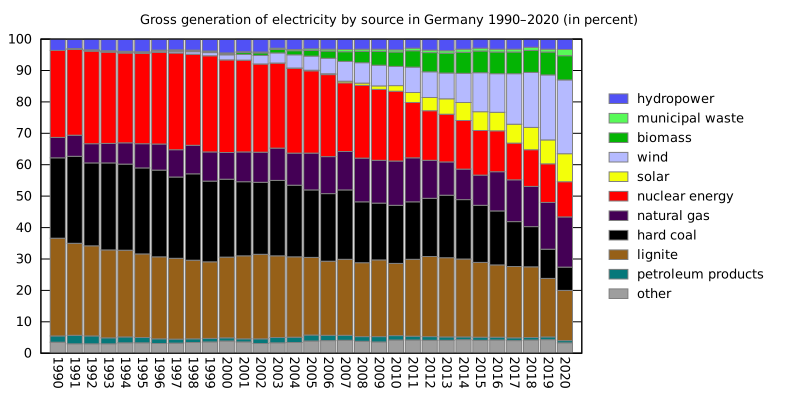
German nuclear power began with research reactors in the 1950s and 1960s, with the first commercial plant coming online in 1969. By 1990, nuclear power accounted for about a quarter of the electricity produced in the country. Nuclear power accounted for 13.3% of German electricity supply in 2021, supplied by six power plants. Three of these were switched off at the end of 2021, and the other three ceased operations by April 2023.
The anti-nuclear movement in Germany has a long history dating back to the early 1970s and intensified following the Chernobyl disaster in 1986. After the March 2011 Fukushima nuclear disaster and subsequent anti-nuclear protests, the government announced that it would close all of its nuclear power plants by 2022. Eight of the 17 operating reactors in Germany were permanently shut down following Fukushima.
While nuclear power was gradually phased out of the German power mix, Germany increased its use of fossil fuel energy by 7% over the period 2002–2022, with a massive increase in usage of natural gas and only modest reductions of coal power and oil power. By some estimates, Germany could have achieved a 73% reduction in its carbon emissions by retaining nuclear power during the period 2002–2022 and could have saved €696 billion on its energy transition.
History
Early nuclear research in Germany
Prior to the takeover of Nazi Germany, German universities were the employers of some of the world's most renowned nuclear physicists, including Albert Einstein, Otto Hahn, Lise Meitner, Leo Szilard, and others. In 1938, Hahn and his colleague Fritz Straßmann conducted an experiment designed by Lise Meitner (who had already been driven into exile due to her Jewish ancestry), which led to the discovery of nuclear fission. Soon thereafter, a "race" began between the soon-to-be belligerents of World War II to find military or civilian applications of the new technology. Hampered by infighting, lack of resources, mistakes, and the suspicion of Nazi authorities against "Jewish physics", the Uranverein ("uranium club") led by Werner Heisenberg never got close to building a Uranmaschine ("uranium machine"—what the Americans called a "pile") that achieved criticality, let alone building a nuclear weapon. When the Americans took over the last German attempt at a research reactor during the war at Haigerloch in southwestern Germany, it was clear to the people involved in the Alsos Mission that Germany had fallen behind the Manhattan Project to a considerable degree.
First nuclear power plants
As in many industrialised countries, nuclear power in Germany was first developed in the late 1950s. Only a few experimental reactors went online before 1960, and an experimental nuclear power station in Kahl am Main opened in 1960. All of the German nuclear power plants that opened between 1960 and 1970 had, as in the rest of the world at that time, a power output of less than 1,000 MW and have now all closed down. The first almost fully commercial nuclear power plant started operating in 1969; Obrigheim operated until 2005, when it was shut down by a phaseout decision of the government. The first stations with a power output of more than 1000 MW each were the two units of the Biblis Nuclear Power Plant in 1974 and 1976.
In the early 1960s, there was a proposal to build a nuclear power station in West Berlin, but the project was dropped in 1962. Another attempt to site a reactor in a major city was made in 1967, when BASF planned to build a nuclear power station on its grounds at Ludwigshafen to supply process steam. The project was withdrawn by BASF.
Attempts at developing a closed fuel-cycle and breeding reactors
A closed nuclear fuel cycle was planned, starting with mining operations in the Saarland and the Schwarzwald; uranium ore concentration, fuel rod filling production in Hanau; and reprocessing of the spent fuel in the never-built nuclear fuel reprocessing plant at Wackersdorf. The radioactive waste was intended to be stored in a deep geological repository as part of the Gorleben long-term storage project. Today, there is a "ergebnisoffener" searching process over the whole country for the storage of the irradiated nuclear fuel.
In 1959, 15 municipal electric companies established the Association of Experimental Reactor GmbH (Arbeitsgemeinschaft Versuchsreaktor, AVR) to demonstrate the feasibility and viability of a gas-cooled, graphite-moderated high temperature reactor (HTGR). In the early 1960s, it started the design and construction of AVR at the Jülich Research Centre. The first criticality was attained in 1966, and the AVR was in operation for more than 22 years. Despite the fact that fuel feed and discharge system showed excellent availability, the AVR was shut down for political reasons in 1988. The AVR was designed to breed uranium-233 from thorium-232. Thorium-232 is over 100 times as abundant in the Earth's crust as uranium-235.
In 1965, before the AVR started operation, a basic design for a commercial demonstration HTGR reactor using thorium was started, the THTR-300. The HTGR, rated at 300 MWe, synchronised with the grid in 1985. Six months later, a fuel pebble became lodged in the reactor core. After repairs, it was restarted and operated in July 1986, reaching full power in September 1986. It operated until September 1988 and was shut down in September 1989.
Early opposition and reactor closures
In the early 1970s, large public demonstrations prevented the construction of a nuclear plant at Wyhl. The Wyhl protests were an example of a local community challenging the nuclear industry through a strategy of direct action and civil disobedience. The police were accused of using unnecessarily violent means. Anti-nuclear success at Wyhl inspired nuclear opposition throughout Germany and elsewhere.

The Rheinsberg Nuclear Power Plant was the first (mostly experimental) nuclear power plant in East Germany. It was of low power and operated from 1966 until 1990. The second to be commissioned, the Greifswald Nuclear Power Plant, was planned to house eight of the Russian 440 MW VVER-440 reactors. The first four went online between 1973 and 1979. Greifswald 5 operated for less than a month before it was closed; the other three were cancelled during different stages of their build-up. In 1990, during the German reunification, all eastern German nuclear power plants were closed due to flaws in safety standards. The Stendal Nuclear Power Plant in East Germany was to be the largest nuclear power station in Germany. After German reunification and due to concerns about the Soviet design, construction was stopped, and the power station was never completed. In the 1990s, the three cooling towers that had been erected were demolished, and the area is an industrial estate today.
By 1992, a group of German and Swiss firms planned to proceed with the construction of the HTR-500, a design that made considerable use of the THTR-300 technology. But the politically hostile environment in the light of the Chernobyl disaster as well as technical issues with the THTR-300 halted any effort. The technology is now being pursued by the Chinese as the HTR-PM.
Construction ban and first phase-out schedule

During the chancellorship of Gerhard Schröder, the social democratic-green government decreed Germany's final retreat from using nuclear power by 2022.
This involved a ban on the construction of new nuclear power plants. Additionally, all existing nuclear power plants were given a budget of energy generated before their shutdown would be mandated, resulting in an average projected lifespan per plant of 32 years.
This resulted in first shutdowns of the Stade Nuclear Power Plant in November 2003 and the Obrigheim plant in 2005. The last plant to be shut down was expected to be Neckarwestheim II in 2021.
Changes to phase-out schedule
The phase-out plan was initially delayed in late 2010, when during the chancellorship of centre-right Angela Merkel, the coalition conservative-liberal government decreed a 12-year delay of the schedule. This delay provoked protests, including a human chain of 50,000 from Stuttgart to the nearby nuclear plant in Neckarwestheim. Anti-nuclear demonstrations on 12 March attracted 100,000 people across Germany.

On 14 March 2011, in response to the renewed concern about the use of nuclear energy raised by the Fukushima incident in the German public and in light of upcoming elections in three German states, Merkel declared a 3-month moratorium on the reactor lifespan extension passed in 2010. German engineering-industry giant Siemens announced a complete withdrawal from the nuclear industry in 2011 as a response to the Fukushima nuclear disaster. On 15 March, the German government announced that it would temporarily shut down 8 of its 17 reactors, i.e., all reactors that went online before 1981. Former proponents of nuclear energy, such as Angela Merkel, Guido Westerwelle, and Stefan Mappus, changed their positions. In the largest anti-nuclear demonstration ever held in Germany, some 250,000 people protested on 26 March 2011, under the slogan "heed Fukushima – shut off all nuclear plants".
On 30 May 2011, the German government announced a plan to shut down all nuclear reactors by 2022. Prior to the decision, Germany's renewable energy sector already provided 17% of Germany's electricity and employed about 370,000 people. The decision to phase out nuclear power has been called the swiftest change in political course since unification.
Political writer David Frum characterised Merkel's decision as a political move to improve her approval ratings, which had sagged after the post-2008 financial crisis bailout of southern Europe by Germany.
In September 2011, Siemens, which had been responsible for constructing all 17 of Germany's existing nuclear power plants, announced that it would exit the nuclear sector following the Fukushima disaster and the subsequent changes to German energy policy and would no longer build nuclear power plants anywhere in the world.
Merkel stated that Germany "[does not] only want to renounce nuclear energy by 2022, we also want to reduce our CO2 emissions by 40 percent and double our share of renewable energies, from about 17 percent today to then 35 percent".
Before 2011, Germany was getting just under a quarter of its electricity from nuclear power. After the Fukushima disaster, the following eight German nuclear power reactors were declared permanently shut down on 6 August 2011: BiblisA andB, Brunsbuettel, Isar1, Kruemmel, Neckarwestheim1, Philippsburg1, and Unterweser.

]]
Reactors
Radioactive waste management
Nuclear power plants take years to dismantle, and contaminated sites have to be cleared and declared free of radiation. One estimate puts the cost of dismantling Germany's nuclear reactor sites at €18 billion, not counting the cost of radioactive waste disposal.
Spent nuclear fuel is stockpiled in temporary locations. In Germany, heavily contaminated spent fuel rods are stored in Castor containers on several temporary sites around the country.
Germany is preparing the former iron ore mine Schacht Konrad in Salzgitter as a national facility for the permanent disposal of low- to medium-grade radioactive waste materials.
Nuclear Waste Disposal Fund
Main article: Nuclear Waste Disposal Fund
On 19 October 2016, the German cabinet (Bundeskabinett) finalised a deal with nuclear power plant operators E.ON, EnBW, RWE, and Vattenfall over long-term nuclear waste disposal. Under the agreement, the four operators are freed of responsibility for storing radioactive waste; that responsibility is instead transferred to the state. In return, the operators will pay a total of €17.4billion into a state-administered fund to finance the interim and final storage of nuclear waste. They will also pay an additional "risk surcharge" of €6.2billion (35.5%) to cover the eventuality that costs exceed current projections and that the interest accrued by the fund is lower than expected. The operators will be responsible for decommissioning and deconstructing their own nuclear power plants, as well as preparing their radioactive waste for final storage.
Critics, including the German Renewable Energy Federation and BUND, claim the total of €23.6billion would prove insufficient and that future taxpayers will carry the risk.
Transmutation
While the official policy of Germany is to dispose of spent fuel in a deep geological repository inside Germany's borders, Germany is also involved in research into the nuclear transmutation of high-level waste (primarily actinides, which account for most of the long-term radiotoxicity of spent nuclear fuel). An important research project underway in Belgium is MYRRHA, which relies on German suppliers for the particle accelerator, which is in a sense the "heart" of every accelerator-driven system and whose reliability is the key issue to be solved before such systems can be commercialised.
Accidents
| Date | Location | Description | Fatalities | Cost | |
|---|---|---|---|---|---|
| (million 2006 US$) | INES | ||||
| 24 November 1989 | Greifswald, East Germany | A near-core meltdown at Greifswald Nuclear Power Plant: Three out of six cooling water pumps were switched off for a failed test. A fourth pump broke down due to a loss of electric power, and control of the reactor was lost. 10 fuel elements were slightly damaged before recovery. | 0 | ? | 3 |
| 4 May 1986 | Hamm-Uentrop, West Germany | Operator actions to dislodge damaged fuel elements at the thorium high-temperature reactor released radioactivity to 4 km2 surrounding the facility. | 0 | 267 | ? |
| 17 December 1987 | Hessen, West Germany | The stop valve failed for a moment at Biblis Nuclear Power Plant; contamination of the local area in the reactor building. | 0 | 13 |
Phase-out
Germany decided to phase out nuclear power in 2002. After multiple changes to its Atomgesetz (nuclear energy law) in 2010 and 2011, the phase-out was completed in 2023. The country has combined the phase-out with an initiative for renewable energy and wants to increase the efficiency of fossil power plants in an effort to reduce its reliance on coal. According to the former German Minister for the Environment, Jürgen Trittin, in 2020, this would cut carbon dioxide emissions by 40 percent compared with 1990 levels. Germany has become one of the leaders in the efforts to fulfil the Kyoto protocol. Critics of the German policy have called it a mistake to abandon nuclear power, claiming the only alternative to nuclear power was coal, and abandoning nuclear power was therefore contradictory to the goal of lowering CO2 emissions.
The German nuclear industry has insisted that its shutdown would cause major damage to the country's industrial base. In 2012, member firms of the Verband der Industriellen Energie- und Kraftwirtschaft (VIK) reported power failures of several seconds duration, combined with a rise in frequency fluctuations. These were reportedly caused by network overloads due to the shutdown of nuclear power plants and an increase in wind power generation. VIK also fears that industrial control units will be damaged by outages.
The cost of replacing Germany's nuclear power generation with renewable energy has been officially estimated by the German Ministry of Economics at about €0.01/kWh (about €55 billion for the next decade), on top of the €13 billion per year already devoted to subsidizing renewables. However, unofficial estimates of the ministry and of the Rhenish-Westphalian Institute for Economic Research (RWI), the German Energy Agency (DENA), the Federation of German Consumer Organisations (VZBV), and the government-owned development bank (KfW) put the cost several times higher, at about €250 billion ($340 billion) over the next decade.
Some German manufacturers and energy companies have criticised the phase-out plans, warning that Germany could face blackouts. While this did not happen, there has been an increase in voltage fluctuations, which has damaged industrial facilities and caused them to install voltage regulators. A 2020 study found that lost nuclear electricity production has been replaced primarily by coal-fired production and net electricity imports. The social cost of this shift from nuclear to coal is approximately €3 to €8 billion annually, mostly from the eleven hundred additional deaths associated with exposure to the local air pollution emitted when burning fossil fuels.{{cite web | url = https://haas.berkeley.edu/wp-content/uploads/WP304.pdf | title =The Private and External Costs of Germany's Nuclear Phase-Out | url-status =live }} Swedish energy company Vattenfall went in front of the World Bank's International Centre for Settlement of Investment Disputes (ICSID) to seek compensation from the German government for the premature shut-down of its nuclear plants.
.jpg)
In March 2013, the administrative court for the German state of Hesse ruled that a three-month closure imposed by the government on RWE's Biblis A and B reactors as an immediate response to the Fukushima Daiichi accident was illegal. The state ministry of the environment acted illegally in March 2011, when an order was issued for the immediate closure of the Biblis units. RWE complied with the decree by shutting Biblis-A immediately; however, as the plants were in compliance with the relevant safety requirements, the German government had no legal grounds for shutting them. The court ruled that the closure notice was illegal because RWE had not been given sufficient opportunity to respond to the order.
In 2022, Vox commented that "Germany’s decision to restart old coal plants rather than extend the life of its nuclear power facilities reflects a failure of environmental priorities", and NPR wrote, "Facing an energy crisis, Germans stock up on candles." The last three nuclear power plants in Germany—Emsland, Isar II and Neckarwestheim II—were shut down on 15 April 2023. In April 2023, several critics of nuclear power plant shutdowns argued that the switching off of nuclear power plants deprives Germany of a source of low-emission power and forces the country to continue using fossil fuels that contribute to climate change.
References
References
- link. (27 December 2021, which give 13.2% for 2017 and 24.8% for 2010, compared to 11.63% in 2017 according to [[IAEA]] https://pris.iaea.org/PRIS/CountryStatistics/CountryDetails.aspx?current=DE {{Webarchive). link. (17 November 2018 and 22.4% in 2010 according to [[BDEW]] https://web.archive.org/web/20120207200938/http://www.bdew.de/internet.nsf/id/DE_20111216-PI-Die-Verantwortung-waechst?open&ccm=900010020010)
- [https://www.handelsblatt.com/unternehmen/energie/energie-atomkraft-konnte-die-versprechungen-nie-einloesen-deutschland-beendet-das-kernkraft-zeitalter/29085488.html Handelsblatt.com: „Atomkraft konnte die Versprechungen nie einlösen“ – Deutschland beendet das Kernkraft-Zeitalter] {{Webarchive. link. (13 April 2023 (german))
- [https://www.tagesschau.de/inland/innenpolitik/atomausstieg-atomkraft-risiken-101.html Tagesschau.de: Nukleare Risiken bleiben] {{Webarchive. link. (13 April 2023 (german))
- John Greenwald. [https://web.archive.org/web/20080228221114/http://www.time.com/time/magazine/article/0,9171,961509-2,00.html#ixzz0ceyKaRdI Energy and Now, the Political Fallout], ''TIME'', 2 June 1986.
- Hanneke Brooymans. France, Germany: A tale of two nuclear nations, ''The Edmonton Journal'', 25 May 2009.
- Gross, Stephen G.. (2023). "Green Energy and the Remaking of West German Politics in the 1970s". Oxford University Press.
- Caroline Jorant. (July 2011). "The implications of Fukushima: The European perspective". Bulletin of the Atomic Scientists.
- Knight, Ben. (15 March 2011). "Merkel shuts down seven nuclear reactors". [[Deutsche Welle]].
- Emblemsvåg, Jan. (2024). "What if Germany had invested in nuclear power? A comparison between the German energy policy the last 20 years and an alternative policy of investing in nuclear power". International Journal of Sustainable Energy.
- "Wissenschaftsgeschichte: Hitlers Atombombe – warum es sie nicht gab".
- Wolfgang Rudig (1990). ''Anti-nuclear Movements: A World Survey of Opposition to Nuclear Energy'', Longman, p. 63.
- Wolfgang Rudig (1990). ''Anti-nuclear Movements: A World Survey of Opposition to Nuclear Energy'', Longman, pp. 130–135.
- "BASE - Nuclear phase-out".
- "Zehn Jahre Atomausstieg: Meilenstein als Zerreißprobe".
- "AKW-Restlaufzeiten in Deutschland".
- (14 March 2011). "Germany Reconsiders Reactor Lifespan Extensions". Der Spiegel.
- (12 March 2011). "Nuclear safety worries spread to Europe". Guardian UK.
- (15 March 2011). "Nuclear power? No thanks (again)". The Economist.
- (14 March 2011). "AKW Neckarwestheim muss vom Netz". Der Spiegel.
- John Broder. (10 October 2011). "The Year of Peril and Promise in Energy Production". New York Times.
- (18 September 2011). "Siemens to quit nuclear industry". BBC News.
- (15 March 2011). "Germany to shut down seven reactors temporarily". Hurriyet Daily News and Economic Review.
- (14 March 2011). "Nuclear backlash forces Merkel to rethink energy policy". Deutsche Welle.
- (26 March 2011). "Rekord-Demos in Deutschland. Atomstreit trifft Koalition mit voller Wucht". Der Spiegel.
- (30 May 2011). "German govt wants nuclear exit by 2022 at latest". Reuters.
- Baetz, Juergen. (30 May 2011). "Germany Decides to Abandon Nuclear Power by 2022".
- (4–10 June 2011). "German Energy: Nuclear? Nein, danke". The Economist Newspaper Limited.
- Frum, David. (8 December 2021). "The West's Nuclear Mistake - No government that really regarded climate change as its top energy priority would close nuclear plants before the end of their useful lives.". [[The Atlantic]].
- John Broder. (10 October 2011). "The Year of Peril and Promise in Energy Production". New York Times.
- IAEA. (2011). "Power Reactor Information System".
- (6 December 2016). "German utilities eligible for "adequate" nuclear exit compensation". Clean Energy Wire (CLEW).
- (5 December 2016). "German utilities win compensation for nuclear phaseout". Deutsche Welle (DW).
- (8 December 2016). "Nuclear plant operators continue lawsuits". Clean Energy Wire (CLEW).
- "Atomausstieg: Konzerne klagen weiter – auf Auskunft". Der Tagesspiegel.
- Wecker, Katharina. (3 March 2019). "Germany's atomic phase-out: How to dismantle a nuclear power plant {{!}} DW {{!}} 11 March 2019".
- (24 February 2022). "Factbox: How dependent is Germany on Russian gas?". Reuters.
- (16 November 2021). "German energy regulator suspends Nord Stream 2 certification, sets demands".
- Germany, Stuttgarter Zeitung, Stuttgart. "Atomkraftwerke in Deutschland: Habeck hält Laufzeitverlängerung für nicht sinnvoll".
- Altenbockum, Jasper von. "Atomkraft: Denkverbote? Nein, danke!". Faz.net.
- Wetzel, Daniel. (1 March 2022). "AKW: Atomkraftwerke doch nicht abschalten? So ginge es ohne russisches Gas". Die Welt.
- "Kohle- oder Atomenergie statt russischem Gas?".
- Germany, Stuttgarter Zeitung, Stuttgart. "Energieversorgung: Betreiber von Atomkraftwerken zeigen sich gesprächsbereit".
- Glas, Andreas. (2 March 2022). "Bayern diskutiert über Laufzeitverlängerung des Kernkraftwerks Isar 2".
- (21 August 2022). "Germany rules out delay to nuclear phaseout".
- (19 July 2023). "Why ultra-green Germany turned its back on nuclear energy". Vox.
- (5 September 2022). "Bundesregierung will zwei AKW bis April 2023 als Reserve nutzen". Die Zeit.
- (17 October 2022). "Germany extends lifetime of remaining nuclear plants". DW.
- (12 April 2023). "German government rejects new call to delay nuclear shutdown".
- (26 April 2024). "German greens accused of lying over nuclear power safety to force plant shutdowns". The Telegraph.
- (26 April 2024). "German Green's minister Robert Habeck under fire over 2022 nuclear shutdown". Euractiv.
- (26 April 2024). "German ministers quizzed over nuclear phase out 'deception". Deutsche Welle.
- (15 January 2025). "Abwürgen der KKW-Nutzung um jeden Preis". Cicero.de.
- Zimmermann, Nils. (26 April 2016). "Nuclear reactor sites: Dismantle or fence off? {{!}} DW {{!}} 26 April 2016".
- (19 July 2017). "Burying the atom: Europe struggles to dispose of nuclear waste".
- Wettengel, Julian. (19 October 2016). "German utilities buy out of nuclear waste liability for 23.6 bln euros". Clean Energy Wire (CLEW).
- "Aufgaben der BGE - BGE".
- (17 February 2022). "Cutting-edge accelerator technologies are key to success for the MYRRHA research reactor".
- Benjamin K. Sovacool (2009). [http://www.touchoilandgas.com/ebooks/A1ioj0/eandpvol7iss2/resources/134.htm The Accidental Century – Prominent Energy Accidents in the Last 100 Years] {{webarchive. link. (21 August 2012)
- Sovacool, Benjamin K.. (August 2010). "A Critical Evaluation of Nuclear Power and Renewable Electricity in Asia". Journal of Contemporary Asia.
- (25 February 2005). "Germany split over green energy". BBC News.
- (27 March 2012). "Companies de-energised by blackouts". Aggregates Business.
- Neubacher, Alexander. (27 July 2011). "The Latte Fallacy: German Switch to Renewables Likely to Be Expensive". Der Spiegel.
- Nicola, Stefan. (19 September 2011). "KfW to Provide 100 Billion Euros to Aid German Energy Transition". [[Bloomberg L.P.]].
- (30 May 2011). "Nuclear Phaseout Is an 'Historic Moment'". Der Spiegel.
- Alexander Ochs. (16 March 2012). "The End of the Atomic Dream: One Year After Fukushima, the Shortfalls of Nuclear Energy Are Clearer Than Ever". Worldwatch.
- (16 August 2012). "Grid Instability Has Industry Scrambling for Solutions".
- "Why Vattenfall is taking Germany to court".
- (25 September 2015). "Atomausstieg: EU unterstützt Deutschland im Streit mit Vattenfall". Der Spiegel.
- "Court rules Biblis closure unlawful - World Nuclear News".
- [https://www.vox.com/future-perfect/2022/7/12/23205691/germany-energy-crisis-nuclear-power-coal-climate-change-russia-ukraine A needed nuclear option for climate change] {{Webarchive. link. (29 March 2023, Vox, 12 July 2022)
- [https://www.npr.org/sections/money/2022/12/20/1144258347/facing-an-energy-crisis-germans-stock-up-on-candles Facing an energy crisis, Germans stock up on candles] {{Webarchive. link. (29 March 2023, NPR, 20 December 2022)
- (18 April 2023). "Germany has shut down its last three nuclear power plants, and some climate scientists are aghast". NBC News.
- (5 February 2024). "After scrapping nuclear reactors, Germany to spend billions on new gas power plants". Politico.
- Ritchie, Hannah. (10 May 2023). "Opinion - Data on the German retreat from nuclear energy tell a cautionary tale". [[The Washington Post]].
This article was imported from Wikipedia and is available under the Creative Commons Attribution-ShareAlike 4.0 License. Content has been adapted to SurfDoc format. Original contributors can be found on the article history page.
Ask Mako anything about Nuclear power in Germany — get instant answers, deeper analysis, and related topics.
Research with MakoFree with your Surf account
Create a free account to save articles, ask Mako questions, and organize your research.
Sign up freeThis content may have been generated or modified by AI. CloudSurf Software LLC is not responsible for the accuracy, completeness, or reliability of AI-generated content. Always verify important information from primary sources.
Report