From Surf Wiki (app.surf) — the open knowledge base
Notre-Dame de Paris
Cathedral in Paris, France, built 1163–1345

Cathedral in Paris, France, built 1163–1345
| Field | Value |
|---|---|
| denomination | Catholic Church |
| sui iuris church | Latin Church |
| image | Notre-Dame de Paris, 4 October 2017.jpg |
| caption | South façade and the nave of Notre-Dame in 2017, two years before the fire. It was generally restored to this outward appearance by 2024. |
| coordinates | |
| country | France |
| location | Parvis Notre-Dame – Place Jean-Paul-II, Paris |
| website | |
| founded date | 24 March 1163 to 25 April 1163 (laying of the cornerstone) |
| founder | Maurice de Sully |
| consecrated date | 19 May 1182 (high altar) |
| relics | Crown of thorns, a nail from the True Cross, and a sliver of the True Cross |
| status | Cathedral, minor basilica |
| functional status | Reopened 7 December 2024 |
| architectural type | Gothic |
| style | French Gothic |
| years built | 1163–1345 |
| groundbreaking | |
| completed date | |
| length | 128 m |
| width | 48 m |
| tower quantity | 2 |
| height nave | 35 m |
| tower height | 69 m |
| spire quantity | 1 (the third, completed 16 December 2023) |
| spire height | 96 m |
| materials | Limestone and marble |
| bells | 10 (bronze) |
| archdiocese | Paris |
| archbishop | Laurent Ulrich |
| rector | Olivier Ribadeau Dumas |
| director | Sylvain Dieudonné |
| organist | Olivier Latry (since 1985); |
| (since 2016); | |
| Thierry Escaich (since 2024); | |
| Thibault Fajoles (assistant organist, since 2024) | |
| embedded | {{Infobox historic site |
| embed | yes |
| designation1 | WHS |
| designation1_date | 1991 |
| designation1_partof | Paris, Banks of the Seine |
| designation1_number | 600 |
| designation1_criteria | I, II, IV |
| designation2 | Monument historique |
| designation2_offname | Cathédrale Notre-Dame de Paris |
| designation2_type | Cathédrale |
| designation2_date | 1862 |
| designation2_number | PA00086250 |
the French cathedral
(since 2016); Thierry Escaich (since 2024); Thibault Fajoles (assistant organist, since 2024)
Notre-Dame de Paris ( : "Cathedral of Our Lady of Paris"), often referred to simply as Notre-Dame, is a medieval Catholic cathedral on the Île de la Cité (an island in the River Seine), in the 4th arrondissement of Paris, France. It is the cathedral church of the Roman Catholic Archdiocese of Paris.
The cathedral, dedicated to the Virgin Mary ("Our Lady"), is considered one of the finest examples of French Gothic architecture. Several attributes set it apart from the earlier Romanesque style, including its pioneering use of the rib vault and flying buttress, its enormous and colourful rose windows, and the naturalism and abundance of its sculptural decoration. Notre-Dame is also exceptional for its three pipe organs (one historic) and its immense church bells.
The construction of the cathedral began in 1163 under Bishop Maurice de Sully and was largely completed by 1260, though it was modified in succeeding centuries. In the 1790s, during the French Revolution, Notre-Dame suffered extensive desecration; much of its religious imagery was damaged or destroyed. In the 19th century, the cathedral hosted the coronation of Napoleon and the funerals of many of the French Republic's presidents. The 1831 publication of Victor Hugo's novel Notre-Dame de Paris (English title: The Hunchback of Notre-Dame) inspired interest which led to restoration between 1844 and 1864, supervised by Eugène Viollet-le-Duc. On 26 August 1944, the Liberation of Paris from German occupation was celebrated in Notre-Dame with the singing of the Magnificat. Beginning in 1963, the cathedral's façade was cleaned of soot and grime. Another cleaning and restoration project was carried out between 1991 and 2000. A fire in April 2019 caused serious damage, closing the cathedral for extensive and costly repairs; it reopened in December 2024.
Notre-Dame is a widely recognised symbol of both the city of Paris and the French nation. In 1805, Pope Pius VII awarded it honorary status as a minor basilica. As the cathedral of the archdiocese of Paris, Notre-Dame contains the cathedra or seat of the archbishop of Paris (currently Laurent Ulrich). In the early 21st century, about 12 million people visited Notre-Dame annually, making it the most visited monument in Paris.
Since 1905, Notre-Dame, like the other cathedrals in France, has been owned by the French government, with the exclusive rights of use granted to the French Roman Catholic Church. The French government is responsible for its maintenance.
Over time, the cathedral has gradually been stripped of many decorations and artworks. It still contains Gothic, Baroque, and 19th-century sculptures, 17th- and early 18th-century altarpieces, and some of the most important relics in Christendom, including the crown of thorns, and a sliver and nail from the True Cross.
Key dates


4th century – Cathedral of Saint Étienne, dedicated to Saint Stephen, built just west of present cathedral
- 1163 – Bishop Maurice de Sully begins construction of new cathedral.
- 1182 or 1185 – Choir completed, clerestory with two levels: upper level of upright windows with pointed arches, still without tracery, lower level of small rose windows.
- **** – Construction of nave, with flying buttresses, completed.
- –1220 – Construction of towers begins.
- –1220 – Two new traverses join towers with nave. West rose window complete in 1220.
- After 1220 – New flying buttresses added to choir walls, remodeling of the clerestories: pointed arched windows are enlarged downward, replacing the triforia, and get tracery.
- 1235–1245 – Chapels constructed between buttresses of nave and choir.
- 1250–1260 – North transept lengthened by Jean de Chelles to provide more light. North rose window constructed.
- 1270 – South transept and rose window completed by Pierre de Montreuil.
- 1699 – Beginning of major redecoration of interior in Louis XIV style by Hardouin Mansart and Robert de Cotte.
- 1725–1727 – South rose window, poorly built, is reconstructed. Later entirely rebuilt in 1854.
- 1790 – In the French Revolution the Revolutionary Paris Commune removes all bronze, lead, and precious metals from the cathedral to be melted down.
- 1793 – The cathedral is converted into a Temple of Reason and then Temple of the Supreme Being.
- 1801–1802 – With the Concordat of 1801, Napoleon restores the use of the cathedral (though not ownership) to the Catholic Church.
- 1804 – On 2 December, Napoleon crowns himself Emperor at Notre-Dame.
- 1844–1864 – Major restoration by Jean-Baptiste Lassus and Eugène Viollet-le-Duc with additions in the spirit of the original Gothic style.
- 1871 – In final days of the Paris Commune, the Communards prepared to burn the cathedral, but abandoned their plan since it would necessarily also burn the crowded neighboring hospital for the elderly.
- 1944 – On 26 August, General Charles de Gaulle celebrates the Liberation of Paris with a special Mass at Notre-Dame.
- 1963 – Culture Minister André Malraux begins the cleaning of centuries of grime and soot from the cathedral façade.
- 2019 – On 15 April, a fire destroys a large part of the roof and the flèche.
- 2021 – Reconstruction begins, which lasted 3 years.
- 2024 – Reopening ceremonies 7–8 December. On 13 December 2024 the revered Crown of Thorns relic was returned to the cathedral.
History

It is believed that before the arrival of Christianity in France, a Gallo-Roman temple dedicated to Jupiter stood on the site of Notre-Dame. Evidence for this includes the Pillar of the Boatmen, discovered beneath the cathedral in 1710. In the 4th or 5th century, a large early Christian church, the Cathedral of Saint Étienne, was built on the site, close to the royal palace. The entrance was situated about 40 m west of the present west front of Notre-Dame, and the apse was located about where the west façade is today. It was roughly half the size of the later Notre-Dame, 70 m long—and separated into nave and four aisles by marble columns, then decorated with mosaics.
The last church before the cathedral of Notre-Dame was a Romanesque remodelling of Saint-Étienne that, although enlarged and remodelled, was found to be unfit for the growing population of Paris. A baptistery, the Church of Saint-John-le-Rond, built about 452, was located on the north side of the west front of Notre-Dame until the work of Jacques-Germain Soufflot in the 18th century.
In 1160, the bishop of Paris, Maurice de Sully, decided to build a new and much larger church. He summarily demolished the earlier cathedral and recycled its materials. Sully decided that the new church should be built in the Gothic style, which had been inaugurated at the royal abbey of Saint Denis in the late 1130s.
Construction
The chronicler recorded in the Memorial Historiarum that the construction of Notre-Dame began between 24 March and 25 April 1163 with the laying of the cornerstone in the presence of King Louis VII and Pope Alexander III. Four phases of construction took place under bishops Maurice de Sully and Eudes de Sully (not related to Maurice), according to masters whose names have been lost. Analysis of vault stones that fell in the 2019 fire shows that they were quarried in Vexin, a county northwest of Paris, and presumably brought up the Seine by boat.
Five years after the devastating fire, Notre-Dame de Paris formally reopened with a two hour ceremony inside its newly renovated interior following an estimated $739 million restoration. This was then followed by an event that was attended by global leaders including French president Emmanuel Macron and US president-elect Donald Trump. This celebration honoured the successful completion of the 2,000-plus day rebuilding effort that destroyed the spire and wooden roof structure. Macron hailed the cathedral as a metaphor for the nation's ability to "accomplish the impossible".

The first phase began with the construction of the choir and its two ambulatories. According to Robert of Torigni, the choir was completed in 1177 and the high altar consecrated on 19 May 1182 by Cardinal Henri de Château-Marçay, the Papal legate in Paris, and Maurice de Sully. The second phase, from 1182 to 1190, concerned the construction of the four sections of the nave behind the choir and its aisles to the height of the clerestories. It began after the completion of the choir but ended before the final allotted section of the nave was finished. Beginning in 1190, the bases of the façade were put in place, and the first traverses were completed. Patriarch Heraclius of Jerusalem called for the Third Crusade in 1185 from the still-incomplete cathedral.
Louis IX deposited the relics of the passion of Christ, which included the crown of thorns, a nail from the True Cross and a sliver of the True Cross, which he had purchased at great expense from the Latin Emperor Baldwin II, in the cathedral during the construction of the Sainte-Chapelle. An under-shirt, believed to have belonged to Louis, was added to the collection of relics at some time after his death.
Transepts were added at the choir, where the altar was located, in order to bring more light into the centre of the church. The use of simpler four-part rather than six-part rib vaults meant that the roofs were stronger and could be higher. After Bishop Maurice de Sully's death in 1196, his successor, Eudes de Sully oversaw the completion of the transepts, and continued work on the nave, which was nearing completion at the time of his death in 1208. By this time, the western façade was already largely built; it was completed around the mid-1240s. Between 1225 and 1250 the upper gallery of the nave was constructed, along with the two towers on the west façade.
Another significant change came in the mid-13th century, when the transepts were remodelled in the latest Rayonnant style; in the late 1240s Jean de Chelles added a gabled portal to the north transept topped by a spectacular rose window. Shortly afterward (from 1258) Pierre de Montreuil executed a similar scheme on the southern transept. Both these transept portals were richly embellished with sculpture; the south portal depicts scenes from the lives of Saint Stephen and of various local saints, and the north portal featured the infancy of Christ and the story of Theophilus in the tympanum, with a highly influential statue of the Virgin and Child in the trumeau. Master builders Pierre de Chelles, , Jean le Bouteiller, and succeeded de Chelles and de Montreuil and then each other in the construction of the cathedral. Ravy completed de Chelles's rood screen and chevet chapels, then began the 15 m flying buttresses of the choir. Jean le Bouteiller, Ravy's nephew, succeeded him in 1344 and was himself replaced on his death in 1363 by his deputy, Raymond du Temple.
Philip the Fair opened the first Estates General in the cathedral in 1302.
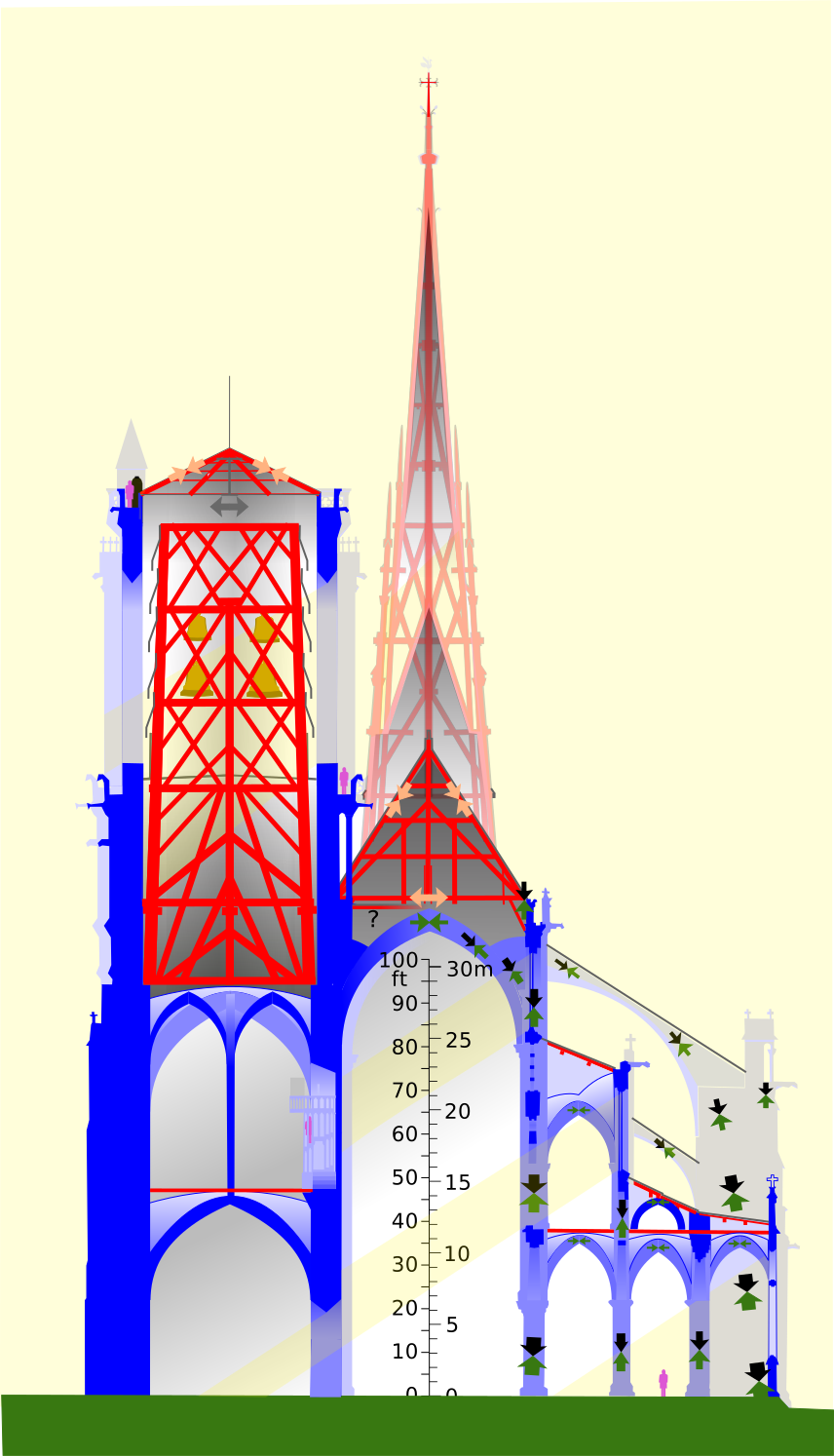
An important innovation in the 12th century was the introduction of the flying buttress. Before the buttresses, all of the weight of the roof pressed outward and down to the walls, and the abutments supporting them. With the flying buttress, the weight was carried by the ribs of the vault entirely outside the structure to a series of counter-supports, which were topped with stone pinnacles which gave them greater weight. The buttresses meant that the walls could be higher and thinner, and could have larger windows. The date of the first buttresses is not known with precision beyond an installation date in the 12th century. Art historian Andrew Tallon has argued, based on detailed laser scans of the entire structure, that the buttresses were part of the original design. According to Tallon, the scans indicate that "the upper part of the building has not moved one smidgen in 800 years," whereas if they were added later some movement from prior to their addition would be expected. Tallon thus concluded that flying buttresses were present from the outset. The first buttresses were replaced by larger and stronger ones in the 14th century; these had a reach of 15 m between the walls and counter-supports.
John of Jandun recognized the cathedral as one of Paris's three most important buildings [prominent structures] in his 1323 Treatise on the Praises of Paris:
File:Plan.cathedrale.Paris.png|Plan of the cathedral made by Viollet-le-Duc in the 19th century. Portals and nave to the left, a choir in the center, and apse and ambulatory to the right. The annex to the south is the sacristy. File:Cathédrale Notre-Dame de Paris - 15.jpg|Early six-part rib vaults of the nave. The ribs transferred the thrust of the weight of the roof downward and outwards to the pillars and the supporting buttresses. File:P1180494 Paris IV Notre-Dame détail sud rwk.jpg|The massive buttresses which counter the outward thrust from the rib vaults of the nave. The weight of the building-shaped pinnacles helps keep the line of thrust safely within the buttresses. File:Notre-Dame-Paris east 2.jpg|Later flying buttresses of the apse of Notre-Dame (14th century) reached 15 m from the wall to the counter-supports.
15th–18th century
On 16 December 1431, the boy-king Henry VI of England was crowned king of France in Notre-Dame, aged ten, the traditional coronation church of Reims Cathedral being under French control.
During the Renaissance, the Gothic style fell out of style, and the internal pillars and walls of Notre-Dame were covered with tapestries.
In 1548, rioting Huguenots damaged some of the statues of Notre-Dame, considering them idolatrous.
in Notre-Dame's parvis was added in 1625 to provide nearby Parisians with running water.
Since 1449, the Parisian goldsmith guild had made regular donations to the cathedral chapter. In 1630, the guild began donating a large altarpiece every year on 1 May. These works came to be known as the grands mays. The subject matter was restricted to episodes from the Acts of the Apostles. The prestigious commission was awarded to the most prominent painters and, after 1648, members of the Académie Royale.
Seventy-six paintings had been donated by 1708, when the custom was discontinued for financial reasons. Those works were confiscated in 1793 and the majority were subsequently dispersed among regional museums in France. Those that remained in the cathedral were removed or relocated within the building by the 19th-century restorers.
Thirteen of the grands mays hang in Notre-Dame; these paintings suffered water damage during the fire of 2019 and were removed for conservation.
An altarpiece depicting The Visitation, painted by Jean Jouvenet in 1707, was also in the cathedral.
The canon Antoine de La Porte commissioned for Louis XIV six paintings depicting the life of the Virgin Mary for the choir. At this same time, Charles de La Fosse painted his Adoration of the Magi, now in the Louvre. Louis Antoine de Noailles, archbishop of Paris, extensively modified the roof of Notre-Dame in 1726, renovating its framing and removing the gargoyles with lead gutters. Noailles also strengthened the buttresses, galleries, terraces, and vaults. In 1756, the cathedral's canons decided that its interior was too dark. The medieval stained glass windows, except the rosettes, were removed and replaced with plain, white glass panes. Lastly, Jacques-Germain Soufflot was tasked with the modification of the portals at the front of the cathedral to allow processions to enter more easily.
File:Sacre Henry6 England-France 02.jpg|Henry VI of England's coronation in Notre-Dame as King of France, aged ten, during the Hundred Years' War. His accession to the throne was in accordance with the Treaty of Troyes of 1420. File:La Descente du Saint-Esprit.jpg|La Descente du Saint-Esprit; illustration depicting Notre-Dame from the Hours of Étienne Chevalier by Jean Fouquet, File:Choeur de ND de Paris 1669.jpg|A Te Deum in the choir of Notre-Dame in 1669, during the reign of Louis XIV. The choir was redesigned to make room for more lavish ceremonies.
French Revolution and Napoleon
After the French Revolution in 1789, Notre-Dame and the rest of the church's property in France was seized and made public property. The cathedral was rededicated in 1793 to the Cult of Reason, and then to the Cult of the Supreme Being in 1794. During this time, many of the treasures of the cathedral were either destroyed or plundered. The twenty-eight statues of biblical kings located at the west façade, mistaken for statues of French kings, were beheaded. Many of the heads were found during a 1977 excavation nearby, and are on display at the Musée de Cluny. For a time the Goddess of Liberty replaced the Virgin Mary on several altars. The cathedral's great bells escaped being melted down. All of the other large statues on the façade, with the exception of the statue of the Virgin Mary on the portal of the cloister, were destroyed. The cathedral came to be used as a warehouse for the storage of food and other non-religious purposes.
With the Concordat of 1801, Napoleon Bonaparte restored Notre-Dame to the Catholic Church; this was finalised on 18 April 1802. Napoleon also named Paris's new bishop, Jean-Baptiste de Belloy, who restored the cathedral's interior. Charles Percier and Pierre-François-Léonard Fontaine made quasi-Gothic modifications to Notre-Dame for the coronation of Napoleon as Emperor of the French within the cathedral. The building's exterior was whitewashed and the interior decorated in Neoclassical style, then in vogue.
File:Fête de la Raison 1793.jpg|The Cult of Reason is celebrated at Notre-Dame during the French Revolution (1793) File:Percier et Fontaine 004.jpg|Arrival of Napoleon at the east end of Notre-Dame for his coronation as Emperor of the French on 2 December 1804 File:Jacques-Louis David - The Coronation of Napoleon (1805-1807).jpg|The coronation of Napoleon, on 2 December 1804 at Notre-Dame, as portrayed in the 1807 painting The Coronation of Napoleon by Jacques-Louis David
19th-century restoration
In the decades after the Napoleonic Wars, Notre-Dame fell into such a state of disrepair that Paris officials considered its demolition. Victor Hugo, who admired the cathedral, wrote the novel Notre-Dame de Paris (published in English as The Hunchback of Notre-Dame) in 1831 to save Notre-Dame. The book was an enormous success, raising awareness of the cathedral's decaying state. The same year as Hugo's novel was published, anti-Legitimists plundered Notre-Dame's sacristy. In 1844 King Louis Philippe ordered that the church be restored.
The architect who had been in charge of Notre-Dame's maintenance, Étienne-Hippolyte Godde, was dismissed. Jean-Baptiste Lassus and Eugène Viollet-le-Duc, who had distinguished themselves with the restoration of the nearby Sainte-Chapelle, were appointed in 1844. The next year, Viollet-le-Duc submitted a budget of 3,888,500 francs, which was reduced to 2,650,000 francs, for the restoration of Notre-Dame and the construction of a new sacristy building. This budget was exhausted in 1850, and work stopped as Viollet-le-Duc made proposals for more money. In totality, the restoration cost over 12 million francs. Supervising a large team of sculptors, glass makers and other craftsmen, and working from drawings or engravings, Viollet-le-Duc remade or added decorations if he felt they were in the spirit of the original style. One of the latter items was a taller and more ornate flèche, to replace the original 13th-century flèche, which had been removed in 1786. The decoration of the restoration included a bronze roof statue of Saint Thomas that resembles Viollet-le-Duc, as well as the sculpture of mythical creatures on the Galerie des Chimères.
The construction of the sacristy was especially financially costly. To secure a firm foundation, it was necessary for Viollet-le-Duc's labourers to dig 9 m. Master glassworkers meticulously copied styles of the 13th century, as written about by art historians Antoine Lusson and Adolphe Napoléon Didron.
During the Paris Commune of March through May 1871, the cathedral and other churches were closed, and some two hundred priests and the Archbishop of Paris were taken as hostages. In May, during the Semaine sanglante of "Bloody Week", as the army recaptured the city, the Communards targeted the cathedral, along with the Tuileries Palace and other landmarks, for destruction; the Communards piled the furniture together in order to burn the cathedral. The arson was halted when the Communard government realised that the fire would also destroy the neighbouring Hôtel-Dieu hospital, filled with hundreds of patients.
File:ND de Paris avant 1841.jpg|The western façade of Notre-Dame in 1841, showing the building in an advanced state of disrepair before the major restoration by Viollet-le-Duc File:Lassus, Viollet-le-Duc - Projet de restauration de Notre-Dame de Paris - page 4.jpg|Proposed doorway decoration by Lassus and Viollet-le-Duc; plate engraved by Léon Gaucherel File:Bayard, Hippolyte - Notre-Dame de Paris (2) (Zeno Fotografie).jpg|The southern façade of Notre-Dame at the beginning of the restoration work; photo from 1847 by Hippolyte Bayard File:Notre-Dame Spire Model (1859).jpg|Model of the flèche and "forest" of wooden roof beams made for Viollet-le-Duc (1859) (Museum of Historic Monuments, Paris)
20th century

During the liberation of Paris in August 1944, the cathedral suffered some minor damage from stray bullets. Some of the medieval glass was damaged, and was replaced by glass with modern abstract designs. On 26 August, a special Mass was held in the cathedral to celebrate the liberation of Paris from the Germans; it was attended by General Charles De Gaulle and General Philippe Leclerc.
In 1963, on the initiative of culture minister André Malraux and to mark the 800th anniversary of the cathedral, the façade was cleaned of the centuries of soot and grime, restoring it to its original off-white colour.
On 19 January 1969, vandals placed a North Vietnamese flag at the top of the flèche, and sabotaged the stairway leading to it. The flag was cut from the flèche by Paris Fire Brigade Sergeant Raymond Belle in a helicopter mission, the first of its kind in France.
The Requiem Mass of Charles de Gaulle was held in Notre-Dame on 12 November 1970. On 26 June 1971, Philippe Petit walked across a tight-rope strung between Notre-Dame's two bell towers entertaining spectators.
After the Magnificat of 30 May 1980, Pope John Paul II celebrated Mass on the parvis of the cathedral.
The Requiem Mass of François Mitterrand was held at the cathedral, as with past French heads of state, on 11 January 1996.
The stone masonry of the cathedral's exterior had deteriorated in the 19th and 20th centuries due to increased air pollution in Paris, which accelerated erosion of decorations and discoloured the stone. By the late 1980s, several gargoyles and turrets had fallen or become too loose to remain safely in place. A decade-long renovation programme began in 1991 and replaced much of the exterior, with care given to retain the authentic architectural elements of the cathedral, including rigorous inspection of new limestone blocks. A discreet system of electrical wires, not visible from below, was also installed on the roof to deter pigeons. The cathedral's pipe organ was upgraded with a computerised system to control the mechanical connections to the pipes. The west face was cleaned and restored in time for millennium celebrations in December 1999.
21st century
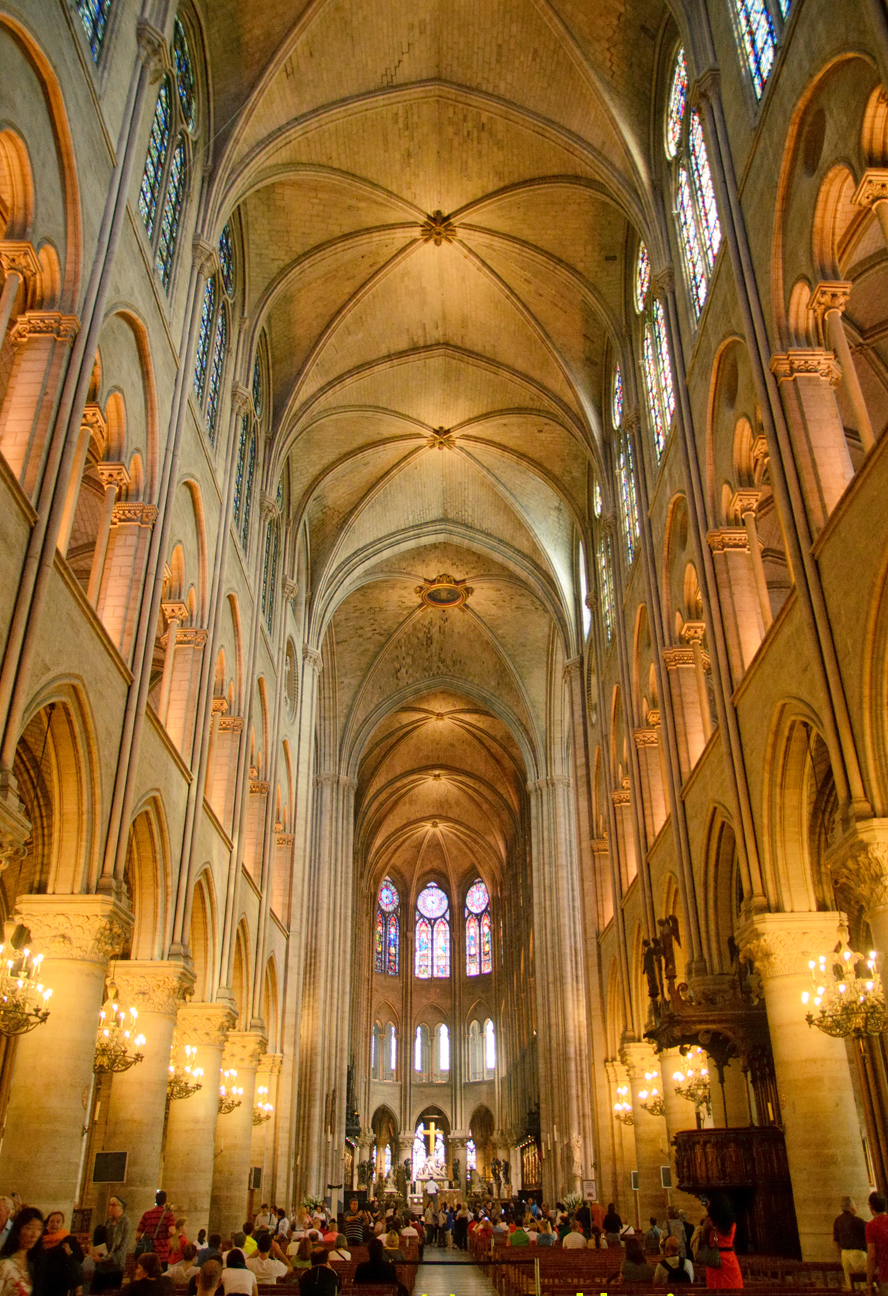
The Requiem Mass of Cardinal Jean-Marie Lustiger, former archbishop of Paris and Jewish convert to Catholicism, was held in Notre-Dame on 10 August 2007.
The set of four 19th-century bells at the top of the northern towers at Notre-Dame were melted down and recast into new bronze bells in 2013, to celebrate the building's 850th anniversary. They were designed to recreate the sound of the cathedral's original bells from the 17th century. Despite the 1990s renovation, the cathedral had continued to show signs of deterioration that prompted the national government to propose a new renovation program in the late 2010s. The entire renovation was estimated to cost €100 million, which the archbishop of Paris planned to raise through funds from the national government and private donations. A €6 million renovation of the cathedral's flèche began in late 2018 and continued into the following year, requiring the temporary removal of copper statues on the roof and other decorative elements.
Notre-Dame began a year-long celebration of the 850th anniversary of the laying of the first building block for the cathedral on 12 December 2012. On 21 May 2013, Dominique Venner, a historian and white nationalist, placed a letter on the church altar and shot himself, dying instantly. Around 1,500 visitors were evacuated from the cathedral.
French police arrested two people on 8 September 2016 after a car containing seven gas canisters filled with diesel fuel was found near Notre-Dame.
On 10 February 2017, French police arrested four people in Montpellier known to have ties to radical Islamist organisations on charges of plotting to travel to Paris and attack the cathedral. On 6 June, visitors were shut inside Notre-Dame cathedral in Paris after a man with a hammer attacked a police officer outside.
2019 fire
Main article: Notre-Dame fire
On 15 April 2019 the cathedral caught fire, destroying the flèche and the "forest" of oak roof beams supporting the lead roof. It was speculated that the fire was linked to ongoing renovation work.
The fire broke out in the attic of the cathedral at 18:18, investigators concluded. The smoke detectors immediately signalled the fire to a cathedral employee, who did not summon the fire brigade but instead sent a cathedral guard to investigate. The guard was sent to the wrong location, to the attic of the adjoining sacristy, and reported there was no fire. About 15 minutes later the error was discovered and the guard's supervisor told him to go to the correct location. The fire brigade was still not notified. By the time the guard had climbed the 300 steps to the cathedral attic, the fire was well advanced. The alarm system was not designed to automatically notify the fire brigade, which was summoned at 18:51 after the guard had returned from the attic and reported a now-raging fire, and more than half an hour after the fire alarm had begun sounding. Firefighters arrived in less than ten minutes.
The cathedral's flèche collapsed at 19:50, bringing down 750 tonnes of stone and lead. The firefighters inside were ordered down. By this time the fire had spread to the north tower, where the eight bells were. The firefighters concentrated their efforts in the tower. They feared that, if the bells fell, they could wreck the tower, and endanger the structure of the other tower and the whole cathedral. They had to ascend a stairway threatened by fire, and to contend with low water pressure for their hoses. As others watered the stairway and the roof, a team of 20 firefighters climbed the narrow stairway of the south tower, crossed to the north tower, lowered hoses to be connected to fire engines outside the cathedral, and sprayed water on the fire beneath the bells. By 21:45, they brought the fire under control.
The main structure was intact; firefighters saved the façade, towers, walls, buttresses, and stained-glass windows. The stone vaulting that forms the ceiling of the cathedral had several holes but was otherwise intact. The Great Organ, which has over 8,000 pipes and was built by François Thierry in the 18th century, was also saved but damaged by water. Because of the renovation, the copper statues on the flèche had been removed before the fire. About 500 firefighters helped to battle the fire, President Emmanuel Macron said. One firefighter was seriously injured and two police officers were hurt during the blaze.
No Christmas Mass was held in 2019 for the first time in more than 200 years. The first cathedral choir performance since the fire took place in December 2020; only eight members sang because of COVID-19 pandemic restrictions. A video of the event aired just before midnight on 24 December.
File:NotreDame20190415QuaideMontebello (cropped).jpg|The 2019 fire destroyed Notre-Dame's wooden roof and flèche but left the outer structure largely intact. File:Flèche en feu - Spire on Fire.jpeg|The flèche aflame during the 2019 fire, before its collapse File:Notre Dame before and after 2019 fire.gif|Animation showing the south façade before and after the fire; scaffolding had been erected as part of renovations underway when the fire started File:Paris and environs with routes from London to Paris handbook for travellers (1913) eingenordet.png|The area directly under the crossing and two other cells of vaulting collapsed File:Notre Dame de Paris by dayV1.svg|In red, the destroyed parts
Stabilisation of the building
Immediately after the fire, Macron promised that Notre-Dame would be restored, and called for the work to be completed within five years. An international architectural competition was announced to redesign the flèche and roof. The announcement drew criticism in the international press from heritage academics and professionals who faulted the French government for being too focused on quickly building a new flèche, and neglecting to frame its response holistically as an inclusive social process encompassing the whole building and its long-term users. A new law was drafted to make Notre-Dame exempt from existing heritage laws and procedures, which prompted an open letter to Macron signed by over 1,170 heritage experts urging respect for existing regulations. The law, which passed on 11 May 2019, was hotly debated in the French National Assembly, with opponents accusing Macron's administration of using Notre-Dame for political grandstanding, and defenders arguing the need for expediency and tax breaks to encourage philanthropic giving.
Macron suggested he was open to a "contemporary architectural gesture". Even before the competition rules were announced, architects around the world offered suggestions: the proposals included a 100 m flèche made of carbon fibre, covered with gold leaf; a roof built of stained glass; a greenhouse; a garden with trees, open to the sky; and a column of light pointed upwards. A poll published in the French newspaper Le Figaro on 8 May 2019 showed that 55% of French respondents wanted a flèche identical to the original. French culture minister Franck Riester promised that the restoration would not be hasty. On 29 July 2019, the French National Assembly enacted a law requiring that the restoration must "preserve the historic, artistic and architectural interest of the monument."
In October 2019, the French government announced that the first stage of reconstruction, the stabilising of the structure against collapse, would last until the end of 2020. In December 2019, Monseigneur Patrick Chauvet, the rector of the cathedral, said there was still a 50% chance that Notre-Dame could not be saved due to the risk of the remaining scaffolding falling onto the three damaged vaults. Reconstruction could not begin before early 2021. Macron announced that he hoped the reconstructed Cathedral could be finished in time for the opening of the 2024 Summer Olympics.
The first task of the restoration was the removal of 250–300 tonnes of melted metal tubes, the remains of the scaffolding, which could have fallen onto the vaults and caused further structural damage. This began in February 2020. A crane 84 m high was put in place next to the cathedral to help remove the scaffolding. The work was completed in November 2020. Wooden support beams were added to stabilise the flying buttresses and other structures.
On 10 April 2020, the archbishop of Paris, Michel Aupetit, and a handful of participants, all in protective clothing to prevent exposure to lead dust, performed a Good Friday service inside the cathedral. Music was provided by the violinist Renaud Capuçon; the lectors were the actors Philippe Torreton and Judith Chemla. Chemla gave an a cappella rendition of Ave Maria.
Heading reconstruction
In February 2021, the selection of oak trees to replace the flèche and roof timbers destroyed by the fire began. A thousand mature trees were chosen from the forests of France, each of a diameter of 50 to and a height of 8 to, and an age of several hundred years. Once cut, the trees had to dry for 12 to 18 months. The trees were to be replaced by new plantings. Two years after the fire, a news report stated that: "there is still a hole on top of the church. They're also building a replica of the church's spire". More oak trees needed to be shipped to Paris, where they would need to be dried before use. The oaks used to make the framework were tested and selected by Sylvatest.
On 18 September 2021, the public agency overseeing the Cathedral stated that the safety work was completed, the cathedral was fully secured, and that reconstruction would begin within a few months.
Research
In 2022, a preventive dig carried out between February and April before the construction of a scaffold for reconstructing the cathedral's flèche unearthed several statues and tombs under the cathedral. One of the discoveries was a 14th-century lead sarcophagus found 65 feet below where the transept crosses the church's 12th-century nave. On 14 April 2022, France's National Preventive Archaeological Research Institute (Inrap) announced that the sarcophagus was extracted from the cathedral and that scientists had examined the casket using an endoscopic camera, revealing the upper part of a skeleton. An opening was discovered below the cathedral floor, likely made around 1230 when the Gothic cathedral was first under construction; inside were fragments of a choir screen dating from the 13th century that had been destroyed in the early 18th century. In March 2023, archaeologists uncovered thousands of metal staples in various parts of the cathedral, some dating back to the early 1160s. The archaeologists concluded that "Notre Dame is now unquestionably the first known Gothic cathedral where iron was massively used to bind stones as a proper construction material."
File:Notre Dame Cathedral Renovation Feb 29,2020.jpg|Ongoing stabilization of Notre-Dame in February 2020 File:Notre Dame restoration long view Feb 29 2020.jpg|Stabilization of Notre-Dame and removal of roof debris and scaffolding in February 2020 File:Notre-Dame de Paris en 2023 et la grue du chantier.JPG|Front view of Notre-Dame in January 2023 File:Notre-Dame de Paris reconstruction.jpg|Southwest corner of Notre-Dame in September 2023
Reopening
Main article: Reopening of Notre-Dame de Paris
.jpg)
Colour and controversy
The colour of the restored interior would be "a shock" to some returning visitors, according to General Jean-Louis Georgelin, the French army officer heading the restoration. "The whiteness under the dirt was quite spectacular". The stone was sprayed with a latex solution to remove accumulated grime and soot. The cleaning of the church interior with latex solutions was criticised by Michael Daley of Artwatch UK, referring to the earlier cleaning of St Paul's Cathedral in London. He asked, "Is there any good basis for wishing to present an artificially brightened and ahistorical white interior?" Jean-Michel Guilemont of the French Ministry of culture responded, "The interior elevations will regain their original colour, since the chapels and side aisles were very dirty. Of course it is not a white colour. The stone has a blonde colour, and the architects are very attentive to obtaining a patina which respects the centuries".
New window controversy
.jpg)
A new controversy arose in late 2024 over a proposal by French president Macron and the archbishop Laurent Ulrich to replace six stained glass windows installed in chapels in the 19th century by Viollet-le-Duc and undamaged by the fire, with six modernist windows designed by contemporary artist Claire Tabouret. Tabouret won a competition sponsored by the French government for a new window design. Her proposed windows are described as inclusive and representative of the modern world, intending to realistically depict people from different cultures and backgrounds praying together. The proposed windows are strongly opposed by preservationists, who want the cathedral to be restored exactly as it was before the fire.
Furthermore, Emmanuel Macron announced the creation of a museum dedicated to Notre-Dame within the Hôtel-Dieu.
Towers and the flèche
Main article: Spire of Notre-Dame de Paris
The two towers are 69 m high. The towers were the last major element of the cathedral to be constructed. The south tower was built first, between 1220 and 1240, and the north tower between 1235 and 1250. The newer north tower is slightly larger, as can be seen when they are viewed from directly in front of the church. The contrefort or buttress of the north tower is also larger. The cathedral's main peal of bells is within these towers.
The south tower is accessible to visitors by a stairway, whose entrance is on the south side of the tower. The stairway has 387 steps, and has a stop at the Gothic hall at the level of the rose window, where visitors could look over the parvis and see a collection of paintings and sculpture from earlier periods of the cathedral's history.
The cathedral's flèche (or spirelet) was located over the transept. The original flèche was constructed in the 13th century, probably between 1220 and 1230. It was battered, weakened and bent by the wind over five centuries, and was removed in 1786. During the 19th-century restoration, Viollet-le-Duc recreated it, making a new version of oak covered with lead. The entire flèche weighed 750 tonnes.
The cockerel weathervane on top of the flèche has both a religious and political symbolism. The cockerel is the symbol of the French state, which since 1905 has owned Notre-Dame and the other 86 cathedrals in France. It is found over all French cathedrals, as well as over the entrance of the Elysée Palace, the residence of the French president, on other government buildings, and on French postage stamps.
Following Viollet-le-Duc's plans, the flèche was surrounded by copper statues of the Twelve Apostlesa group of three at each point of the compass. In front of each group is a symbol representing one of the four evangelists: a winged ox for Saint Luke, a lion for Saint Mark, an eagle for Saint John and an angel for Saint Matthew. Just days prior to the fire, the statues were removed for restoration. While in place, they had faced outwards towards Paris, except one: the statue of Saint Thomas, the patron saint of architects, faced the flèche, and had the features of Viollet-le-Duc.
The cockerel weathervane at the top of the flèche contained three relics: a tiny piece from the Crown of Thorns in the cathedral treasury, and relics of Saint Denis and Saint Genevieve, patron saints of Paris. They were placed there in 1935 by Archbishop Jean Verdier, to protect the congregation from lightning or other harm. The cockerel was recovered in the rubble shortly after the fire, and has since been on display inside the reopened cathedral.
The new flèche was put in place on 16 December 2023, and a new gilded cockerel sculpture, designed by architect Philippe Villeneuve, was also installed, containing the same relics as old flèche, as well as the names of two thousand people who had participated in the reconstruction. Getting to work, Villeneuve's team scrutinised the journal in which Viollet-le-Duc had entered all the details of Notre-Dame's 19th century restoration work.
File:Notre Dame de Paris 2013-07-24.jpg|Towers on west façade (1220–1250) File:The Rooftops of Notre Dame.jpg|The gallery of chimeras pictured in 1910 by File:Flèche Notre-Dame de Paris.jpg|The 19th-century flèche File:Rooster on the spire of Notre Dame in Paris retusche.jpg|The cockerel reliquary at the top of the flèche. It was found lightly damaged in the rubble after the 2019 fire. File:Spire of Notre-Dame de Paris, September 2013.jpg|The flèche from above, File:Notre-Dame de Paris 086.jpg|Statue of Thomas the Apostle, with the features of restorer Viollet-le-Duc, at the base of the flèche
Iconography
The Gothic cathedral was a liber pauperum, a "poor people's book", covered with sculptures vividly illustrating biblical stories, for the vast majority of parishioners who were, at the time, illiterate. To add to the effect, all of the sculpture on the façades was originally painted and gilded.
The tympanum over the central portal on the west façade, facing the square, vividly illustrates the Last Judgment, with figures of sinners being led off to hell, and good Christians taken to heaven. The sculpture of the right portal shows the coronation of the Virgin Mary, and the left portal shows the lives of saints who were important to Parisians, particularly Saint Anne, the mother of the Virgin Mary.
The exteriors of cathedrals and other Gothic churches were also decorated with sculptures of grotesques or monsters. These included the gargoyle, the chimera, a mythical hybrid creature which usually had the body of a lion and the head of a goat, and the strix or stryge, a creature resembling an owl or bat, which was said to eat human flesh. The strix appeared in classical Roman literature; it was described by the Roman poet Ovid, who was widely read in the Middle Ages, as a large-headed bird with transfixed eyes, rapacious beak, and greyish white wings. They were part of the visual message for the illiterate worshipers, symbols of the evil and danger that threatened those who did not follow the teachings of the church.
The gargoyles, which were added about 1240, had a more practical purpose. They were the rain spouts of the cathedral, designed to divide the torrent of water which poured from the roof after rain, and to project it outwards as far as possible from the buttresses and the walls and windows where it might erode the mortar binding the stone. To produce many thin streams rather than a torrent of water, a large number of gargoyles were used, so they were also designed to be a decorative element of the architecture. The rainwater ran from the roof into lead gutters, then down channels on the flying buttresses, then along a channel cut in the back of the gargoyle and out of the mouth away from the cathedral.
Amid all the religious figures, some of the sculptural decoration was devoted to illustrating medieval science and philosophy. The central portal of the west façade is decorated with carved figures holding circular plaques with symbols of transformation taken from alchemy. The central pillar of the central door of Notre-Dame features a statue of a woman on a throne holding a sceptre in her left hand, and in her right hand, two books, one open (symbol of public knowledge), and the other closed (esoteric knowledge), along with a ladder with seven steps, symbolising the seven steps alchemists followed in trying to transform ordinary metals into gold. On each side of the west façade, there are statues of Ecclesia and Synagoga. The statues represent supersessionism, the Christian belief that Christianity has replaced Judaism.
Many of the statues, particularly the grotesques, were removed from the façade in the 17th and 18th centuries, or were destroyed during the French Revolution. They were replaced with figures in the Gothic style, designed by Viollet-le-Duc, during the 19th-century restoration.
File:Cathédrale Notre-Dame de Paris - 10.jpg|Illustration of the Last Judgment, central portal of west façade File:Paris - Cathédrale Notre-Dame - Portail de la Vierge - PA00086250 - 003.jpg|The martyr Saint Denis, holding his head, over the Portal of the Virgin File:Notre-Dame de Paris - Portail de la Vierge - détail 01.jpg|The serpent tempts Adam and Eve; on the Portal of the Virgin File:DevilCentralGateNotreDameParis.jpg|Archangel Michael and Satan weighing souls during the Last Judgment (central portal, west façade) File:Chimera of Notre-Dame de Paris, 26 April 2014.jpg|A strix on the west façade File:Notre-Dame Rzygacze.JPG|Gargoyles were the rainspouts of the cathedral File:Gargoyle Point of View (3575829233).jpg|Chimera on the façade File:Alegoría de la alquimia en Notre-Dame.jpg|Allegory of alchemy, central portal File:Ecclesia et synagoga.jpg|Ecclesia and Synagoga, statues on each side of the west façade
Stained glass
The stained glass windows of Notre-Dame, particularly the three rose windows, are among the most famous features of the cathedral. The west rose window, over the portals, was the first and smallest of the roses in Notre-Dame. It is 9.6 m in diameter, and was made in about 1225, with the pieces of glass set in a thick circular stone frame. None of the original glass remains in this window; it was recreated in the 19th century.
The two transept windows are larger and contain a greater proportion of glass than the rose on the west façade, because the new system of buttresses made the nave walls thinner and stronger. The north rose was created in about 1250, and the south rose in about 1260. The south rose in the transept is 12.9 m in diameter; with the claire-voie surrounding it, a total of 19 m. It was given to the cathedral by King Louis IX of France, known as Saint Louis.
The south rose has 94 medallions, arranged in four circles, depicting scenes from the life of Christ and those who witnessed his time on earth. The inner circle has twelve medallions showing the twelve apostles. During later restorations, some of these original medallions were moved to circles farther out. The next two circles depict celebrated martyrs and virgins. The fourth circle shows twenty angels, and saints important to Paris, such as Saint Denis, Margaret the Virgin with a dragon, and Saint Eustace. The third and fourth circles also have some depictions of Old Testament subjects. The third circle has some medallions with scenes from the New Testament Gospel of Matthew which date from the last quarter of the 12th century. These are the oldest glass in the window.
Additional scenes in the corners around the rose window include Jesus's Descent into Hell, Adam and Eve, the Resurrection of Christ. Saint Peter and Saint Paul are at the bottom of the window, and Mary Magdalene and John the Apostle at the top.
Above the rose was a window depicting Christ triumphant seated in the sky, surrounded by his Apostles. Below are sixteen windows with painted images of Prophets. These were painted during the restoration in the 19th century by Alfred Gérenthe, under the direction of Eugène Viollet-le-Duc, based upon a similar window at Chartres Cathedral.
The south rose had a difficult history. In 1543 it was damaged by the settling of the masonry walls, and not restored until 1725–1727. It was seriously damaged in the French Revolution of 1830. Rioters burned the residence of the archbishop, next to the cathedral, and many of the panes were destroyed. The window was rebuilt by Viollet-le-Duc in 1861 who rotated it by fifteen degrees to give it a clear vertical and horizontal axis, and replaced the destroyed pieces of glass with new glass in the same style. The window now contains both medieval and 19th-century glass.
In the 1960s, after three decades of debate, it was decided to replace many of the 19th-century grisaille windows in the nave designed by Viollet-le-Duc with new windows. The new windows, made by Jacques Le Chevallier, are without human figures and use abstract designs and colour to try to recreate the luminosity of the cathedral's interior in the 13th century.
The fire left the three great medieval rose windows mostly intact, but with some damage. The rector of the cathedral noted that one rose window would have to be dismantled, as it was unstable and at risk. Most of the other damaged windows were of much less historical value.
In early 2024 Macron proposed removing six of the seven undamaged 19th-century stained glass windows created by Eugene Viollet-le-Duc in the chapels along the south aisle of the nave, and replacing them with new windows with more contemporary designs. He invited contemporary artists to submit designs for the new windows. This proposal inspired a backlash in the press, and 140,000 people signed a petition to keep the old windows. The plan for contemporary windows was rejected by the French Commission on Architectural Monuments and Patrimony in July 2024.
File:2016-02-23 15-56-57 paris.jpg|The earliest rose window, on the west façade (about 1225) File:Great_organ_of_Notre-Dame_de_Paris_2024_(8).jpg|The west rose window (about 1225) File:Gothic-Rayonnant Rose-6.jpg|North rose window (about 1250) File:Paris Cathédrale Notre-Dame Innen Südliche Rosette 1.jpg|North rose window including lower 18 vertical windows
Burials and crypts
Unlike some other French cathedrals, Notre-Dame was originally constructed without a crypt. In the medieval period, burials were made directly into the floor of the church, or in above-ground sarcophagi, some with tomb effigies (French: gisant). High-ranking clergy and some royals were buried in the choir and apse, and many others, including lower-ranking clergy and lay people, were buried in the nave or chapels. There is no surviving complete record of the burials.
In 1699, many of the choir tombs were disturbed or covered over during a major renovation project. Remains which were exhumed were reburied in a common tomb beside the high altar. In 1711, a small crypt measuring about 6 by was dug out in the middle of the choir which was used as a burial vault for the archbishops, if they had not requested to be buried elsewhere. It was during this excavation that the 1st-century Pillar of the Boatmen was discovered. In 1758, three more crypts were dug in the Chapel of Saint-Georges to be used for burials of canons of Notre-Dame. In 1765, a larger crypt was built under the nave to be used for burials of canons, beneficiaries, chaplains, cantors, and choirboys. Between 1771 and 1773, the cathedral floor was repaved with black and white marble tiles, which covered over most of the remaining tombs. This prevented many of these tombs from being disturbed during the French Revolution.
In 1858, the choir crypt was expanded to stretch most of the length of the choir. During this project, many medieval tombs were rediscovered. Likewise the nave crypt was also rediscovered in 1863 when a larger vault was dug out to install a vault heater. Many other tombs are also located in the chapels.
File:Tombeau d'Eudes de Sully, détail.jpg|Eudes de Sully was the first bishop to be buried in Notre-Dame. His copper-covered sarcophagus was placed in the middle of the choir where it remained for almost five centuries. File:1 Tomb in ambulatory, Notre Dame in Paris, ZM.JPG|The tomb of bishop Matifort (died 1304) located behind the high altar is the only surviving medieval funerary sculpture at Notre-Dame. File:Relevé du caveau des archevêques de Paris dans le chœur de Notre-Dame.jpg|Burial vault under the choir of Notre-Dame, . Pictured left to right are the tombs of Archbishops Vintimille and Bellefonds, the funerary urn of Archbishop Noailles, and two unidentified tombs. File:Chapelle Saint Denis, Notre Dame.jpg|The tomb of Archbishop Affre (1793–1848) in the Chapel of Saint-Denis. The sculpture depicts the archbishop's mortal wounding during the June Days uprising while holding an olive branch as a sign of peace. The inscription reads Puisse mon sang être le dernier versé! ("May my blood be the last shed!").
Great organ
.jpg)
One of the earliest organs at Notre-Dame was built in 1403 by Frédéric Schambantz. It was rebuilt many times over the course of 300 years; however, twelve pipes and some wood survive from Schambantz. It was replaced between 1730 and 1738 by François Thierry, then once again rebuilt by François-Henri Clicquot. During the mid-19th-century restoration of the cathedral by Eugène Viollet-le-Duc, Aristide Cavaillé-Coll used pipework from earlier instruments to build a new organ, which was dedicated in 1868.
In 1904, Charles Mutin modified and added several stops upon the suggestions of titular organist Louis Vierne. In 1924, the installation of an electric blower was financed by Rolls-Royce CEO Claude Johnson. An extensive restoration and cleaning was carried out by Joseph Beuchet in 1932 which mostly included changes to the Récit. Between 1959 and 1963, the mechanical action with Barker levers was replaced with an electric action by Jean Hermann, and a new organ console was installed.
The stoplist was gradually modified by Robert Boisseau, who in 1968 added three chamade stops (8′, 4′, and 2′/16′) and by Jean-Loup Boisseau after 1975, all upon the orders of Pierre Cochereau. In autumn 1983, the electric combination system was disconnected due to short-circuit risk.
Between 1990 and 1992, Jean-Loup Boisseau, Bertrand Cattiaux, Philippe Émeriau, Michel Giroud, and the Société Synaptel revised and augmented the instrument. A new frame for the Jean Hermann console was created. Between 2012 and 2014, Bertrand Cattiaux and Pascal Quoirin restored, cleaned, and modified the organ. The stop and key action was upgraded, a new frame for selected components of the Hermann-Boisseau-Cattiaux console was created, a new enclosed division ("Résonnance expressive", using pipework from the former "Petite Pédale" by Boisseau, which can now be used as a floating division), the organ case and the façade pipes were restored, and a general tuning was carried out. The current organ has 115 stops (156 ranks) on five manuals and pedal, and more than 8,000 pipes.
In addition to the great organ in the west end, the quire of the cathedral carries a medium-sized choir organ of 2 manuals, 30 stops and 37 ranks in a nineteenth-century case from the 1960s. During the fire of 2019, it was heavily damaged by waterlogging, but is at least partially reusable. It also had a 5-stop single-manual continuo organ, which was completely destroyed by water from firefighters.
The great organ itself suffered minimal damage (mostly to a single pipe of the Principal 32' and substantial dust) in the fire of April 2019 and underwent maintenance for cleaning and tuning. It was formally reblessed in 2024.
| I. Grand-Orgue | ||||||
|---|---|---|---|---|---|---|
| C–g | II. Positif | |||||
| C–g | III. Récit | |||||
| C–g | IV. Solo | |||||
| C–g | V. Grand-Chœur | |||||
| C–g | Résonnance expressive | |||||
| C–g | Pédale | |||||
| C–f(keys go to g1, but f#1 and g1 silent) | ||||||
| {{ubl | Violon-Basse 16 | Bourdon 16 | Montre 8 | Viole de Gambe 8 | Flûte harmonique 8 | Bourdon 8 |
Couplers: II/I, III/I, IV/I, V/I; III/II, IV/II, V/II; IV/III, V/III; V/IV, Octave grave général, inversion Positif/Grand-orgue, Tirasses (Grand-orgue, Positif, Récit, Solo, Grand-Chœur en 8; Grand-Orgue en 4, Positif en 4, Récit en 4, Solo en 4, Grand-Chœur en 4), Sub and Super octave couplers and Unison Off for all manuals (Octaves graves, octaves aiguës, annulation 8′); octaves aiguës Pédalier
Additional features: Coupure Pédalier; Coupure Chamade; Appel Résonnance; sostenuto for all manuals and the pedal; cancel buttons for each division; 50,000 combinations (5,000 groups each); replay system
Organists
The position of titular organist ("head" or "chief" organist; French: titulaires des grandes orgues) of the great organ of Notre-Dame is considered one of the most prestigious organist posts in France, along with the post of titular organist of Saint Sulpice in Paris, Cavaillé-Coll's largest instrument.
After the death of Pierre Cochereau, the cathedral authorities controversially decided to return to the Clicquot practice of having several titulaires, and also to guarantee that no one organist would have so much influence over the organ.
- (1600–1609)
- (1609–1610)
- (1610–1616)
- Charles Racquet (1618–1643)
- (–1689)
- (1689–1730)
- Guillaume-Antoine Calvière (1730–1755)
- René Drouart de Bousset (1755–1760)
- (1755–1761)
- Louis-Claude Daquin (1755–1772)
- Armand-Louis Couperin (1755–1789)
- Claude Balbastre (1760–1793)
- Pierre-Claude Foucquet (1761–1772)
- Nicolas Séjan (1772–1793)
- (1772–1783)
- Jean-Jacques Beauvarlet Charpentier (1783–1793)
- (1802–1806)
- (1806–1834)
- (1834–1840)
- Félix Danjou (1840–1847)
- (1847–1900)
- Louis Vierne (1900–1937)
- Léonce de Saint-Martin (1937–1954)
- Pierre Cochereau (1955–1984)
- Yves Devernay (1985–1990)
- Jean-Pierre Leguay (1985–2015)
- Philippe Lefebvre (1985–2019)
- Olivier Latry (since 1985)
- (since 2016)
- Thierry Escaich (since 2024)
- Thibault Fajoles (assistant organist, since 2024)
Bells
Main article: Bells of Notre-Dame de Paris
Notre-Dame currently has ten bells. The two largest bells, Emmanuel and Marie, are mounted in the south tower. The eight others; Gabriel, Anne Geneviève, Denis, Marcel, Étienne, Benoît-Joseph, Maurice, and Jean-Marie; are mounted in the north tower. In addition to accompanying regular activities at the cathedral, the bells have also rung to commemorate events of national and international significance, such as the armistice of 11 November 1918, the liberation of Paris, the fall of the Berlin Wall, and the September 11 attacks.
The bells are made with bronze for its resonance and resistance to corrosion. During the medieval period, they were often founded on the grounds of the cathedral so they would not need to be transported long distances. According to tradition, the bishop of Paris held a ceremony in which he blessed and baptized the bells, and a godparent formally bestowed a name on the bell. Most of the cathedral's early bells were named after the person who donated them, but they were also named after biblical figures, saints, bishops, and others.
After the baptism, the bells were hoisted into the towers through circular openings in the vaulted ceilings and mounted to headstocks to allow the bells to swing. Notre-Dame's bells swing on a straight swinging axis, meaning the axis of rotation is just above the crown of the bell. This style of ringing produces a clearer tone, as the clapper strikes the bell on the upswing, called a flying clapper. It also causes horizontal forces, which can be up to one and a half times the weight of the bell. For this reason the bells are mounted within wooden belfries which are recessed from the towers' stone walls. These absorb the horizontal forces and prevent the bells from damaging the relatively brittle stonework. The current belfries date to the 19th-century restoration.
Before the French Revolution, it was common for the bells to break, and they were often removed for repairs or to be entirely recast, and sometimes renamed. The bell Guillaume, for example, was renamed three times and recast five times between 1230 and 1770.
The practice of bell-ringing at Notre-Dame is recorded as early as 1198. By the end of the 14th century the bells were marking the civil hours, and in 1472 they began to call to prayer for the Angelus three times a day, both practices which continue today. During the French Revolution, most of the cathedral's bells were removed and melted down. Many of them bore the names of the medieval bells, and were relatively recent recastings made from most of the same metal. During the 19th-century restoration, four new bells were made for the north tower. These were replaced in 2012 with nine as part of the cathedral's 850th anniversary celebration.
In addition to the main bells, the cathedral also had smaller secondary bells. These included a carillon in the medieval flèche, three clock bells on the north transept in the 18th century, and six bells added in the 19th century – three in the reconstructed flèche and three within the roof to be heard in the sanctuary. These were destroyed during the 2019 fire.
File:Notre-dame-de-paris-vue-interieure-salle-nord.jpg|Circular utility door (right of center) in the ceiling below the north tower made for raising and lowering bells File:Bourdon Emmanuel in 2016 (36378821523).jpg|The bourdon Emmanuel, Notre-Dame's largest and oldest bell, cast in 1686 File:Encyclopedie volume 4-176pl7 (2).jpg|1767 illustration of a bell headstock and mounting components (left) and Notre-Dame's original south belfry (right) File:Coupe.beffroi.cathedrale.Paris.2.png|1854 illustration by Pégard showing the 1850 belfry which is present today File:Anciennes cloches de la cathédrale Notre-Dame de Paris le 6 août 2014 - 02.jpg|The four 19th-century bells which were retired in 2012 File:Notre-Dame de Paris - Les nouvelles cloches - 001.jpg|Nine new bells exhibited in the nave in February 2013 File:Bourdon Marie.JPG|The second bourdon Marie mounted in the south belfry
Clock

The first clocks used at Notre-Dame were clepsydras. These were used to tell the hours, which were marked by striking bells. In the 14th century Notre-Dame had two clepsydras running simultaneously, one in the cloister and one in the church itself. A lay chamberlain was responsible for keeping the clocks filled with water and to notify a churchwarden when it was time to strike the bells for the hour.
In 1766, Guillot de Montjoye and Jean-Bernard de Vienne, canons and stewards of the church fabric, donated a mechanical clock to the cathedral. The movement was installed in a glass cabinet in the gallery beneath the north rose window and rang three bells outside above the north portal. Between 1812 and 1813, the clock and bells were moved to the north tower. A 1.34 m clock face was installed inside the church below the organ platform.
During Viollet-le-Duc's restoration in the 19th century, a new clock was made. The 1867 Collin-Wagner movement, measuring 2 m across, was located in the forest underneath the central flèche within a glass-enclosed room. This controlled four dormer clock faces visible on the transept roofs, two on each side. This clock was destroyed by the 2019 fire. Shortly after the fire, French clockmaker Jean-Baptiste Vior discovered an almost identical 1867 Collin-Wagner movement in storage at Sainte-Trinité Church in northern Paris. Olivier Chandez, who had been responsible for the upkeep of Notre-Dame's clock, described the find as "almost a miracle." The clock cannot be installed in Notre-Dame, but it was hoped that the clock could be used to create a new clock for Notre-Dame to the same specifications as the one which was destroyed.
Ownership
Until the French Revolution, Notre-Dame was the property of the archbishop of Paris and therefore the Catholic Church. It was nationalized on 2 November 1789 and since then has been the property of the French state. Under the Concordat of 1801, use of the cathedral was returned to the Church, but not ownership. Legislation from 1833 and 1838 clarified that cathedrals were maintained at the expense of the French government. This was reaffirmed in the 1905 law on the separation of Church and State, designating the Catholic Church as having the exclusive right to use it for religious purposes in perpetuity. Notre-Dame is one of seventy historic churches in France with this status. The archdiocese is responsible for paying the employees, for security, heating and cleaning, and for ensuring that the cathedral is open free of charge to visitors. The archdiocese does not receive subsidies from the French state.
Gallery
File:Notre Dame Catherdral.jpg|During reconstruction following the fire File:Notre-Dame - Eglise Cathédrale de Paris 2.jpg|Notre-Dame at the end of the 19th century File:Henri Le Secq near a Gargoyle.jpg|An 1853 photo by Charles Nègre of Henri Le Secq next to Le Stryge File:Paris - Cathédrale Notre-Dame - Trésor de la cathédrale - Ornements sacerdotaux -3.JPG|19th-century vestments File:Notre-dame-looking-up-np.jpg|A wide angle view of Notre-Dame's western façade File:Notre Dame Paris front facade lower.jpg|Notre-Dame's façade showing the Portal of the Virgin, Portal of the Last Judgment, and Portal of St-Anne File:Notre dame view from Montparnasse Tower.jpg|A 2010 view of Notre-Dame from Tour Montparnasse File:Notre Dame de Paris.JPG|A wide angle view of Notre-Dame's western façade File:Madonna_and_Child_dit_Notre-Dame_de_Paris_2024_(32).jpg |Virgin of the pillar, 14th century. The Statue of Virgin and Child inside Notre-Dame de Paris File:Cathedrale Notre-Dame de Paris maitre-autel.jpg|Notre-Dame's high altar with the kneeling statues of Louis XIII and Louis XIV File:Rose du transept Sud Notre-Dame de Paris 170208 04.jpg|South rose window of Notre-Dame File:Notre Dame buttress.jpg|Flying buttresses of Notre-Dame File:050903 Paris 052 NotreDame memoriaInglesi.JPG|Memorial tablet to the British Empire dead of the First World War File:Notre-Dame de Paris, Tympanum of of the Last Judgment.jpg|Tympanum of the Last Judgment File:Joan of Arc-Notre Dame.jpg|Statue of Joan of Arc in Notre-Dame's interior File:Close look of the details on the Tympanum of the Last Judgment.jpg|Close look of the details on the Tympanum of the Last Judgment (2016) File:Facade of Notre-Dame de Paris - 2018-06-23.jpg|Façade of Notre-Dame File:Point Zéro des Routes de France (1).JPG|French road system's Point Zéro spot on the ground in front of Notre-Dame (since 1924) File:Notre Dame Paris Goldener Schnitt.png|Characteristics of the Golden ratio
Notes
Footnotes
Citations
References
English-language
- Davis, Michael T. "Splendor and Peril: The Cathedral of Paris, 1290–1350." The Art Bulletin (1998) 80#1 pp: 34–66.
- Jacobs, Jay, ed. The Horizon Book of Great Cathedrals. New York City: American Heritage Publishing, 1968
- Janson, H. W. History of Art. 3rd Edition. New York City: Harry N. Abrams, Inc., 1986
- Myers, Bernard S. Art and Civilization. New York City: McGraw-Hill, 1957
- Wright, Craig. Music and ceremony at Notre Dame of Paris, 500–1550 (Cambridge University Press, 2008)
French-language
- Renault, Christophe and Lazé, Christophe, Les Styles de l'architecture et du mobilier, (2006), Gisserot;
- Tonazzi, Pascal. Florilège de Notre-Dame de Paris (anthologie), Editions Arléa, Paris, 2007,
- Trintignac, Andre and Coloni, Marie-Jeanne, Decouvrir Notre-Dame de Paris, Les Editions du Cerf, Paris, 1984
Online references
References
- Watkin, David. (1986). "A History of Western Architecture". Barrie and Jenkins.
- (16 December 2023). "Notre-Dame rooster back on Paris cathedral's spire as renovation enters final stage". Reuters.
- "Musique Sacrée à Notre-Dame de Paris".
- Centre, UNESCO World Heritage. "Paris, Banks of the Seine".
- {{harvnb. Mérimée database. 1993
- Gomez, Melissa. (2019-04-15). "Five things to know about Notre Dame Cathedral".
- Chavis, Jason. "Facts on the Notre Dame Cathedral in France".
- "Beautiful sacred music created for Notre Dame of Paris".
- "Historique de la construction".
- (December 7, 2024). "An archbishop's knock formally restores Notre Dame to life as heads of state look on – The Boston Globe".
- (2018). "Paris facts". Paris Digest.
- (1981). "Notre Dame Cathedral North Rose Window".
- Trintignac and Coloni (1984), p. 45.
- Trintignac and Coloni (1984), p. 60.
- "Le Guide du Patrimoine en France, Editions du Patrimoine, Centre des Monuments Nationaux, p. 303
- (2024-12-11). "Relive the reopening ceremonies (December 7-8)".
- The Associated Press (AP). (2024-12-13). "'Crown of Thorns' returns to Notre Dame Cathedral for public veneration".
- "Notre-Dame de Paris. Une des premières cathédrales gothiques de France".
- Fourny, Marc. (12 December 2012). "Les dix secrets de Notre-Dame de Paris".
- "Paris à l'époque de Philippe Auguste".
- Rouche, Michel. (19 December 2012). "Jubilé de cathédrale Notre-Dame de Paris – La symbolique des cathédrales: approche historique, religieuse, sociale". Radio Notre-Dame.
- (12 March 2020). "Scientists are leading Notre Dame's restoration—and probing mysteries laid bare by its devastating fire". Science.
- Berlinger, Joshua. (17 December 2024). "Inside Notre Dame, Paris' Gothic gem, as it reopens to the world".
- Murray, Stephen. (1998). "Notre-Dame of Paris and the Anticipation of Gothic". The Art Bulletin.
- Shea, Rachel Hartigan. (16 April 2019). "Historian uses lasers to unlock mysteries of Gothic cathedrals".
- Sandron, Dany. (2020). "Notre-Dame Cathedral: nine centuries of history". The Pennsylvania State University Press.
- Allmand, C.. (May 1982). "The Coronations of Henry VI".
- (12 December 2012}}{{Dead link). "Notre-Dame de Paris, joyau de l'art gothique, célèbre ses 850 ans". [[Libération]].
- Chavis, Jason. "Facts on the Notre Dame Cathedral in France". USA Today.
- "Fontaines et réservoirs de Paris".
- "Les grands "Mays"".
- "L'Adoration des mages". The [[Louvre]].
- (12 April 2023). "Visiting Notre Dame Cathedral – Find Cheap Holidays".
- "Cathédrale Notre-Dame de Paris". Foundation Napoleon.
- Limouzin-Lamothe, Roger. (1964). "La dévastation de Notre-Dame et de l'archevêché de Paris en février 1831". Revue d'histoire de l'Église de France.
- Mignon, Olivier, ''Architecture des Cathédrales Gothiques'', (2015), Éditions Ouest-France, (in French), pg. 18.
- Lissagaray (1896), p. 338.
- Laurent, Xavier. (2003). "Grandeur et misère du patrimoine, d'André Malraux à Jacques Duhamel (1959–1973)". Librairie Droz.
- (21 July 2015). "SYND 19-1-69 VIET CONG FLAG REMOVED FROM NOTRE DAME".
- (20 January 1969). "Vietcong Flag Put Atop Notre Dame". The New York Times.
- (July 2016). "Breaking the Jump: The Secret Story of Parkour's High Flying Rebellion". Aurum Press.
- (11 November 1970). "France mourns de Gaulle; world leaders to attend a service at Notre Dame". [[The New York Times]].
- (27 June 1971). "Sneaky Juggler Has Ball Up in Sky at Notre Dame". Ogden-Standard Examiner.
- Gohn, Pat. (15 April 2019). "Prayer of St. John Paul II at Notre Dame from May 30, 1980". [[Catholic Digest]].
- Whitney, Craig R.. (9 January 1996). "Francois Mitterrand Dies at 79; Champion of a Unified Europe". [[The New York Times]].
- Simons, Marlisle. (9 April 1992). "To Notre Dame's Rescue, Sickly Gargoyles and All". The New York Times.
- August, Marilyn. (7 April 1991). "Notre Dame Church Will Get Face Lift". [[Los Angeles Times]].
- (14 April 1998). "Paris pigeons to get shock treatment at Notre Dame". The Guardian.
- Whitney, Craig R.. (3 April 1995). "Notre Dame's Organ and Computer Are No Duet". The New York Times.
- Bremner, Charles. (21 December 1999). "Paris given a millennium makeover". [[The Times]].
- (9 August 2007). "Nicolas Sarkozy assistera aux obsèques du cardinal Lustiger". [[L'Express (France).
- de la Baume, Maia. (19 October 2011). "A Melodic Emblem Falls Out of Tune". The New York Times.
- (2 February 2013). "New Notre Dame bells make harmonious history". [[USA Today]].
- Breeden, Aurelien. (28 September 2017). "In Paris, Worn-Out Notre-Dame Needs a Makeover, and Hopes You Can Help". The New York Times.
- Walt, Vivienne. (27 July 2017). "Notre Dame Cathedral Is Crumbling. Who Will Help Save It?".
- Sage, Adam. (10 March 2018). "Paris's crumbling Notre-Dame looks to wealthy foreigners for salvation". The Times.
- (15 April 2019). "Massive fire engulfs beloved Notre Dame Cathedral in Paris". Associated Press.
- (16 April 2019). "Notre-Dame cathedral: Macron pledges reconstruction after fire". BBC News.
- "Paris's Notre Dame cathedral celebrates 850 years". GIE ATOUT FRANCE.
- Frémont, Anne-Laure. (21 May 2013). "Un historien d'extrême droite se suicide à Notre-Dame". Le Figaro.
- (7 September 2017). "Gas Containers Found Near Notre Dame". [[U.S. News & World Report.
- (23 September 2019). "Notre-Dame plot: Five women in court over foiled car bomb attack". BBC.
- (10 February 2016). "After Louvre attack, France foils another terrorist plot". The Washington Post.
- "Paris: Inside Notre-Dame during lockdown". BBC News.
- "Notre Dame, Paris: Hundreds put in terror lockdown". Queensland Time.
- Breeden, Aurelien. (15 April 2019). "Part of Notre-Dame Spire Collapses as Paris Cathedral Catches Fire". The New York Times.
- Seiger, Theresa. "Fire reported at Paris' Notre Dame cathedral". The Atlanta Journal-Constitution.
- El-Bawab, Nadine. (15 April 2019). "Roof burns at Paris' Notre Dame Cathedral as massive fire rages".
- (16 July 2019). "Notre-Dame came far closer to collapsing than people knew. This is how it was saved.". The New York Times.
- (19 April 2019). "Notre-Dame's Safety Planners Underestimated the Risk, With Devastating Results". [[The New York Times]].
- Landauro, Inti. (17 April 2017). "Paris firefighters got on Notre-Dame site in less than 10 minutes". Reuters.
- "Notre Dame Cathedral Fire, Paris, France".
- (21 April 2019). "After The Flames, Notre Dame's Centuries-Old Organ May Never Be The Same Again". NPR.
- (15 April 2019). "Notre-Dame cathedral engulfed by fire".
- Diebelius, Georgia. (15 April 2019). "Firefighter and two police officers injured battling 'catastrophic' Notre-Dame fire". [[Metro (British newspaper).
- (25 December 2019). "No Christmas Mass at Notre-Dame for the first time since Napoleon". The Hindu.
- (25 December 2020). "Notre Dame choir returns for first time since devastating fire for Christmas Eve concert". [[CBS News]].
- ''Le Parisien'', 16 April 2019.
- (15 April 2019). "Notre-Dame cathedral engulfed by fire". BBC News.
- (15 April 2019). "The Latest: French leader vows to rebuild damaged Notre Dame". Associated Press.
- (16 January 2012). "Years? Decades? Uncertainty over time needed to rebuild Notre-Dame".
- Henley, Jon. (17 April 2019). "France announces contest to redesign Notre Dame spire". The Guardian.
- Otero-Pailos, Jorge. (19 April 2019). "In Notre Dame, we find a heritage that invites us to breathe and reflect: A spire competition is the wrong approach". The Art Newspaper.
- Bandarin, Francesco. (30 April 2019). "Notre Dame Should Be Rebuilt As It Was". The Art Newspaper.
- Collective, Tribune. (29 April 2019). "Notre-Dame: 'Monsieur le président, ne dessaisissez pas les experts du patrimoine!'". Le Figaro.
- Rescan, Manon. (11 May 2019). "Le projet de loi pour la restauration de Notre-Dame adopté par l'Assemblée nationale: Ce projet de loi prévoit des dérogations aux règles d'urbanisme pour respecter le calendrier voulu par Emmanuel Macron". Le Monde.
- (10 May 2019). "Glass, Golden Flames or a Beam of Light: What Should Replace Notre-Dame's Spire?". The New York Times.
- Bandarin, Francesco. (2 August 2019). "New law regarding Notre Dame says restoration must preserve its 'historic, artistic and architectural interest'". [[The Art Newspaper]].
- Klar, Rebecca. (25 December 2019). "Notre Dame rector sees 'maybe' 50 percent chance cathedral can be saved".
- Bacon, John. "Notre Dame Cathedral, empty for Christmas, may never recover from devastating fire".
- Radio France International, 10 October 2019.
- (27 April 2020). "Builders back at Paris's Notre-Dame after COVID-19 shutdown".
- LCI News, 20 December 2019.
- (8 June 2020). "Incendie de Notre-Dame de Paris: le délicat démontage de l'échafaudage commence".
- (2 April 2020). "The Notre Dame Fire: One Year Later".
- (10 April 2020). "Vénération de la Sainte Couronne d'épines à Notre-Dame de Paris". [[KTO (TV channel).
- Vincendon, Salomé. (10 April 2020). "Vendredi saint à Notre-Dame". [[BFM TV]].
- (10 April 2020). "L'émouvante interprétation de l'Ave Maria chanté par la comédienne Judith Chemla". [[BFM TV]].
- (16 February 2021). "A la recherche des chênes pour reconstruire la flêche de Notre-Dame". Le Figaro.
- (13 April 2021). "Two Years Later, Here's the Latest With Notre-Dame's Restoration".
- (7 June 2022). "CBT: le contrôle non destructif du bois au service de son usage efficient".
- (18 September 2021). "Notre-Dame Cathedral ready for restoration after post-fire safety work completed".
- Willsher, Kim. (14 April 2022). "'Extraordinary': ancient tombs and statues unearthed beneath Notre Dame Cathedral".
- Solomon, Tessa. (15 April 2022). "A Mysterious Sarcophagus Discovered Beneath Notre-Dame Will Soon Be Opened". ARTnews.
- (14 April 2022). "Mysterious sarcophagus found below fire-damaged Notre Dame cathedral will soon be opened and its secrets revealed". CBS.
- Solomon, Tessa. (17 March 2022). "700-Year-Old Sarcophagus Discovered Beneath Notre-Dame Cathedral". ARTnews.
- Cassella, Carly. (19 March 2023). "Notre Dame's Fire Reveals a Major Surprise Hidden in Its Architecture".
- Ouellette, Jennifer. (5 January 2024). "Notre Dame cathedral first to use iron reinforcements in 12th century".
- (2023). "Notre-Dame de Paris: The first iron lady? Archaeometallurgical study and dating of the Parisian cathedral iron reinforcements". PLOS ONE.
- (December 7, 2024). "An archbishop's knock formally restores Notre Dame to life as winds howl and heads of state look on".
- (23 November 2024). "Pope to skip Notre Dame opening in Paris for Corsica visit". France 24.
- "The Art Newspaper", "Notre Dame's fresh interior—cleaned with controversial latex paste—will deliver a 'shock', restoration chief promises," 22 November 2022.
- "Notre Dame's fresh interior—cleaned with controversial latex paste—will deliver a 'shock', restoration chief promises", "The Art Newspaper", 22 November 2022.
- "The Art Newspaper", 22 November 2022.
- (2024-12-18). "Qui est Claire Tabouret, la peintre qui réalisera les nouveaux vitraux de Notre-Dame ?".
- (2023-12-08). "Notre-Dame de Paris: Emmanuel Macron annonce le lancement d'un concours de vitraux contemporains et la création d'un musée". Le Monde.
- Marcel Aubert, ''Notre-Dame de Paris : sa place dans l'histoire de l'architecture du xiie au xive siècle'', H. Laurens, 1920, p. 133. (in French).
- Saunders, Father William. (18 October 2019). "What are the Symbols of the Four Evangelists?". [[Sophia Institute Press.
- (15 April 2019). "Notre Dame's historic statues safe after being removed just days before massive fire". [[The Independent]].
- (18 April 2019). "Notre Dame weathervane comes home to roost". [[Catholic Herald]].
- Sawa, Dale Berning. (2024-12-16). "'It was so fragile, we weren't certain it wouldn't collapse': the architect who sketched Notre Dame's ancient insides".
- Viollet-le-Duc, Eugéne, ''Dictionnaire Raisonné de l'architecture Française du XIe au XVI siecle'', Volume 6. (Project Gutenburg).
- Renault and Lazé (2006), p. 35.
- "P. Ovidius Naso, Fasti, book 6".
- (20 March 2015). "From Notre Dame to Prague, Europe's anti-Semitism is literally carved in stone". [[Jewish Telegraphic Agency]].
- (1981). "West rose window of Notre Dame de Paris, Notre Dame Cathedral West Rose Window, Detail, Digital and Special Collections, Georgetown University Library".
- "The South Rose – official site of Notre Dame de Paris".
- ''Le Figaro'', 17 April 2019.
- (16 April 2019). "Notre-Dame: Les vitraux des rosaces ont survécu à l'incendie". Huffington Post France.
- Binswanger, Julia. "Plans to Install Contemporary Stained-Glass Windows in Notre-Dame Cathedral Spark Backlash".
- Busson, Didier. (1998). "Carte archéologique de la Gaule: 75, Paris". Académie des Inscriptions et Belles-Lettres.
- Pénin, Marie Christine. "Tombes et sepultures dans les cimetieres et autrex lieux".
- Gueffier 1763.
- Follett 2019, pp. 24–25.
- (2005). "Campanology Textbook".
- Sandron 2005.
- Doré 2012, pp. 200–208.
- Doré 2012, p. 203.
- (1767). "Fonte des cloches". Chez Briasson, David, Le Breton.
- "Dictionnaire raisonné de l'architecture française du XIe au XVIe siècle/Beffroi – Wikisource".
- (2020). "Notre Dame Cathedral: Nine Centuries of History". The Pennsylvania University Press.
- Gilbert, Antoine P.M.. (1821). "Description historique de la Basilique métropolitaine de Paris: ornée de gravures". Chez Adrien Le Clere, Imprimeur de S. Em. Mgr. le Cardinal Archeveque de Paris, quai des Augustins, no. 35.
- . (26 June 2019). ["Replica clock find sparks hope for Notre-Dame restoration"](https://www.ctvnews.ca/world/article/replica-clock-find-sparks-hope-for-notre-dame-restoration/). *AFP News Agency*.
- (25 June 2019). "Watchmaker finds model to replace Notre-Dame's destroyed clock". AFP News Agency.
- (16 April 2019). "À qui appartient la cathédrale Notre-Dame de Paris?". [[BFM TV]].
- "Loi du 9 décembre 1905 concernant la séparation des Eglises et de l'Etat.". Government of France.
- Communique of the Press and Communication Service of the Cathedral of Notre-Dame-de-Paris, November 2014.
This article was imported from Wikipedia and is available under the Creative Commons Attribution-ShareAlike 4.0 License. Content has been adapted to SurfDoc format. Original contributors can be found on the article history page.
Ask Mako anything about Notre-Dame de Paris — get instant answers, deeper analysis, and related topics.
Research with MakoFree with your Surf account
Create a free account to save articles, ask Mako questions, and organize your research.
Sign up freeThis content may have been generated or modified by AI. CloudSurf Software LLC is not responsible for the accuracy, completeness, or reliability of AI-generated content. Always verify important information from primary sources.
Report