From Surf Wiki (app.surf) — the open knowledge base
Norwegian royal family
Family of the Norwegian monarch
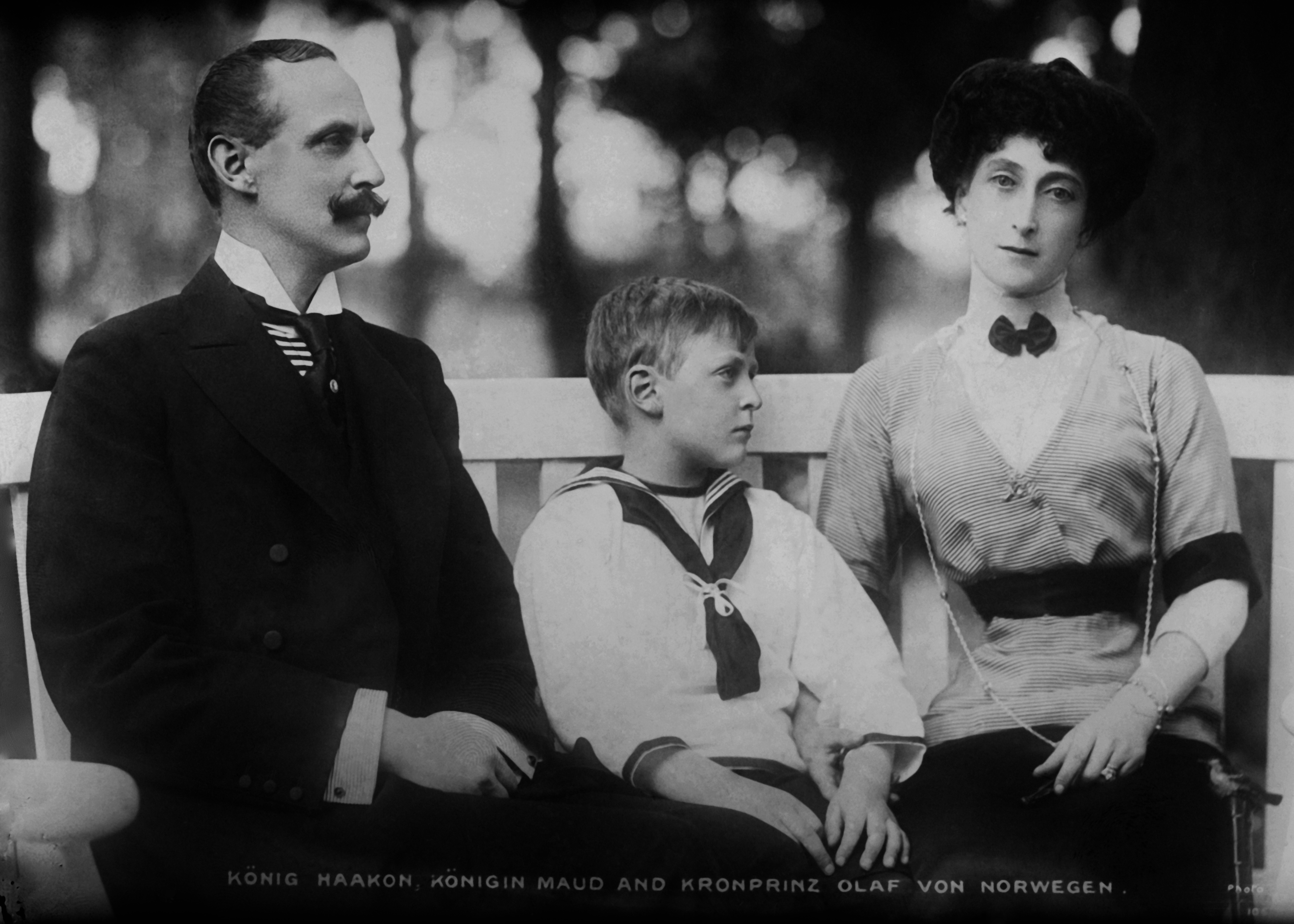
Family of the Norwegian monarch
Members of the Norwegian royal family are people related to King Harald V of Norway or former Norwegian monarchs who are royals and who hold royal titles. The term does not include non-royal relatives. The current family who holds the throne are members of the House of Glücksburg who ascended to the Norwegian throne after the election of Prince Carl of Denmark as King of Norway (regnal name Haakon VII) during the dissolution of the Swedish-Norwegian union in 1905.
The Norwegian monarch holds the title King of Norway while his consort is Queen of Norway with the style Majesty. The heir apparent to the Norwegian throne holds the title Crown Prince of Norway while his wife is Crown Princess of Norway with the style Royal Highness. The children of the reigning Monarch and the children of the heir apparent are granted the title Prince of Norway or Princess of Norway. Only the eldest child is a Royal Highness, while the others do not have any styles in Norwegian, although the style of Highnesses may be used informally in foreign languages. In Norway there is traditionally no distinction between the royal house (kongehuset) and the royal family (kongelige familie). Both are informal terms. The Constitution specifically recognizes only those who hold royal titles such as prince or princess, or those who are in the line of succession. Since the 2000s, the term royal house has been used on the website of the royal family to refer only to the monarch and his spouse, the heir apparent and his spouse, and the heir apparent's eldest child. The royal family was from the same time used to refer to other princes or princesses, but did not include untitled relatives of the royal family.
In the 2020s, the Norwegian royal family has faced extensive criticism and scandals, including Mette-Marit's association with Jeffrey Epstein, the indictment for rape against her son Marius Borg Høiby, nicknamed "Little Marius," scandals surrounding the King's son-in-law, American conspiracy theorist Durek Verrett, and criticism of Märtha Louise for commercial exploitation of her title to promote alternative medicine. The scandals have been cited as contributing to a "decimation of the Norwegian royal family's reputation" The royal family was the subject of the Netflix documentary Rebel Royals, which followed Märtha Louise and her second husband Durek Verrett, and in which Verrett accused the royal family of racism.
History
The Norwegian monarchy traces its history and origin back to the unification and founding of Norway, as well as Norway's first king, Harald I of the Fairhair dynasty. With the introduction of the Norwegian Law of Succession in 1163, the legal framework established that only one monarch and one royal family was, through succession, allowed to rule.
Norway, Sweden and Denmark had joint monarchs during the Kalmar Union in the late Middle Ages, and Norway remained in union with Denmark after Sweden left the union in 1523. Following the reformation a joint Danish-Norwegian state was established 1536–37, which was ruled from Copenhagen by the House of Oldenburg until Norway was ceded to Sweden at the Treaty of Kiel in 1814 following Denmark-Norway's defeat in the Napoleonic Wars. Norway was briefly independent with its own king in 1814, but forced into a new union with Sweden under the rule of the House of Bernadotte.
Upon becoming independent in 1905, Norway decided through a referendum to remain as a monarchy, with its first monarch being the Danish-born King Haakon VII, whose family consisted of the British Princess Maud and their son Olav. It is King Haakon's descendants that today make up the current royal family of Norway.
Through marriages and historical alliances, the Norwegian royal family is closely related to the Swedish and Danish royal families as well as being more distantly related to royal families of Greece and the United Kingdom.
The current king Harald V descends from all of the four kings belonging to the House of Bernadotte (1818–1905) that preceded the House of Glücksburg on the throne and is the first Norwegian monarch to be a descendant of all previous Norwegian monarchs since 1818.
Mette-Marit's association with Jeffrey Epstein and the scandals surrounding the King's son-in-law, American conspiracy theorist Durek Verrett, have been cited as contributing to a deterioration in its reputation. Norwegian media criticized King Harald V for legitimizing and endorsing the exploitation of national values and symbols for Märtha Louise's and Verrett's personal financial gain.
The royal family is defined as those who hold a royal title. , the website of the royal family stated that the royal house consisted of King Harald, Queen Sonja, Crown Prince Haakon and Crown Princess Mette-Marit, and Princess Ingrid Alexandra, and that the extended royal family consists Prince Sverre Magnus, Princess Märtha Louise, Princess Ragnhild and Astrid. The website mentioned that Märtha Louise has the children Maud Angelica Behn and Leah Isadora Behn, but did not describe them as royal or part of the royal house or royal family, as they are commoners and do not hold any title. The website did not describe Ari Behn as part of the royal family, only as the father of Märtha Louise's children, in line with traditional practice. The website made no mention at all of Marius Borg Høiby, Mette-Marit's son from a previous relationship.
In September 2024, three days after Märtha Louise married conspiracy theorist Durek Verrett, the royal court removed the term "royal family" from the website (of the royal court) and clarified that Marius Borg Høiby is not royal.
Jan Bøhler wrote that "organized crime is today a greater threat to our country than terrorism, and we are allocating increasingly larger resources to combat it. At the same time, a member of the royal family has for years vacationed and partied with central figures in drug-related crime. Individuals known for involvement in serious money laundering cases and violent gangs, including the Hells Angels, have also participated in the festivities. These enemies of society have been allowed to roam freely on the Crown Prince couple's properties during events referred to as "Skaugum festivals."
Members
Members of the Royal House are:
- HM The King of Norway (The Monarch) HM The Queen of Norway (The Consort)
- HRH The Crown Prince of Norway (The King's son and heir apparent)
HRH The Crown Princess of Norway (The King's daughter-in-law)
- HRH Princess Ingrid Alexandra of Norway (The King's granddaughter)
- HRH The Crown Prince of Norway (The King's son and heir apparent)
HRH The Crown Princess of Norway (The King's daughter-in-law)
Other royals are:
- HH Prince Sverre Magnus of Norway (The King's grandson)
- HH Princess Märtha Louise of Norway (The King's daughter), married firstly to Ari Behn and secondly to Durek Verrett
- HH Princess Astrid of Norway, Mrs. Ferner (The King's sister), married to Johan Ferner
Non-royal grandchildren of Norwegian kings
The following are grandchildren of Norwegian kings who are not royal themselves and who hold no title. In each case they are children of "other royals", that is other people than the king or the crown prince.
- Children of Princess Ragnhild
- Haakon Lorentzen (b. 1954)
- Ingeborg Lorentzen (b. 1957)
- Ragnhild Lorentzen (b. 1968)
- Children of Princess Astrid
- Cathrine Ferner (b. 1962)
- Benedikte Ferner (b. 1963)
- Alexander Ferner (b. 1965)
- Elisabeth Ferner (b. 1969)
- Carl-Christian Ferner (b. 1972)
- Children of Princess Märtha Louise
- Maud Angelica Behn (b. 2003)
- Leah Isadora Behn (b. 2005)
- Emma Tallulah Behn (b. 2008)
Deceased royals
- HM Queen Maud (The King's grandmother; died in 1938)
- HRH Crown Princess Märtha (The King's mother; died in 1954)
- HM King Haakon VII (The King's grandfather; died in 1957)
- HM King Olav V (The King's father; died in 1991)
- HH Princess Ragnhild, Mrs. Lorentzen (The King's sister; died in 2012), married to Erling Lorentzen
Family tree of members


;Notes
- Member of the Royal House
Netflix documentary ''Rebel Royals''
Princess Märtha Louise and her second husband Durek Verrett were featured in the Netflix documentary Rebel Royals, in which Verrett said he had not been welcomed with open arms by the royal family, and that King Harald, Queen Sonja and Crown Prince Haakon "didn't know what racism was" and that "they looked at me as if I were crazy when I said that racism existed." Verrett said the first time that King Harald asked about his experiences of racism was when Oprah with Meghan and Harry aired, and that "they didn't want a family discussion because they didn't want to treat me that way. They wanted to have a family discussion because they were afraid I might be the next one on Oprah." The royal family said the documentary violated Märtha Louise's and Verrett's agreement with the royal family not to use her title or connection to the royal family.
Royal coat of arms
The coat of arms of Norway is one of the oldest in Europe and serves both as the coat of arms of the nation and of the Royal House. This is in keeping with its origin as the coat of arms of the kings of Norway during the Middle Ages.
Håkon the Old (1217–1263) used a shield with a lion. The earliest preserved reference to the colour of the arms is the King's Saga written down in 1220.
In 1280 King Eirik Magnusson added the crown and silver axe to the lion. The axe is the martyr axe of St. Olav, the weapon used to kill him in the battle of Stiklestad in 1030.
The specific rendering of the Norwegian arms has changed through the years, following changing heraldic fashions. In the late Middle Ages, the axe handle gradually grew longer and came to resemble a halberd. The handle was usually curved in order to fit the shape of shield preferred at the time, and also to match the shape of coins. The halberd was officially discarded and the shorter axe reintroduced by royal decree in 1844, when an authorized rendering was instituted for the first time. In 1905 the official design for royal and government arms was again changed, this time reverting to the medieval pattern, with a triangular shield and a more upright lion.
The coat of arms of the royal house as well as the Royal Standard uses the lion design from 1905. The earliest preserved depiction of the Royal Standard is on the seal of Duchess Ingebjørg from 1318. The rendering used as the official coat of arms of Norway is slightly different and was last approved by the king 20 May 1992.
When used as the royal coat of arms the shield features the insignias of the Royal Norwegian Order of St. Olav around it and is framed by a royal ermine robe, surmounted by the crown of Norway.
The royal coat of arms is not used frequently. Instead, the king's monogram is extensively used, for instance in military insignia and on coins.
File:Blason Norvège.svg|Arms of Norway File:Greater royal coat of arms of Norway.svg|Royal Coat of Arms of Norway File:Coat of Arms of His Royal Highness the Crown Prince of Norway.svg|Coat of Arms of the Crown Prince of Norway
File:Royal Monogram of King Haakon VII of Norway.svg|Royal Monogram of HM King Haakon VII of Norway File:Royal Monogram of Queen Maud of Norway.svg|Royal Monogram of HM Queen Maud of Norway File:Royal Monogram of King Olav V of Norway.svg|Royal Monogram of HM King Olav V of Norway File:Royal Monogram of Princess Martha of Norway.svg|Royal Monogram of HRH Crown Princess Märtha of Norway File:Royal Monogram of King Harald V of Norway.svg|Royal Monogram of HM King Harald V of Norway File:Royal Monogram of Queen Sonja of Norway.svg|Royal Monogram of HM Queen Sonja of Norway File:Royal Monogram of Prince Haakon of Norway.svg|Royal Monogram of HRH Crown Prince Haakon of Norway File:Royal Monogram of Princess Metta-Merit of Norway.svg|Royal Monogram of HRH Crown Princess Mette-Marit of Norway File:Royal Monogram of Princess Ingrid Alexandra of Norway.svg|Royal Monogram of HRH Princess Ingrid Alexandra of Norway File:Royal Monogram of Prince Sverre Magnus of Norway.svg|Royal Monogram of HH Prince Sverre Magnus of Norway File:Royal Monogram of Princess Martha Louise of Norway.svg|Royal Monogram of HH Princess Martha Louise of Norway File:Royal Monogram of Princess Ragnhild of Norway.svg|Royal Monogram of HH Princess Ragnhild, Mrs. Lorentzen File:Royal Monogram of Princess Astrid of Norway.svg|Royal Monogram of HH Princess Astrid, Mrs. Ferner
References
References
- "History". Norwegian Royal Court.
- "Son of Norway's crown princess arrested on suspicion of rape". The Washington Post.
- Hanbaly, Laik. (2024-10-12). "Drømmer om en republikk".
- (2024-11-28). "Norway's royal family reels under the weight of scandal".
- "Rikssamling".
- "The Family tree".
- "Am Wochenende heiratet die Prinzessin Märtha Louise einen Hollywood-Schamanen – wie die norwegische Königsfamilie ihren guten Ruf verlor". [[Neue Zürcher Zeitung]].
- "Kongefamilien bør ikke akseptere Märtha Louises salg av Kongehuset". Nettavisen.
- "Kongefamilien – dagens familie". Royal Court.
- Helljesen, Vilde. (2024-09-03). "Kong Harald rydder opp – fjerner «kongefamilien»".
- "De kriminelle vennene kan være mer enn bare venner". Nettavisen.
- (24 August 2024). "The princess and the shaman: how a royal wedding is dividing Norway". The Times.
- "Kongehuset etter Durek Verretts rasismeoppgjør: – Kan huske ting litt ulikt". NRK.
- "Durek Verrett tar et rasismeoppgjør med kongen i ny Netflix-dokumentar". NRK.
- "Sjokkuttalelser om kongeparet". Dagbladet.
- "Watch Rebel Royals: An Unlikely Love Story".
- "Thought Harry and Meghan were bad? Meet Norway's Rebel Royals". The Daily Telegraph.
- "Kongehuset om Netflix-dokumentar: – Brudd på avtalen med kongehuset". NRK.
- [http://www.ngw.nl/int/nor/nornat.htm A web page featuring the history of the coat of arms of Norway] {{webarchive. link. (2015-04-02 Retrieved 21 November 2006)
- [http://www.riksarkivet.no/manedens/juli2002/juli.html An article from the Norwegian National Archives depicting the seal of Duchess Ingebjørg] {{webarchive. link. (2006-02-14 {{in lang). no Retrieved 5 November 2007
- [http://home.hio.no/~ims/opphavsrett/riksvaapenet/bruk_av_riksvaapenet.htm Web page on rules for the use of the coat of arms (Norwegian)] {{webarchive. link. (2013-11-18 Retrieved 21 November 2006)
This article was imported from Wikipedia and is available under the Creative Commons Attribution-ShareAlike 4.0 License. Content has been adapted to SurfDoc format. Original contributors can be found on the article history page.
Ask Mako anything about Norwegian royal family — get instant answers, deeper analysis, and related topics.
Research with MakoFree with your Surf account
Create a free account to save articles, ask Mako questions, and organize your research.
Sign up freeThis content may have been generated or modified by AI. CloudSurf Software LLC is not responsible for the accuracy, completeness, or reliability of AI-generated content. Always verify important information from primary sources.
Report