From Surf Wiki (app.surf) — the open knowledge base
Norwegian Nobel Committee
Committee that awards the Nobel Peace Prize

Committee that awards the Nobel Peace Prize
| Field | Value |
|---|---|
| name | Norwegian Nobel Committee |
| native_name | Den norske Nobelkomité |
| native_name_lang | no |
| headquarters | Oslo, Norway |
| membership | 5 members |
| website |
The Norwegian Nobel Committee () selects the recipients of the Nobel Peace Prize each year on behalf of Swedish industrialist Alfred Nobel's estate, based on instructions of Nobel's will.
Five members are appointed by the Norwegian Parliament. In his will, Alfred Nobel tasked the parliament of Norway with selecting the winners of the Nobel Peace Prize. At the time, there was a union between Sweden and Norway, with a common monarch and common foreign policy. Despite its members being appointed by Parliament, the committee is a private body tasked with awarding a private prize. In recent decades, most committee members were retired politicians.
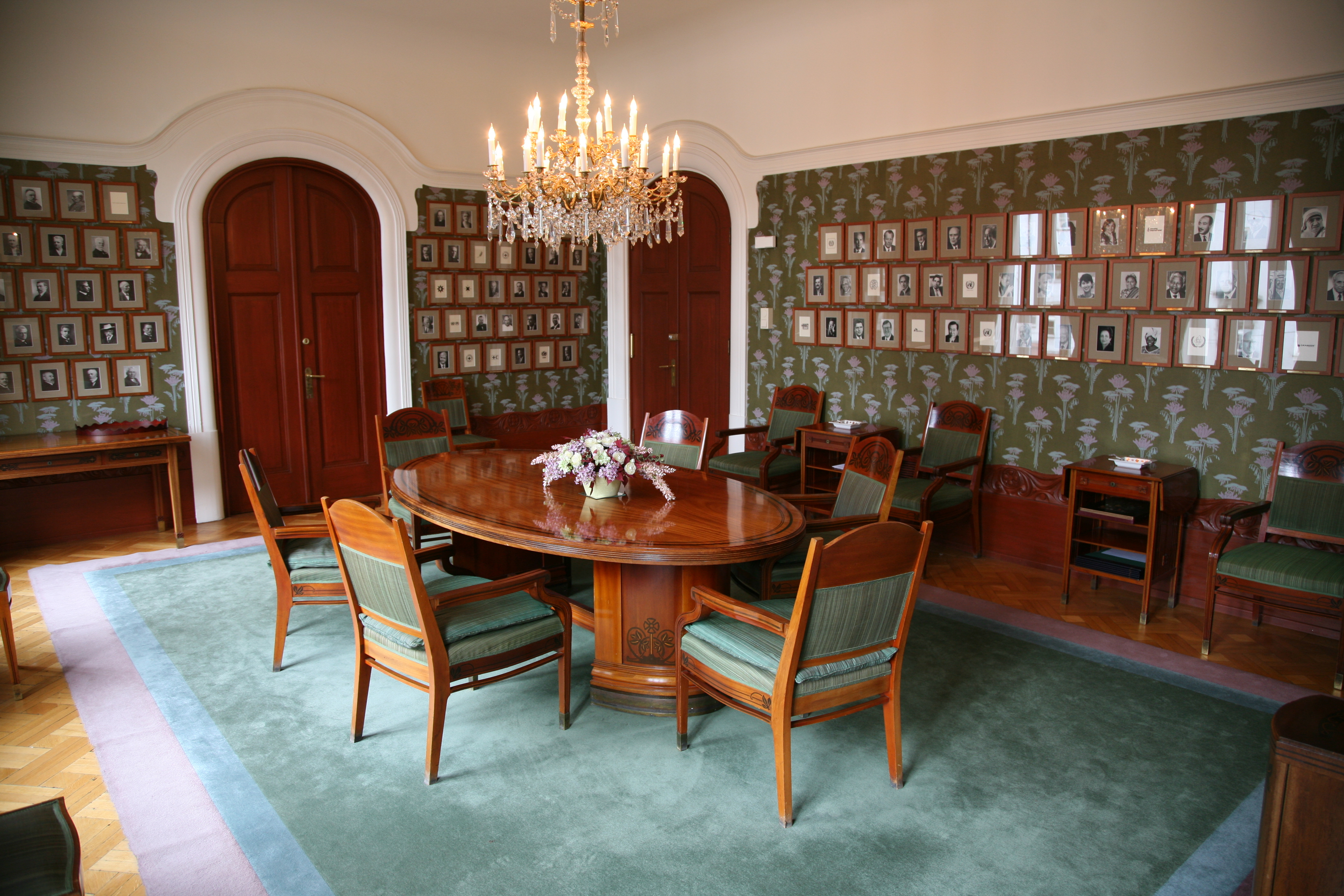
The committee is assisted by its secretariat, the Norwegian Nobel Institute. The committee holds their meetings in the institute's building, where the winner is also announced. Since 1990, however, the award ceremony takes place in Oslo City Hall.
History
Alfred Nobel died in December 1896. In January 1897 the contents of his will were unveiled. It was written as early as in 1895. He declared that a Nobel Peace Prize should be awarded "to the person who shall have done the most or the best work for fraternity between nations, for the abolition or reduction of standing armies and for the holding and promotion of peace congresses". Nobel donated funds for the prize, and the Nobel Foundation now manages the assets. It is not known why Nobel wished the Peace Prize to be administered in Norway -- specifically "a committee of five persons to be elected" by Norway's parliament A new body had to be created—the Norwegian Nobel Committee.
Jurist Fredrik Heffermehl has noted that a legislative body could not necessarily be expected to handle a judicial task like managing a legal will. The task of a parliament is to create and change laws whereas a will cannot be changed unless the premises are clearly outdated. However, this question was not debated in depth, out of contemporary fear that the donated money might be lost in legal battles if the body was not created soon. On 26 April 1897 the Norwegian Parliament accepted the assignment and on 5 August the same year it formalized the process of election and service time for committee members. The first Peace Prize was awarded in 1901 to Henri Dunant and Frédéric Passy.
Nonetheless, the committee is still composed mainly of politicians. A 1903 proposition to elect a law scholar (Ebbe Hertzberg) was rejected. This practice has been cemented, but sharply criticized. There have been propositions about including non-Norwegian members in the committee, but this has never happened.
The Norwegian Nobel Committee is assisted by the Norwegian Nobel Institute, established in 1904. The director of the Nobel Institute also serves as secretary to the Norwegian Nobel Committee; currently this position belongs to Olav Njølstad.
List of Chairpersons
;List of chairpersons
- 1900–1901: Bernhard Getz
- 1901–1922: Jørgen Løvland
- 1922–1922: Hans Jacob Horst
- 1922–1941: Fredrik Stang
- 1941–1943: Gunnar Jahn
- 1944–1945: see below
- 1945–1945: Carl Joachim Hambro
- 1945–1966: Gunnar Jahn
- 1967–1967: Nils Langhelle
- 1967–1967: Bernt Ingvaldsen
- 1968–1978: Aase Lionæs
- 1979–1981: John Sanness
- 1982–1989: Egil Aarvik
- 1990–1990: Gidske Anderson
- 1991–1999: Francis Sejersted
- 2000–2002: Gunnar Berge
- 2003–2008: Ole Danbolt Mjøs
- 2009–2015: Thorbjørn Jagland
- 2015–2017: Kaci Kullmann Five
- 2017–2023: Berit Reiss-Andersen
- 2024–present: Jørgen Watne Frydnes In January 1944 an attempt by the Quisling government to take over the functions of the Nobel Committee led to the resignation of Jahn and other committee members. The Swedish consulate-general in Oslo formally took over the management of the Foundation's Oslo property on behalf of the Nobel Foundation.
Members
Main article: List of members of the Norwegian Nobel Committee
The members are:
- Anne Enger, former Leader of the Centre Party and Minister of Culture. Appointed for the period 2018–2020, and reappointed for the period 2021–2026.
- Asle Toje (Vice Chair), foreign policy scholar. Appointed for the period 2018–2023, reappointed for the period 2024–2029.
- Kristin Clemet, former Conservative Party cabinet member who previously represented Oslo in Norwegian Parliament. Appointed for the period 2021–2026.
- Jørgen Watne Frydnes (Chair), businessman and nonprofit leader, appointed for the period 2021–2026.
- Gry Larsen, former Labour Party Foreign Affairs Secretary of Norway. Appointed for the period 2024–2029
Secretariat

The committee is assisted by the Norwegian Nobel Institute, its secretariat. The leader of the institute holds the title secretary. The secretary is not a member of the committee, but is an employee of the Norwegian Nobel Institute.
;List of secretaries
- 1901–1909: Christian Lous Lange
- 1910–1945: Ragnvald Moe
- 1946–1973: August Schou
- 1974–1977: Tim Greve
- 1978–1989: Jakob Sverdrup
- 1990–2015: Geir Lundestad
- 2015–2025: Olav Njølstad
- 2025–present: Kristian Berg Harpviken
References
;Notes
;Bibliography
- Heffermehl, Fredrik (2010). ''The Nobel Peace Prize. What Nobel really wanted'''. Sta Barbara: Praeger. .
References
- Heffermehl, 2008: pp. 15–17
- "Excerpt from the Will of Alfred Nobel". [[Nobel Foundation]].
- Arntzen, Jon Gunnar. (2007). "Nobelprisen". Kunnskapsforlaget.
- Lundestad, Geir. "Why Norway?". Nobel Peace Prize.
- (27 January 2026). "Prize awarder for the Nobel Peace Prize". NobelPrize.org.
- Heffermehl, 2008: p. 39
- Heffermehl, 2008: p. 72
- Heffermehl, 2008: pp. 53–54
- Helljesen, Geir. "Bare nordmenn i Nobelkomiteen". Norwegian Broadcasting Corporation.
- In late 1948, the election system was changed to make the committee more proportional with parliamentary representation of [[List of political parties in Norway. Norwegian political parties]]. The Norwegian Labour Party, which controlled a simple majority of seats in the Norwegian Parliament orchestrated this change.Heffermehl, 2008: pp. 84–85
- Dahl, Miriam Stackpole. (10 October 2008). "Fredspriskuppet". Ny Tid.
- Heffermehl, 2008: pp. 60–64
- "The Norwegian Nobel Committee 1901-2008". Nobelprize.org.
- (18 January 2021). "Valg av medlemmer til Nobelkomiteen". [[Stortinget]].
This article was imported from Wikipedia and is available under the Creative Commons Attribution-ShareAlike 4.0 License. Content has been adapted to SurfDoc format. Original contributors can be found on the article history page.
Ask Mako anything about Norwegian Nobel Committee — get instant answers, deeper analysis, and related topics.
Research with MakoFree with your Surf account
Create a free account to save articles, ask Mako questions, and organize your research.
Sign up freeThis content may have been generated or modified by AI. CloudSurf Software LLC is not responsible for the accuracy, completeness, or reliability of AI-generated content. Always verify important information from primary sources.
Report