From Surf Wiki (app.surf) — the open knowledge base
Norwegian Forest Cat
Breed of cat
.jpg)
Breed of cat
| Field | Value | |
|---|---|---|
| name | Norwegian Forest Cat | |
| image | Norwegian Forest Cat in snow.jpg | |
| imagecaption | Red tabby blotched and white | |
| nickname | , , | |
| country | Norway | |
| landrace | landrace | cfastd=https://cfa.org/wp-content/uploads/2024/05/norwegian-forest-cat-presentation.pdf |
| fifestd | https://fifeweb.org/app/uploads/2023/10/NFO.pdf | |
| ticastd | https://tica.org/phocadownload/nf.pdf | |
| wcfstd | https://wcf.de/pdf-en/breed/NFO_en_2021-12-08.pdf | acfstd=https://www.acf.asn.au/notices/notices/standards/Group%20One/NorwegianForestCat-2023.pdf |
| ccastd | https://www.cca-afc.com/documents/BreedStandards/norwegianforestcat.pdf | |
| gccfstd | https://www.gccfcats.org/Cat-Breeds/Norwegian-Forest-Cat | |
| acfastd1 | http://www.acfacat.com/Breed%20Standards/NORWEGIAN%20FOREST%20CAT.pdf |
The Norwegian Forest Cat ( or norsk skaukatt) is a breed of domestic cat originating in Northern Europe. This landrace breed is adapted to a very cold climate, with a top coat of long, glossy hair and a woolly undercoat for insulation. The breed's ancestors may have been a landrace breed of short-haired cats brought to Norway about A.D. 1000 by the Vikings, who may also have brought with them long-haired cats, like those ancestral to the modern Siberian and Turkish Angora.
During World War II, the Norwegian Forest Cat was nearly extinct; then the Norwegian Forest Cat Club's breeding program increased the cat's number. It was registered as a breed with the European Fédération Internationale Féline in the 1970s, when a cat fancier, Carl-Fredrik Nordane, took notice of the breed and made efforts to register it. The breed is very popular in Norway, Denmark, Sweden, Iceland, and France.
It is a large breed with a strong body, similar to the Siberian and Maine Coon cat breeds, with long legs, a bushy tail, and a sturdy body. It is very good at climbing, partly because of its strong claws.
History and adaption
The Norwegian Forest Cat is adapted to survive Norway's cold weather. Its ancestors may include cold-adapted black and white British Shorthair cats brought to Norway from Great Britain some time after 1000 AD by the Vikings, and longhaired cats brought to Norway by Crusaders around the 14th century. These cats could have reproduced with farm and feral stock and may have eventually evolved into the modern-day Norwegian Forest breed. The Siberian and the Turkish Angora, longhaired cats from Russia and Turkey, respectively, are also possible ancestors of the breed.
Norse legends refer to the skogkatt as a "mountain-dwelling fairy cat with an ability to climb sheer rock faces that other cats could not manage." Since the Norwegian Forest Cat is a very adept climber, author Claire Bessant believes that the skogkatt folktale could be about the ancestor of the modern Norwegian Forest breed. The name Norse skogkatt is used by some breeders and fancier organizations for the modern breed.
The ancestors of the Norwegian Forest Cat most likely served as ships' cats (mousers) on Viking ships. The original landrace lived in the Norwegian forests for many centuries, but were later prized for their hunting skills and were used on Norwegian farms, until they were discovered in the early 20th century by cat enthusiasts.
.jpeg)
In 1938 the first organization devoted to the breed, the Norwegian Forest Cat Club, was formed in Oslo, Norway. The club's movement to preserve the breed was interrupted by World War II. Owing to cross-breeding with free-ranging domestic cats during the war, the Norwegian Forest Cat became endangered and nearly extinct until the Norwegian Forest Cat Club helped the breed make a comeback by developing an official breeding program.
In the 1950s, King Olav V declared them the official cat of Norway. Since the cat did not leave Norway until the 1970s, it was not registered as a breed in the Fédération Internationale Féline (FIFe), the pan-European federation of cat registries, until Carl-Fredrik Nordane, a Norwegian cat fancier, took notice of the breed, and made efforts to register it. The breed was registered in Europe by the 1970s, and in the American Cat Fanciers Association in 1994. In 1978, it was recognized in Sweden as an official breed, In 1989, they were accepted as a breed in the United Kingdom by the Norwegian Cat Club of Britain.
The Norwegian Forest breed is very popular in Norway and Sweden. Since 2003, it has been the fifth most popular cat breed in France, where there are about 400 to 500 births per year.
Description
Appearance
The Norwegian Forest Cat is strongly built and larger than an average cat. Adult females weigh 3.6–8 kg; males, 4.5–9 kg. The breed has a long, sturdy body; long legs; and a bushy tail. The coat consists of a long, thick, glossy, water-repellent top layer and a woolly undercoat and is thickest at the legs, chest, and head. The undercoat appears as a ruff. The profile of the breed is generally straight. Their water-resistant coat with a dense undercoat developed to help the cat survive in the harsh Scandinavian climate.
The head is long with an overall shape similar to an equilateral triangle, a strong chin, and a muzzle of medium length; a square or round-shaped head is considered to be a defect. The eyes are almond-shaped and oblique, and may be of any color. The ears are large, wide at the base, and high set, have a tufted top, are placed in the extension of the triangle formed by the head, and end with a tuft of hair like the ears of the lynx.
All coat colors and divisions in the traditional, sepia, and mink categories are accepted. Since the cats have very strong claws, they are very good climbers, and can even climb rocks.
Behaviour
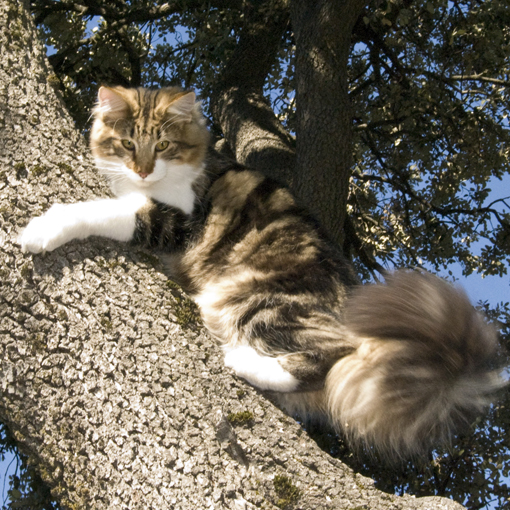
They are friendly, intelligent, and generally good with people. The Norwegian Forest Cat has a lot of energy. Fanciers note that these cats produce a variety of high-pitched "chirping" vocalizations.
Norwegian Forest Cats that live primarily outdoors become swift and effective hunters, but the breed can also adapt to indoor life.
A study comparing Norwegian Forest Cat kittens to Siamese, Oriental, and Abyssinian kittens found the Norwegian Forest Cat to be more likely to explore and try to escape.
Health
In an experiment directed by John C. Fyfea, Rebeccah L. Kurzhals, and others, it was concluded that a complex rearrangement in the breed's Glycogen branching enzyme (GBE1) can cause both a perinatal hypoglycemic collapse and a late-juvenile-onset neuromuscular degeneration in glycogen storage disease type IV in the breed. This disorder, while rare, can prove fatal to cats that have it.
The breed has also been known to suffer from hip dysplasia, which is a rare, partially hereditary disease of the hip joint.
An analysis of pedigree records of cats in England found evidence of hereditary cardiomyopathy. A 2005 study looking at 17 cases of eosinophilic granuloma complex in Norwegian Forest Cats found a link between the cats after reviewing pedigree analysis, suggesting a hereditary nature of the condition.
References
References
- "Breed Profile: The Norwegian Forest Cat".
- "Accueil - chat norvegien - chat des forets norvegiennes". Kogkatt-norvegien.org.
- Rousselet-Blanc, Pie. (1992). "Encyclopedie Active Le Cha". Larousse Kingfisher Chambers.
- Richards, James. (1999). "ASPCA Complete Guide to Cats: Everything You Need to Know About Choosing and Caring for Your Pet". [[Chronicle Books]].
- Case, Linda. (2003). "The Cat: Its Behavior, Nutrition and Health". [[Wiley-Blackwell]].
- Taylor, David. (1989). "Ultimate Cat Book: A Unique Photographic Guide to More Than 100 International Breeds and Variations". [[Simon & Schuster]].
- Caravan, Jill. (1998). "An Identification Guide to Cat Breeds". Hertfordshire: Eagle Editions.
- "Norwegian Forest Cat Breed Information". Vetstreet.
- Bessant, Claire. (1999). "The Complete Guide to the Cat (Complete Animal Guides)". [[Barron's Educational Series]].
- "Breed Profile: The Norwegian Forest Cat". [[Cat Fanciers' Association]].
- Furstinger, Nancy. (2005). "Norwegian Forest Cats". Abdo Publishing.
- Duno, Steve. (2008). "Be the Cat: Secrets of the Natural Cat Owner". [[Sterling Publishing]].
- (2009). "Lost Woods Norwegian Forest Cats".
- Richards, Dorothy Silkstone. (1996). "Cat: Selection, Care, Training, Nutrition, Health, Breeding, Showing". Salamander Books.
- (1999). "Robinson's Genetics for Cat Breeders and Veterinarians". [[Butterworth–Heinemann]].
- Diaz, Roman. (2015). "Origami Chess: Cats Vs. Dogs". Thunder Bay Press.
- "Kattförbundet Sverak".
- McGreevy, Paul. (2002). "Cats (Home Reference Library)". Fog City Press.
- "Pour l'Angleterre". Aniwa.com.
- "Le Sphynx: Haut dans les cœurs du classement CFA".
- "Bienvenue sur le site de l'Unité de Médecine de l'Elevage et du Sport de l'Ecole Nationale Vétérinaire d'Alfort".
- (13 August 2018). "Norwegian Forest Breed".
- Rousselet-Blanc, Pie. (1992). "Encyclopedie Active Le Chat". Larousse Kingfisher Chambers.
- [http://www.tica.org/members/publications/standards/nf.pdf Norwegian Forest Breed Standard] {{Webarchive. link. (28 July 2011 . [[The International Cat Association]]. Published 1 May 2004. Accessed 26 March 2011.)
- (23 March 2009). "Breed differences in behavioural development in kittens". Physiology & Behavior.
- (2007). "A complex rearrangement in GBE1 causes both perinatal hypoglycemic collapse and late-juvenile-onset neuromuscular degeneration in glycogen storage disease type IV of Norwegian forest cats". Molecular Genetics and Metabolism.
- (10 December 2007). "Cat Owner's Home Veterinary Handbook, Fully Revised and Updated". [[John Wiley & Sons.
- (December 1992). "Glycogen Storage Disease Type IV: Inherited Deficiency of Branching Enzyme Activity in Cats". Pediatric Research.
- Eldredge, Debra. (2003). "Pills For Pets: The A to Z Guide to Drugs and Medications for Your Animal Companion". [[Kensington Books.
- (2000). "What Your Cat Is Trying To Tell You". [[St. Martin's Press]].
- (30 October 2014). "Familial cardiomyopathy in Norwegian Forest cats". Journal of Feline Medicine and Surgery.
- (30 April 2005). "Non-pruritic granuloma in Norwegian forest cats". Veterinary Record.
This article was imported from Wikipedia and is available under the Creative Commons Attribution-ShareAlike 4.0 License. Content has been adapted to SurfDoc format. Original contributors can be found on the article history page.
Ask Mako anything about Norwegian Forest Cat — get instant answers, deeper analysis, and related topics.
Research with MakoFree with your Surf account
Create a free account to save articles, ask Mako questions, and organize your research.
Sign up freeThis content may have been generated or modified by AI. CloudSurf Software LLC is not responsible for the accuracy, completeness, or reliability of AI-generated content. Always verify important information from primary sources.
Report