From Surf Wiki (app.surf) — the open knowledge base
Northwest Region (Cameroon)
Region of Cameroon

Region of Cameroon
| Field | Value |
|---|---|
| name | Northwest Region |
| settlement_type | Region of Cameroon with special status |
| image_seal | Emblem of the Northwest Regional Assembly (Cameroon).png |
| subdivision_type | Country |
| subdivision_name | Cameroon |
| parts_type | Departments |
| parts_style | para |
| p1 | Boyo |
| p2 | Bui |
| p3 | Donga-Mantung |
| p4 | Menchum |
| p5 | Mezam |
| p6 | Momo |
| p7 | Ngo-Ketunjia (Ngoketunjia) |
| image_map | Cameroon - Northwest.svg |
| map_caption | Location of the Northwest Region within Cameroon |
| coordinates | |
| leader_title1 | Governor |
| leader_name1 | Adolphe Lele Lafrique |
| leader_title2 | President of the Regional Assembly & Executive Council |
| leader_name2 | Fru Fobuzshi Angwafo III |
| seat | Bamenda |
| seat_type | Capital |
| area_total_km2 | 17300 |
| population_as_of | 2015 |
| population_total | 1968578 |
| population_density_km2 | auto |
| iso_code | CM-NW |
| blank_name_sec2 | HDI (2022) |
| blank_info_sec2 | 0.560 |
| · 6th of 10 |
· 6th of 10
The Northwest Region, or North-West Region () is a region with special status in Cameroon. Its capital is Bamenda. The Northwest Region was part of the Southern Cameroons, found in the western highlands of Cameroon. It is bordered to the southwest by the Southwest Region, to the south by the West Region, to the east by the Adamawa Region, and to the north by Nigeria. Various Ambazonian nationalist and separatist factions regard the region as being distinct as a polity from Cameroon.

In 1919, the Northwest Region became solely administered by the United Kingdom. In 1961, the region joined the Cameroon. Ambazonian separatists regard both the North-West and South-West regions as being constituent components of their envisaged breakaway state.
History
The origins of the region are linked to the settlement of the Tikar people who joined the Bamoun Kingdom, in the 1700s. In 1884, the region was colonized by Germany under the regime of the protectorate until 1916 when it became a condominium administered jointly by the United Kingdom and the France. In 1919, the administration of the North West region, as part of Southern Cameroons became solely British. In 1961, the region joined Cameroon as part of the federated state of West Cameroon, under the 1961 British Cameroons referendum.
At the end of 2017, an Ambazonian separatist movement in the two English-speaking regions of North West and South West began a wave of violence affecting soldiers, police, business leaders and workers. Separatist activists are trying in particular to prevent children from returning to school. Between 2016 and 2019, separatists reportedly ransacked, destroyed or burned down more than 174 schools.
Administration

The Northwest Region (known before 2008 as the Northwest Province) is the third most populated province in Cameroon. It has one major metropolitan city, Bamenda, with several other smaller towns such as Wum, Kumbo, Mbengwi, Ndop, Nkambé, Batibo, Bambui, Bafut and Oshie. The province saw an increase in its population from approximately 1.2 million in 1987 to 1.8 million in 2010. The population density of 99.12 people per square kilometer is higher than the national average of 22.6. The provincial urban growth rate is 7.95%, higher than the national average of 5.6%, while the rural growth rate, at 1.16%, is equal to the national rate. In 2001, according to the Statistical Provincial Services of the North-West Province, the population of the province is young, with over 62% of its residents being less than 20 years old. Therefore, the dependency rate in the province is high, particularly in the rural areas.
Like other regions in Cameroon, the Northwest Region is made up of administrative divisions. The province was created in 1972 with five divisions or departments: Bui, Donga-Mantung, Menchum, Mezam, and Momo. Today, it has seven divisions, the additions being Boyo, which was carved out of the Menchum division, and Ngo-Ketunjia or Ngoketunjia, split off from the Mezam division. Each division is further subdivided, with thirty-one total subdivisions in the Northwest Province. The basic unit of local government is the council, and there are thirty-two councils in the region.
Politics
The Northwest is a stronghold of the Social Democratic Front (SDF) which is one of the main opposition parties of Cameroon. Some Northwesterners feel completely marginalized by the government. There is also a secessionist movement, the SCNC (Southern Cameroons National Council) whose goal is to secede from Cameroon and form a republic consisting of the English-speaking regions. Much of the SCNC's influence exists in the Northwest. In 2008, the President of the Republic of Cameroon, Paul Biya, signed decrees abolishing "provinces" and replacing them with "regions". The Northwest Province subsequently became the Northwest Region.
Special status
As part of the Major National Dialogue, the region was given a "special status" in December 2019, granting additional rights and responsibilities in relation to economic, health, social, educational, sports and cultural development. Under the special status the region has a bicameral Regional Assembly, made up of a 20-member House of Chiefs composed of traditional leaders and a 70-member House of Divisional Representatives nominated by municipal councils. The Regional Assembly appoints a Regional Executive Council. Additional powers over health and education were also granted to municipalities.
Regional Executive Council
The Regional Executive Council is led by the president of the Regional Assembly and includes a vice president, three commissioners, two secretaries and a questor.
| Name | Portfolios |
|---|---|
| Fru Fobuzshi Angwafo III | President of the Regional Assembly |
| President of the House of Divisional Representatives | |
| President of the Regional Executive Council | |
| Fon Yakum Kevin | Vice-president of the Regional Assembly |
| President of the House of Chiefs | |
| Vice-president of the Regional Executive Council | |
| Awunti Gheunti | Commissioner for Economic Development |
| Fundufe Lydia | Commissioner for Health and Social Development |
| Fri Manjo Rose | Commissioner for Education, Sports and Cultural Development |
| Kalak Mbonteh | Secretary |
| Fon Bahmbi III Mathias Njuh | Secretary |
| Jude Waindim | Questor |
Population

The Northwest Region has many ethnic groups, including immigrants from other regions and countries. Nigeria is well represented, as it borders the region to both the north and the northwest. The native population comprises a variety of ethnic and linguistic groups. The main ethnic groups are of Tikar origin: Tikari, Widikum, Fulani, and Moghamo. The most widely spoken languages in the province include Mungaka, Limbum, Yamba, spoken by the Yamba people also of the Donga Mantung Division; Bafmen, Oku, Lamnso, Ngemba, Pidgin English, Balikumbat, Papiakum, Moghamo, and Nkom. During the colonial period, administrative boundaries were created which cut across ethnic groups and cultures. As a result, parts of some ethnic groups now lie in different divisions and provinces, which is believed to have led to several land conflicts.

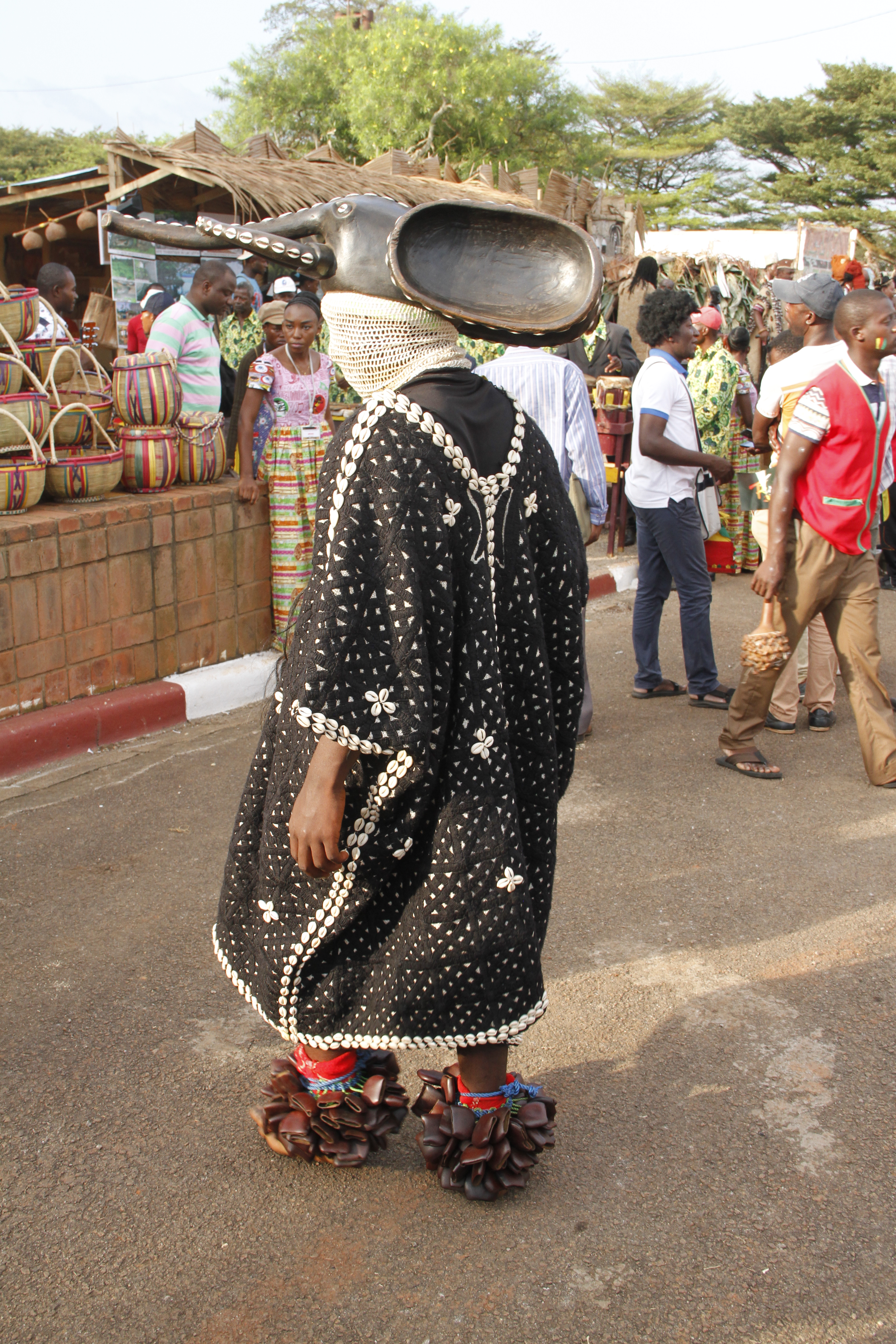
In the provinces, the social organization recognizes a chief as its head, also called the Fon. The Fons, who in their tribal area may be more influential than the official administrative authorities, are considered the living representative of the tribal ancestors.
Natural attractions
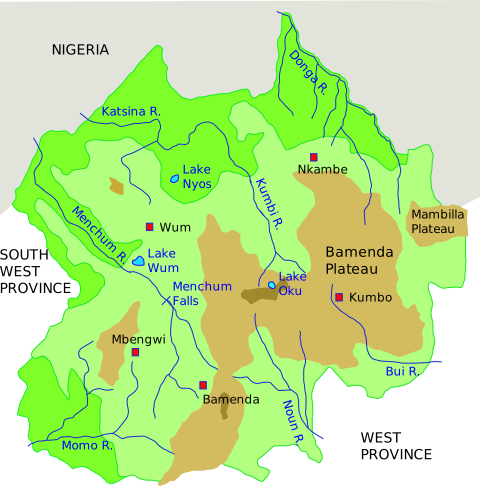
The Northwest region has unique attractions, including the second highest mountain in West Africa, Mount Oku. It is home to birds such as the Bannerman's turaco, which is unique to this region. There are also many crater lakes such as Lake Oku, Lake Awing, and Lake Nyos. The largest remaining mountain forest in the Northwest Region is the Kilum-Ijim Forest. Menchum Falls, and Abbi Falls in the Mbengwi Division, are also located here.
File:Nyos Lake.jpg|Lake Nyos File:Lake Oku Cameroon.jpg|Lake Oku File:Lake Awing and Environment.jpg|Lake Awing and environment File:Kameroen 987.jpg|Forest around the Menchum Falls File:Lake Awing 2.jpg|Closer view of lake Awing File:Chute de menchum.jpg|Full extent of Menchum Falls
References
- "Background Note: Cameroon". 2010. Government of Cameroon. Accessed 11 March 2013.
References
- https://theguardianpostcameroon.com/post/4141/en/nw-regional-assembly-road-covered-so-far-in-four-years-of-existence
- "Sub-national HDI – Area Database – Global Data Lab".
- Tatah-Mentan, I., and F. Achankeng. "Stopping war before it starts: testing preventive diplomacy in the selfdetermination case of British Southern Cameroons (aka Ambazonia)." British Southern Cameroons: Nationalism & Conflict in Postcolonial Africa (2014): 127-170.
- "North-West Cameroon".
- ''Identity Politics in Colonial Africa: Fulani Migrations and Land Conflict'', Taylor & Francis, UK, 2016, p. 20
- Emmanuel Mbah, ''Environment and Identity Politics in Colonial Africa: Fulani Migrations and Land Conflict'', Taylor & Francis, UK, 2016, p. 21
- Adepoju, Paul. "World Report Hospital attack in anglophone Cameroon kills four patients." (2019).
- Toyin Falola, Daniel Jean-Jacques, ' 'Africa: An Encyclopedia of Culture and Society [3 volumes]: An Encyclopedia of Culture and Society', ABC-CLIO, USA, 2015, p. 142
- Emmanuel Mbah, ''Environment and Identity Politics in Colonial Africa: Fulani Migrations and Land Conflict'', Taylor & Francis, UK, 2016, p. 20
- Philippe Karsenty, [https://www.causeur.fr/rentree-scolaire-cameroun-ambazoniens-terrorisme-165174 in Cameroon], causeur.fr, 2 September 2019
- Government of Cameroon. "La Population du Cameroun 2010".
- "Cameroon grants special status to Anglophone regions".
- (2019-12-21). "Cameroon MPs Approve Law Giving Special Status to English-Speaking Regions".
- (2020-11-25). "Comprendre la Région CTDEN".
- Bone, R. Maxwell. (2020-01-13). "Cameroon grants 'special status' its to restive regions. They don't feel special".
- (2021-01-22). "NW Regional Council President Recommends Moral Rearmament, Human Development".
- https://www.facebook.com/photo.php?fbid=4340783146034703&id=652585094854545&set=a.871141382998914&
- https://www.facebook.com/story.php/?story_fbid=548655571173987&id=100080886463330&_rdr
- [http://www.citypopulation.de/Cameroon-Cities.html Cameroon: Administrative Division population statistics]
- "Life in the Cameroon Grasslands". University of Iowa Stanley Museum of Art.
This article was imported from Wikipedia and is available under the Creative Commons Attribution-ShareAlike 4.0 License. Content has been adapted to SurfDoc format. Original contributors can be found on the article history page.
Ask Mako anything about Northwest Region (Cameroon) — get instant answers, deeper analysis, and related topics.
Research with MakoFree with your Surf account
Create a free account to save articles, ask Mako questions, and organize your research.
Sign up freeThis content may have been generated or modified by AI. CloudSurf Software LLC is not responsible for the accuracy, completeness, or reliability of AI-generated content. Always verify important information from primary sources.
Report