From Surf Wiki (app.surf) — the open knowledge base
Northern Zhou
Xianbei-led dynasty of China
Xianbei-led dynasty of China
| Field | Value | ||||||||
|---|---|---|---|---|---|---|---|---|---|
| native_name | 周 | ||||||||
| conventional_long_name | Zhou | ||||||||
| common_name | Northern Zhou | ||||||||
| era | |||||||||
| status | Empire | ||||||||
| status_text | |||||||||
| empire | |||||||||
| government_type | Monarchy | ||||||||
| year_start | 557 | ||||||||
| year_end | 581 AD | ||||||||
| year_exile_start | |||||||||
| year_exile_end | |||||||||
| event_start | |||||||||
| date_start | 15 February | ||||||||
| event_end | |||||||||
| date_end | 4 March | ||||||||
| event1 | |||||||||
| date_event4 | |||||||||
| event_pre | |||||||||
| event_post | |||||||||
| date_post | |||||||||
| p1 | Western Wei | ||||||||
| flag_p1 | |||||||||
| image_p1 | |||||||||
| p2 | Northern Qi | ||||||||
| s1 | Sui dynasty | ||||||||
| flag_s1 | |||||||||
| image_s1 | |||||||||
| flag_s5 | |||||||||
| image_flag | |||||||||
| flag | |||||||||
| flag_type | |||||||||
| image_coat | |||||||||
| symbol | |||||||||
| symbol_type | |||||||||
| image_map | {{Location map+ | ||||||||
| overlay_image | Map of the Northern Zhou in 577.png | ||||||||
| width | 300 | ||||||||
| float | center | ||||||||
| border | none | ||||||||
| nodiv | 1 | ||||||||
| mini | 1 | ||||||||
| relief | yes | ||||||||
| {{Annotation | 218 | 80 | Northern Zhou | text-align | center | font-weight=bold | font-style=normal | font-size=7 | color=#4F311CFF}} |
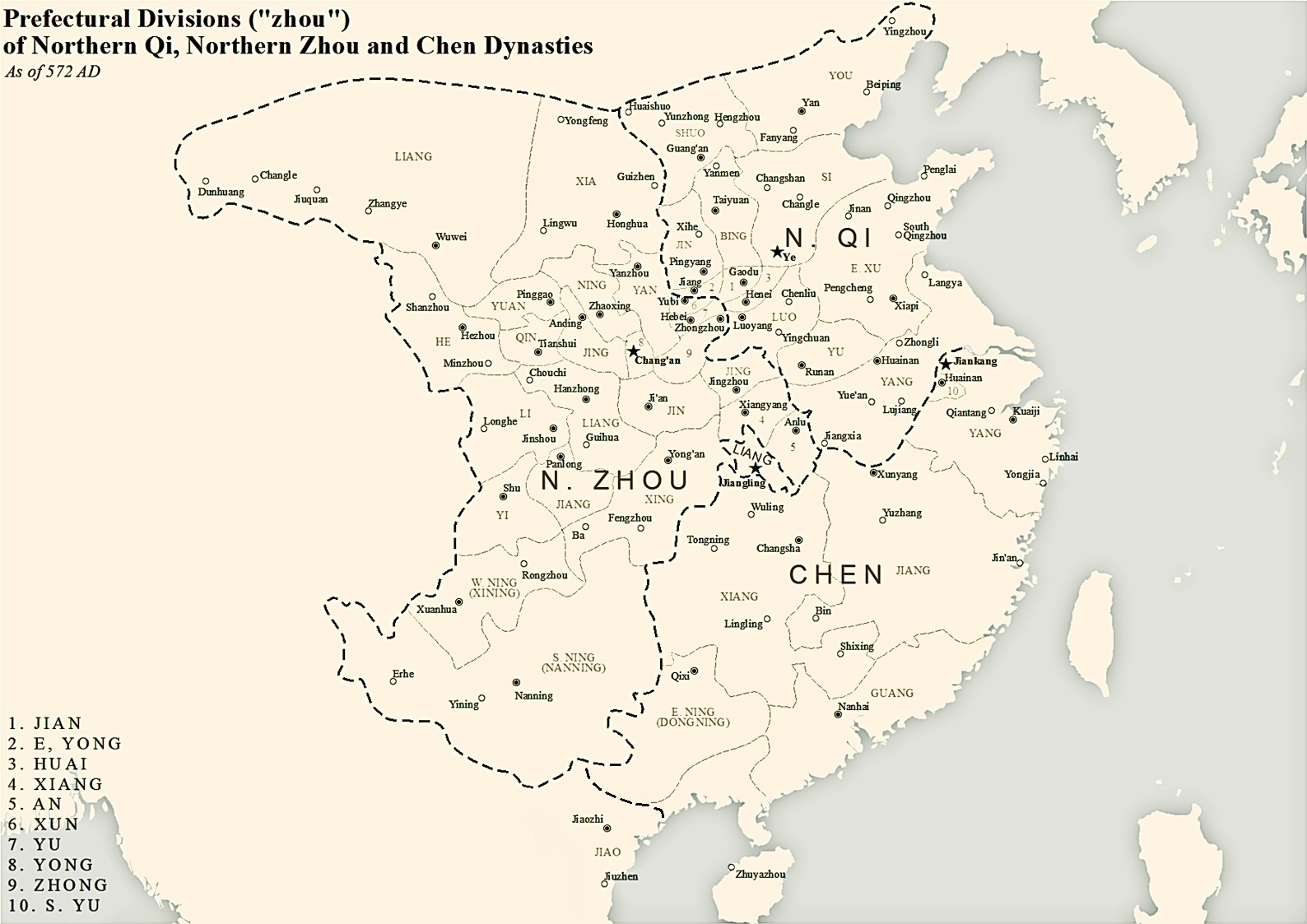
| image_map_caption | The Northern Zhou () after conquest of Northern Qi in 577 | ||||||||
| image_map2_caption | Northern Zhou territories in light blue | ||||||||
| image_map2_size | 300 | ||||||||
| capital | Chang'an | ||||||||
| capital_exile | |||||||||
| longEW | |||||||||
| currency | Chinese coin, | ||||||||
| Chinese cash | |||||||||
| leader1 | Emperor Xiaomin of Northern Zhou | ||||||||
| leader2 | Emperor Ming of Northern Zhou | ||||||||
| leader3 | Emperor Wu of Northern Zhou | ||||||||
| leader4 | Emperor Xuan of Northern Zhou | ||||||||
| leader5 | Emperor Jing of Northern Zhou | ||||||||
| year_leader1 | 557 | ||||||||
| year_leader2 | 557–560 | ||||||||
| year_leader3 | 560–578 | ||||||||
| year_leader4 | 578–579 | ||||||||
| year_leader5 | 579–581 | ||||||||
| title_leader | Emperor | ||||||||
| representative1 | |||||||||
| year_representative1 | |||||||||
| title_representative | |||||||||
| deputy1 | |||||||||
| year_deputy1 | |||||||||
| title_deputy | |||||||||
| legislature | |||||||||
| house1 | |||||||||
| type_house1 | |||||||||
| house2 | |||||||||
| type_house2 | |||||||||
| stat_year1 | 577 | ||||||||
| stat_area1 | 1500000 | ||||||||
| stat_pop1 | |||||||||
| footnotes | |||||||||
| today | China | ||||||||
| Mongolia |
|Continental Asia
Chinese cash|| Mongolia
Zhou (), known in historiography as the Northern Zhou (), was a Xianbei-led dynasty of China (founded by member of Yuwen tribe of Xiongnu origin) that lasted from 557 to 581 AD. One of the Northern dynasties of China's Northern and Southern dynasties period, it succeeded the Western Wei dynasty and was eventually overthrown by the Sui dynasty.
History
Northern Zhou dynasty founded by member of Yuwen tribe. Yuwen were descendants of the nomadic Xiongnu who integrated into the Xianbei after 89 CE and ruled the Kumo Xi and Khitan.
The Northern Zhou's basis of power was established by Yuwen Tai, who was paramount general of Western Wei, following the split of Northern Wei into Western Wei and Eastern Wei in 535. After Yuwen Tai's death in 556, Yuwen Tai's nephew Yuwen Hu forced Emperor Gong of Western Wei to yield the throne to Yuwen Tai's son Yuwen Jue (Emperor Xiaomin), establishing Northern Zhou. The reigns of the first three emperors (Yuwen Tai's sons) Emperor Xiaomin, Emperor Ming, and Emperor Wu were dominated by Yuwen Hu, until Emperor Wu ambushed and killed Yuwen Hu in 572 and assumed power personally. With Emperor Wu as a capable ruler, Northern Zhou destroyed rival Northern Qi in 577, taking over Northern Qi's territory. However, Emperor Wu's death in 578 doomed the state, as his son Emperor Xuan was an arbitrary and violent ruler whose unorthodox behavior greatly weakened the state. After his death in 580, when he was already nominally retired (Taishang Huang), Xuan's father-in-law Yang Jian took power, and in 581 seized the throne from Emperor Xuan's son Emperor Jing, establishing Sui. The young Emperor Jing and the imperial Yuwen clan, were subsequently slaughtered by Yang Jian.
The area was known as Guannei 關內. The Northern Zhou drew upon the Zhou dynasty for inspiration. The Northern Zhou military included Han Chinese.
Trade contacts with Sogdians and Turks
The Tomb of An Jia, a Sogdian merchant (518-579 CE) based in China during the Northern Zhou dynasty, shows the omnipresence of the Turks (at the time of the First Turkic Khaganate), who were probably the main trading partners of the Sogdians in China. The Hephthalites are essentially absent, or possibly showed once as a vassal ruler outside of the yurt of the Turk Qaghan, as they probably had been replaced by Turk hegemony by that time (they were destroyed by the alliance of the Sasanians and the Turks between 556 and 560 CE). In contrast, the Hephthalites are omnipresent in the Tomb of Wirkak, who, although he died at the same time of An Jia was much older at 85: Wirkak may therefore have primarily dealt with the Hephthalites during his younger years. There were also marital alliances: the Northern Zhou Emperor Wu had a Turkic Empress named Ashina.
File:An Jia welcoming a Turk. Shaanxi Provincial Institute of Archaeology, Xi’an.jpg|Anjia (right) welcomes a Turkic leader (left, long hair combed in the back). File:An Jia with a Turkic Chieftain in Yurt. Xi’an, 579 CE. Shaanxi Provincial Institute of Archaeology, Xi’an.jpg|The Sogdian merchant An Jia with a Turkic Chieftain in his yurt. File:An Jia brokering an alliance with Turks. Shaanxi Provincial Institute of Archaeology, Xi’an.jpg|An Jia (right) brokering an alliance with Turks (left). File:Sogdian_musicians_on_the_tomb_of_Wirkak.jpg|Sogdian musicians on the tomb of Wirkak, Northern Zhou period, Xi'An
Cultural artifacts
Numerous artifacts are known from the period, many of them showing contacts with Sogdians merchants who resided in China and often had official administrative positions (seen in the Tomb of An Jia or the Tomb of Wirkak), or even with northern India (Tomb of Li Dan). Central Asian precious artifacts were often included in the funeral material of Chinese people of high rank, as seen in the tomb of the Xianbei-Tuoba Northern Zhou general Li Xian. File:Tomb_of_Li_Xian,_panel_1.jpg|The Northern Zhou Xianbei-Tuoba general Li Xian (504-569 CE) Northern Zhou Dynasty Tomb of Shijun (roof reconstructed).jpg|The tomb of Wirkak, a Sogdian official among the Northern Zhou, 580 CE, Xi'an City Museum File:Chinese pavillion scene, Tomb of An Jia, 579 CE.jpg|Scene in a Chinese pavilion, Tomb of An Jia, 579 CE. File:Northern Zhou dish inspired by Western metalwork 557 581.jpg|Northern Zhou dish inspired by Western metalwork, 557–581. Northern Zhou Dynasty Stone Coffin (9923781185).jpg|Tomb of Li Dan, an Indian "Brahmin" from Jibin, Gandhara. 564 CE Xi'an City Museum. Northern Zhou Gilded Silver Ewer (9833405755).jpg|Northern Zhou gilded silver ewer in Greco-Roman style from the tomb of Li Xian. File:Northern Zhou QIaoling Mausoleum.png|Side plan of the Northern Zhou Qiaoling Mausoleum, where Emperor Wu was buried with his Turkic wife, Empress Ashina
Buddhism
Buddhism and Buddhist art flourished under the Northern Zhou. The dynasty also contributed some of the paintings in the Dunhuang caves: specifically, narrative paintings of the biography of the Buddha in Cave 428, following the prototypes of Gandhara and Kizil. File:Stele with the Boddhisattva Maitreya (Mile), reverse with the Buddha Vairochana (Pilushena), probably Shaanxi province, Northern Zhou dynasty, 557-581 AD, marble - Freer Gallery of Art - DSC05065.jpg|Stele with the Boddhisattva Maitreya (Mile), probably Shaanxi province, Northern Zhou dynasty, 557-581. Freer Gallery of Art File:Shanxi Museum 2009 Taiyuan 913.jpg|Shakyamuni Buddha, Northern Zhou dynasty, 557-581. Shanxi Museum File:Shanxi Museum 2009 Taiyuan 911.jpg| Shakyamuni Buddha. Northern Zhou dynasty, 557-581. Shanxi Museum File:Buddha flanked by bodhisattvas with flying apsaras. Dunhuang mural. Cave 428, Northern Zhou dynasty..jpg|Buddha flanked by bodhisattvas with flying apsaras. Dunhuang mural. Cave 428, Northern Zhou dynasty File:Xian 2006 4-68.jpg|Northern Zhou statue of the Buddha. Xi'an (Shaanxi).
Empress Ashina
Empress Ashina (阿史那皇后, 551–582) was a Turkic empress of the Northern Zhou dynasty, spouse of Emperor Wu of Northern Zhou. She was the daughter of Göktürk ruler Muqan Qaghan. Her tomb was discovered in 1993 in Chenma village, Xianyang. A genetic analysis on her remains was conducted in 2023, finding nearly exclusively Ancient Northeast Asian ancestry (97,7%) next to minor West-Eurasian components (2,7%), confirming an East Asian origin for the Türks.
Emperors{{anchor|Rulers}}
| Posthumous name | Personal name | Period of Reigns | Era name |
|---|---|---|---|
| Xiaomin | Yuwen Jue | 557 | – |
| Ming, Xiaoming | Yuwen Yu | 557–560 | Wucheng (武成) 559–560 |
| Wu | Yuwen Yong | 561–578 | Baoding (保定) 560–565 |
| Tianhe (天和) 566–572 | |||
| Jiande (建德) 572–578 | |||
| Xuanzheng (宣政) 578 | |||
| Xuan | Yuwen Yun | 578–579 | Dacheng (大成) 579 |
| Jing | Yuwen Chan | 579–581 | Daxiang (大象) 579–581 |
| Dading (大定) 581 |
Emperors' family tree
Notes
References
Citations
Sources
- Book of Zhou
- History of Northern Dynasties
- Zizhi Tongjian
References
- ''[[Zizhi Tongjian]]'', [[:zh:s:資治通鑑/卷167. vol. 167]].
- ''Zizhi Tongjian'', [[:zh:s:資治通鑑/卷175. vol. 175]].
- Rein Taagepera "Size and Duration of Empires: Growth-Decline Curves, 600 B.C. to 600 A.D.", Social Science History Vol. 3, 115-138 (1979)
- ''[[Yuanhe Xingzuan]]'' "The register of the great families from the Yuanhe reign (806-820)" vol. 6, the Yuwen part 2
- The ''[[Book of Wei]]'' vol. 103, Biography of Yuwen Mohuai of Xiongnu records
- (1 January 2013). "East Asia: A Cultural, Social, and Political History". Cengage Learning.
- (1 January 2013). "Pre-Modern East Asia: A Cultural, Social, and Political History, Volume I: To 1800". Cengage Learning.
- Charles Holcombe. (2011). "A History of East Asia: From the Origins of Civilization to the Twenty-First Century". Cambridge University Press.
- (1986). "ARS ORIENTALIS". Freer Gallery of Art, Smithsonian Institution.
- (2003). "A Reflection of the Hephthalite Empire: The Biographical Narra- tive in the Reliefs of the Tomb of the Sabao Wirkak (494-579)". Bulletin of the Asia Institute.
- (18 April 2018). "History of Central Asia, The: 4-volume set". Bloomsbury Publishing.
- (August 2009). "Early Turks: Male Costume in the Chinese Art". Transoxiana.
- (2004). "Exotic Goods as Mortuary Display in Sui Dynasty Tombs--A Case Study of Li Jingxun's Tomb". Sino-Platonic Papers.
- (2007). "Buddhist Sculpture from China: Selections from the Xi'an Beilin Museum : Fifth Through Ninth Centuries". China Institute Gallery.
- (26 April 2000). "Early Buddhist Narrative Art: Illustrations of the Life of the Buddha from Central Asia to China, Korea and Japan". University Press of America.
- Steinhardt, Nancy Shatzman. (2014-12-31). "Chinese Architecture in an Age of Turmoil, 200-600". University of Hawaii Press.
- (2023-01-09). "Ancient Genome of Empress Ashina reveals the Northeast Asian origin of Göktürk Khanate". Journal of Systematics and Evolution.
This article was imported from Wikipedia and is available under the Creative Commons Attribution-ShareAlike 4.0 License. Content has been adapted to SurfDoc format. Original contributors can be found on the article history page.
Ask Mako anything about Northern Zhou — get instant answers, deeper analysis, and related topics.
Research with MakoFree with your Surf account
Create a free account to save articles, ask Mako questions, and organize your research.
Sign up freeThis content may have been generated or modified by AI. CloudSurf Software LLC is not responsible for the accuracy, completeness, or reliability of AI-generated content. Always verify important information from primary sources.
Report