From Surf Wiki (app.surf) — the open knowledge base
Northern Oregon Coast Range
Mountain in United States of America

Mountain in United States of America
| Field | Value |
|---|---|
| name | Northern Oregon Coast Range |
| photo | Lewis and Clark River 3641.JPG |
| photo_size | 250 |
| photo_caption | The Northern Coast Range, seen from Saddle Mountain in Clatsop County |
| country | United States |
| subdivision1 | Oregon |
| parent | Oregon Coast Range, Pacific Coast Ranges |
| subdivision4_type | Subdivision |
| subdivision4 | Tualatin Mountains |
| borders_on | Central Oregon Coast Range |
| geology | |
| age | |
| orogeny | Geologic fault, basalt flows |
| length_mi | 100 |
| length_orientation | north–south |
| highest | Rogers Peak |
| elevation_ft | 3706 |
| coordinates |
The Northern Oregon Coast Range is the northern section of the Oregon Coast Range, in the Pacific Coast Ranges physiographic region, located in the northwest portion of the state of Oregon, United States. This section of the mountain range, part of the Pacific Coast Ranges, contains peaks as high as 3710 ft for Rogers Peak. Forests in these mountains are considered to be some of the most productive timber land in the world. The Central Oregon Coast Range is directly south of this section with the Southern Oregon Coast Range beyond the central range.
Geology
The origins of these mountains began approximately 40 million years ago during the Eocene age. During this time-period, sandstone and siltstone formed in the area. Additionally, igneous rocks and basalt flows combined with basaltic sandstone to create many of the mountainous formations. Other sedimentary rock in the area formed more recently, around 20 million years ago. It is hypothesized that portions of the northern section of the range were islands during parts of the Eocene era. Other portions of the mountains consist of marine sedimentary rock. The entire coast range sits on a convergent tectonic margin interacting with the Juan de Fuca Plate that is subducting beneath North America tectonic plate. Also, weathering and erosion of the region is a major factor in shaping the landscape. Heavy rainfall and landslides have worked to alter the mountains.
The range is part of a broad, plunging structural arch of sedimentary and Tertiary volcanic strata that is being uplifted. Eocene and Miocene sections form the flanks of the uplifted sections. Some of the oldest rocks are submarine tholeiitic basalts from the Eocene era. The basalt came from the basalt flows that covered much of Oregon and originated from volcanoes in the central portion of the state. Other rocks include sandstone, mudstone, and siltstone. It was during the middle Miocene period that the range was uplifted in the broad, northeast-plunging arch.
Flora and fauna
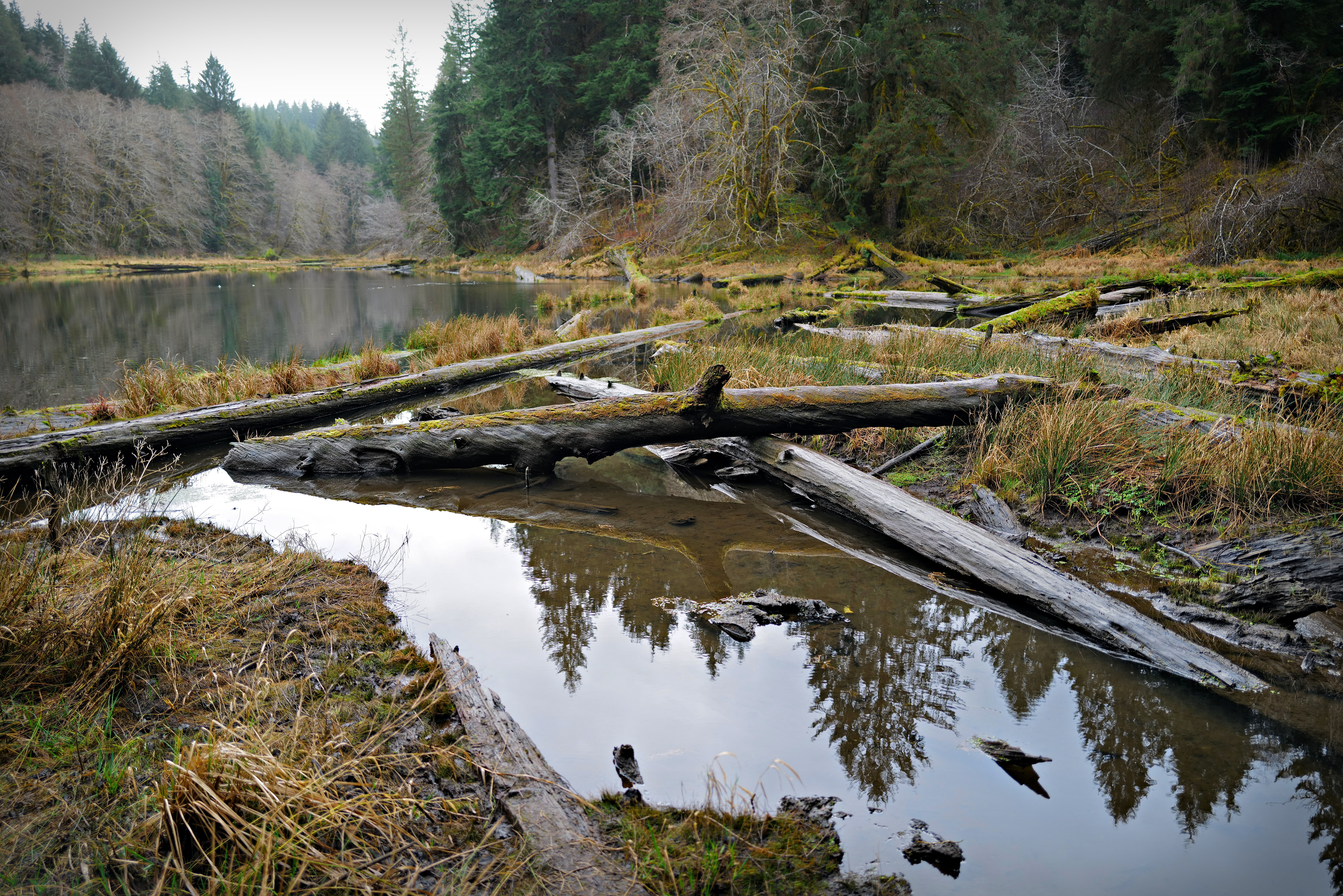
Portions of the range are in the Siuslaw National Forest and Tillamook State Forest, and large sections of the range were burned in forest fires during the 1930s and 1940s as part of the Tillamook Burn. In the forested areas trees include Sitka spruce, western redcedar, Douglas fir, and western hemlock. Other plants that grow in the region are huckleberry, salmonberry, thimbleberry, salal, vine maple, sword and bracken ferns and Oregon grape to name a few.
Arthropods and molluscs found include collembolans, spiders, beetles, slugs, millipedes, weevils, and various centipedes. Animals that inhabit the Northern Coast range are the rough-skinned newt, chipmunks, bears, rabbits, white-footed deer mice, Columbian black tail deer and others. Birds include chickadees, red-breasted nuthatches, kinglets, Western pileated woodpeckers, Oregon Canada jays, California creepers, and Sitka red crossbills among others.
Location and climate
The range begins at the Columbia River, with some mountainous features on the north side of the river, and continues south roughly 100 mi to the Salmon River where Oregon Route 18 traverses the range from the Willamette Valley to the Oregon Coast. The width of the range varies but is roughly 35 mi.
The climate of the range is moderate because of marine influences, and annual precipitation is heavy, varying from 60 to.
Peaks


All mountains over 3000 ft in elevation in the Northern Coast Range.
| Mountain Name | Elevation | County |
|---|---|---|
| feet | metres | |
| Rogers Peak | 3706 ft | Tillamook |
| South Saddle Mountain | 3465 ft | Washington |
| Larch Mountain | 3452 ft | Washington |
| Trask Mountain | 3426 ft | Yamhill |
| Saddle Mountain | 3288 ft | Clatsop |
| Triangulation Point | 3235 ft | Tillamook |
| Kings Mountain | 3226 ft | Tillamook |
| Mount Hebo | 3154 ft | Yamhill |
| Edwards Butte | 3136 ft | Tillamook |
| Buck Mountain | 3097 ft | Tillamook |
| Sheridan Peak | 3091 ft | Yamhill |
| Woods Point | 3084 ft | Tillamook |
| Gobblers Knob | 3058 ft | Tillamook |
| Onion Peak | 3057 ft | Clatsop |
Other peaks
- Round Top (Oregon) 2982 ft
- Neahkahnie Mountain 1634 ft
Rivers

The following rivers have their headwaters in the Northern Oregon Coast Range:
- Drains to Columbia River:
- Clatskanie River
- John Day River
- Klaskanine River
- Lewis and Clark River
- Skipanon River
- Wallooskee River
- Youngs River
- Drains to Willamette River:
- Tualatin River
- Yamhill River
- Drains to Pacific Ocean:
- Kilchis River
- Miami River
- Necanicum River
- Nehalem River
- Nestucca River
- Salmonberry River
- Salmon River
- Tillamook River
- Trask River
- Wilson River
References
References
- [http://www.peakbagger.com/peak.aspx?pid=1075 Rogers Peak.] Peakbagger.com. Retrieved February 29, 2008.
- [http://www.fsl.orst.edu/ncama/guidch2.htm Northern Coast Range Adaptive Management Area; Chapter 2: Physical and Biological Environment.] Oregon State University. Retrieved February 29, 2008.
- [http://www.oregon.gov/ODF/STATE_FORESTS/docs/Watershed/Nehalem_Watershed_Analysis/Part_I-Ch_1-4.pdf Upper Nehalem Watershed Analysis.] (PDF) Oregon Department of Forestry. Retrieved February 29, 2008.
- Byrne, John V. "An Erosional Classification for the Northern Oregon Coast", ''Annals of the Association of American Geographers'', Vol. 54, No. 3. (Sep. 1964), pp. 329–335.
- [http://www.wou.edu/las/natsci_math/geology/luckiamute/Appendix%20A%20Geology%20of%20Luckiamute%20River%20Watershed.pdf Geology of the Luckiamute River Watershed, Upper Willamette Basin, Polk and Benton Counties, Oregon.] (PDF) Western Oregon University. Retrieved February 29, 2008.
- [https://pubs.usgs.gov/of/1994/of94-021/tilgeo.txt Geologic Map of the Tillamook Highlands, Northwest Oregon Coast Range.] U.S. Geological Survey. Retrieved February 29, 2008.
- [http://www.treedictionary.com/DICT2003/hardtoget/jk-64-html/index.html From the Forest to the Sea: A Story of Fallen Trees.] Tree Dictionary. Retrieved February 29, 2008.
- Macnab, James A. Biotic Aspection in the Coast Range Mountains of Northwestern Oregon. ''Ecological Monographs'', Vol. 28, No. 1. (Jan. 1958), pp. 21–54.
- [http://www.oregon.gov/ODF/PRIVATE_FORESTS/docs/Legacy/AppendixA.pdf Private Forests.] Oregon Department of Forestry. Retrieved February 29, 2008.
This article was imported from Wikipedia and is available under the Creative Commons Attribution-ShareAlike 4.0 License. Content has been adapted to SurfDoc format. Original contributors can be found on the article history page.
Ask Mako anything about Northern Oregon Coast Range — get instant answers, deeper analysis, and related topics.
Research with MakoFree with your Surf account
Create a free account to save articles, ask Mako questions, and organize your research.
Sign up freeThis content may have been generated or modified by AI. CloudSurf Software LLC is not responsible for the accuracy, completeness, or reliability of AI-generated content. Always verify important information from primary sources.
Report