From Surf Wiki (app.surf) — the open knowledge base
Northeast Italy
Geographic region of Italy

Geographic region of Italy
| Field | Value |
|---|---|
| name | Northeast Italy |
| native_name | it |
| it | |
| native_name_lang | it |
| image_map | File:Italia nord-orientale.svg |
| map_alt | Map of Italy, highlighting Northeast Italy |
| subdivision_type | Country |
| subdivision_name | Italy |
| parts_type | Regions |
| parts_style | list |
| parts | List |
| p1 | Emilia-Romagna Emilia-Romagna |
| p2 | Friuli Venezia Giulia Friuli-Venezia Giulia |
| p3 | Veneto Veneto |
| p4 | Trentino-Alto Adige Trentino-Alto Adige |
| blank_name | Languages |
| blank_info | |
| blank1_name | – Official language |
| blank1_info | Italian |
| blank2_name | – Official linguistic minorities |
| blank2_info | {{unbulleted list |
| blank3_name | – Regional languages |
| blank3_info | {{unbulleted list |
| area_total_km2 | 62310 |
| population_total | 11597719 |
| population_as_of | 2025 |
| population_footnotes | |
| population_density_km2 | auto |
it |Friulian |German |Ladin |Slovene |Emilian-Romagnol |Venetian
Northeast Italy ( or just Nord-est) is one of the five official statistical regions of Italy used by the National Institute of Statistics (ISTAT), a first level NUTS region and a European Parliament constituency. Northeast encompasses four of the country's 20 regions:
- Emilia-Romagna
- Friuli-Venezia Giulia
- Trentino-Alto Adige/Südtirol
- Veneto
Historical names
Triveneto (literally "Triple Veneto") is a historical region of Italy. The area is made up of the three smaller historical regions of Venezia Euganea ("Euganean Venetia"), Venezia Giulia ("Julian March") and Venezia Tridentina ("Tridentine Venetia"). This territory was named after the Roman region of Venetia et Histria. The entire area was under Austrian rule in 1863; Italy annexed Venezia Euganea in 1866, following the Third Italian War of Independence and a controversial plebiscite (see Venetian nationalism); Julian Venetia and Venezia Tridentina passed under the Italian rule in 1919, following the end of World War I. After World War II, Italy retained the most part of Tre Venezie, but lost Slovenian and Croatian majority areas of the upper Isonzo valley (together with the eastern part of Gorizia, today called Nova Gorica), the city of Fiume, most part of Carso region and most part of Istria to Yugoslavia. The areas of Trieste (Zone A) and north-west Istria (Zone B) were formed in the Free Territory of Trieste: in 1954, Italy reannexed Zone A, while Zone B was ceded to Yugoslavia. Nowadays the name Triveneto includes the three administrative regions of Veneto, Friuli-Venezia Giulia and Trentino-Alto Adige/Südtirol
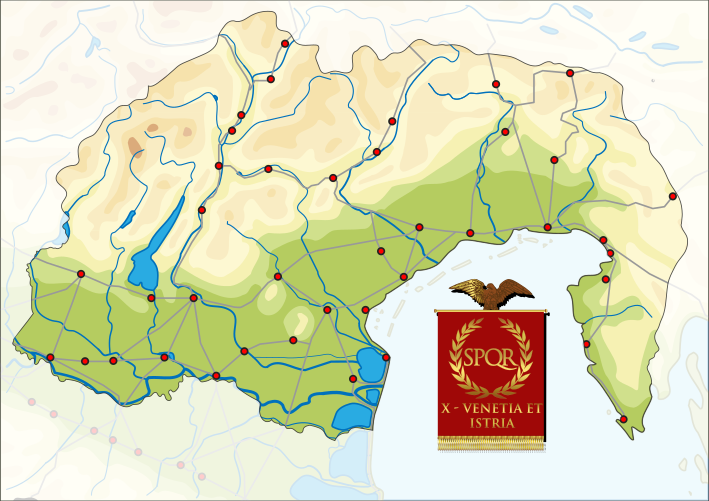
Venetia et Histria, an old region of Italy at the time of Roman Empire, refers to Veneto, Trentino, Friuli-Venezia Giulia, East Lombardy and Istria; it was named after the people of Veneti, who inhabited that region, and who are still largely the main ethnic group of the Italian area (other main ethnic groups include Friulani in the east, mostly in Udine province; Ladins in the Dolomites are between Veneto and Trentino-Alto Adige/Südtirol; Germans in South Tyrol; and Slovene minorities on the border with Slovenia and in the city of Trieste); while after 1947 Venetian/Istrian Italians are just a minority in Slovenian and Croatian Istria. Roman Venetia et Histria was originally created by Augustus as the tenth regio in 7 AD alongside the nine other regiones. The region had been one of the last regions of Italy to be incorporated into the Roman Empire. It was later renamed by Diocletian the VIII provincia Venetia et Histria in the third century. Its capital was at Aquileia, and it stretched geographically from the Arsia River in the east in what is now Croatia to the Abdua in the current Italian region of Lombardy and from the Alps to the Adriatic Sea. Venetia, a region which indicated the old land provinces of the Republic of Venice from river Adda to river Isonzo, and is sometimes still used today to indicate this territory together with Trentino and Trieste.
Geography
It borders to the north with Austria and Switzerland, to the east with Slovenia, to the south with Liguria, Tuscany, Marche and the small state of San Marino, to the west with Lombardy and for a very short stretch with Piedmont. Emilia-Romagna, Friuli-Venezia Giulia and Veneto are washed by the Adriatic Sea
Northeastern Italy includes most of the Po Valley, crossed by the Po river, the longest river in Italy, and includes highly industrialized regions with a high tourist activity.
Demography
Northeast Italy has 11,597,719 inhabitants as of 2025.
Regions
| Region | Capital | Inhabitants | Area | Density | ||
|---|---|---|---|---|---|---|
| Emilia-Romagna | Bologna | 4,465,678 | ||||
| Friuli-Venezia Giulia | Trieste | 1,194,095 | ||||
| Trentino-Alto Adige/Südtirol | Trento | 1,086,095 | ||||
| Veneto | Venice | 4,851,851 |
Most populous municipalities


Below is the list of the most populous municipalities with more than inhabitants.
| # | Municipality | Region | Inhabitants | |||
|---|---|---|---|---|---|---|
| 1 | ||||||
| 2 | ||||||
| 3 | ||||||
| 4 | ||||||
| 5 | ||||||
| 6 | ||||||
| 7 | ||||||
| 8 | ||||||
| 9 | ||||||
| 10 | ||||||
| 11 | ||||||
| 12 | ||||||
| 13 | ||||||
| 14 | ||||||
| 15 | ||||||
| 16 | ||||||
| 17 | ||||||
| 18 | ||||||
| 19 | ||||||
| 20 | ||||||
| 21 | ||||||
| 22 | ||||||
| 23 |
Languages
Italian is the main language. Other languages include Venetian, widely spoken in Veneto and along the coast to Trieste and Istria, as well as in the towns of Pordenone and Gorizia in Friuli, and in most of Trentino, but only recognised by the Veneto region; Friulian, spoken in most of Friuli and nationally recognized, and Ladin, spoken by a few thousand people in the Dolomites. Other languages are German, the primary language of South Tyrol, where Italian is spoken by about two thirds of the inhabitants, and Slovene, recognized by Italy and spoken on the border of Italy and Istria, where the main language today is Croatian but Italian is recognized as a minority language due to the presence of the Istrian Italians.
Economy
The Gross domestic product (GDP) of the region was 407.9 billion euros in 2018, accounting for 23.1% of Italy's economic output. GDP per capita adjusted for purchasing power was 34,900 euros or 116% of the EU27 average in the same year.
References
References
- "Legge 482". Webcitation.org.
- "Monthly Demographic Balance". [[Italian National Institute of Statistics.
- [http://www.britannica.com/EBchecked/topic/625132/Venetia Venetia]
- [[Peace of Prague (1866)]]
- [[Treaty of Saint-Germain-en-Laye (1919)]]
- [[Treaty of Peace with Italy, 1947]]
- (2007). "Pliny the Elder's Italy". Bulletin of the Institute of Classical Studies.
- (2013). ""Venetia (Venice)": Its Formation and Meaning in the Middle Ages". NeMLA Italian Studies.
- (1971-10-24). "Popolazione residente e presente dei comuni. Censimenti dal 1861 al 1971". [[National Institute of Statistics (Italy).
- "Dashboard Permanent census of population and housing". [[National Institute of Statistics (Italy).
- "Regional GDP per capita ranged from 30% to 263% of the EU average in 2018".
This article was imported from Wikipedia and is available under the Creative Commons Attribution-ShareAlike 4.0 License. Content has been adapted to SurfDoc format. Original contributors can be found on the article history page.
Ask Mako anything about Northeast Italy — get instant answers, deeper analysis, and related topics.
Research with MakoFree with your Surf account
Create a free account to save articles, ask Mako questions, and organize your research.
Sign up freeThis content may have been generated or modified by AI. CloudSurf Software LLC is not responsible for the accuracy, completeness, or reliability of AI-generated content. Always verify important information from primary sources.
Report