From Surf Wiki (app.surf) — the open knowledge base
North by Northwest
1959 film by Alfred Hitchcock
.jpg)
1959 film by Alfred Hitchcock
| Field | Value |
|---|---|
| name | North by Northwest |
| image | Northbynorthwest1.jpg |
| caption | Theatrical release poster |
| director | Alfred Hitchcock |
| writer | Ernest Lehman |
| producer | Alfred Hitchcock |
| starring | |
| cinematography | Robert Burks |
| editing | George Tomasini |
| music | Bernard Herrmann |
| studio | Metro-Goldwyn-Mayer |
| distributor | Metro-Goldwyn-Mayer |
| released | |
| runtime | 136 minutes |
| country | United States |
| language | English |
| budget | $4.3 million |
| gross | $9.8 million |
North by Northwest is a 1959 American spy thriller film produced and directed by Alfred Hitchcock, starring Cary Grant, Eva Marie Saint, and James Mason. The original screenplay written by Ernest Lehman was intended to be the basis for "the Hitchcock picture to end all Hitchcock pictures".
North by Northwest is a tale of mistaken identity: an innocent man (Grant) is pursued across the United States by agents of a mysterious organization that aims to prevent him from blocking their plan to smuggle microfilm containing government secrets out of the country. It is one of several Hitchcock films featuring a musical score by Bernard Herrmann and an opening title sequence by graphic designer Saul Bass. The film was the first to feature extended use of kinetic typography in its opening credits.
The film was released on July 1, 1959, to critical and commercial success. It topped the box office in the United States for seven consecutive weeks. The film was nominated for three Academy Awards and garnered Hitchcock the Silver Shell for Best Director at the San Sebastián Film Festival.
It is listed among the canonical Hitchcock films of the 1950s and is widely ranked among the greatest films ever made. In 1995, the Library of Congress selected North by Northwest for preservation in the National Film Registry for being "culturally, historically, or aesthetically significant".
Plot
A waiter pages George Kaplan at the Oak Room restaurant at the Plaza Hotel in New York City at the request of two well-dressed men. As advertising executive Roger Thornhill summons the same waiter, he is mistaken for Kaplan, kidnapped by the pair, and brought to the estate of Lester Townsend in Glen Cove. Townsend interrogates Thornhill and subsequently arranges to kill him in a staged drunk-driving crash; Thornhill survives, but fails to convince the police or his mother of what happened. Returning to the estate, Thornhill learns that Townsend is a United Nations diplomat.
Thornhill and his mother sneak into Kaplan's empty room at the Plaza, where the thugs have followed him. Thornhill heads to the U.N. General Assembly Building to meet Townsend, who turns out to be a completely different man. As he asks him about the man impersonating him, one of the gang's thugs throws a knife into Townsend's back. Townsend collapses in Thornhill's arms, and Thornhill is photographed grabbing at the knife, giving the appearance that he is the murderer. Thornhill flees, attempting to find the real Kaplan.
The "United States Intelligence Agency" (USIA) realizes that Thornhill has been mistaken for Kaplan, a non-existent agent they created as a decoy to distract their quarries, but its chief, "the Professor", decides against rescuing him for fear of compromising their operation.
Thornhill sneaks aboard the luxurious 20th Century Limited train to Chicago without a ticket, where he meets Eve Kendall, who hides him from the police in her stateroom's upper berth. The two establish a relationship—on Kendall's part because she is secretly working with the federal agents—and she helps him elude a police dragnet. She then tells Thornhill that she has arranged a meeting with Kaplan at a rural bus stop in Indiana. When Thornhill arrives there, he is attacked by a crop duster armed with a machine gun. After being flushed from cover in a cornfield, he attempts to halt a passing tanker truck; the airplane crashes into it and both explode. In the ensuing confusion he steals a bystander's pickup truck. At Kaplan's hotel in Chicago, Thornhill learns that Kaplan had checked out before the time when Kendall claimed to have spoken with him. He goes to her room and confronts her, but she eludes him.
Thornhill tracks Kendall to an art auction, where the Townsend-impersonator—Phillip Vandamm, the ringleader of the group—is purchasing a small primitive statue. Vandamm instructs his henchmen to deal with Thornhill. Thornhill disrupts the auction until police are called to remove him. He confesses to them that he is the fugitive murderer, but the Professor intervenes. At the airport, he tells Thornhill that Kaplan was fictitious and that Eve Kendall is their real agent. Vandamm lives above Mount Rushmore, and the agency thinks he will be leaving the country by plane from there. Thornhill agrees to help maintain Kendall's cover.
At the Mount Rushmore visitor center, now playing the role of Kaplan at the USIA's request, Thornhill negotiates for Vandamm's turnover of Kendall to be arrested. Kendall shoots Thornhill with blanks and flees. Afterward, the Professor arranges for Thornhill and Kendall to meet; Thornhill learns that Kendall is to depart on the plane with Vandamm and his right-hand man Leonard. He tries to dissuade her from going, but is knocked unconscious by the Professor's driver and locked in a hospital room.
Thornhill escapes and goes to Vandamm's home to rescue Kendall, where he overhears that the sculpture holds microfilm and that Leonard has discovered the blanks in Kendall's gun. Vandamm indicates that he will dispose of Kendall by throwing her from the plane; Thornhill manages to warn her with a surreptitious note. Vandamm, Leonard, and Kendall head for the plane. Thornhill is momentarily held at gunpoint by the housekeeper until he realizes she is holding Kendall's gun loaded with blanks. As Vandamm boards, Kendall takes the sculpture and runs to the pursuing Thornhill, and they flee to the top of Mount Rushmore. As they climb down, they are pursued by Vandamm's men. A park ranger fatally shoots Leonard, and Vandamm is taken into custody by the Professor.
As Kendall hangs on by her fingertips, Thornhill reaches down to pull her up. She is next seen—as Mrs. Thornhill—being pulled into an upper berth on a train, which suggestively enters a tunnel.
Cast
Cast information from Turner Classic Movies Database
- Cary Grant as Roger Thornhill
- Eva Marie Saint as Eve Kendall
- James Mason as Phillip Vandamm
- Jessie Royce Landis as Clara Thornhill
- Leo G. Carroll as The Professor
- Josephine Hutchinson as "Mrs. Townsend"
- Philip Ober as Lester Townsend
- Martin Landau as Leonard
- Adam Williams as Valerian
- Edward Platt as Victor Larrabee
- Robert Ellenstein as Licht
- Les Tremayne as Auctioneer
- Philip Coolidge as Dr. Cross
- Patrick McVey as Sergeant Flamm
- Edward Binns as Captain Junket
- Ken Lynch as Charlie Uncredited cast
- Maudie Prickett as Elsie the Maid
- Malcolm Atterbury as Man at the crossroads
- Tol Avery as State Police Detective
- John Beradino as Sergeant Emile Klinger
- Ned Glass as Ticket Seller
- Doreen Lang as Maggie, Roger's Secretary
- Nora Marlowe as Anna, the housekeeper
- Ralph Reed as Bellboy
- Olan Soule as Assistant Auctioneer
- Carleton Young as Fanning Nelson
- Frank Wilcox as Herman Weitner
- Robert Shayne as Larry Wade
- Sara Berner as Telephone Operator (voice)
Hitchcock's cameo appearances are a signature occurrence in most of his films. In North by Northwest, he is seen getting a bus door slammed in his face, just as his credit appears on the screen. There has been some speculation as to whether he made one of his rare second appearances, this time at around the 45-minute mark in drag as a woman in a turquoise dress on the train, but in fact, the woman was played by Jesslyn Fax, who went on to appear in many episodes of Alfred Hitchcock Presents. She had previously appeared in Rear Window.
Production
Writing

Hitchcock often told journalists of an idea that he had about Cary Grant hiding from the villains inside Abraham Lincoln's nose and being given away when he sneezes. He speculated that the film could be called The Man on Lincoln's Nose. Hitchcock sat on the idea, waiting for the right screenwriter to develop it. The original traveling salesman character had been suited to James Stewart, but Lehman changed it to a Madison Avenue advertising executive, a position that he had formerly held.
John Russell Taylor's 1978 biography Hitch: The Life and Times of Alfred Hitchcock suggests that the story originated after a spell of writer's block during the scripting of another film project:
Lehman repeated this story in the documentary Destination Hitchcock: The Making of North by Northwest that accompanied the 2001 DVD release of the film. Screenwriter William Goldman insisted in Which Lie Did I Tell? that it was Lehman who created North by Northwest and that many of Hitchcock's ideas were not used. Hitchcock had the idea of the hero being stranded in the middle of nowhere but suggested that the villains try to kill him with a tornado. "But they're trying to kill him. How are they going to work up a cyclone?" Lehman responded. "I just can't tell you who said what to whom, but somewhere during that afternoon, the cyclone in the sky became the crop-duster plane."
Hitchcock had been working on the story for nearly nine years prior to meeting Lehman. Otis Guernsey was the American journalist who had the idea which influenced Hitchcock, inspired by a true story during World War II when British Intelligence obtained a dead body, invented a fictitious officer who was carrying secret papers, and arranged for the body and misleading papers to be discovered by the Germans as a disinformation scheme called Operation Mincemeat. Guernsey turned his idea into a story about an American salesman who travels to the Middle East and is mistaken for a fictitious agent, becoming "saddled with a romantic and dangerous identity".
Guernsey admitted that his treatment was full of "corn" and "lacking logic", and he urged Hitchcock to do what he liked with the story. Hitchcock bought the 60 pages for $10,000. In an interview in the book Screenwriters on Screenwriting (1995), Lehman stated that he had already written much of the screenplay before coming up with critical elements of the climax. An example of the "corn" in the finished screenplay was the scene where Roger Thornhill returns to the Townsend estate with the detectives to find everything changed. If Thornhill was indeed a spy, he would have had no reason to return to the estate after his escape the previous night, nor would the criminals be expecting him to return as they obviously did.
This was the only Hitchcock film released by Metro-Goldwyn-Mayer. Since 1986, it has been owned by Turner Entertainment, as part of the pre-May 1986 MGM film library that it acquired through temporary ownership of MGM.
Production costs on North by Northwest rose when a delay in filming put Cary Grant into the penalty phase of his contract, resulting in his being paid an additional $5,000 per day before shooting even began.
Casting
Eva Marie Saint's agent had told her that she had received an invitation to a dinner with Alfred Hitchcock and his family, the first time she and Hitchcock met. Days after the dinner, Saint's mother called her and reminded her that Hitchcock loved casting women wearing beige clothing and white gloves. Following her mother's advice, she met with Hitchcock again, wearing that combination. She credited this for helping her win the role. MGM wanted Cyd Charisse for the role of Eve Kendall. Hitchcock stood by his choice of Saint.
Hitchcock attended the play Middle of the Night in order to watch a performance by Edward G. Robinson. After being impressed by the performance of Martin Landau, Hitchcock asked to meet him at MGM. Landau arrived and Hitchcock showed him the entirety of the project, including the storyboards. While they were looking at the project, Hitchcock turned and told Landau, "You're now Leonard."
Filming
.jpg)
At Hitchcock's insistence, the film was made in Paramount's VistaVision widescreen process. The only other VistaVision film made at MGM was High Society.
The opening title sequence was created by graphic designer Saul Bass. North by Northwest was the first film to feature extended use of kinetic typography in its opening credits.
The aircraft flying in the aerial chase scene is a Naval Aircraft Factory N3N Canary, better known as the "Yellow Peril", a World War II Navy primary trainer sometimes converted for crop-dusting. The aircraft that hits the truck and explodes is a wartime Boeing-Stearman Model 75 trainer, and many of these were used for agricultural purposes until the 1970s. The plane was piloted by Bob Coe, a crop-duster from Wasco, California. Hitchcock placed replicas of square Indiana highway signs in the scene. In 2000, The Guardian ranked the crop-duster scene at No. 29 on their list of "The top 100 film moments". The British film magazine Empire ranked it as the "greatest movie moment" of all time in its August 2009 issue.
Among the locations used in the film are:
- 430 Park Avenue
- This is the building used by Bass during the opening credits. The building was constructed in 1916 as a luxury apartment tower called the Avenue Apartments and was designed by the firm Warren and Wetmore. In 1953, the building was stripped of its façade, given a new curtain wall designed by Emery Roth and Sons in the style of Lever House, and converted to offices. Bass's title sequence is based on the geometric structure of the international style.
- Commercial Investment Trust Building (650 Madison Avenue, New York)
- This is the location of Roger Thornhill's office, and the building he walks out of in his first appearance in the film. The CIT Building was designed by the firm Harrison and Abramovitz and constructed in 1957.
- Plaza Hotel (768 Fifth Avenue, New York)
- After taking a cab with his secretary, Thornhill has a drink in the Oak Room of the Plaza Hotel. It is here that he is kidnapped by Vandamm's henchmen. Thornhill later returns to the Plaza, where he breaks into George Kaplan's room. For space reasons, most of the shots in and around the Oak Room were actually done on a set.
- Old Westbury Gardens (71 Old Westbury Road, Old Westbury)
- Thornhill's kidnappers drive him to Townsend's estate on Long Island. After questioning Thornhill, Vandamm instructs Leonard and his other henchmen to intoxicate Thornhill by force.
- United Nations headquarters
- Following Thornhill's escape from Vandamm's henchmen at the Plaza, he takes a taxi to the United Nations headquarters to meet Lester Townsend. The U.N. headquarters buildings were also designed by Harrison and Abramovitz, the architects of Thornhill's office. The scene of Cary Grant going to the United Nations in New York was filmed illicitly because, after reviewing the script, U.N. authorities denied permission to film on or near its property. After two failed attempts to get the required shots, Hitchcock had Grant pull up in a taxicab right outside the General Assembly Building while a hidden camera crew filmed him exiting the vehicle and walking across the plaza.
- Grand Central Terminal (89 East 42nd Street, New York)
- Following the murder of Townsend at the United Nations, Thornhill rushes to Grand Central Terminal, where he sneaks onto the 20th Century Limited en route to Chicago.
- LaSalle Street Station (414 South LaSalle Street, Chicago)
- Thornhill and Eve Kendall arrive in Chicago at the LaSalle Street Station. At the station, Kendall gives Thornhill the instructions for his meeting with Kaplan.
- Prairie Stop
- The famous "crop duster scene", which in the film takes place in rural Indiana, was actually filmed on a highway in central California near the town of Wasco. Hitchcock added square signs to the location to replicate those found in Indiana.
- Ambassador East Hotel
- Thornhill returns to Chicago in a stolen truck that he parks outside the Ambassador East Hotel. The hotel, designed by Robert S. DeGolyer and Co., opened in 1926. Today, it continues to be operated as a hotel, under the name The Ambassador.
- Chicago Midway Airport
- Following Thornhill's arrest at the auction, he and the Professor travel to Midway Airport, where they board a flight for Rapid City, South Dakota. The terminal seen in the film was built in 1945–46 and was designed by architect Paul Gerhardt Sr. This terminal building was demolished in 2002.
- Memorial View Building, Mount Rushmore
- The spurious murder of Roger Thornhill takes place in the Buffalo Room of the Memorial View Building at Mount Rushmore—the one location in the park where Hitchcock was permitted to film. This building was constructed in 1957 as part of the National Park Service's Mission 66 program, and was designed jointly by NPS architect Cecil J. Doty and local architect Harold Spitznagel. The building was demolished in 1994.
- Vandamm House
- Vandamm's house, set on a cliff atop Mount Rushmore, was not a real structure. Hitchcock asked the set designers to make the house in the style of Frank Lloyd Wright—at the time the most popular architect in the United States—using the materials, form, and interiors associated with him. Set designer Robert F. Boyle planned the house, which featured a cantilevered living room and made extensive use of limestone. Exterior shots were done using matte paintings, while interior shots were filmed using a set built in Culver City, California, where MGM's studios were located.
Costuming
A panel of fashion experts convened by GQ in 2006 said the gray suit worn by Cary Grant throughout almost the entire film was the best suit in film history, and the most influential on men's style, stating that it has since been copied for Tom Cruise's character in Collateral and Ben Affleck's character in Paycheck. This sentiment has been echoed by writer Todd McEwen, who called it "gorgeous" and wrote a short story, "Cary Grant's Suit", that recounts the film's plot, featuring the suit.
There is some disagreement as to who tailored the suit; Vanity Fair magazine claimed it was Norton & Sons of London, although according to The Independent, it was Quintino of Beverly Hills. Another article states that Grant used his Savile Row tailor, Kilgour French and Stanbury for the suit. A label reading "Quintino" is visible on one of the suits in the film, but this is because Quintino made duplicate suits for scenes involving more activity or stunts.
Eva Marie Saint's wardrobe for the film was originally entirely chosen by MGM. Hitchcock disliked MGM's selections, and the actress and director went to Bergdorf Goodman in New York to select what she would wear.
Editing and post-production
In François Truffaut's book-length interview, Hitchcock/Truffaut (1967), Hitchcock said that MGM wanted North by Northwest cut by 15 minutes so the film's length would run under two hours. Hitchcock had his agent check his contract, learned that he had absolute control over the final cut, and refused.
One of Eva Marie Saint's lines in the dining-car seduction scene was redubbed. She originally said, "I never make love on an empty stomach", but it was changed in post-production to "I never discuss love on an empty stomach", as the censors considered the original version too risqué.
Release
The film opened on July 1, 1959, at the United Artists Theatre in Chicago. A new 70mm restoration of the film, remastered in 13K resolution from the original VistaVision elements, premiered at the 2024 Tribeca Festival on June 12, 2024, to celebrate the film's 65th anniversary.
Home media
North by Northwest was released on the Blu-ray Disc format in the United States in November 2009, by Warner Bros. with a 1080p VC-1 encoding. This release is a special 50th-anniversary edition, restored and remastered from original VistaVision elements. A DVD edition was also released. A 65th anniversary 4K Ultra HD Blu-ray was released in 2024 by Warner Bros. Home Entertainment.
Reception
Box office
In its opening in Chicago, it grossed $46,000 in its first week and $35,000 the second week. The film grossed $209,000 in its opening week at Radio City Music Hall, setting a record opening week at the theater, as well as its record non-holiday week gross, and went on to gross a record $404,056 in two weeks. Its opening at the Music Hall saw it become the number one film at the US box office, where it remained for its seven weeks at the Music Hall. By the end of August, it had grossed $2,568,000 from 139 engagements ($ in dollars).
According to MGM records, the film earned theatrical rentals of $5,740,000 in the United States and Canada and $4.1 million elsewhere, resulting in a profit of $837,000.
Critical reception
A contemporary in Time called the film "smoothly troweled and thoroughly entertaining". A. H. Weiler of The New York Times made it a "Critic's Pick" and said it was the "year's most scenic, intriguing and merriest chase"; he also complimented the two leads:
Period film critic Charles Champlin saw the film as an "anthology of typical Hitchcockian situations" and was particularly taken by the scene and suspense in which Grant's character avoids death when attacked by a crop-dusting plane in the cornfields, which he believed was representative of Hitchcock's finest work. Sight & Sound critic Penelope Houston called it "the purest piece of entertainment filmmaking". In 2002 author and journalist Nick Clooney praised Lehman's original story and sophisticated dialogue, calling the film "certainly Alfred Hitchcock's most stylish thriller, if not his best".
The London edition of Time Out, reviewing the film in 2008, commented:
The Village Voice ranked North by Northwest at No. 49 in its "Top 250 Best Films of the Century" list in 1999, based on a poll of critics. Entertainment Weekly voted it the 44th-greatest film of all time in 1999. The film was voted at No. 28 on the list of "100 Greatest Films" by the prominent French magazine Cahiers du cinéma in 2008. In 2010, The Guardian ranked it as the second-best action and war film of all time. The film ranks at No. 98 in *Empire'''s 2011 list of the 500 Greatest Films of All Time. In the British Film Institute's 2012 Sight & Sound polls of the greatest films ever made, *North by Northwest'' was ranked 53rd among critics;
As of 2025 North by Northwest holds a 97% rating on the review aggregator Rotten Tomatoes, based on 119 reviews, with an average rating of 9.3/10. The site states the critical consensus as: "Gripping, suspenseful and visually iconic, this late-period Hitchcock classic laid the groundwork for countless action thrillers to follow." On Metacritic, it has a score of 98 out of 100, based on reviews from 16 critics. In 1998, Time Out conducted a poll, and North by Northwest was voted the twelfth greatest film of all time.
North by Northwest was ranked 13th in BBC's 2015 list of the 100 greatest American films. In 2022, Time Out named North by Northwest the greatest thriller film ever made. In 2006, the Writers Guild of America ranked the screenplay No. 21 on its 2020 list of 101 Greatest Screenplays ever written. It is ranked the 40th-greatest American film by the American Film Institute. The Sight and Sound Greatest Films of All Time 2022 poll ranked the film 45th among critics.
Awards
North by Northwest was nominated for three Academy Awards—Best Film Editing (George Tomasini), Best Art Direction – Set Decoration, Color (William A. Horning, Robert F. Boyle, Merrill Pye, Henry Grace, and Frank R. McKelvy), and Best Original Screenplay (Ernest Lehman)—at the 32nd Academy Awards ceremony. Two of the three awards went instead to Ben-Hur, and the other went to Pillow Talk. The film—and Lehman specifically—also won a 1960 Edgar Award for Best Motion Picture Screenplay. Hitchcock received his second Silver Shell for Best Director award at the San Sebastián International Film Festival. (He was also awarded the Silver Shell the year before for Vertigo.)
In 1995, North by Northwest was selected for preservation in the National Film Registry by the United States Library of Congress as being "culturally, historically, or aesthetically significant." In June 2008, the American Film Institute revealed its "10 Top 10"—the best 10 films in 10 "classic" American film genres—after polling over 1,500 people from the creative community. North by Northwest was acknowledged as the seventh-best film in the mystery genre. It was also listed as No. 40 in AFI's 100 Years...100 Movies, No. 4 in AFI's 100 Years...100 Thrills, and No. 55 in AFI's 100 Years...100 Movies (10th Anniversary Edition).
Themes and motifs{{Anchor|Themes}}

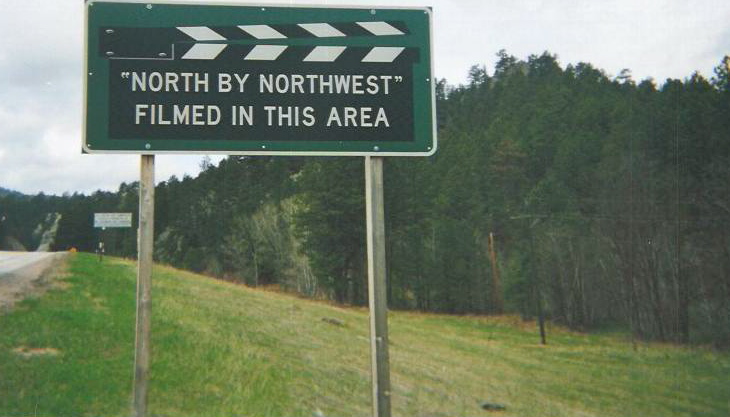
Hitchcock planned the film as a change of pace after his dark romantic thriller Vertigo a year earlier. In his book-length interview Hitchcock/Truffaut (1967) with François Truffaut, Hitchcock said that he wanted to do "something fun, light-hearted, and generally free of the symbolism permeating his other movies." Writer Ernest Lehman has mocked those who look for symbolism in the film. In addition to its popular appeal, the film is considered to be a masterpiece for its themes of deception, mistaken identity, and moral relativism in the Cold War era.
Some have mistaken the title North by Northwest as having come from a line in Hamlet ("I am but mad north-north-west: when the wind is southerly I know a hawk from a handsaw"), a work also concerned with the shifty nature of reality. However, Hitchcock explained in an interview with Peter Bogdanovich in 1963: "It's a fantasy. The whole film is epitomized in the title—there is no such thing as north-by-northwest on the compass." (The similar "northwest by north" is indeed one of 32 points of the compass.)
Lehman states that he used a working title for the film of In a Northwesterly Direction because the film's action was to begin in New York and climax in Alaska. Then the head of the story department at MGM suggested North by Northwest, but this was still to be a working title—shared with the public as early as June 1958. Other titles were considered, including The Man on Lincoln's Nose, but North by Northwest was kept because, according to Lehman, "We never did find a [better] title." The Northwest Airlines was worked into the film, reinforcing the title.
The film's plot involves a "MacGuffin"—a term popularized by Hitchcock—which is a physical object that everyone in the film is chasing, but which has no deep relationship to the plot. Late in North by Northwest, it emerges that the spies are attempting to smuggle microfilm containing government secrets out of the country. The film's protagonist, Roger Thornhill, only becomes involved through a case of mistaken identity (with a spy that does not even exist, "George Kaplan"), and only becomes a target for elimination when he becomes a persistent nuisance as a result.
North by Northwest has been referred to as "the first James Bond film"{{Cite web
The film's final shot—that of the train speeding into a tunnel during a romantic embrace onboard—is a famous bit of self-conscious Freudian symbolism reflecting Hitchcock's mischievous sense of humor. In the book Hitchcock/Truffaut (pp. 107–108), Hitchcock called it a "phallic symbol ... probably one of the most impudent shots I ever made".
Influences
The film was very influential on the James Bond films and subsequent action-thriller films, as well as the TV series The Man from U.N.C.L.E., where Leo G. Carroll played the same sort of role as the head of a top secret intelligence agency.
The film's title is reported to have been the influence for the name of the popular annual live-music festival South by Southwest in Austin, Texas, started in 1987, with the name idea coming from Louis Black, editor and co-founder of the local alternative weekly The Austin Chronicle, as a play on the Hitchcock film title.
The third episode of the 14th season of Doctor Who serial "The Deadly Assassin" (1976) includes an homage to North by Northwest, when the Doctor, who like Hitchcock's hero is falsely accused of a politically motivated murder, is attacked by gunfire from a biplane piloted by one of his enemy's henchmen.
The 2010 Spanish dark comedy film The Last Circus pays visual homage to the Mount Rushmore scene in its climactic scene atop a controversial Francoist monument.
Adaptations
North by Northwest was adapted as a stage play by Carolyn Burns. The adaptation premiered at the Melbourne Theatre Company in 2015.
Another stage adaptation, adapted and directed by Emma Rice, opened at the York Theatre Royal in March 2025 before touring the UK, ending with a run at the Alexandra Palace Theatre, London.
References
Bibliography
References
- (July 1, 1959). "Chicago [Picture Grosses]". [[Variety (magazine).
- "The Eddie Mannix Ledger". Margaret Herrick Library, Center for Motion Picture Study.
- (2004). "Cary Grant: A Class Apart". [[Turner Classic Movies]].
- Freedman, Jonathan. (2015-07-08). "The Cambridge Companion to Alfred Hitchcock". Cambridge University Press.
- "AFI'S 100 Years ... 100 Movies — 10th Anniversary Edition".
- Sight and Sound. "The Greatest Films of All Time".
- "Complete National Film Registry Listing".
- (2016). "North by Northwest: Full Credits". [[WarnerMedia#Time Warner (2003–2018).
- "North by Northwest (1959)". British Film Institute.
- (2024). "Malcolm Atterbury". Time Warner.
- (June 25, 2009). "Alfred Hitchcock's Movie Cameos: North by Northwest (1959)". [[Empire (magazine).
- Moore, Matthew. (August 15, 2008). "Did Alfred Hitchcock make a secret cameo appearance in drag?". [[The Daily Telegraph]].
- {{Harvnb. Brady. 1981
- Engel, Joel. (1995). "Screenwriters on Screen-Writing: The Best in the Business Discuss Their Craft". Hyperion.
- {{Harvnb. Brady. 1981
- Spoto, Donald. (1999). "The Dark Side of Genius: The Life of Alfred Hitchcock". Da Capo.
- (April 16, 2020). "Eva Marie Saint and Martin Landau Discuss Alfred Hitchcock's North by Northwest".
- Hart, Martin. "The Development of VistaVision: Paramount Marches to a Different Drummer". The American WideScreen Museum.
- (2002-10-27). "Proceedings of the 15th annual ACM symposium on User interface software and technology". [[Association for Computing Machinery]].
- link. (September 28, 2011 , Laverne Hoestenbach, "The Dispatch", Winter 1992)
- [http://www.bakersfield.com/102/story/258178.html The Bakersfield Californian], ''Wasco man had Hitchcock movie role'', October 11, 2007 {{Webarchive. link. (January 13, 2009)
- (6 February 2000). "The top 100 film moments".
- "1001 Greatest Movie Moments".
- Holusha, John. (2001-07-22). "Commercial Property/430 Park Avenue; Redesigning and Upgrading a Faded Office Building". The New York Times.
- Scout. (2012-10-01). "The Complete NY Filming Locations of North By Northwest".
- "Filming Locations for Alfred Hitchcock's North By Northwest (1959), in New York, Chicago, and Mount Rushmore in South Dakota.".
- James Gaddy. (January 2010). "The Plaza Hotel Renovated". TLC Magazine.
- "United Nations, New York City, New York - The Alfred Hitchcock Wiki".
- Coleman, Herbert. (2007). "The Man Who Knew Hitchcock: A Hollywood Memoir". Scarecrow Press.
- Heron, Ambrose. (2010-02-15). "Location of the Crop Dusting Sequence in North By Northwest".
- "Filming Locations for Alfred Hitchcock's North By Northwest (1959), in New York, Chicago, and Mount Rushmore in South Dakota.".
- "Part 8 – Midway Airport".
- James Chapman, ''Hitchcock and the Spy Film'' (2017), p. 222.
- "Keeping Up With the Times". U.S. National Park Service.
- "People & Events: Mount Rushmore and Hitchcock's North by Northwest". PBS.
- "ALFRED HITCHCOCK'S North by Northwest (1959; 136 mins.)". W.W, Norton.
- (June 12, 2016). "Connecting The Dots – THE VANDAMM HOUSE in 'North By Northwest'".
- (October 16, 2006). "Cary Grant's gray suit tops movie clothing list. GQ rates the most chic men's clothing on film". Today.com.
- McEwen, Todd. [http://granta.com/Cary-Grant%92s-Suit/ "Cary Grant's Suit"]. ''Granta'' (Summer 2006).
- McEwen, Todd. (March 7, 2023). "The Real Star of ''North by Northwest'' is Cary Grant's Suit".
- [http://www.vanityfair.com/culture/features/2008/03/behindthescenes200803 It's the Hitch in Hitchcock] {{webarchive. link. (February 7, 2008, Jim Windolf, ''[[Vanity Fair (magazine)). Vanity Fair]]'', March 2008
- [https://www.independent.co.uk/life-style/fashion/features/fashion-suits-they-are-achangin-774750.html Fashion: Suits they are a-changin] {{webarchive. link. (September 25, 2015, Glenn Waldron, ''The Independent'', January 28, 2008)
- [https://www.grailed.com/drycleanonly/cary-grant-north-by-northwest-style Fashion: Suits they are a-changin Cary Grant's "North By Northwest" Suit Is the Greatest in Film History] {{webarchive. link. (November 21, 2020, Brenden Gallagher, grailed.com, January 28, 2019)
- [https://bamfstyle.com/2012/09/26/north-by-northwest/ North by Northwest] {{webarchive. link. (November 25, 2022, BAMF Style, September 26, 2012)
- "Why ''North by Northwest'' Is Essential".
- Truffaut, François. (1985). "Hitchcock". Simon & Schuster.
- Roman, James. (2009). "Bigger than Blockbusters: Movies That Defined America". Greenwood.
- It had a seven-week run at [[Radio City Music Hall]] in August and September 1959. One trailer for ''North by Northwest'' features Hitchcock presenting himself as the owner of Alfred Hitchcock Travel Agency and telling the viewer he has made a motion picture to advertise these wonderful vacation stops.DVD Extras – Original Trailer
- Carson, Lexi. (2024-04-30). "Tribeca Sets Conversations With Martin Scorsese, Robert De Niro, Steven Spielberg and More".
- "North by Northwest {{!}} 2024 Tribeca Festival".
- (October 26, 2009). "Release date from IGN.com".
- Thill, Scott. (December 6, 2009). "Blu-ray Disc and DVD details from Wired.com".
- Hunt, Bill. "Hitchcock's North by Northwest is coming to 4K, plus a Se7en Ultra HD update, Panic Room, South Park, Team America, Civil War, and more!".
- (July 15, 1959). "Chicago [Picture Grosses]". [[Variety (magazine).
- (August 31, 1959). "Box Office: For the Books".
- Wear, Mike. (September 2, 1959). "July Spillover, Hot Newies Hypo Aug.; Top 2 Alone Rake in Tall $2,375,000; 'North,' 'Murder,' 'Hole,' 'Porgy' Aces".
- (August 12, 1959). "National Boxoffice Survey".
- (September 2, 1959). "'Northwest' $2,568,000 In First 139 Stands".
- (August 17, 1959). "Cinema: The New Pictures".
- A. H. Weiler. (August 7, 1959). "Hitchcock Takes Suspenseful Cook's Tour: ''North by Northwest'' Opens at Music Hall". [[The New York Times]].
- Deschner, Donald. (1973). "The Complete Films of Cary Grant". Citadel Press.
- (July 1959). "North by North-west archive review: pure entertainment that never puts a foot wrong".
- (November 2002). "The Movies That Changed Us: Reflections on the Screen". Atria Books, a trademark of Simon & Schuster.
- Dave Calhoun. (June 18–24, 2008). "North by Northwest (1959)". [[Time Out (magazine).
- (1999). "Take One: The First Annual Village Voice Film Critics' Poll". The Village Voice.
- "Entertainment Weekly's 100 Greatest Movies of All Time". [[Filmsite.org]].
- (23 November 2008). "Cahiers du cinéma's 100 Greatest Films".
- Thomson, David. (19 October 2010). "North By Northwest: No 2 best action and war film of all time". The Guardian.
- "The 500 Greatest Movies of All Time". Empire.
- (2012). "Critics' Top 100". British Film Institute.
- "North by Northwest".
- "North by Northwest".
- "Top 100 Films (Readers)". American Movie Classics Company.
- (20 July 2015). "The 100 Greatest American Films".
- (23 March 2022). "The 100 best thriller films of all time".
- Writers Guild of America West. (April 9, 2020). "101 Greatest Screenplays".
- "America's Greatest movies". American Film Institute.
- "The Greatest Films of All Time".
- (2008). "NY Times: North by Northwest". [[The New York Times]].
- "6 edition. 1958 Awards".
- "7 edition. 1959 Awards".
- (June 17, 2008). "AFI's 10 Top 10". [[American Film Institute]].
- "AFI 100 Years...100 Movies".
- "American Film Institute's 100 Years, 100 Thrills (winners)".
- "AFI 100 Years...100 Movies".
- Hitchcock was not above inserting a [[Sigmund Freud. Freudian]] joke as the last shot, which, notably, eluded contemporary censors.
- {{Harvnb. Brady. 1981
- Act II, Scene ii. Hamlet thus hints to Rosencrantz and Guildenstern, his friends, that his madness is only an act to protect himself while he gathers information on his father's murder.
- Bogdanovich, Peter. (1963). "Peter Bogdanovich Interviews Alfred Hitchcock".
- "Hedda Hopper's Hollywood" (syndicated column). Berkeley (CA) Daily Gaette, 4 June 1958, 40.
- Rubin, Steven Jay. (1990). "The James Bond Movie Encyclopedia". Contemporary Books, Inc..
- (12 June 2009). "Hitching a ride with the Master of Suspense".
- (4 July 2019). "How Hitchcock's North By Northwest showed the way for James Bond-and summer moviegoing".
- (6 August 2019). "How North by Northwest changed cinema forever".
- [http://www.dailytexanonline.com/content/sxsw-stays-course-continues-growth SXSW stays course, continues growth], Alex Geiser, ''[[The Daily Texan]]'', March 18, 2010 {{Webarchive. link. (April 13, 2011)
- "Doctor Who Classic Episode Guide – The Deadly Assassin – Details". BBC.
- AP. [https://www.hollywoodreporter.com/review/last-circus-film-review-30071 "The Last Circus -- Film Review"]. {{Webarchive. link. (November 25, 2022 ''The Hollywood Reporter'' (10/14/2010).)
- [https://extracine.com/2010/12/balada-triste-de-trompeta-triste-poco "«Balada Triste de Trompeta», triste es poco"] {{Webarchive. link. (December 26, 2010 . ''Extracine'' (Dec. 2010). Retrieved April 15, 2021.)
- Woodhead, Cameron. (June 5, 2015). "North by Northwest review: Slick and entertaining adaptation of Hitchcock's iconic film". The Age.
- Akbar, Arifa. (March 27, 2025). "North by Northwest review – Emma Rice takes Hitchcock in delightful new directions".
- "North by Northwest".
- (2020-02-09). "Backdrops, front and center: These massive paintings by unheralded movie studio artists, which provided magical settings during Hollywood's Golden Age, are finding a new life - CBS News".
- Faires, Robert. ""The Art of the Hollywood Backdrop" Provides a Close-up on Cinema's Scenic Paintings".
This article was imported from Wikipedia and is available under the Creative Commons Attribution-ShareAlike 4.0 License. Content has been adapted to SurfDoc format. Original contributors can be found on the article history page.
Ask Mako anything about North by Northwest — get instant answers, deeper analysis, and related topics.
Research with MakoFree with your Surf account
Create a free account to save articles, ask Mako questions, and organize your research.
Sign up freeThis content may have been generated or modified by AI. CloudSurf Software LLC is not responsible for the accuracy, completeness, or reliability of AI-generated content. Always verify important information from primary sources.
Report