From Surf Wiki (app.surf) — the open knowledge base
Norepinephrine reuptake inhibitor
Medications that increase norepinephrine

Medications that increase norepinephrine
| Field | Value |
|---|---|
| Synonyms | adrenergic reuptake inhibitor |
| Drugs.com | |
| MeshID | D018759 |
| Drugs.com =
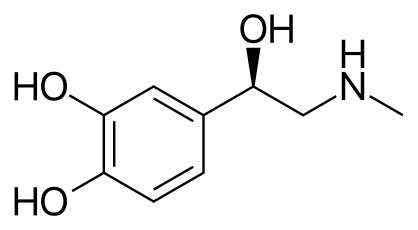
A norepinephrine reuptake inhibitor (NRI, NERI) or noradrenaline reuptake inhibitor or adrenergic reuptake inhibitor (ARI), is a type of drug that acts as a reuptake inhibitor for the neurotransmitters norepinephrine (noradrenaline) and epinephrine (adrenaline) by blocking the action of the norepinephrine transporter (NET). This in turn leads to increased extracellular concentrations of norepinephrine and epinephrine and therefore can increase adrenergic neurotransmission.
Medical use
NRIs are commonly used in the treatment of conditions like ADHD and narcolepsy due to their psychostimulant effects and in obesity due to their appetite suppressant effects. They are also frequently used as antidepressants for the treatment of major depressive disorder, anxiety and panic disorder. Additionally, many addictive substances such as cocaine and methylphenidate possess NRI activity, though NRIs without combined dopamine reuptake inhibitor (DRI) properties are not significantly rewarding and hence are considered to have negligible potential for addiction. However, norepinephrine has been implicated as acting synergistically with dopamine when actions on the two neurotransmitters are combined (e.g., in the case of NDRIs) to produce rewarding effects in psychostimulant addictive substances.
Depression
A meta analysis published in BMJ in 2011 concluded that the selective NRI reboxetine is indistinguishable from placebo in the treatment of depression. A second review by the European Medicines Agency concluded that reboxetine was significantly more effective than placebo, and that its risk/benefit ratio was positive. The latter review, also examined the efficacy of reboxetine as a function of baseline depression, and concluded that it was effective in severe depression and panic disorder but did not show effects significantly superior to placebo in mild depression.
A closely related type of drug is a norepinephrine releasing agent (NRA).
List of selective NRIs

Many NRIs exist, including the following:
- Selective norepinephrine reuptake inhibitors
- Marketed
- Atomoxetine (Strattera)
- Reboxetine (Edronax, Vestra)
- Viloxazine (Qelbree, Vivalan) – but also has some other weaker activities
- Never marketed
- Amedalin (UK-3540-1)
- Daledalin (UK-3557-15)
- Edivoxetine (LY-2216684)
- Esreboxetine (AXS-14; PNU-165442G)
- Lortalamine (LM-1404)
- Nisoxetine (LY-94,939)
- Talopram (tasulopram) (Lu 3–010)
- Talsupram (Lu 5–005)
- Tandamine (AY-23,946)
- Marketed
- NRIs with activity at other sites
- Marketed
- Bupropion (Wellbutrin, Zyban)
- Desipramine (Norpramin)
- Maprotiline (Ludiomil)
- Nortriptyline (Pamelor)
- Protriptyline (Vivactil)
- Tapentadol (Nucynta)
- Teniloxazine (Lucelan, Metatone)
- Never marketed
- Ampreloxetine (TD-9855)
- Ciclazindol (Wy-23,409)
- CP-39,332
- Manifaxine (GW-320,659)
- Radafaxine (GW-353,162)
- Marketed
Note: Only NRIs selective for the NET greater than the other two monoamine transporters (MATs) are listed here. For a list of NRIs that act at multiple MATs, see the other monoamine reuptake inhibitor pages such as NDRI, SNRI, and SNDRI.
References
References
- (September 2004). "Evaluation of the reinforcing effects of atomoxetine in monkeys: comparison to methylphenidate and desipramine". Drug and Alcohol Dependence.
- (April 2005). "Evaluation of the reinforcing effects of monoamine reuptake inhibitors under a concurrent schedule of food and i.v. drug delivery in rhesus monkeys". Neuropsychopharmacology.
- (January 2001). "Amphetamine-type central nervous system stimulants release norepinephrine more potently than they release dopamine and serotonin". Synapse.
- (2010). "Reboxetine for acute treatment of major depression: systematic review and meta-analysis of published and unpublished placebo and selective serotonin reuptake inhibitor controlled trials". BMJ.
- "MHRA Public Assessment Report".
- (2020). "New Insights into the Mechanism of Action of Viloxazine: Serotonin and Norepinephrine Modulating Properties". J Exp Pharmacol.
This article was imported from Wikipedia and is available under the Creative Commons Attribution-ShareAlike 4.0 License. Content has been adapted to SurfDoc format. Original contributors can be found on the article history page.
Ask Mako anything about Norepinephrine reuptake inhibitor — get instant answers, deeper analysis, and related topics.
Research with MakoFree with your Surf account
Create a free account to save articles, ask Mako questions, and organize your research.
Sign up freeThis content may have been generated or modified by AI. CloudSurf Software LLC is not responsible for the accuracy, completeness, or reliability of AI-generated content. Always verify important information from primary sources.
Report