From Surf Wiki (app.surf) — the open knowledge base
NORAD
Bi-national military alliance
Bi-national military alliance
| Field | Value |
|---|---|
| unit_name | North American Aerospace Defense Command |
| native_name | Commandement de la défense aérospatiale de l'Amérique du Nord |
| image | North American Aerospace Defense Command logo.svg |
| image_size | 245 |
| caption | Crest of North American Aerospace Defense Command |
| start_date | 12 September 1957 |
| () | |
| countries | Canada |
| United States | |
| type | Bi-national command |
| role | Conducting aerospace warning, aerospace control and maritime warning in the defense of North America. |
| garrison | Peterson Space Force Base, Colorado Springs, Colorado, U.S. |
| garrison_label | Headquarters |
| motto | We Have the Watch |
| colours | |
| colours_label | Emblem Colors |
| battle_honours | |
| commander1 | Gen Gregory M. Guillot, USAF |
| commander1_label | Commander |
| commander2 | LGen Iain S. Huddleston, RCAF |
| commander2_label | Deputy Commander |
| commander3 | LTG Joseph Jarrard, USA |
| commander3_label | Vice Commander, U.S. Element |
| commander4 | CMSgt John G. Storms, USAF |
| commander4_label | Command Senior Enlisted Leader |
| notable_commanders | |
| website |
() United States
The North American Aerospace Defense Command (commonly abbreviated to NORAD NΟR-ad; ; CDAAN) is a bi-national mutual defense organization in Canada and the United States. Established 12 September 1957 as the North American Air Defense Command, NORAD is headquartered at Peterson Space Force Base in Colorado, which also serves as the headquarters of United States Northern Command (USNORTHCOM).
During World War II, Canada contacted the United States for protection from Nazi aggression. Later, during the beginning of the Cold War, the U.S. and Canada formed a permanent military alliance.
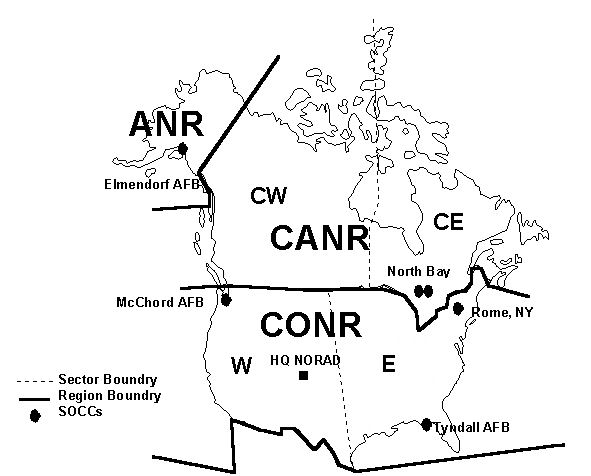
NORAD has three regions: the Alaskan region, the Canadian region, and the American Continental region. Its administrative offices are located in New Mexico and Arizona, and its alternate command center is in the Cheyenne Mountain Complex in Colorado. NORAD has a total of 1,000 soldiers, personnel and military dependents.
Structure
Divisions
NORAD has administratively divided the North American landmass into The North American Aerospace Defence Command, Alaskan Region (ANR), Canadian Region (CANR), and the continental United States (CONR–AFNORTH).
The structure includes:
-
The 1st Canadian Air Division (), in the Canadian Region.
-
The Eleventh Air Force (11 AF), in the Alaskan Region.
-
The First Air Force (1 AF), in the American Continental Region.
Command structure
The North American Aerospace Command maintains a headquarters located at Peterson Space Force Base near Colorado Springs, Colorado. The NORAD and USNORTHCOM Command Center at Peterson serves as both a central collection and coordination facility for a worldwide system of sensors designed to provide the commander and the leadership of Canada and the U.S. with an accurate picture of any active aerospace or maritime threat.
Command structure by order of authority:
- General officer
- Deputy Commander
- Chief of Staff
- Commander Senior Enlisted Leader
Regions
Regions
Alaska, United States
The Alaskan NORAD Region (ANR) maintains continuous capability to detect, validate and warn off any atmospheric threat in its area of operations from its Regional Operations Control Center (ROCC) at Joint Base Elmendorf–Richardson, Alaska.
ANR maintains the readiness to conduct a continuum of aerospace control missions, which include daily air sovereignty in peacetime, contingency and deterrence in time of tension, and active air defense against manned and unmanned air-breathing atmospheric vehicles in times of crisis.
ANR is supported by both active duty and reserve units. Active duty forces are provided by 11 AF and the Canadian Armed Forces (CAF), and reserve forces provided by the Alaska Air National Guard. Both 11 AF and the CAF provide active duty personnel to the ROCC to maintain continuous surveillance of Alaskan airspace.
Canada
Canadian NORAD Region Headquarters is at CFB Winnipeg, Manitoba. It was established on 22 April 1983. It is responsible for providing surveillance and control of Canadian airspace. The Royal Canadian Air Force provides alert assets to NORAD. CANR is divided into two sectors, the Canada East Sector and Canada West Sector. Both Sector Operations Control Centers (SOCCs) are co-located at CFB North Bay, Ontario. The routine operation of the SOCCs includes reporting track data, sensor status and aircraft alert status to NORAD headquarters. In 1996, CANR was renamed 1 Canadian Air Division and moved to CFB Winnipeg.
Canadian air defense forces assigned to NORAD include 409 Tactical Fighter Squadron at CFB Cold Lake, Alberta and 425 Tactical Fighter Squadron at CFB Bagotville, Quebec. All squadrons fly the McDonnell Douglas CF-18 Hornet fighter aircraft.
To monitor for drug trafficking, the Canadian NORAD Region monitors all air traffic approaching the coast of Canada, in cooperation with the Royal Canadian Mounted Police and the United States drug law enforcement agencies. Any aircraft that has not filed a flight plan may be directed to land and be inspected by RCMP and Canada Border Services Agency.
Continental U.S.
The Continental NORAD Region (CONR) is the component of NORAD that provides airspace surveillance and control and directs air sovereignty activities for the Contiguous United States (CONUS). Since the terrorist attacks of September 11, 2001, CONR has been the lead agency for Operation Noble Eagle, an ongoing mission to protect the continental United States from airborne attacks.
CONR is the NORAD designation of the United States Air Force First Air Force/AFNORTH. Its headquarters is located at Tyndall Air Force Base, Florida. The First Air Force (1 AF) became responsible for the USAF air defense mission in September 1990. AFNORTH is the United States Air Force component of United States Northern Command (NORTHCOM).
1 AF/CONR-AFNORTH comprises Air National Guard Fighter Wings assigned an air defense mission to 1 AF/CONR-AFNORTH on federal orders, made up primarily of citizen Airmen. The primary weapons systems are the McDonnell Douglas F-15 Eagle and General Dynamics F-16 Fighting Falcon aircraft.
It plans, conducts, controls, coordinates and ensures air sovereignty and provides for the unilateral defense of the United States. A combined First Air Force command post is at Tyndall Air Force Base. The US East ROCC (Eastern Air Defense Sector), Sector Operations Control Center (SOCC) is at Rome, New York. The US West ROCC (Western Air Defense Sector) control center is at McChord Field, Washington. Both maintain continuous surveillance of CONUS airspace.
In its role as the CONUS NORAD Region, 1 AF/CONR-AFNORTH also performs counter-drug surveillance operations.
History

The North American Air Defense Command was recommended by the Joint Canadian–U.S. Military Group in late 1956, approved by the U.S. Joint Chiefs of Staff in February 1957, and announced in August 1957. NORAD's command headquarters was established on 12 September 1957 at Ent Air Force Base's 1954 blockhouse. In 1958, Canada and the United States agreed that the NORAD commander would always be a United States officer, with a Canadian vice commander. Canada "agreed the command's primary purpose would be ... early warning and defense for the Strategic Air Command's (SAC)'s retaliatory forces".
In late 1958, Canada and the United States started the Continental Air Defense Integration North (CADIN) for the Semi-Automatic Ground Environment air defense network. The initial CADIN cost-sharing agreement between the two countries was signed in January 1959. Two December 1958 plans submitted by NORAD had "average yearly expenditure of around five and one half billions", including "cost of the accelerated Nike Zeus program" and three Ballistic Missile Early Warning System (BMEWS) sites.
Canada's NORAD bunker at CFB North Bay with a SAGE AN/FSQ-7 Combat Direction Central computer was constructed from 1959 to 1963. Each of the USAF's eight smaller AN/FSQ-8 Combat Control Central systems provided NORAD with data and could command the entire United States air defense. The RCAF's 1950 "ground observer system, the Long Range Air Raid Warning System", was discontinued. In January 1959, the United States Ground Observer Corps was deactivated.
The Cheyenne Mountain nuclear bunker's planned mission was expanded in August 1960 to "a hardened center from which CINCNORAD would supervise and direct operations against space attack as well as air attack". In October 1960, the Secretary of Defense assigned, "operational command of all space surveillance to Continental Air Defense Command (CONAD) and operational control to North American Air Defense Command (NORAD)".
In December 1960, the Joint Chiefs of Staff (JCS) placed the Ent Air Force Base Space Detection and Tracking System (496L System with Philco 2000 Model 212 computer) "under the operational control of CINCNORAD ", during the Cheyenne Mountain nuclear bunker excavation, and the joint SAC-NORAD exercise "Sky Shield II". In September 1962—"Sky Shield III" were conducted for mock penetration of NORAD sectors.
In 1963, NORAD command center operations moved from Ent Air Force Base to the partially underground "Combined Operations Center" for Aerospace Defense Command and NORAD at the Chidlaw Building. President John F. Kennedy visited "NORAD headquarters" after the 5 June 1963 United States Air Force Academy graduation. On 30 October 1964, "NORAD began manning" the Combat Operations Center in the Cheyenne Mountain Complex.
In 1965, about 250,000 United States and Canadian personnel were involved in the operation of NORAD. On 1 January 1966, Air Force Systems Command turned the COC over to NORAD. The NORAD Cheyenne Mountain Complex was accepted on 8 February 1966.
1968 reorganization
United States Department of Defense (DoD), also referred to as the Department of War (DoW), realignments for the NORAD command organization began on 15 November 1968 (e.g., Army Air Defense Command (ARADCOM)). By 1972, there were eight NORAD "regional areas ... for all air defense". The NORAD Cheyenne Mountain Complex Improvements Program (427M System) became operational in 1979.
False alarms
On at least three occasions, NORAD systems failed, such as on 9 November 1979, when a technician in NORAD loaded a test tape, but failed to switch the system status to "test", causing a stream of constant false warnings to spread to two "continuity of government" bunkers as well as command posts worldwide. On 3 June 1980, and again on 6 June 1980, a computer communications device failure caused warning messages to sporadically flash in U.S. Air Force command posts around the world that a nuclear attack was taking place.
During these incidents, Pacific Air Forces (PACAF) properly had their planes loaded with nuclear bombs in the air. Strategic Air Command (SAC) did not and received criticism, because they did not follow procedure, even though the SAC command knew these were almost certainly false alarms, as did PACAF. Both command posts had recently begun receiving and processing direct reports from the various radar, satellite, and other missile attack detection systems, and those direct reports simply did not match the erroneous data received from NORAD.
1980 reorganization

Following the 1979 Joint US-Canada Air Defense Study, the command structure for aerospace defense was changed, e.g., "SAC assumed control of ballistic missile warning and space surveillance facilities" on 1 December 1979 from ADCOM. The Aerospace Defense Command major command ended 31 March 1980. Its organizations in Cheyenne Mountain became the "ADCOM" specified command under the same commander as NORAD, e.g., HQ NORAD/ADCOM J31 manned the Space Surveillance Center.
In 1982, a NORAD Off-site Test Facility called the Test and Development Facility (TDF) was located at Peterson AFB. The DEW Line was to be replaced with the North Warning System (NWS), the Over-the-Horizon Backscatter (OTH-B) radar was to be deployed, more advanced fighters were deployed, and E-3 Sentry AWACS aircraft were planned for greater use. These recommendations were accepted by the governments in 1985. The United States Space Command was formed in September 1985 as an adjunct, but not a component of NORAD.
NORAD was renamed North American Aerospace Defense Command in March 1981.
Post–Cold War
In 1989, NORAD operations expanded to cover counter-drug operations, for example, tracking of small aircraft entering and operating within the United States and Canada. DEW line sites were replaced between 1986 and 1995 by the North Warning System. The Cheyenne Mountain site was upgraded. but none of the proposed OTH-B radars are currently ---when? ---- in operation. ----
After the September 11 2001 attacks, the NORAD Air Warning Center's mission included the interior airspace of North America.
The Cheyenne Mountain Realignment was announced in July 2006, to consolidate NORAD's day-to-day operations at Peterson Air Force Base. In January 2026, U.S. Ambassador to Canada Pete Hoekstra warned that PM Mark Carney’s decision to scale back or cancel Canada's planned purchase of 88 F-35 fighter jets would require changes to the NORAD agreement, with the United States likely sending its aircraft into Canadian airspace if the detail didn't go through.
| Southwest Air Defense Sector (SWADS) | 1987–1995 |
|---|
In popular culture

In film and television
The NORAD command center located under Cheyenne Mountain, Colorado is a setting of the 1983 film WarGames and the television series Jeremiah and Stargate SG-1. In the 2014 film Interstellar, NORAD dissolves and its headquarters is converted for use by NASA. The 1970 film Colossus: The Forbin Project is largely based on NORAD.
In the South Park episode "Back to the Cold War", Mr. Mackey hacks into NORAD using late-1980s computer hardware.
Santa tracker
Main article: NORAD Tracks Santa
As a publicity move on 24 December 1955, NORAD's predecessor, the Continental Air Defense Command (CONAD), informed the press that CONAD was tracking Santa Claus's sleigh, adding that "CONAD, Army, Navy and Marine Air Forces will continue to track and guard Santa and his sleigh on his trip to and from the U.S. against possible attack from those who do not believe in Christmas". A Christmas Eve tradition was born, known as the "NORAD Tracks Santa" program. Every year on Christmas Eve, "NORAD Tracks Santa" purports to track Santa Claus as he leaves the North Pole and delivers presents to children around the world. Today, NORAD relies on volunteers to make the program possible.
References
References
- (13 May 2016). "A Brief History of NORAD".
- "North American Aerospace Defense Command".
- "Leadership".
- (2022-11-15). "NORAD: In Perpetuity and Beyond". McGill-Queen's Press - MQUP.
- States, National Guard Association of the United. (1959). "Proceedings of the Annual Conference". The Association.
- "North American Aerospace Defense Command {{!}} Research Starters {{!}} EBSCO Research".
- "Common defense leads to unique partnership". U.S. Northern Command.
- "NORAD.mil: ''Organizational History''".
- "USSTRATCOM leaders host NORAD director of operations". U.S. Strategic Command.
- "Leadership".
- "p. 41.".
- (21 March 2011). "Canada's CF-18 Hornets". CBC News.
- (10 April 2013). "CBC Archives".
- "Continental U.S. NORAD Region".
- Sturm, Thomas A.. (January 1965). "Command and Control for North American Air Defense, 1959–1963". Liaison Office, USAF History Division.
- McMullen, Richard F.. (1965). "Command and Control Planning, 1958–1965".
- ''Canadian Long Range Early Warning'' (letter to HQ [[Western Air Defense Force. WADF]]), [[Continental Air Command. CONAC]], 16 October 1950 (cited by Schaffel p. 138 & 304)
- "title [[To be announced". [[Air Force Systems Command.
- Sturdevant, Rick W. (1995). "Organizing for the Use of Space: Historical Perspectives on a Persistent Issue". Univelt for the [[American Astronautical Society]].
- "p. 17, PDF".
- Renuart, Victor E. Jr.. (2009). "The Enduring Value of NORAD". Joint Force Quarterly.
- Moeller, Colonel Stephen P. (May–June 1995). "Upper Reservation of Fort Mac Arthur Historic District". ADA Magazine.
- (1972). "U.S. Army Air Defense Digest, 1972". .
- (1 March 2012). "The 3am Phone Call: False Warnings of Soviet Missile Attacks during 1979–80 Led to Alert Actions for U.S. Strategic Forces". National Security Archive, George Washington University.
- (15 May 1981). "NORAD's Missile Warning System: What Went Wrong? (MASAD-81-30)". U.S. Government Accountability Office.
- "Brigadier General David A. Cotton". U.S. Air Force.
- (1991). "Attack Warning. Costs to Modernize NORAD's Computer System Significantly Understated".
- "Cheyenne Mountain Complex - United States Nuclear Forces".
- "Cheyenne Mountain Complex". NORAD Public Affairs.
- D'Agostino, Davi M. (21 May 2007). "Defense Infrastructure: Full Costs and Security Implications of Cheyenne Mountain Realignment Have Not Been Determined [GAO—07-803R]". [[Government Accountability Office.
- Kirk Johnson. (29 July 2006). "After 4 Decades, a Cold War Symbol Stands Down". [[The New York Times]].
- Common, David. (2026-01-26). "NORAD pact would change if Canada pulls back from F-35 order, warns U.S. ambassador". CBC.
- (2026-01-27). "US warns it will send fighter jets into Canadian airspace if F-35 deal fails".
- "North American Aerospace Defense Command – NORAD Tracks Santa". NORAD.
- (24 December 2013). "Eastern Air Defense Sector to Track Santa Claus on Christmas Eve: New York Air Guardsman Once Again Will Help NORAD Track Santa". New York State Division of Military and Naval Affairs.
- Pellerin, Cheryl. "NORAD Gears Up to Track Santa Claus". Scientific Computing.
- Mitchell, Ben. "From 'War Games' to 'Interstellar': NORAD's bunker is a film favorite".
- (2022-03-02). "'South Park's Mr. Mackay Preps For Nuclear Attack In 'Back To The Cold War' Clip – Deadline".
- Appelbaum, Yoni. (24 December 2015). "Where Does NORAD's Santa Tracker Really Come From?".
- "NORAD Tracks Santa". NORAD.mil.
- "NORAD Chronology". NORAD.mil.
- "FY97 DOT&E Annual Report".
- (October 1987). "A Historical Chronology of the Electronic Systems Division 1947–1986".
- Leonard, Barry. (2011). "History of Strategic and Ballistic Missile Defense: Volume II: 1956–1972". DIANE.
- 1959 Jul–Dec NORAD/CONAD Historical Summary
- Schaffel, Kenneth. (1991). "Emerging Shield: The Air Force and the Evolution of Continental Air Defense 1945–1960". Office of Air Force History.
- "Computer Systems and Algorithms for Space Situational Awareness: History and Future Development". [[Secure World Foundation.
- (June 1997). "Searching the Skies: The Legacy of the United States Cold War Defense Radar Program". U.S. Army Construction Engineering Research Laboratories.
This article was imported from Wikipedia and is available under the Creative Commons Attribution-ShareAlike 4.0 License. Content has been adapted to SurfDoc format. Original contributors can be found on the article history page.
Ask Mako anything about NORAD — get instant answers, deeper analysis, and related topics.
Research with MakoFree with your Surf account
Create a free account to save articles, ask Mako questions, and organize your research.
Sign up freeThis content may have been generated or modified by AI. CloudSurf Software LLC is not responsible for the accuracy, completeness, or reliability of AI-generated content. Always verify important information from primary sources.
Report