From Surf Wiki (app.surf) — the open knowledge base
Non-proteinogenic amino acids
Amino acids not naturally encoded in the genome
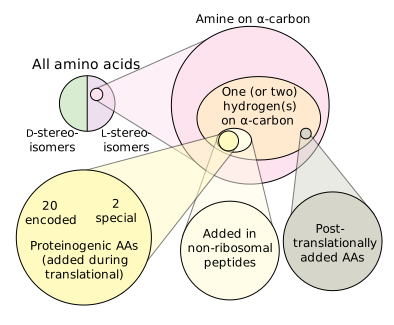
Amino acids not naturally encoded in the genome
In biochemistry, non-coded or non-proteinogenic amino acids are distinct from the 22 proteinogenic amino acids (21 in eukaryotesplus formylmethionine in eukaryotes with prokaryote organelles like mitochondria), which are naturally encoded in the genome of organisms for the assembly of proteins. However, over 140 non-proteinogenic amino acids occur naturally in proteins (but not included in the genetic code) and thousands more may occur in nature or be synthesized in the laboratory.{{Cite journal | last1 = Ambrogelly | first1 = A. | last2 = Palioura | first2 = S. | last3 = Söll | first3 = D.
- intermediates in biosynthesis,
- in post-translational formation of proteins,
- in a physiological role (e.g. components of bacterial cell walls, neurotransmitters and toxins),
- natural or man-made pharmacological compounds,
- present in meteorites or used in prebiotic experiments (such as the Miller–Urey experiment),
- might be important neurotransmitters, such as γ-aminobutyric acid,{{Cite journal
- can play a crucial role in cellular bioenergetics, such as creatine.
Definition by negation

Technically, any organic compound with an amine (–NH2) and a carboxylic acid (–COOH) functional group is an amino acid. The proteinogenic amino acids are a small subset of this group that possess a central carbon atom (α- or 2-) bearing an amino group, a carboxyl group, a side chain and an α-hydrogen levo conformation, with the exception of glycine, which is achiral, and proline, whose amine group is a secondary amine and is consequently frequently referred to as an imino acid for traditional reasons, albeit not an imino.
The genetic code encodes 20 standard amino acids for incorporation into proteins during translation. However, there are two extra proteinogenic amino acids: selenocysteine and pyrrolysine. These non-standard amino acids do not have a dedicated codon, but are added in place of a stop codon when a specific sequence is present, UGA codon and SECIS element for selenocysteine,{{Cite journal L-selenocysteine-2D-skeletal.png|Selenocysteine. This amino acid contains a selenol group on its β-carbon Pyrrolysine.svg|Pyrrolysine. This amino acid is formed by joining to the ε-amino group of lysine a carboxylated pyrroline ring
There are various groups of amino acids:
- 20 standard amino acids
- 22 proteinogenic amino acids
- over 80 amino acids created abiotically in high concentrations
- about 900 are produced by natural pathways
- over 118 engineered amino acids have been placed into proteins These groups overlap, but are not identical. All 22 proteinogenic amino acids are biosynthesised by organisms and some, but not all, of them also are abiotic (found in prebiotic experiments and meteorites). Some natural amino acids, such as norleucine, are misincorporated translationally into proteins due to infidelity of the protein-synthesis process. Many amino acids, such as ornithine, are metabolic intermediates produced biosynthetically, but not incorporated translationally into proteins. Post-translational modification of amino acid residues in proteins leads to the formation of many proteinaceous, but non-proteinogenic, amino acids. Other amino acids are solely found in abiotic mixes (e.g. α-methylnorvaline). Over 30 unnatural amino acids have been inserted translationally into proteins in engineered systems, yet are not biosynthetic.
Nomenclature
In addition to the IUPAC numbering system to differentiate the various carbons in an organic molecule, by sequentially assigning a number to each carbon, including those forming a carboxylic group, the carbons along the side-chain of amino acids can also be labelled with Greek letters, where the α-carbon is the central chiral carbon possessing a carboxyl group, a side chain and, in α-amino acids, an amino group – the carbon in carboxylic groups is not counted. (Consequently, the IUPAC names of many non-proteinogenic α-amino acids start with 2-amino- and end in -ic acid.)
Natural non-L-α-amino acids
Most natural amino acids are α-amino acids in the L configuration, but some exceptions exist.
Non-alpha

Some non-α-amino acids exist in organisms. In these structures, the amine group is displaced further from the carboxylic acid end of the amino acid molecule. Thus a β-amino acid has the amine group bonded to the second carbon away, and a γ-amino acid has it on the third. Examples include β-alanine, GABA, and δ-aminolevulinic acid.
Beta-alanine structure.svg|β-alanine: an amino acid produced by aspartate 1-decarboxylase and a precursor to coenzyme A and the peptides carnosine and anserine. Gamma-Aminobuttersäure - gamma-aminobutyric acid.svg|γ-Aminobutyric acid (GABA): a neurotransmitter in animals. Aminolevulinic_acid.svg|δ-Aminolevulinic acid: an intermediate in tetrapyrrole biosynthesis (haem, chlorophyll, cobalamin etc.). 4-Aminobenzoic_acid.svg|4-Aminobenzoic acid (PABA): an intermediate in folate biosynthesis
The reason why α-amino acids are used in proteins has been linked to their frequency in meteorites and prebiotic experiments.{{Cite journal
D-amino acids
Some amino acids contain the opposite absolute chirality, chemicals that are not available from normal ribosomal translation and transcription machinery. Most bacterial cells walls are formed by peptidoglycan, a polymer composed of amino sugars crosslinked with short oligopeptides bridged between each other. The oligopeptide is non-ribosomally synthesised and contains several peculiarities including D-amino acids, generally D-alanine and D-glutamate. A further peculiarity is that the former is racemised by a PLP-binding enzymes (encoded by alr or the homologue dadX), whereas the latter is racemised by a cofactor independent enzyme (murI). Some variants are present, in Thermotoga spp. D-Lysine is present and in certain vancomycin-resistant bacteria D-serine is present (vanT gene).{{Cite journal
Without a hydrogen on the α-carbon
All proteinogenic amino acids have at least one hydrogen on the α-carbon. Glycine has two hydrogens, and all others have one hydrogen and one side-chain. Replacement of the remaining hydrogen with a larger substituent, such as a methyl group, distorts the protein backbone.
In some fungi α-aminoisobutyric acid is produced as a precursor to peptides, some of which exhibit antibiotic properties.{{Cite journal L-Alanin - L-Alanine.svg|alanine 2-aminoisobutyric acid.svg|aminoisobutyric acid Dehydroalanin.svg|dehydroalanine
Twin amino acid stereocentres
A subset of L-α-amino acids are ambiguous as to which of two ends is the α-carbon. In proteins a cysteine residue can form a disulfide bond with another cysteine residue, thus crosslinking the protein. Two crosslinked cysteines form a cystine molecule. Cysteine and methionine are generally produced by direct sulfurylation, but in some species they can be produced by transsulfuration, where the activated homoserine or serine is fused to a cysteine or homocysteine forming cystathionine. A similar compound is lanthionine, which can be seen as two alanine molecules joined via a thioether bond and is found in various organisms. Similarly, djenkolic acid, a plant toxin from jengkol beans, is composed of two cysteines connected by a methylene group. Diaminopimelic acid is both used as a bridge in peptidoglycan and is used a precursor to lysine (via its decarboxylation). Amminoacido cistina formula.svg|cystine Cystathionin.svg|cystathionine Lanthionin.svg|lanthionine Djenkolic acid.svg|djenkolic acid Diaminopimelic acid.svg|diaminopimelic acid
Prebiotic amino acids and alternative biochemistries
In meteorites and in prebiotic experiments (e.g. Miller–Urey experiment) many more amino acids than the twenty standard amino acids are found, several of which are at higher concentrations than the standard ones. It has been conjectured that if amino acid based life were to arise elsewhere in the universe, no more than 75% of the amino acids would be in common. The most notable anomaly is the lack of aminobutyric acid.
| Molecule | Electric discharge | Murchinson meteorite |
|---|---|---|
| glycine | 100 | 100 |
| alanine | 180 | 36 |
| α-amino-n-butyric acid | 61 | 19 |
| norvaline | 14 | 14 |
| valine | 4.4 | |
| norleucine | 1.4 | |
| leucine | 2.6 | |
| isoleucine | 1.1 | |
| alloisoleucine | 1.2 | |
| t-leucine | ||
| α-amino-n-heptanoic acid | 0.3 | |
| proline | 0.3 | 22 |
| pipecolic acid | 0.01 | 11 |
| α,β-diaminopropionic acid | 1.5 | |
| α,γ-diaminobutyric acid | 7.6 | |
| ornithine | ||
| lysine | ||
| aspartic acid | 7.7 | 13 |
| glutamic acid | 1.7 | 20 |
| serine | 1.1 | |
| threonine | 0.2 | |
| allothreonine | 0.2 | |
| methionine | 0.1 | |
| homocysteine | 0.5 | |
| homoserine | 0.5 | |
| β-alanine | 4.3 | 10 |
| β-amino-n-butyric acid | 0.1 | 5 |
| β-aminoisobutyric acid | 0.5 | 7 |
| γ-aminobutyric acid | 0.5 | 7 |
| α-aminoisobutyric acid | 7 | 33 |
| isovaline | 1 | 11 |
| sarcosine | 12.5 | 7 |
| N-ethylglycine | 6.8 | 6 |
| N-propylglycine | 0.5 | |
| N-isopropylglycine | 0.5 | |
| N-methylalanine | 3.4 | 3 |
| N-ethylalanine | ||
| N-methyl-β-alanine | 1.0 | |
| N-ethyl-β-alanine | ||
| isoserine | 1.2 | |
| α-hydroxy-γ-aminobutyric acid | 17 |
Straight side chain
The genetic code has been described as a frozen accident and the reasons why there is only one standard amino acid with a straight chain, alanine, could simply be redundancy with valine, leucine and isoleucine. However, straight chained amino acids are reported to form much more stable alpha helices.{{Cite journal | doi-access = free
File:Glycin - Glycine.svg|glycine (hydrogen side-chain) File:L-Alanin - L-Alanine.svg|alanine (methyl side-chain) File:Alpha-aminobutyric acid.png|homoalanine, or α-aminobutyric acid (ethyl side-chain) File:L-Norvalin.svg|norvaline (n-propyl side-chain) File:L-Norleucin.svg|norleucine (n-butyl side-chain)
Chalcogen
Serine, homoserine, O-methylhomoserine and O-ethylhomoserine possess a hydroxymethyl, hydroxyethyl, O-methylhydroxymethyl and O-methylhydroxyethyl side chain; whereas cysteine, homocysteine, methionine and ethionine possess the thiol equivalents. The selenol equivalents are selenocysteine, selenohomocysteine, selenomethionine and selenoethionine. Amino acids with the next chalcogen down are also found in nature: several species such as Aspergillus fumigatus, Aspergillus terreus, and Penicillium chrysogenum in the absence of sulfur are able to produce and incorporate into protein tellurocysteine and telluromethionine.{{Cite journal
Expanded genetic code
Main article: Expanded genetic code
Roles
In cells, especially autotrophs, several non-proteinogenic amino acids are found as metabolic intermediates. However, despite the catalytic flexibility of PLP-binding enzymes, many amino acids are synthesised as keto acids (such as 4-methyl-2-oxopentanoate to leucine) and aminated in the last step, thus keeping the number of non-proteinogenic amino acid intermediates fairly low.
Ornithine and citrulline occur in the urea cycle, part of amino acid catabolism (see below).{{Cite journal
In addition to primary metabolism, several non-proteinogenic amino acids are precursors or the final production in secondary metabolism to make small compounds or non-ribosomal peptides (such as some toxins).
Post-translationally incorporated into protein
Despite not being encoded by the genetic code as proteinogenic amino acids, some non-standard amino acids are nevertheless found in proteins. These are formed by post-translational modification of the side chains of standard amino acids present in the target protein. These modifications are often essential for the function or regulation of a protein; for example, in γ-carboxyglutamate the carboxylation of glutamate allows for better binding of calcium cations,{{Cite journal Carboxyglutamic_acid.svg|Carboxyglutamic acid. Whereas glutamic acid possess one γ-carboxyl group, Carboxyglutamic acid possess two. 4-Hydroxyprolin.svg|Hydroxyproline. This imino acid differs from proline due to a hydroxyl group on carbon 4. Hypusine natural.svg|Hypusine. This amino acid is obtained by adding to the ε-amino group of a lysine a 4-aminobutyl moiety (obtained from spermidine) (S)-Pyroglutamic_acid_Structural_Formulae.png|Pyroglutamic acid
There is some preliminary evidence that aminomalonic acid may be present, possibly by misincorporation, in protein.{{Cite journal
Toxic analogues
Several non-proteinogenic amino acids are toxic due to their ability to mimic certain properties of proteinogenic amino acids, such as thialysine. Some non-proteinogenic amino acids are neurotoxic by mimicking amino acids used as neurotransmitters (that is, not for protein biosynthesis), including quisqualic acid, canavanine, caramboxin and azetidine-2-carboxylic acid. Cephalosporin C has an α-aminoadipic acid (homoglutamate) backbone that is amidated with a cephalosporin moiety.{{Cite journal
Thialysine.png|Thialysine Quisqualic acid.svg|quisqualic acid L-S-Canavanine.svg|canavanine (S)-(-)-2-Azetidinecarboxylic acid.svg|azetidine-2-carboxylic acid Cephalosporin C.svg|cephalosporin C Penicillamine structure.png|penicillamine Naturally occurring cyanotoxins can also include non-proteinogenic amino acids. Microcystin and nodularin, for example, are both derived from ADDA, a β-amino acid.
Taurine
Main article: Taurine
Taurine is an amino sulfonic acid and not an amino carboxylic acid, however it is occasionally considered as such as the amounts required to suppress the auxotroph in certain organisms (such as cats) are closer to those of "essential amino acids" (amino acid auxotrophy) than of vitamins (cofactor auxotrophy).
The osmolytes, sarcosine and glycine betaine are derived from amino acids, but have a secondary and quaternary amine respectively.
Notes
References
References
- (22 April 2014). "Peptidomimetics via modifications of amino acids and peptide bonds". Chemical Society Reviews.
- Ostojic, Sergej M.. (2021-08-01). "Creatine as a food supplement for the general population". Journal of Functional Foods.
- (2006). "On the evolution of the standard amino-acid alphabet". Genome Biology.
- (2004). "Biochemistry". John Wiley & Sons.
- (2005). "Pantothenate biosynthesis in higher plants". Biochemical Society Transactions.
- (2006). "Protein Design".
- (2005). "Collagen structure: The Madras triple helix and the current scenario". IUBMB Life.
- (2006). "The post-translational synthesis of a polyamine-derived amino acid, hypusine, in the eukaryotic translation initiation factor 5A (eIF5A)". Journal of Biochemistry.
- (1993). "Subcellular localization specified by protein acylation and phosphorylation". Current Opinion in Cell Biology.
- (2011). "Amino acid analog toxicity in primary rat neuronal and astrocyte cultures: Implications for protein misfolding and TDP-43 regulation". Journal of Neuroscience Research.
This article was imported from Wikipedia and is available under the Creative Commons Attribution-ShareAlike 4.0 License. Content has been adapted to SurfDoc format. Original contributors can be found on the article history page.
Ask Mako anything about Non-proteinogenic amino acids — get instant answers, deeper analysis, and related topics.
Research with MakoFree with your Surf account
Create a free account to save articles, ask Mako questions, and organize your research.
Sign up freeThis content may have been generated or modified by AI. CloudSurf Software LLC is not responsible for the accuracy, completeness, or reliability of AI-generated content. Always verify important information from primary sources.
Report