From Surf Wiki (app.surf) — the open knowledge base
Noise music
Music genre

Music genre
| Field | Value |
|---|---|
| name | Noise music |
| other_names | * Noise |
| stylistic_origins | |
| cultural_origins | 1910s, Italy |
| derivatives | |
| subgenres | |
| fusiongenres | |
| regional_scenes | |
| other_topics |
Noise music (or simply noise) is a subgenre of experimental music that is characterised by its use of unwanted noise as a primary musical element. The genre has roots in early 20th century avant-garde music, but later drew influence from industrial and electronic music. It is characterized by a rejection of conventional music theory and traditional song structures, often featuring little or no melody, rhythm, or harmony. This type of music tends to challenge the conventional distinction between musical and non-musical sound.
"Noise as music" originated as an avant-garde music style in the 1910s through the work of Luigi Russolo an Italian Futurist, who published the manifesto The Art of Noises in 1913*.* Elements of noise music were later explored by artists in the Dada and Fluxus movements, as well as through electroacoustic music, modern classical and musique concrète. Composers such as John Cage, Edgard Varèse and James Tenney would explicitly use the term "noise" to describe some of their experimental practices. During the 1960s and 1970s, compositions such as Robert Ashley's "The Wolfman" (1964) and Pauline Oliveros "A Little Noise In The System" (1967) were among the earliest examples of contemporary noise music, while works by non-academic artists such as Lou Reed's Metal Machine Music were influential for later noise artists.
By the late 1970s and early 1980s, the emergence of industrial music and commercial synthesizers, encouraged non-musicians to experiment with strictly noise-oriented styles, leading to genres such as power electronics, coined by English noise act Whitehouse, as well as post-industrial styles like dark ambient, death industrial and power noise. In Japan, the Japanoise scene which stemmed out of the Kansai no wave movement, produced several influential noise acts such as Merzbow, Hijokaidan, Hanatarash, C.C.C.C. and Incapacitants, who, together with American and European noise artists the Haters, Daniel Menche, Vomir and Richard Ramirez, contributed to the emergence of harsh noise and harsh noise wall into the 1990s and 2000s.
Etymology
According to Danish noise and music theorist Torben Sangild, no single definition of noise in music is possible. Sangild instead provides three basic definitions of noise: a musical acoustics definition, a second communicative definition based on distortion or disturbance of a communicative signal, and a third definition based in subjectivity (what is noise to one person can be meaningful to another; what was considered unpleasant sound yesterday is not today).{{Listen In common use, the word noise means unwanted sound or noise pollution. In electronics, noise can refer to the electronic signal corresponding to acoustic noise (in an audio system) or the electronic signal corresponding to the (visual) noise commonly seen as 'snow' on a degraded television or video image. In signal processing or computing it can be considered data without meaning; that is, data that is not being used to transmit a signal, but is simply produced as an unwanted by-product of other activities. Noise can block, distort, or change the meaning of a message in both human and electronic communication. White noise is a random signal (or process) with a flat power spectral density. In other words, the signal contains equal power within a fixed bandwidth at any center frequency. White noise is considered analogous to white light which contains all frequencies.
According to Murray Schafer there are four types of noise: unwanted noise, unmusical sound, any loud sound, and a disturbance in any signaling system (such as static on a telephone). Definitions regarding what is considered noise, relative to music, have changed over time. Ben Watson, in his article Noise as Permanent Revolution, points out that Ludwig van Beethoven's Grosse Fuge (1825) "sounded like noise" to his audience at the time. Indeed, Beethoven's publishers persuaded him to remove it from its original setting as the last movement of a string quartet. He did so, replacing it with a sparkling Allegro. They subsequently published it separately.
In the 1920s, the French composer Edgard Varèse was influenced by the ideals of New York Dada associated via Marcel Duchamp and Francis Picabia's magazine 391. He conceived of the elements of his music in terms of sound-masses. This resulted in his compositions Offrandes, Hyperprism, Octandre, and Intégrales of the early 1920s. Varèse declared that "to stubbornly conditioned ears, anything new in music has always been called noise", and he posed the question: "What is music but organized noises?"
In attempting to define noise music and its value, Paul Hegarty (2007) cites the work of noted cultural critics Jean Baudrillard, Georges Bataille and Theodor Adorno and through their work traces the history of "noise". He defines noise at different times as "intrusive, unwanted", "lacking skill, not being appropriate" and "a threatening emptiness". He traces these trends starting with 18th-century concert hall music. Hegarty contends that John Cage's composition 4'33", in which an audience and performer sit through four and a half minutes of "silence" (Cage 1973), represents the beginning of noise music proper. For Hegarty, "noise music", as with 4'33", is that music made up of incidental sounds that represent perfectly the tension between "desirable" sound (properly played musical notes) and undesirable "noise" that make up all noise music.
Characteristics
Like much of modern and contemporary art, noise music takes characteristics of the perceived negative traits of noise mentioned below and uses them in aesthetic and imaginative ways.
Noise music can feature acoustically or electronically generated noise, and both traditional and unconventional musical instruments. It may incorporate live machine sounds, non-musical vocal techniques, physically manipulated audio media, processed sound recordings, field recording, computer-generated noise, noise produced by stochastic processes, and other randomly produced electronic signals such as distortion, feedback, static, hiss and hum. There may also be emphasis on high volume levels and lengthy, continuous pieces. More generally noise music may contain aspects such as improvisation, extended technique, cacophony and indeterminacy. In many instances, conventional use of melody, harmony, rhythm or pulse is dispensed with.
In much the same way the early modernists were inspired by naïve art, some contemporary digital art noise musicians are excited by the archaic audio technologies such as wire-recorders, the 8-track cartridge, and vinyl records. Many artists not only build their own noise-generating devices, but even their own specialized recording equipment and custom software (for example, the C++ software used in creating the viral symphOny by Joseph Nechvatal).
Contemporary noise music is often associated with extreme volume and distortion, as well as computerized sounds and 8+kHz sine waves.
History
Pre-20th Century
During the 14th century, the charivari, a European and North American folk custom designed to shame a member of the community, made use of a mock parade aimed to make as much noise as possible by beating on pots and pans or anything that came to hand, these parades were often referred to as "rough music". By the 19th century, the classical period led to one of the earliest examples of non-musical sounds being used in contemporary western music such as Beethoven’s Wellington’s Victory (1813), which included sounds of muskets and cannons to represent battle. Later, Tchaikovsky’s 1812 Overture (1880) went further by writing real cannon fire directly into the score.
1910s–1930s: Early noise music
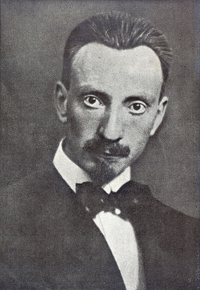
By 1913, Italian Futurist artist Luigi Russolo wrote his manifesto, L'Arte dei Rumori, translated as The Art of Noises, stating that the industrial revolution had given modern men a greater capacity to appreciate more complex sounds: "We must break this restricted circle of pure sounds and conquer the infinite variety of noise-sounds". Russolo found traditional melodic music confining and envisioned noise music as its future replacement. He designed and constructed a number of noise-generating devices called intonarumori and assembled a noise orchestra to perform with them. Works entitled Risveglio di una città (Awakening of a City) and Convegno d'aeroplani e d'automobili (The Meeting of Aeroplanes and Automobiles) were both performed for the first time in 1914.
A performance of his Gran Concerto Futuristico (1917) was met with strong disapproval and violence from the audience, as Russolo himself had predicted. None of his intoning devices have survived, though recently some have been reconstructed and used in performances. Although Russolo's works bear little resemblance to contemporary noise music, his efforts helped to introduce noise as an intentional musical aesthetic and broaden the perception of traditionally unwanted sound as an artistic medium.[[File:Luigi_Russolo_and_assistant_Ugo_Piatti_in_their_Milan_studio_with_Intonarumori,L’Arte_dei_rumori(The_Art_of_Noises),_1913.jpg|left|thumb|[[Luigi Russolo]] and his assistant [[Ugo Piatti]] in their Milan studio in 1913 with the Intonarumori (noise machines)]]
Antonio Russolo, Luigi's brother and fellow Italian Futurist composer, produced a recording of two works featuring the original intonarumori. The 1921 made phonograph with works entitled Corale and Serenata, combined conventional orchestral music set against the famous noise machines and is the only surviving sound recording.
The Dada art movement's Antisymphony concert performed on April 30, 1919, in Berlin would also be an early influence and progenitor of noise music. The Dada-related work from 1916 by Marcel Duchamp also worked with noise, but in an almost silent way. One of the found object Readymades of Marcel Duchamp, A Bruit Secret (With Hidden Noise), was a collaborative work that created a noise instrument that Duchamp accomplished with Walter Arensberg. What rattles inside when A Bruit Secret is shaken remains a mystery.
Found sound
In the same period the utilisation of found sound as a musical resource was starting to be explored. In 1931, Edgard Varèse's Ionisation for 13 players featured 2 sirens, a lion's roar, and used 37 percussion instruments to create a repertoire of unpitched sounds making it the first musical work to be organized solely on the basis of noise. In remarking on Varese's contributions the American composer John Cage stated that Varese had "established the present nature of music" and that he had "moved into the field of sound itself while others were still discriminating 'musical tones' from noises".
In an essay written in 1937, Cage expressed an interest in using extra-musical materials and came to distinguish between found sounds, which he called noise, and musical sounds, examples of which included: rain, static between radio channels, and "a truck at fifty miles per hour". Essentially, Cage made no distinction, in his view all sounds have the potential to be used creatively. His aim was to capture and control elements of the sonic environment and employ a method of sound organisation, a term borrowed from Varese, to bring meaning to the sound materials. Cage began in 1939 to create a series of works that explored his stated aims, the first being Imaginary Landscape #1 for instruments including two variable speed turntables with frequency recordings.
1940s–1960s: Electroacoustic music and musique concrète
During the late 1940s, French composer Pierre Schaeffer theorized and coined a type of electroacoustic music known as "musique concrète". Schaeffer's 1948 compositions Cinq études de bruits (Five Noise Studies), that began with Etude aux Chemins de Fer (Railway Study) which consisted of locomotive sounds made at the Paris train station Gare des Batignolles. Which premiered via a radio broadcast on October 5, 1948, called Concert de bruits (Noise Concert).
Under the influence of Henry Cowell in San Francisco in the late 1940s, Lou Harrison and John Cage began composing music for junk (waste) percussion ensembles, scouring junkyards and Chinatown antique shops for appropriately tuned brake drums, flower pots, gongs, and more. Music journalist Paul Hegarty retrospectively remarked that Antonin Artaud's 1947 composition Pour en Finir avec le Jugement de dieu (To Have Done with the Judgment of God) as "a great example of how literal noise becomes a more interesting threat." In 1957, Edgard Varèse created on tape an extended piece of electronic music using noises created by scraping, thumping and blowing titled Poème électronique.
In 1960, John Cage completed his noise composition Cartridge Music for phono cartridges with foreign objects replacing the 'stylus' and small sounds amplified by contact microphones. That same year, Nam June Paik composed Fluxusobjekt for fixed tape and hand-controlled tape playback head. On May 8, six young Japanese musicians, including Takehisa Kosugi and Yasunao Tone, who later joined the Japanese branch of the Fluxus art movement, formed the early noise music collective, Group Ongaku, recording Automatism and Object. These recordings made use of a mixture of traditional musical instruments along with a vacuum cleaner, a radio, an oil drum, a doll, and a set of dishes. Moreover, the speed of the tape recording was manipulated, further distorting the sounds being recorded. Tone later became an early pioneer of "glitch" music in the 1990s.
In 1961, James Tenney composed Analogue #1: Noise Study (for tape) using computer synthesized noise and Collage No.1 (Blue Suede) (for tape) by manipulating Elvis Presley's recording of "Blue Suede Shoes". By 1964, composer Robert Ashley released the composition "The Wolfman", in a retrospective the Wire stated, "he [Robert Ashley] played his own vocals through loudspeakers simultaneously with a tape composition and controlled the feedback by putting his mouth up against the mic. The avalanche of noise was so overpowering to the listener that no one ever understands how the sound is made". In 1965, London free improvisation group AMM was founded by Keith Rowe, Lou Gare and Eddie Prévost, their work has been considered as presaging noise music, with AllMusic's Brian Olewnick stating, "noise bands owe it to themselves to check out their primary source." In Canada, Nihilist Spasm Band, the world's longest-running self-described "noise band", was formed that same year, they later worked with artists they influenced such as Thurston Moore of Sonic Youth and Jojo Hiroshige of Hijokaidan in the 1990s.
In 1966, New York band the Velvet Underground released their first recording, a track entitled "Noise" which was originally recorded by John Cale in 1964. Lou Reed and John Cale later cited the drone music of La Monte Young as being a major influence, with Reed later drawing from Young on his solo album Metal Machine Music. Cale later released early noise music recordings made with Tony Conrad in the early to-mid 60s, such as Inside the Dream Syndicate series.
In 1967, composer Pauline Oliveros released the composition "A Little Noise In The System", regarded as one of the earliest examples of contemporary noise music. Other contemporaneous developments include underground and psychedelic acts such as Intersystems, Musica Elettronica Viva, the Mothers of Invention, Red Krayola, Michael Yonkers, Cromagnon, Pärson Sound, the Godz, the Ethix, the Sperm and Fifty Foot Hose. In 1968, the Beatles' The White Album incorporated influences from musique concrète on track "Revolution 9", alongside George Harrison's Electronic Sound and John Lennon's Two Virgins and Life with the Lions albums with Yoko Ono who had been a part of the New York Fluxus scene.
1970s–1990s: Contemporary noise music
In 1975, Lou Reed released the double album Metal Machine Music, which has been cited as containing the primary characteristics of contemporary noise music and inspiring artists such as Merzbow. The album, recorded on a three speed Uher machine and mastered/engineered by Bob Ludwig, is an early, well-known example of commercial studio noise music that the music critic Lester Bangs sarcastically called the "greatest album ever made in the history of the human eardrum". It has also been cited as one of the "worst albums of all time". At the time, RCA also released a Quadrophonic version of the Metal Machine Music recording that was produced by playing the master tape back both forward and backward, and by flipping the tape over.
By the late 1970s to early 1980s, the emergence of industrial music encouraged non-musicians to experiment with strictly noise oriented styles, leading to genres such as power electronics, coined by English noise act Whitehouse, as well as power noise which drew influence from Spanish industrial group Esplendor Geométrico. Followed by post-industrial styles such as dark ambient and death industrial.
In Japan, artists such as Aunt Sally, Inu, Ultra Bide members Hide and Jojo Hiroshige, and SS became a part of the Kansai no wave scene centered around Osaka, Kobe, Kyoto and other parts of the Kansai region. The movement drew from New York's no wave scene, and later led to the emergence of the Japanoise movement, which was spearheaded by prominent noise acts such as Merzbow, Hijokaidan, Hanatarash, C.C.C.C. and Incapacitants, who alongside American and European noise artists the Haters, Daniel Menche, Vomir and Richard Ramirez, contributed to the formation of harsh noise and harsh noise wall. In the 1990s, noise music began incorporating influences from computerized sounds such as those found in "glitch" music.
Outside of the Western and Japanese scenes, noise music has also developed in Southeast Asia, where a number of experimental artists and groups emerged from the 1990s onward. Indonesian duo Senyawa combines traditional instruments with harsh, abrasive sounds, blending local cultural elements with noise experimentation. Thailand's Mongoose and Filipino project Children of Cathode Ray are also noted as pioneers in their respective countries, gaining recognition through international performances and underground networks.
2000s–2020s
During the 2000s and 2010s, the popularity of the harsh noise genre expanded with regional scenes emerging internationally in Japan, England, Canada, Indonesia and America. By the 2020s, some harsh noise artists would gain notoriety and attention on the internet through social media, due to their unconventional sound.
Legacy
In Noise: The Political Economy of Music (1985), Jacques Attali explores the relationship between noise music and the future of society by considering noise music as not merely reflective of, but importantly pre-figurative of social transformations. He indicates that noise in music is a predictor of social change and demonstrates how noise acts as the subconscious of society—validating and testing new social and political realities. His alternative view of the standard history of music, with his emphasis on noise, theorized culture in a way that influenced many noise music theoretical studies to follow, such as Brandon LaBelle's Background Noise: Perspectives on Sound Art (2006), Alan Licht's Sound Art: Beyond Music, between Categories (2007), Thomas Bey William Bailey's Micro Bionic: Radical Electronic Music and Sound Art in the 21st Century (2009), Caleb Kelly's Cracked Media: The Sound of Malfunction (2009), Joseph Nechvatal's Immersion Into Noise (2011), and Mark Delaere's Noise as a Constructive Element in Music Theoretical and Music-Analytical Perspectives (2022).
Writer Douglas Kahn, in his work Noise, Water, Meat: A History of Sound in the Arts (1999), discusses the use of noise as a medium and explores the ideas of Antonin Artaud, George Brecht, William Burroughs, Sergei Eisenstein, Fluxus, Allan Kaprow, Michael McClure, Yoko Ono, Jackson Pollock, Luigi Russolo, and Dziga Vertov.
In 2008, independent filmmaker Adam Cornelius released a documentary on the contemporary noise music scene titled People Who Do Noise, the film featured avant-garde noise artists such as Smegma, Oscillating Innards, Yellow Swans, and Daniel Menche.
Related genres
Industrial music
Main article: Industrial music
Industrial music (also known as industrial) is a music genre inspired by post-industrial society, that originally emerged in the 1970s, drawing influences from avant-garde and early electronic music genres such as musique concrète, tape music, noise and sound collage. The term was originally coined in 1976 by Monte Cazazza and Throbbing Gristle, with the founding of Industrial Records. Other early industrial musicians include NON and Cabaret Voltaire. By the late 1970s, additional artists emerged such as Clock DVA, Nocturnal Emissions, Einstürzende Neubauten, SPK, Nurse with Wound, and Z’EV, alongside Whitehouse who coined the subgenre "power electronics" which became a key influence on contemporary noise music.
Japanese noise music
Main article: Japanoise

Since the early 1980s, Japan has produced a significant output of characteristically harsh artists and bands, sometimes referred to as Japanoise, with names such as Government Alpha, Alienlovers in Amagasaki and Koji Tano, and perhaps the best known being Merzbow (pseudonym for the Japanese noise artist Masami Akita who himself was inspired by the Dada artist Kurt Schwitters's Merz art project of psychological collage). In the late 1970s and early 1980s, Akita took Metal Machine Music as a point of departure and further abstracted the noise aesthetic by freeing the sound from guitar based feedback alone. According to Hegarty (2007), "in many ways it only makes sense to talk of noise music since the advent of various types of noise produced in Japanese music, and in terms of quantity this is really to do with the 1990s onwards ... with the vast growth of Japanese noise, finally, noise music becomes a genre". Other key Japanese noise artists that contributed to this upsurge of activity include Hijokaidan, Boredoms, C.C.C.C., Incapacitants, KK Null, Yamazaki Maso's Masonna, Solmania, K2, the Gerogerigegege and Hanatarash. Nick Cain of The Wire identifies the "primacy of Japanese Noise artists like Merzbow, Hijokaidan and Incapacitants" as one of the major developments in noise music since 1990.
Power noise
Main article: Power noise
Power noise (also known as rhythmic noise, rhythm 'n' noise and distorted beat music) is a subgenre of noise and post-industrial music, that originated predominantly in Europe during the 1990s. It draws primary influence from various styles of electronic dance music.
Harsh noise
Main article: Harsh noise
Harsh noise is a subgenre of noise music that emerged in the early 1980s, originating from the Japanese noise music scene and the European power electronics movement.
Compilations
- An Anthology of Noise & Electronic Music Volumes 1–7 Sub Rosa, Various Artists (1920–2012)
- The Japanese-American Noise Treaty (1995) CD, Relapse
- New York Noise hour music video television program
References
Sources
- Albright, Daniel (ed.) Modernism and Music: An Anthology of Source. Chicago: University Of Chicago Press, 2004.
- Attali, Jacques. Noise: The Political Economy of Music, translated by Brian Massumi, foreword by Fredric Jameson, afterword by Susan McClary. Minneapolis: University of Minnesota Press, 1985.
- Atton, Chris (2011). "Fan Discourse and the Construction of Noise Music as a Genre". Journal of Popular Music Studies, Volume 23, Issue 3, pages 324–42, September 2011.
- Ballet, Nicolas (2025) Shock Factory: The Visual Culture of Industrial Music. Intellect Books
- Bangs, Lester. Psychotic Reactions and Carburetor Dung: The Work of a Legendary Critic, collected writings,edited by Greil Marcus. Anchor Press, 1988.
- Biro, Matthew. The Dada Cyborg: Visions of the New Human in Weimar Berlin. Minneapolis: University of Minnesota Press, 2009.
- Cage, John. Silence: Lectures and Writings. Wesleyan University Press, 1961. Reprinted 1973.
- Cage, John. "The Future of Music: Credo (1937)". In John Cage, Documentary Monographs in Modern Art, edited by Richard Kostelanetz, Praeger Publishers, 1970
- Cahoone, Lawrence. From Modernism to Postmodernism: An Anthology. Cambridge, Mass: Blackwell, 1996.
- Cain, Nick "Noise" in The Wire Primers: A Guide to Modern Music, Rob Young, ed., London: Verso, 2009.
- Cascone, Kim. "The Aesthetics of Failure: 'Post-Digital' Tendencies in Contemporary Computer Music".Computer Music Journal 24, no. 4 (Winter 2002): 12–18.
- Cowell, Henry. The Joys of Noise in Audio Culture. Readings in Modern Music, edited by Christoph Cox and Dan Warner, pp. 22–24. New York: Continuum, 2004. (hardcover) (pbk)
- by De Maria, Walter (1968)]
- Gere, Charles. Art, Time and Technology: Histories of the Disappearing Body. Oxford: Berg Publishers, 2005.
- Goodman, Steve. 2009. "Contagious Noise: From Digital Glitches to Audio Viruses". In The Spam Book: On Viruses, Porn and Other Anomalies From the Dark Side of Digital Culture, edited by Jussi Parikka and Tony D. Sampson, 125–40.. Cresskill, New Jersey: Hampton Press.
- Hecht, Eugene. Optics, 4th edition. Boston: Pearson Education, 2001.
- Hegarty, Paul. 2004. "Full with Noise: Theory and Japanese Noise Music". In Life in the Wires, edited by Arthur Kroker and Marilouise Kroker, 86–98. Victoria, Canada: NWPCTheory Books.
- Hegarty, Paul. Noise/Music: A History. London: Continuum International Publishing Group, 2007.
- Piekut, Benjamin. Experimentalism Otherwise: The New York Avant-Garde and Its Limits. Berkeley: University of California Press, 2012.
- Kahn, Douglas. Noise, Water, Meat: A History of Sound in the Arts. Cambridge: MIT Press, 1999.
- Kelly, Caleb. Cracked Media: The Sound of Malfunction Cambridge, Ma.: MIT Press, 2009.
- Kemp, Mark. 1992. "She Who Laughs Last: Yoko Ono Reconsidered". Option Magazine (July–August): 74–81.
- Krauss, Rosalind E. 1979. The Originality of the Avant Garde and Other Modernist Myths. Cambridge: MIT Press. Reprinted as Sculpture in the Expanded Field. Cambridge: MIT Press, 1986.
- LaBelle, Brandon. 2006. Background Noise: Perspectives on Sound Art. New York and London: Continuum International Publishing.
- Landy, Leigh (2007),Understanding the Art of Sound Organization, Cambridge, Massachusetts: MIT Press, xiv, 303p.
- Lewisohn, Mark. 1988. The Beatles Recording Sessions. New York: Harmony Books.
- Lombardi, Daniele. 1981. "Futurism and Musical Notes". Artforum January 1981. FUTURISM AND MUSICAL NOTES
- Masters, Marc. 2007. No Wave London: Black Dog Publishing.
- Mereweather, Charles (ed.). 2007. Art Anti-Art Non-Art. Los Angeles: Getty Research Institute.
- Nechvatal, Joseph. 2012. Immersion Into Noise. Ann Arbor: Open Humanities Press. .
- Nechvatal, Joseph. 2000. Towards a Sound Ecstatic Electronica. New York: The Thing Post.thing.net
- Pedersen, Steven Mygind. 2007. Notes on Joseph Nechvatal: Viral SymphOny. Alfred, New York: Institute for Electronic Arts, School of Art & Design, Alfred University.
- Petrusich, Amanda. " Pitchfork net. (Accessed 13 September 2009)
- Priest, Eldritch. "Music Noise". In his Boring Formless Nonsense: Experimental Music and The Aesthetics of Failure, 128–39. London: Bloomsbury Publishing; New York: Bloomsbury Academic, 2013. ; (pbk).
- Rice, Ron. 1994. A Brief History of Anti-Records and Conceptual Records. Unfiled: Music under New Technology 0402 [i.e., vol. 1, no. 2]: Republished online, Ubuweb Papers (Accessed 4 December 2009).
- Ross, Alex. 2007. The Rest Is Noise: Listening to the Twentieth Century. New York: Farrar, Straus and Giroux.
- Sangild, Torben. 2002. The Aesthetics of Noise. Copenhagen: Datanom. . Reprinted at UbuWeb
- Sanouillet, Michel, and Elmer Peterson (eds.). 1989. The Writings of Marcel Duchamp. New York: Da Capo Press.
- Smith, Owen. 1998. Fluxus: The History of an Attitude. San Diego: San Diego State University Press.
- Tunbridge, Laura. 2011. The Song Cycle. Cambridge and New York: Cambridge University Press. .
- Watson, Ben. "Noise as Permanent Revolution: or, Why Culture Is a Sow Which Devours Its Own Farrow". In Noise & Capitalism, edited by Anthony and Mattin Iles, 104–20. Kritika Series. Donostia-San Sebastián: Arteleku Audiolab, 2009.
- Watson, Steven. 2003. Factory Made: Warhol and the Sixties. New York: Pantheon.
- Weiss, Allen S. 1995. Phantasmic Radio. Durham NC: Duke University Press.
- Young, Rob (ed.). 2009. The Wire Primers: A Guide To Modern Music. London: Verso.
- Van Nort, Doug. (2006), Noise/music and representation systems, Organised Sound, 11(2), Cambridge University Press, pp 173–178.
References
- (16 November 2018). "Samarinda noise music makes waves".
- (23 August 2019). "Musician collective to talk about noise".
- (21 July 2015). "A Look into Indonesia's Insane Noise Scene".
- Priest, Eldritch. "Music Noise" in ''Boring Formless Nonsense: Experimental Music and The Aesthetics of Failure'', p. 132. London: Bloomsbury Publishing; New York: Bloomsbury Academic, 2013.
- Merzbow. "Lou Reed 1942–2013: Masami Akita/Merzbow: Noise Gate - The Wire".
- "Japanoise.net".
- (2015-08-13). "William Bennett Explains His Career, From the Power Electronics of Whitehouse to the Rabid African Rhythms of Cut Hands - self-titled".
- Woods, Peter. (2019-07-03). "A Beginner's Guide to Noise Music".
- Hymen Records, Converter, Coma record description. [http://www.hymen-records.com/vinylium/y014/y014.html] {{Webarchive. link. (11 November 2007. Access date: 8 August 2008.)
- "The Birth of Noise in Japan".
- Hegarty, Paul. (2007). "Noise Music: A History". Bloomsbury Academic.
- Sangild, Torben, ''The Aesthetics of Noise''. Copenhagen: Datanom, 2002. pp. 12–13
- "About Noise and NPC".
- "Noise Generator".
- {{usurped
- Hecht, Eugene. (September 2009). "Optics". Pearson Education.
- (25 May 2017). "Catharsis in Cacophony: The Necessity of a 'Noise Phase'".
- Schafer, R. Murray. (2006). "The soundscape: our sonic environment and the tuning of the world". Destiny Books [u.a.].
- Joseph Nechvatal, ''Immersion Into Noise'' (Ann Arbor: Open Humanities Press, 2012), p. 19.
- Watson 2009, 109–10.
- Wen-chung, Chou. (April 1966). "Varèse: A Sketch of the Man and His Music". [[The Musical Quarterly]].
- Hegarty, Paul. (2007). "Noise/music: a history". Continuum.
- Alex Ross, ''The Rest Is Noise: Listening to the Twentieth Century'' (New York: Farrar, Straus and Giroux, 2007), p. 401.
- link. (2007-03-13 Paul Hegarty, "Full With Noise: Theory and Japanese Noise Music", in ''Life in the Wires'', edited by Arthur Kroker and Marilouise Kroker, 86–98 (Victoria, Canada: NWP [[CTheory]] Books, 2004).)
- Chris Atton, "Fan Discourse and the Construction of Noise Music as a Genre", ''Journal of Popular Music Studies'' 23, no. 3 (September 2011): 324–42. Citation on 326.
- Torben Sangild, ''[http://www.ubu.com/papers/noise.html The Aesthetics of Noise]'' (Copenhagen: Datanom, 2002):{{Page needed. (January 2013. {{ISBN). 87-988955-0-8. Reprinted at [[UbuWeb]].
- Paul Hegarty, ''Noise/Music: A History'' (London: Continuum International Publishing Group, 2007): 3–19.
- Caleb Kelly, ''Cracked Media: The Sound of Malfunction'' (Cambridge, Ma.: [[MIT Press]], 2009): 60–76.
- [http://www.ubu.com/papers/noise.html UBU.com], Torben Sangild, "The Aesthetics of Noise", Datanom, 2002.
- [http://www.ubu.com/sound/nechvatal.html UBU.com], Steven Mygind Pedersen, [[Joseph Nechvatal]]: ''[[viral symphOny]]'' (Alfred, New York: Institute for Electronic Arts, School of Art & Design, [[Alfred University]], 2007).
- Observatori A.C. (ed.), ''Observatori 2008: After The Future'' (Valencia, Spain: Museo de Bellas Artes de Valencia, 2008), p. 80.
- Piekut, Benjamin. ''Experimentalism Otherwise: The New York Avant-Garde and Its Limits''. 2012. p. 193
- Paul Hegarty, ''Noise/Music: A History'' (London: Continuum International Publishing Group, 2007), pp. 189–92.
- [[Caleb Kelly (curator). Caleb Kelly]], ''Cracked Media: The Sound of Malfunction'' (Cambridge, Massachusetts: MIT Press, 2009), pp. 6–10.
- (17 September 2007). "Pitchfork: Interviews: Lou Reed".
- Such as ''23 VIII 64 2:50:45 – 3:11 am The Volga Delta From Studies In The Bowed Disc'' from ''The Black Record (1969)''
- (December 2, 2015). ""Stang riding" as punishment for male victims of intimate partner violence". gynocentrism.files.wordpress.com.
- [http://www.nottsheritagegateway.org.uk/themes/folklore/folkloregraphic.htm The Nottinghamshire Heritage Gateway: Folklore and customs, by Dr Peter Millington] Includes a rare photograph of a ran-tan at Rampton, Nottinghamshire (1909)
- (1989). "The Great Song Thesaurus". Oxford University Press.
- Lombardi, Daniele. (January 10, 1981). "FUTURISM AND MUSICAL NOTES".
- Russolo, Luigi. "The Art of Noises".
- Sitsky, Larry. (2002-12-30). "Music of the Twentieth-Century Avant-Garde: A Biocritical Sourcebook". Bloomsbury Academic.
- Paul Hegarty, ''Noise/Music: A History'' (London: Continuum International Publishing Group, 2007), pp. 13–14.
- [[László Moholy-Nagy]] in 1923 recognized the unprecedented efforts of the Italian Futurists to broaden our perception of sound using noise. In an article in ''Der Storm #7'', he outlined the fundamentals of his own experimentation: "I have suggested to change the gramophone from a reproductive instrument to a productive one, so that on a record without prior acoustic information, the acoustic information, the acoustic phenomenon itself originates by engraving the necessary Ritchriftreihen (etched grooves)." He presents detailed descriptions for manipulating discs, creating "real sound forms" to train people to be "true music receivers and creators" ([http://ubu.com/papers/rice.html Rice 1994],{{Page needed. (December 2009).)
- [[Luigi Russolo. Russolo, Luigi]] from [http://www.unknown.nu/futurism/noises.html ''The Art of Noises''], March 1913.
- [[Daniel Albright. Albright, Daniel]] (ed.) ''Modernism and Music: An Anthology of Source''. Chicago: University Of Chicago Press, 2004. p. 174
- Nicolas Ballet, ''Shock Factory: The Visual Culture of [[Industrial Music]]'', [[Intellect Books]], pp. 135-140
- Matthew Biro, ''The Dada Cyborg: Visions of the New Human in Weimar Berlin'', 2009, p. 50.
- Documents at The International Dada archive at The University of Iowa show that ''Antisymphonie'' was held at the Graphisches Kabinett, Kurfürstendamm 232, at 7:45 PM. The printed program lists five numbers: "Proclamation dada 1919" by Huelsenbeck, "Simultan-Gedicht" performed by seven people, "Bruitistisches Gedicht" performed by Huelsenbeck (these latter two pieces grouped together under the category "DADA-machine"), "Seelenautomobil" by Hausmann, and finally, [[Yefim Golyshev. Golyscheff]]'s Antisymphonie in 3 movements, subtitled "Musikalische Kriegsguillotine". The three movements of Golyscheff's piece are titled "provokatorische Spritze", "chaotische Mundhöhle oder das submarine Flugzeug", and "zusammenklappbares Hyper-fis-chendur".
- Chilvers, Ian & Glaves-Smith, John eds., ''Dictionary of Modern and Contemporary Art'', Oxford: [[Oxford University Press]], 2009. pp. 587–588
- [[Michel Sanouillet]] & Elmer Peterson (Eds.), ''The Writings of Marcel Duchamp'', [[Da Capo Press]], p. 135.
- {{harvnb. Chadabe. 1996
- {{harvnb. Nyman. 1974
- {{harvnb. Chadabe. 1996
- {{harvnb. Griffiths. 1995
- {{harvnb. Chadabe. 1996
- {{harvnb. Griffiths. 1995
- D. Teruggi, "Technology and Musique Concrete: The Technical Developments of the Groupe de Recherches Musicales and Their Implication in Musical Composition", ''Organised Sound'' 12, no. 3 (2007): 213–31.
- Alex Ross, ''The Rest Is Noise: Listening to the Twentieth Century'' (New York: Farrar, Straus and Giroux, 2007), p. 369.
- [[Henry Cowell (musician). Henry Cowell]], "The Joys of Noise", in ''Audio Culture: Readings in Modern Music'' (New York: Continuum, 2004), pp. 22–24.
- [[Antonin Artaud]] ''{{lang. fr. Pour en finir avec le jugement de dieu'', original recording, edited with an introduction by Marc Dachy. Compact Disc (Sub Rosa/aural documents, 1995).
- Paul Hegarty, ''Noise/Music: A History'', pp. 25–26.
- "OHM- The Early Gurus of Electronic Music: Edgard Varese's "Poem Electronique"". Perfect Sound Forever.
- [[Daniel Albright. Albright, Daniel]] (ed.) ''Modernism and Music: An Anthology of Source''. Chicago: University Of Chicago Press, 2004. p. 185.
- Doornbusch, Paul. "A Chronology / History of Electronic and Computer Music and Related Events 1906–2011".
- Charles Mereweather (ed.), ''Art Anti-Art Non-Art'' (Los Angeles: Getty Research Institute, 2007), pp. 13 & 16.
- Monroe, Jazz. (2025-06-03). "Japanese Composer Yasunao Tone Dies at 90".
- Holmes, Thom. "Robert Ashley: Built For Speed - The Wire".
- "Ammmusic Review by Brian Olewnick".
- "In the realm of nothing: a Keith Rowe radio playlist - The Wire".
- Spicer, Daniel. (April 2016). "AMMMusic".
- Breznikar, Klemen. (2014-11-24). "The Nihilist Spasm Band {{!}} Interview".
- [http://zoolander52.tripod.com/theartsection5.8/id21.html] Warhol Live: Music and Dance in [[Andy Warhol]]'s Workat the Frist Center for the Visual Arts by Robert Stalker
- Indeed, Reed mentions (and misspells) Young's name on the cover of ''Metal Machine Music'': "Drone cognizance and harmonic possibilities vis a vis Lamont Young's Dream Music".
- link. (2008-02-22 Zeitkratzer Lou Reed''Metal Machine Music''.)
- [http://encarta.msn.com/encyclopedia_701610421/Minimalism_(music).html "Minimalism (music)"], ''Encarta'' (Accessed 20 October 2009). {{webarchive. link. (April 29, 2009 2009-11-01.)
- [[Steven Watson (author). Steven Watson]], ''Factory Made: Warhol and the Sixties'' (2003) Pantheon, New York, p. 157.
- Watson, ''Factory Made'', p. 103.
- [http://www.dramonline.org/albums/mev-40-1967-2007/notes] ''Liner Notes'' for [[Musica Elettronica Viva]] recording set ''MEV 40 (1967–2007)'' 80675-2 (4CDs)
- ''Spacecraft'' was recorded in Cologne in 1967 by Bryant, Curran, Rzewski, Teitelbaum and Vandor
- "The Red Krayola – Frederick Barthelme".
- Dazed. (2014-09-21). "Sounding off: Michael Yonkers".
- "Orgasm - Cromagnon {{!}} Album {{!}} AllMusic".
- Breznikar, Klemen. (2022-12-20). "Jeffrey Wengrofsky {{!}} Interview {{!}} Here to Eternity with The Godz".
- "Synthedelia: Psychedelic Electronic Music in the 1960s".
- from ''[[Rolling Stone]]'' issues # 74 & 75 (21 Jan & 4 Feb, 1971). "John Lennon: The Rolling Stone Interview" by editor [[Jann Wenner]]
- Atton (2011:326)
- [[Alan Licht]], ''Common Tones: Selected Interviews with Artists and Musicians 1995-2020'', [[Blank Forms]] Edition, ''Interview with Lou Reed'', p. 163
- Lester Bangs, ''Psychotic Reactions and Carburetor Dung: The Work of a Legendary Critic'', [[Greil Marcus]], ed. (1988) Anchor Press, p. 200.
- [[Charlie Gere]], ''Art, Time and Technology: Histories of the Disappearing Body'', (2005) Berg, p. 110.
- [[Alan Licht]], ''Common Tones: Selected Interviews with Artists and Musicians 1995-2020'', [[Blank Forms]] Edition, ''Interview with Lou Reed'', p. 164
- (2020). "Not Your World Music: Noise in South East Asia". Syrphe.
- (2015-07-20). "A Look into Indonesia's Insane Noise Scene".
- Sood, Akhil. (2017-05-11). "SISTER's Harsh Noise Is Blowing the Speakers and Minds of New Delhi".
- Kroll, Yoni. (2024-09-18). "The Carrot-Inspired Harsh Noise Band Taking Over The Internet".
- Allen S. Weiss, ''Phantasmic Radio'' (Durham, North Carolina: Duke University Press, 1995), p. 90.
- Kahn, Douglas. (2001). "Noise, water, meat: a history of sound in the arts". The MIT Press.
- (2011-11-29). "Watch: People Who Do Noise, a full-length doc on Portland music makers".
- "Industrial". All Media Network.
- Hegarty 2007, p. 133
- link. (2007-03-13 , CTheory.net.)
- [[Rob Young (writer). Young, Rob]] (ed.), ''The Wire Primers: A Guide To Modern Music'' (London: Verso, 2009), p. 30.
- Hegarty (2007:133)
- [http://www.japanoise.net/profile/electronics.htm Japanoise.net] {{Webarchive. link. (2012-03-26 , japanoise noisicians profiled at japnoise.net.)
- Nick Cain, "Noise" ''The Wire Primers: A Guide to Modern Music'', Rob Young, ed., London: Verso, 2009, p. 29.
- "Whitehouse Asceticists Susan Lawly – Arts".
This article was imported from Wikipedia and is available under the Creative Commons Attribution-ShareAlike 4.0 License. Content has been adapted to SurfDoc format. Original contributors can be found on the article history page.
Ask Mako anything about Noise music — get instant answers, deeper analysis, and related topics.
Research with MakoFree with your Surf account
Create a free account to save articles, ask Mako questions, and organize your research.
Sign up freeThis content may have been generated or modified by AI. CloudSurf Software LLC is not responsible for the accuracy, completeness, or reliability of AI-generated content. Always verify important information from primary sources.
Report