From Surf Wiki (app.surf) — the open knowledge base
Noctilucent cloud
NLCs Night Shining Clouds

NLCs Night Shining Clouds
| Field | Value |
|---|---|
| name | Noctilucent clouds |
| image location | Noctilucent-clouds-msu-6817.jpg |
| image name | Noctilucent clouds over Laboe, Germany |
| abbreviation | NLC/PMC |
| altitude_m | 76,000 to 85,000 |
| altitude_ft | 250,000 to 280,000 |
| level | other |
| precipitation | No |
Noctilucent clouds (NLCs), or night shining clouds, are tenuous cloud-like phenomena in the upper atmosphere. When viewed from space, they are called polar mesospheric clouds (PMCs), detectable as a diffuse scattering layer of water ice crystals near the summer polar mesopause. They consist of ice crystals and from the ground are only visible during astronomical twilight. Noctilucent roughly means "night shining" in Latin. They are most often observed during the summer months from latitudes between ±50° and ±70°. Too faint to be seen in daylight, they are visible only when the observer and the lower layers of the atmosphere are in Earth's shadow while these very high clouds are still in sunlight. Recent studies suggest that increased atmospheric methane emissions produce additional water vapor through chemical reactions once the methane molecules reach the mesosphere – creating, or reinforcing existing, noctilucent clouds.
General
No confirmed record of their observation exists before 1885, although they may have been observed a few decades earlier by Thomas Romney Robinson in Armagh.
Formation
Noctilucent clouds are composed of tiny crystals of water ice up to 100 nm in diameter and exist at a height of about 76 to, higher than any other clouds in Earth's atmosphere. Clouds in the Earth's lower atmosphere form when water collects on particles, but mesospheric clouds may form directly from water vapour in addition to forming on dust particles.
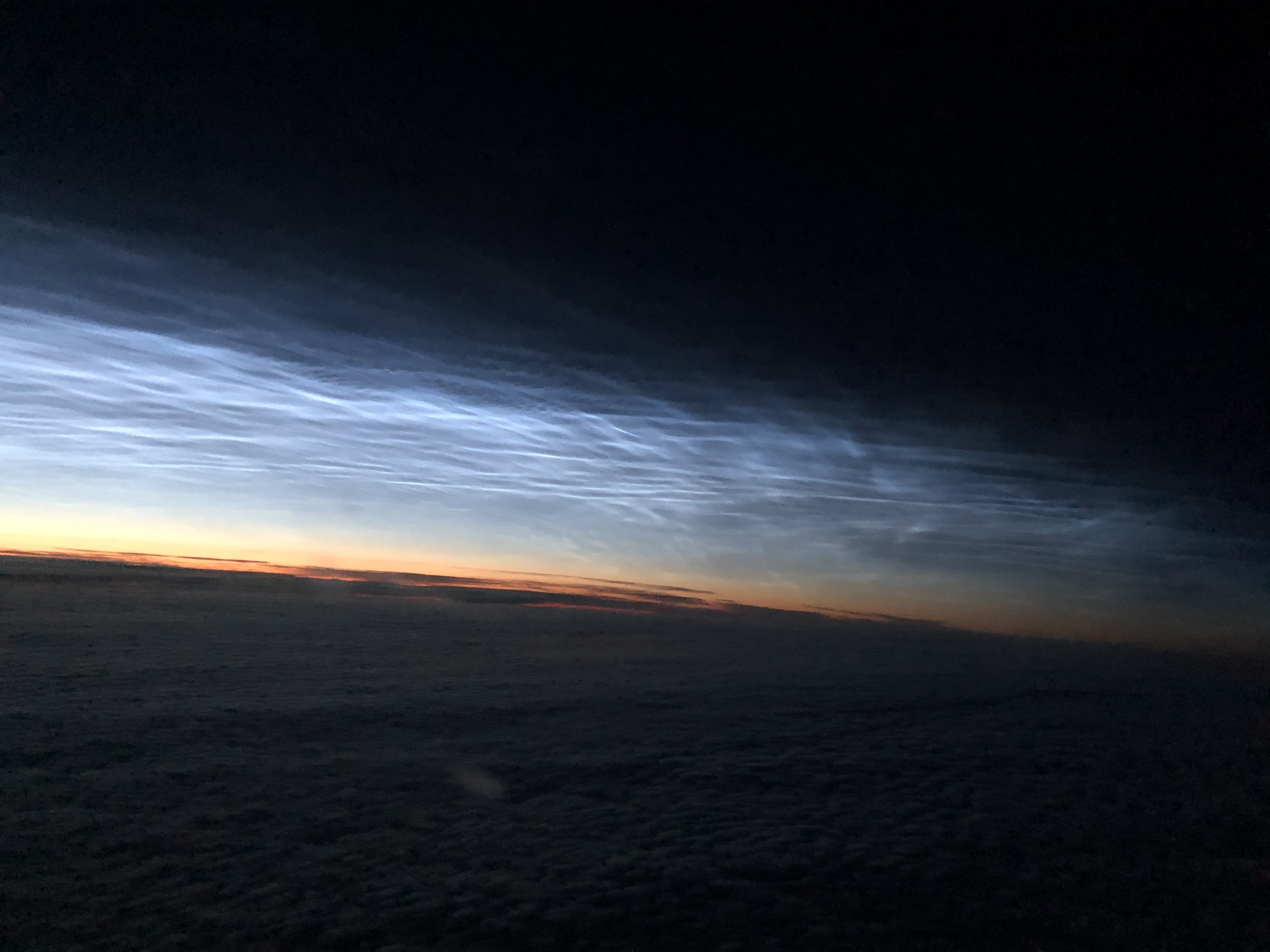
Data from the Aeronomy of Ice in the Mesosphere satellite suggests that noctilucent clouds require water vapour, dust, and very cold temperatures to form. The sources of both the dust and the water vapour in the upper atmosphere are not known with certainty. The dust is believed to come from micrometeors, although particulates from volcanoes and dust from the troposphere are also possibilities. The moisture could be lifted through gaps in the tropopause, as well as forming from the reaction of methane with hydroxyl radicals in the stratosphere.
The exhaust from Space Shuttles, in use between 1981 and 2011, which was almost entirely water vapour after the detachment of the Solid Rocket Booster at a height of about 46 km, was found to generate minuscule individual clouds. About half of the vapour was released into the thermosphere, usually at altitudes of 103 to. In August 2014, a SpaceX Falcon 9 also caused noctilucent clouds over Orlando, Florida after a launch.

The exhaust can be transported to the Arctic region in little over a day, although the exact mechanism of this very high-speed transfer is unknown. As the water migrates northward, it falls from the thermosphere into the colder mesosphere, which occupies the region of the atmosphere just below. Although this mechanism is the cause of individual noctilucent clouds, it is not thought to be a major contributor to the phenomenon as a whole.
As the mesosphere contains very little moisture, approximately one hundred millionth that of air from the Sahara, and is extremely thin, the ice crystals can form only at temperatures below about -120 C. Clouds in the southern hemisphere are about 1 km higher than those in the northern hemisphere.
Ultraviolet radiation from the Sun breaks water molecules apart, reducing the amount of water available to form noctilucent clouds. The radiation is known to vary cyclically with the solar cycle and satellites have been tracking the decrease in brightness of the clouds with the increase of ultraviolet radiation for the last two solar cycles. It has been found that changes in the clouds follow changes in the intensity of ultraviolet rays by about a year, but the reason for this long lag is not yet known.
Noctilucent clouds are known to exhibit high radar reflectivity, in a frequency range of 50 MHz to 1.3 GHz. This behaviour is not well understood but a possible explanation is that the ice grains become coated with a thin metal film composed of sodium and iron, which makes the cloud far more reflective to radar, Sodium and iron atoms are stripped from incoming micrometeors and settle into a layer just above the altitude of noctilucent clouds, and measurements have shown that these elements are severely depleted when the clouds are present. Other experiments have demonstrated that, at the extremely low temperatures of a noctilucent cloud, sodium vapour can rapidly be deposited onto an ice surface.

Discovery and investigation
Noctilucent clouds are first known to have been observed in 1885, two years after the 1883 eruption of Krakatoa. It remains unclear whether their appearance had anything to do with the volcanic eruption or whether their discovery was due to more people observing the spectacular sunsets caused by the volcanic debris in the atmosphere. Studies have shown that noctilucent clouds are not caused solely by volcanic activity, although dust and water vapour could be injected into the upper atmosphere by eruptions and contribute to their formation. His notes provide evidence that noctilucent clouds first appeared in 1885. He had been doing detailed observations of the unusual sunsets caused by the Krakatoa eruption the previous year and firmly believed that, if the clouds had been visible then, he would undoubtedly have noticed them. Systematic photographic observations of the clouds were organized in 1887 by Jesse, Foerster, and Stolze and, after that year, continuous observations were carried out at the Berlin Observatory.
In the decades after Otto Jesse's death in 1901, there were few new insights into the nature of noctilucent clouds. Wegener's conjecture, that they were composed of water ice, was later shown to be correct. Study was limited to ground-based observations and scientists had very little knowledge of the mesosphere until the 1960s, when direct rocket measurements began. These showed for the first time that the clouds' occurrence coincided with very low temperatures in the mesosphere.
Noctilucent clouds were first detected from space by an instrument on the OGO-6 satellite in 1972. The OGO-6 observations of a bright scattering layer over the polar caps were identified as poleward extensions of these clouds. A later satellite, the Solar Mesosphere Explorer, mapped the distribution of the clouds between 1981 and 1986 with its ultraviolet spectrometer. The clouds were detected with Lidar in 1995 at Utah State University, even when they were not visible to the naked eye. The first physical confirmation that water ice is indeed the primary component of noctilucent clouds came from the HALOE instrument on the Upper Atmosphere Research Satellite in 2001.
In 2001, the Swedish Odin satellite performed spectral analyses on the clouds, and produced daily global maps that revealed large patterns in their distribution.
The AIM (Aeronomy of Ice in the Mesosphere) satellite was launched on 25 April 2007. It was the first satellite dedicated to studying noctilucent clouds, and made its first observations a month later (25 May). Images taken by the satellite show shapes in the clouds that are similar to shapes in tropospheric clouds, hinting at similarities in their dynamics.
In the previous year, scientists with the Mars Express mission had announced their discovery of carbon dioxide–crystal clouds on Mars that extended to 100 km above the planet's surface. These are the highest clouds discovered over the surface of a rocky planet. Like noctilucent clouds on Earth, they can be observed only when the Sun is below the horizon.
Research published in the journal Geophysical Research Letters in June 2009 suggests that noctilucent clouds observed following the Tunguska Event of 1908 are evidence that the impact was caused by a comet.
The United States Naval Research Laboratory (NRL) and the United States Department of Defense Space Test Program (STP) conducted the Charged Aerosol Release Experiment (CARE) on September 19, 2009, using exhaust particles from a Black Brant XII suborbital sounding rocket launched from NASA's Wallops Flight Facility to create an artificial noctilucent cloud. The cloud was to be observed over a period of weeks or months by ground instruments and the Spatial Heterodyne IMager for MEsospheric Radicals (SHIMMER) instrument on the NRL/STP STPSat-1 spacecraft. The rocket's exhaust plume was observed and reported to news organizations in the United States from New Jersey to Massachusetts.
A 2018 experiment briefly created noctilucent clouds over Alaska, allowing ground-based measurements and experiments aimed at verifying computer simulations of the phenomenon. A suborbital NASA rocket was launched on 26 January 2018 by University of Alaska professor Richard Collins. It carried water-filled canisters, which were released at about 53 mi above the Earth. Since the naturally occurring clouds only appear in summer, this experiment was conducted in mid-winter to assure that its results would not be mixed with a natural event.
Description from satellites


PMC's have four major types based on physical structure and appearance. Type I veils are very tenuous and lack well-defined structure, somewhat like cirrostratus or poorly defined cirrus. Type II bands are long streaks that often occur in groups arranged roughly parallel to each other. They are usually more widely spaced than the bands or elements seen with cirrocumulus clouds. Type III billows are arrangements of closely spaced, roughly parallel short streaks that mostly resemble cirrus. Type IV whirls are partial or, more rarely, complete rings of cloud with dark centres.
Satellite observations allow the very coldest parts of the polar mesosphere to be observed, all the way to the geographic pole. In the early 1970s, visible airglow photometers first scanned the atmospheric horizon throughout the summer polar mesospause region. This experiment, which flew on the OGO-6 satellite, was the first to trace noctilucent-like cloud layers across the polar cap. The very bright scattering layer was seen in full daylight conditions, and was identified as the poleward extension of noctilucent clouds. In the early 1980s, the layer was observed again from a satellite, the Solar Mesospheric Explorer (SME). On board this satellite was an ultraviolet spectrometer, which mapped the distributions of clouds over the time period 1981 to 1986. The experiment measured the altitude profile of scattering from clouds at two spectral channels (primarily) 265 nm and 296 nm.
Polar mesospheric clouds generally increase in brightness and occurrence frequency with increasing latitude, from about 60° to the highest latitudes observed (85°). So far, no apparent dependence on longitude has been found, nor is there any evidence of a dependence on auroral activity.
On 8 July 2018, NASA launched a giant balloon from Esrange, Sweden which traveled through the stratosphere across the Arctic to Western Nunavut, Canada in five days. The giant balloon was equipped with cameras, which captured six million high-resolution images (120 terabytes). The project aim was to study the relationship between PMCs and the atmospheric gravity waves in the mesosphere that result from air being pushed up by mountain ranges. These images were intended to aid in studying turbulence in the atmosphere, leading to better weather forecasting.
NASA has also used the AIM satellite to study noctilucent clouds. Tomographic analyses of AIM satellite indicate that there is a spatial negative correlation between albedo and wave‐induced altitude.
Observation

Noctilucent clouds are generally colourless or pale blue, although occasionally other colours including red and green have been observed. The characteristic blue colour comes from absorption by ozone in the path of the sunlight illuminating the noctilucent cloud. They can appear as featureless bands,
Noctilucent clouds may be seen at latitudes of 50° to 65°. They seldom occur at lower latitudes (although there have been sightings as far south as Paris, Utah, Italy, Turkey and Spain), and closer to the poles it does not get dark enough for the clouds to become visible. They occur during summer, from mid-May to mid-August in the northern hemisphere and between mid-November and mid-February in the southern hemisphere.
These clouds may be studied from the ground, from space, and directly by sounding rocket. Also, some noctilucent clouds are made of smaller crystals, 30 nm or less, which are invisible to observers on the ground because they do not scatter enough light.
Forms
The clouds may show a large variety of different patterns and forms. An identification scheme was developed by Fogle in 1970 that classified five different forms. These classifications have since been modified and subdivided.
- Type I veils are very tenuous and lack well-defined structure, somewhat like cirrostratus or poorly defined cirrus.
- Type II bands are long streaks that often occur in roughly parallel groups, usually more widely spaced than the bands or elements seen with cirrocumulus clouds.
- Type III billows are arrangements of closely spaced, roughly parallel short streaks that mostly resemble cirrus.
- Type IV whirls are partial or, more rarely, complete rings of cloud with dark centres.
Citations
General and cited references
References
- "Noctilucent clouds: What are they and when can you see them? | Royal Observatory".
- (2018). "Climate Change Is Responsible for These Rare High-Latitude Clouds". Smithsonian.
- Robinson made a series of interesting observations between 1849 and 1852, and two of his entries in May 1850 may describe noctilucent clouds. On 1 May 1850, he notes 'strange luminous clouds in NW, not auroral'. This does seem like NLCs even though early May is outside the typical NLC 'window'; however it is still possible as NLCs can form at Armagh's latitude within this period.
- Phillips, Tony. (August 25, 2008). "Strange Clouds at the Edge of Space". [[NASA]].
- Hsu, Jeremy. (3 September 2008). "Strange clouds spotted at the edge of Earth's atmosphere". USA Today.
- Simons, Paul. (12 May 2008). "Mysterious noctilucent clouds span the heavens". Times Online.
- Chang, Kenneth. (24 July 2007). "First Mission to Explore Those Wisps in the Night Sky". [[New York Times]].
- Murray, B.J.. (2000). "Homogeneous nucleation of amorphous solid water particles in the upper mesosphere". [[Journal of Atmospheric and Solar-Terrestrial Physics]].
- (11 April 2014). "Appearance of night-shining clouds has increased". Science Daily.
- [http://www.atoptics.co.uk/highsky/nlc2.htm About NLCs, Polar Mesospheric Clouds], from Atmospheric optics
- (6 March 2003). "Study Finds Space Shuttle Exhaust Creates Night-Shining Clouds". Naval Research Laboratories.
- [https://twitter.com/SpaceX/status/498935052235857921 11 Aug 2014 SpaceX Falcon 9 caused spectacular noctilucent clouds]
- (3 June 2003). "Study Finds Space Shuttle Exhaust Creates Night-shining Clouds". [[NASA]].
- Phillips, Tony. (19 February 2003). "Strange Clouds". NASA.
- (28 September 2020). "Noctilucent clouds". [[Australian Antarctic Division]].
- Cole, Stephen. (14 March 2007). "AIM at the Edge of Space". NASA.
- (25 September 2008). "Caltech Scientist Proposes Explanation for Puzzling Property of Night-Shining Clouds at the Edge of Space". Caltech.
- (Fall 2003). "Project Studies Night Clouds, Radar Echoes". ECE News.
- Rapp, M.. (2009). "Comment on 'Ice iron/sodium film as cause for high noctilucent cloud radar reflectivity' by P. M. Bellan". Geophys. Res. Lett..
- Murray, B.J.. (2005). "Uptake of Fe, Na and K atoms on low-temperature ice: implications for metal atom scavenging in the vicinity of polar mesospheric clouds". Phys. Chem. Chem. Phys..
- Bergman, Jennifer. (17 August 2004). "History of Observation of Noctilucent Clouds".
- Schröder, Wilfried. "On the Diurnal Variation of Noctilucent Clouds". German Commission on History of Geophysics and Cosmical Physics.
- Keesee, Bob. "Noctilucent Clouds". [[University of Albany]].
- "Welcome". agu.org.
- (March 2001). "First Confirmation that Water Ice is the Primary Component of Polar Mesospheric Clouds". Geophysical Research Letters.
- (2004). "Studies of Noctilucent Clouds by the Odin Satellite". 35th COSPAR Scientific Assembly.
- "Launch of AIM Aboard a Pegasus XL Rocket". NASA.
- NASA/Goddard Space Flight Center Scientific Visualization Studio. (10 December 2007). "The First Season of Noctilucent Clouds from AIM". NASA.
- O'Carroll, Cynthia. (28 June 2007). "NASA Satellite Captures First View of 'Night-Shining Clouds".
- SPACE.com staff. (28 August 2006). "Mars Clouds Higher Than Any On Earth". SPACE.com.
- Kelly, M.C.. (22 June 2009). "Two-dimensional turbulence, space shuttle plume transport in the thermosphere, and a possible relation to the Great Siberian Impact Event". Geophysical Research Letters.
- Ju, Anne. (24 June 2009). "A mystery solved: Space shuttle shows 1908 Tunguska explosion was caused by comet". [[Cornell University]].
- NASA. (19 September 2009). "Night Time Artificial Cloud Study Using NASA Sounding Rocket". NASA.
- (20 September 2009). "Rocket launch prompts calls of strange lights in sky". Cable News Network (CNN).
- Gamilla, Elizabeth. (10 March 2021). "To Study Night-shining Clouds, NASA Used Its "Super-Soaker" Rocket". Smithsonian Magazine.
- (2017). "Type I Veils, International Cloud Atlas".
- (2017). "Type II Bands, International Cloud Atlas".
- (2017). "Type III Billows, International Cloud Atlas".
- (2017). "Type IV Whirls, International Cloud Atlas".
- (1 September 1972). "Free Access Noctilucent Clouds in Daytime: Circumpolar Particulate Layers Near the Summer Mesopause". Journal of the Atmospheric Sciences.
- Thomas, Gary E. (September 1984). "Solar Mesosphere Explorer measurements of polar mesospheric clouds (noctilucent clouds)". Journal of Atmospheric and Terrestrial Physics.
- (20 October 1989). "Climatology of polar mesospheric clouds: 2. Further analysis of solar mesosphere explorer data". Journal of Geophysical Research: Atmospheres.
- (20 September 2018). "NASA Balloon Mission Captures Electric Blue Clouds". NASA.
- (22 September 2018). "NASA balloon captures electric blue clouds during weather forecasting mission". TECH2.
- (11 January 2018). "Investigating Gravity Waves in Polar Mesospheric Clouds Using Tomographic Reconstructions of AIM Satellite Imagery". Journal of Geophysical Research: Space Physics.
- Cowley, Les. "Noctilucent Clouds, NLCs". Atmospheric Optics.
- Gadsen, M.. (October–December 1975). "Observations of the colour and polarization of noctilucent clouds". Annales de Géophysique.
- "Rocket Trails". Atmospheric Optics.
- Tunç Tezel. (13 July 2008). "NLC Surprise". The World At Night (TWAN).
- Calar Alto Observatory. (July 2012). "Noctilucent clouds from Calar Alto". Calar Alto Observatory.
- Giles, Bill. (1933). "Nacreous and Noctilucent Clouds". [[BBC]] Weather.
- (2017). "Type I Veils, International Cloud Atlas".
- (2017). "Type II Bands, International Cloud Atlas".
- (2017). "Type III Billows, International Cloud Atlas".
- (2017). "Type IV Whirls, International Cloud Atlas".
This article was imported from Wikipedia and is available under the Creative Commons Attribution-ShareAlike 4.0 License. Content has been adapted to SurfDoc format. Original contributors can be found on the article history page.
Ask Mako anything about Noctilucent cloud — get instant answers, deeper analysis, and related topics.
Research with MakoFree with your Surf account
Create a free account to save articles, ask Mako questions, and organize your research.
Sign up freeThis content may have been generated or modified by AI. CloudSurf Software LLC is not responsible for the accuracy, completeness, or reliability of AI-generated content. Always verify important information from primary sources.
Report