From Surf Wiki (app.surf) — the open knowledge base
Noble Eightfold Path
Buddhist practices leading to liberation from saṃsāra
Buddhist practices leading to liberation from saṃsāra
|sa-Latn=āryāṣṭāṅgamārga |pi-Latn=ariya aṭṭhaṅgika magga |gu-Latn=āryā aṣṭāṅga mārga |bn-Latn=Astangik ārya mārga Oșŧangik Azzo Maggo Oșŧangik Arzo Margo |hi-aary aashtaangik maarg |my-Latn=mɛʔɡɪ̀ɰ̃ ʃɪʔ pá |ja-Latn=Hasshōdō |km-Latn=areyadthangkikameak 八正道 |ko-Latn=Paljeongdo |si-ārya aṣṭhāṁgika mārgaya |te-Nōbel enimidi reṭlu mārgaṁ |kn-Nōbal eṇṭu paṭṭu |ml-kulīnamāya eṭṭ maṭaṅṅ pāta |ta-Uṉṉata eṭṭu maṭaṅku pātai |th-Latn=Ariya Mak Mi Ong Paet |bo-Latn=Wylie: 'phags pa’i lam yan lag brgyad pa THL: pakpé lam yenlak gyépa Найман гишүүт хутагт мөр |mn-Latn=qutuγtan-u naiman gesigün-ü mör 八正道 |zh-Latn=bā zhèngdào ᜏᜎᜓᜑᜅ᜔ᜋᜑᜎ᜔ᜈᜎᜈ᜔ᜇᜐ᜔
The Noble Eightfold Path () or Eight Right Paths () is an early summary of the path of Buddhist practices leading to liberation from samsara, the painful cycle of rebirth, in the form of nirvana.
The Eightfold Path consists of eight practices: right view, right resolve, right speech, right conduct, right livelihood, right effort, right mindfulness, and right ('meditative absorption or union'; alternatively, equanimous meditative awareness).
In early Buddhism, these practices started with understanding that the body-mind works in a corrupted way (right view), followed by entering the Buddhist path of self-observance, self-restraint, and cultivating kindness and compassion; and culminating in or , which reinforces these practices for the development of the body-mind. In later Buddhism, insight () became the central soteriological instrument, leading to a different concept and structure of the path, in which the "goal" of the Buddhist path came to be specified as ending ignorance and rebirth.
The Noble Eightfold Path is one of the principal summaries of the Buddhist teachings, taught to lead to Arhatship. In the Theravada tradition, this path is also summarized as (morality), (meditation) and (insight). In Mahayana Buddhism, this path is contrasted with the Bodhisattva path, which is believed to go beyond Arhatship to full Buddhahood.
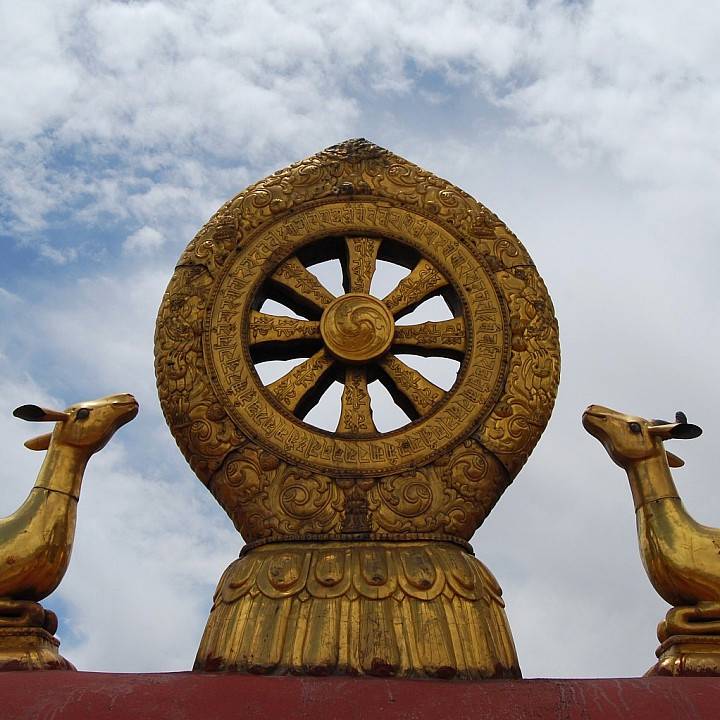
In Buddhist symbolism, the Noble Eightfold Path is often represented by means of the dharma wheel (), in which its eight spokes represent the eight elements of the path.
Etymology and nomenclature
The Pali term pi (Sanskrit: ) is typically translated in English as 'Noble Eightfold Path'. This translation is a convention started by the early translators of Buddhist texts into English, just like is translated as 'Four Noble Truths'. However, the phrase does not mean the path is noble, rather that the path is of the noble people (Pali: pi, meaning 'enlightened, noble, precious people'). The term pi (Sanskrit: ) means 'path', while pi (Sanskrit: ) means 'eightfold'. Thus, an alternate rendering of pi is 'eightfold path of the noble ones', or 'Eightfold Ariya Path'.
All eight elements of the Path begin with the word (in Sanskrit) or pi (in Pāli) which means 'right, proper, as it ought to be, best'. The Buddhist texts contrast pi with its opposite, pi.
The Noble Eightfold Path, in the Buddhist traditions, is the direct means to nirvana and brings a release from the cycle of life and death in the realms of samsara.
The eight divisions
Origins: the Middle Way
According to Indologist Tilmann Vetter, the description of the Buddhist path may initially have been as simple as the term the Middle Way. In time, this short description was elaborated, resulting in the description of the Eightfold Path. Tilmann Vetter and historian Rod Bucknell both note that longer descriptions of "the path" can be found in the early texts, which can be condensed into the Eightfold Path.{{refn|group=note|One of those longer sequences, from the CulaHatthipadopama-sutta, the "Lesser Discourse on the Simile of the Elephant's Footprints", is as follows:
- Dhammalsaddhalpabbajja: A layman hears a Buddha teach the Dhamma, comes to have faith in him, and decides to take ordination as a monk;
- sila: He adopts the moral precepts;
- indriyasamvara: He practises "guarding the six sense-doors";
- sati-sampajanna: He practises mindfulness and self-possession (actually described as mindfulness of the body, kāyānussatti);
- jhana 1: He finds an isolated spot in which to meditate, purifies his mind of the hindrances (nwarana), and attains the first rupa-jhana;
- jhana 2: He attains the second jhana;
- jhana 3: He attains the third jhana;
- jhana 4: He attains the fourth jhana;
- pubbenivasanussati-nana: he recollects his many former existences in samsara;
- sattanam cutupapata-nana: he observes the death and rebirth of beings according to their karmas;
- dsavakkhaya-nana: He brings about the destruction of the dsavas (cankers), and attains a profound realization of (as opposed to mere knowledge about) the four noble truths;
- vimutti: He perceives that he is now liberated, that he has done what was to be done. A similar sequence can be found in the Samaññaphala Sutta.}}
Tenfold path
In the Mahācattārīsaka Sutta which appears in the Chinese and Pali canons, the Buddha explains that cultivation of the noble eightfold path of a learner leads to the development of two further paths of the Arahants, which are right knowledge, or insight (sammā-ñāṇa), and right liberation, or release (sammā-vimutti). These two factors fall under the category of wisdom (paññā).
Short description of the eight divisions
The eight Buddhist practices in the Noble Eightfold Path are:
- Right View: various summaries of "right view" can be found in the sutras. A stock phrase is the opening of the dhamma-eye, in which knowledge arises: "all that has the nature of arising has the nature of ending"; showing the futility of striving after worldly fullfilment. More extensive treatments state that our actions have consequences, death is not the end, and our actions and beliefs have consequences after death. The Buddha followed and taught a successful path out of this world and the other world (heaven and underworld/hell), and his example is to be followed. Later on, right view came to explicitly include karma and rebirth, and the importance of the Four Noble Truths, when "insight" became central to Buddhist soteriology, especially in Theravada Buddhism.
- Right Resolve (samyaka-saṃkalpa/sammā-saṅkappa) can also be known as "right thought", "right aspiration", or "right motivation". In this factor, one resolves to leave home, renounce the worldly life and follow the Buddhist path. The practitioner resolves to strive toward non-violence (ahimsa) and avoid violent and hateful conduct.
- Right Speech: no lying, no abusive speech, no divisive speech, no idle chatter.
- Right Conduct or Action: no killing or injuring, no taking what is not given, no sexual misconduct, no material desires.
- Right Livelihood: no trading in weapons, living beings, meat, liquor, or poisons.
- Right Effort: preventing the arising of unwholesome states, and generating wholesome states, the bojjhaṅgā (Seven Factors of Awakening). This includes indriya-samvara, "guarding the sense-doors", restraint of the sense faculties.
- Right Mindfulness (sati; Satipatthana; Sampajañña): a quality that guards or watches over the mind; the stronger it becomes, the weaker unwholesome states of mind become, weakening their power "to take over and dominate thought, word and deed." In the vipassana movement, sati is interpreted as "bare attention": never be absent minded, being conscious of what one is doing; this encourages the awareness of the impermanence of body, feeling and mind, as well as to experience the five aggregates (skandhas), the five hindrances, the four True Realities and seven factors of awakening.
- Right samadhi (passaddhi; ekaggata; sampasadana): practicing four stages of dhyāna ("meditation"), which includes samadhi proper in the second stage, and reinforces the development of the bojjhaṅgā, culminating into upekkhā (equanimity) and mindfulness. In the Theravada tradition and the vipassana movement, this is interpreted as ekaggata, concentration or one-pointedness of the mind, and supplemented with vipassana meditation, which aims at insight.
Right view
The purpose of "right view" (** / **) or "right understanding" is to clear one's path from confusion, misunderstanding, and deluded thinking. It is a means to gain right understanding of reality.
Sequences in the suttas
The Pali canon and the Agamas contain various "definitions" or descriptions of "right view." The Mahasatipatthana Sutta (Digha Nikaya 22), compiled from elements from other suttas possibly as late as 20 BCE, defines right view summarily as the Four Noble Truths:
In this, right view explicitly includes karma and rebirth, and the importance of the Four Noble Truths. This view of "right view" gained importance when "insight" became central to Buddhist soteriology, and still plays an essential role in Theravada Buddhism.
| Mahācattārīsaka Sutta |
|---|
| And what is right view? Right view is twofold, I say. There is right view that is accompanied by defilements, has the attributes of good deeds, and ripens in attachment. And there is right view that is noble, undefiled, transcendent, a factor of the path. |
Other suttas give a more extensive overview, stating that our actions have consequences, that death is not the end, that our actions and beliefs also have consequences after death, and that the Buddha followed and taught a successful path out of this world and the other world (heaven and underworld or hell).Victor Gunasekara, *The Pāyāsi Sutta: A Commentary and Analysis * The Mahācattārīsaka Sutta ("The Great Forty," Majjhima Nikaya 117) gives an extensive overview, describing the first seven practices as requisites of right samadhi c.q. dhyana. It makes a distinction between mundane right view (karma, rebirth) and noble right view as a path-factor, relating noble right view to dhamma vicaya ("investigation of principles), one of the bojjhanga, the "seven factors of awakening" which give an alternate account of right effort and dhyana.
Alternatively, right view (together with right resolve) is expressed in the stock phrase of dhammalsaddhalpabbajja: "A layman hears a Buddha teach the Dhamma, comes to have faith in him, and decides to take ordination as a monk."
| Sammādiṭṭhi Sutta |
|---|
| The venerable Sāriputta said to the venerable Mahākotthita: "Just ask, friend, knowing I shall answer." The venerable Mahākotthita said to the venerable Sāriputta: "Having accomplished what factors is a learned noble disciple in this teaching and discipline reckoned to be endowed with [right] view, to have accomplished straight view, to have accomplished unshakeable confidence in the Buddha, to have come to and arrived at the right teaching, to have attained this right Dharma and awoken to this right Dharma?" |
Likewise, the Sammādiṭṭhi Sutta (Majjhima Nikaya 9), and its parallel in the Samyukta-āgama, refer to faith in the Buddha and understanding (dhamma vicaya) the path-factors of wholesome bodily actions, verbal actions and mental actions.
Theravada
Right View can be further subdivided, states translator Bhikkhu Bodhi, into mundane right view and superior or supramundane right view:
- Mundane right view, knowledge of the fruits of good behavior (karma). Having this type of view will bring merit and will support the favourable rebirth of the sentient being in the realm of samsara.
- Supramundane (world-transcending) right view, the understanding of the Four Noble Truths, leading to awakening and liberation from rebirths and associated dukkha in the realms of samsara. According to Bhikkhu Bodhi, this kind of right view comes at the end of the path, not at the beginning.
According to Theravada Buddhism, mundane right view is a teaching that is suitable for lay followers, while supramundane right view, which requires a deeper understanding, is suitable for monastics. Mundane and supramundane right view involve accepting the following doctrines of Buddhism:
- Karma: Every action of body, speech, and mind has karmic results, and influences the kind of future rebirths and realms a being enters into.
- Three marks of existence: everything, whether physical or mental, is impermanent (anicca), a source of suffering (dukkha), and lacks a self (anatta).
- The Four Noble Truths are a means to gaining insights and ending dukkha.
A-ditthi
Gombrich notes that there is a tension in the suttas between "right view" and 'no view', release by not clinging to any view at all. According to Chryssides and Wilkins, "right view is ultimately non-view: though the Enlightened One sees things as they really are, 'he has a "critical awareness" of the impossibility of giving full and final expression to his conviction in fixed conceptual terms'. One therefore cannot cling to any particular formulation in a rigid and dogmatic manner."
Right resolve
Right Resolve (samyak-saṃkalpa / sammā-saṅkappa) can also be known as "right thought", "right aspiration", or "right motivation". In section III.248, the Majjhima Nikaya states,
Like right view, this factor has two levels. At the mundane level, the resolve includes being harmless (ahimsa) and refraining from ill will (avyapadha) to any being, as this accrues karma and leads to rebirth.
Right speech
Right speech (samyag-vāc / sammā-vācā) in most Buddhist texts is presented as four abstentions, such as in the Pali Canon thus:
Instead of the usual "abstention and refraining from wrong" terminology, a few texts such as the Samaññaphala Sutta and Kevata Sutta in Digha Nikaya explain this virtue in an active sense, after stating it in the form of an abstention. For example, Samaññaphala Sutta states that a part of a monk's virtue is that "he abstains from false speech. He speaks the truth, holds to the truth, is firm, reliable, no deceiver of the world." Similarly, the virtue of abstaining from divisive speech is explained as delighting in creating concord. The virtue of abstaining from abusive speech is explained in this Sutta to include affectionate and polite speech that is pleasing to people. The virtue of abstaining from idle chatter is explained as speaking what is connected with the Dhamma goal of his liberation.
In the Abhaya-raja-kumara Sutta, the Buddha explains the virtue of right speech in different scenarios, based on its truth value, utility value and emotive content. The Tathagata, states Abhaya Sutta, never speaks anything that is unfactual or factual, untrue or true, disagreeable or agreeable, if that is unbeneficial and unconnected to his goals.
The Buddha thus explains right speech in the Pali Canon, according to Ganeri, as never speaking something that is not beneficial; and, only speaking what is true and beneficial, "when the circumstances are right, whether they are welcome or not".
Right action
Right action (samyak-karmānta / sammā-kammanta) is like right speech, expressed as abstentions but in terms of bodily action. In the Pali Canon, this path factor is stated as:
The prohibition on killing precept in Buddhist scriptures applies to all living beings, states Christopher Gowans, not just human beings. Bhikkhu Bodhi agrees, clarifying that the more accurate rendering of the Pali canon is a prohibition on "taking life of any sentient being", which includes human beings, animals, birds, insects but excludes plants because they are not considered sentient beings. Further, adds Bodhi, this precept refers to intentional killing, as well as any form of intentional harming or torturing any sentient being. This moral virtue in early Buddhist texts, both in context of harm or killing of animals and human beings, is similar to ahimsa precepts found in the texts particularly of Jainism as well as of Hinduism, and has been a subject of significant debate in various Buddhist traditions.
The prohibition on stealing in the Pali Canon is an abstention from intentionally taking what is not voluntarily offered by the person to whom that property belongs. This includes taking by stealth, by force, by fraud or by deceit. Both the intention and the act matters, as this precept is grounded on the impact on one's karma.
The prohibition on sexual misconduct in the Noble Eightfold Path refers to "not performing sexual acts". This virtue is more generically explained in the Cunda Kammaraputta Sutta, which teaches that one must abstain from all sensual misconduct, including getting sexually involved with someone unmarried (anyone protected by parents or by guardians or by siblings), and someone married (protected by husband), and someone betrothed to another person, and female convicts or by dhamma.
For monastics, the abstention from sensual misconduct means strict celibacy while for lay Buddhists this prohibits adultery as well as other forms of sensual misconduct. Later Buddhist texts state that the prohibition on sexual conduct for lay Buddhists includes any sexual involvement with someone married, a girl or woman protected by her parents or relatives, and someone prohibited by dhamma conventions (such as relatives, nuns and others).
Right livelihood
Right livelihood (samyag-ājīva / sammā-ājīva) precept is mentioned in many early Buddhist texts, such as the Mahācattārīsaka Sutta in Majjhima Nikaya as follows:
And what is the right livelihood with effluents, siding with merit, resulting in acquisitions? There is the case where a disciple of the noble ones abandons wrong livelihood and maintains his life with right livelihood. This is the right livelihood with effluents, siding with merit, resulting in acquisitions.
And what is the right livelihood that is noble, without effluents, transcendent, a factor of the path? The abstaining, desisting, abstinence, avoidance of wrong livelihood in one developing the noble path whose mind is noble, whose mind is without effluents, who is fully possessed of the noble path. (...)}}
The early canonical texts state right livelihood as avoiding and abstaining from wrong livelihood. This virtue is further explained in Buddhist texts, states Vetter, as "living from begging, but not accepting everything and not possessing more than is strictly necessary". For lay Buddhists, this precept requires that the livelihood avoid causing suffering to sentient beings by cheating them, or harming or killing them in any way.
The Anguttara Nikaya III.208 asserts that the right livelihood does not trade in weapons, living beings, meat, alcoholic drink or poison. The same text, in section V.177, asserts that this applies to lay Buddhists. This has meant, states Harvey, that raising and trading cattle livestock for slaughter is a breach of "right livelihood" precept in the Buddhist tradition, and Buddhist countries lack the mass slaughter houses found in Western countries.
Right effort
Right effort (samyag-vyāyāma / sammā-vāyāma) is preventing the arising of unwholesome states, and the generation of wholesome states. This includes indriya-samvara, "guarding the sense-doors", restraint of the sense faculties. Right effort is presented in the Pali Canon, such as the Sacca-vibhanga Sutta, as follows: Here the monk arouses his will, puts forth effort, generates energy, exerts his mind, and strives to prevent the arising of evil and unwholesome mental states that have not yet arisen.
He arouses his will... and strives to eliminate evil and unwholesome mental states that have already arisen. He arouses his will... and strives to generate wholesome mental states that have not yet arisen.
He arouses his will, puts forth effort, generates energy, exerts his mind, and strives to maintain wholesome mental states that have already arisen, to keep them free of delusion, to develop, increase, cultivate, and perfect them.
This is called right effort.}}
The unwholesome states (akusala) are described in the Buddhist texts are related to thoughts, emotions, intentions. These include the pancanivarana (five hindrances), that is, sensual thoughts, doubts about the path, restlessness, drowsiness, and ill will of any kind. Of these, the Buddhist traditions consider sensual thoughts and ill will needing more right effort. Sensual desire that must be eliminated by effort includes anything related to sights, sounds, smells, tastes and touch. This is to be done by restraint of the sense faculties (indriya-samvara). Ill will that must be eliminated by effort includes any form of aversion including hatred, anger, resentment towards anything or anyone.
Right mindfulness
Main article: Mindfulness (Buddhism)
While originally, in Yogic practice, sati may have meant to remember the meditation object, to cultivate a deeply absorbed, secluded state of mind, in the oldest Buddhism it has the meaning of "retention", being mindful of the dhammas (both wholesome states of mind, and teachings and practices that remind of those wholesome states of mind) that are beneficial to the Buddhist path. According to Gethin, sati is a quality that guards or watches over the mind; the stronger it becomes, the weaker unwholesome states of mind become, weakening their power "to take over and dominate thought, word and deed." According to Frauwallner, mindfulness was a means to prevent the arising of craving, which resulted simply from contact between the senses and their objects. According to Frauwallner this may have been the Buddha's original idea. According to Trainor, mindfulness aids one not to crave and cling to any transitory state or thing, by complete and constant awareness of phenomena as impermanent, suffering and without self. Gethin refers to the Milindapanha, which states that sati brings to mind the dhammas and their beneficial or unbeneficial qualities, aiding the removal of unbeneficial dhammas and the strengthening of beneficial dhammas. Gethin further notes that sati makes one aware of the "full range and extent of dhammas", that is, the relation between things, broadening one's view and understanding.
The Satipatthana Sutta describes the contemplation of four domains, namely body, feelings, mind and phenomena.{{refn|group=note|The formula is repeated in other sutras, for example the Sacca-vibhanga Sutta (MN 141): "And what is right mindfulness? Here the monk remains contemplating the body as body, resolute, aware and mindful, having put aside worldly desire and sadness; he remains contemplating feelings as feelings; he remains contemplating mental states as mental states; he remains contemplating mental objects as mental objects, resolute, aware and mindful, having put aside worldly desire and sadness; This is called right mindfulness."{{refn|group=note|From The Way of Mindfulness, The Satipatthana Sutta and Its Commentary, Soma Thera (1998),
(...) For the dull-witted man of the theorizing type [ditthi carita] it is convenient to see consciousness [citta] in the fairly simple way it is set forth in this discourse, by way of impermanence [aniccata], and by way of such divisions as mind-with-lust [saragadi vasena], in order to reject the notion of permanence [nicca sañña] in regard to consciousness. Consciousness is a special condition [visesa karana] for the wrong view due to a basic belief in permanence [niccanti abhinivesa vatthutaya ditthiya]. The contemplation on consciousness, the Third Arousing of Mindfulness, is the Path to Purity of this type of man.
For the keen-witted man of the theorizing type it is convenient to see mental objects or things [dhamma], according to the manifold way set forth in this discourse, by way of perception, sense-impression and so forth [nivaranadi vasena], in order to reject the notion of a soul [atta sañña] in regard to mental things. Mental things are special conditions for the wrong view due to a basic belief in a soul [attanti abhinivesa vatthutaya ditthiya]. For this type of man the contemplation on mental objects, the Fourth Arousing of Mindfulness, is the Path to Purity. (...)}} According to Grzegorz Polak, the four upassanā have been misunderstood by the developing Buddhist tradition, including Theravada, to refer to four different foundations. According to Polak, the four upassanā do not refer to four different foundations of which one should be aware, but are an alternate description of the jhanas, describing how the samskharas are tranquilized:
- the six sense-bases which one needs to be aware of (kāyānupassanā);
- contemplation on vedanās, which arise with the contact between the senses and their objects (vedanānupassanā);
- the altered states of mind to which this practice leads (cittānupassanā);
- the development from the five hindrances to the seven factors of enlightenment (dhammānupassanā).
In the vipassana movement, mindfulness (** / sammā-sati) is interpreted as "bare attention": never be absent minded, being conscious of what one is doing. Rupert Gethin notes that the contemporary vipassana movement interprets the Satipatthana Sutta as "describing a pure form of insight (vipassanā) meditation" for which samatha (calm) and dhyāna are not necessary. Yet, in pre-sectarian Buddhism, the establishment of mindfulness was placed before the practice of the Dhyāna, and associated with the abandonment of the five hindrances and the entry into the first Dhyāna.
The dhyāna-scheme describes mindfulness also as appearing in the third and fourth dhyāna, after initial concentration of the mind. Gombrich and Wynne note that, while the second dhyāna denotes a state of absorption, in the third and fourth dhyāna one comes out of this absorption, being mindfully aware of objects while being indifferent to them. According to Gombrich, "the later tradition has falsified the jhana by classifying them as the quintessence of the concentrated, calming kind of meditation, ignoring the other – and indeed higher – element".
Right samadhi (unification of mind)
Main article: Dhyāna in Buddhism
''Samadhi''
Samadhi (samyak-samādhi / sammā-samādhi) is a common practice or goal in Indian religions. The term samadhi derives from the root sam-a-dha, which means "to collect" or "bring together". It is often translated as "concentration" or "unification of mind". In the early Buddhist texts, samadhi is also associated with the term "samatha" (calm abiding).
Dhyana
Bronkhorst notes that neither the Four Noble Truths nor the Noble Eightfold Path discourse provide details of right samadhi. Several Suttas, such as the following in Saccavibhanga Sutta, equate it with dhyana:
[i] Here, the monk, detached from sense-desires, detached from unwholesome states, enters and remains in the first jhana (level of concentration, Sanskrit: dhyāna), in which there is applied and sustained thinking, together with joy and pleasure born of detachment;
[ii] And through the subsiding of applied and sustained thinking, with the gaining of inner stillness and oneness of mind, he enters and remains in the second jhana, which is without applied and sustained thinking, and in which there are joy and pleasure born of concentration;
[iii] And through the fading of joy, he remains equanimous, mindful and aware, and he experiences in his body the pleasure of which the Noble Ones say: "equanimous, mindful and dwelling in pleasure", and thus he enters and remains in the third jhana;
[iv] And through the giving up of pleasure and pain, and through the previous disappearance of happiness and sadness, he enters and remains in the fourth jhana, which is without pleasure and pain, and in which there is pure equanimity and mindfulness.
This is called right concentration.}}
Bronkhorst has questioned the historicity and chronology of the description of the four jhanas. Bronkhorst states that this path may be similar to what the Buddha taught, but the details and the form of the description of the jhanas in particular, and possibly other factors, is likely the work of later scholasticism. Bronkhorst notes that description of the third jhana cannot have been formulated by the Buddha, since it includes the phrase "Noble Ones say", quoting earlier Buddhists, indicating it was formulated by later Buddhists. It is likely that later Buddhist scholars incorporated this, then attributed the details and the path, particularly the insights at the time of liberation, to have been discovered by the Buddha.
Concentration
In the Theravada tradition, samadhi is interpreted as concentration on a meditation object. Buddhagosa defines samadhi as "the centering of consciousness and consciousness concomitants evenly and rightly on a single object...the state in virtue of which consciousness and its concomitants remain evenly and rightly on a single object, undistracted and unscattered."
According to Henepola Gunaratana, in the suttas samadhi is defined as one-pointedness of mind (Cittass'ekaggatā). According to Bhikkhu Bodhi, the right concentration factor is reaching a one-pointedness of mind and unifying all mental factors, but it is not the same as "a gourmet sitting down to a meal, or a soldier on the battlefield" who also experience one-pointed concentration. The difference is that the latter have a one-pointed object in focus with complete awareness directed to that object – the meal or the target, respectively. In contrast, right concentration meditative factor in Buddhism is a state of awareness without any object or subject, and ultimately unto no-thingness and emptiness, as articulated in apophatic discourse.
Development into equanimity
Although often translated as "concentration", as in the limiting of the attention of the mind on one object, in the fourth dhyana "equanimity and mindfulness remain", and the practice of concentration-meditation may well have been incorporated from non-Buddhist traditions. Vetter notes that samadhi consists of the four stages of awakening, but
Gombrich and Wynne note that, while the second jhana denotes a state of absorption, in the third and fourth jhana one comes out of this absorption, being mindfully awareness of objects while being indifferent to it. According to Gombrich, "the later tradition has falsified the jhana by classifying them as the quintessence of the concentrated, calming kind of meditation, ignoring the other – and indeed higher – element."
Liberation
Following the Noble Eightfold Path leads to liberation in the form of nirvana: |The Buddha, Nagara Sutta, Samyutta Nikaya ii.124, Translated by Thanissaro Bhikkhu}}
Practice
Order of practice
Vetter notes that originally the path culminated in the practice of dhyana/samadhi as the core soteriological practice. According to the Pali and Chinese canon, the samadhi state (right concentration) is dependent on the development of preceding path factors:
According to the discourses, right view, right resolve, right speech, right action, right livelihood, right effort, and right mindfulness are used as the support and requisite conditions for the practice of right concentration. Understanding of the right view is the preliminary role, and is also the forerunner of the entire Noble Eightfold Path.
According to the modern Theravada monk and scholar Walpola Rahula, the divisions of the noble eightfold path "are to be developed more or less simultaneously, as far as possible according to the capacity of each individual. They are all linked together and each helps the cultivation of the others." Bhikkhu Bodhi explains that these factors are not sequential, but components, and "with a certain degree of progress all eight factors can be present simultaneously, each supporting the others. However, until that point is reached, some sequence in the unfolding of the path is inevitable."
The stage in the Path where there is no more learning in Yogachara Abhidharma, state Buswell and Gimello, is identical to Nirvana or Buddhahood, the ultimate goal in Buddhism.
Sila-samadhi-prajna
The Noble Eightfold Path is sometimes divided into three basic divisions, with right view and right resolve concluding the sequence:
| Division | Eightfold Path factors |
|---|---|
| Moral virtue (Sanskrit: śīla, Pāli: sīla) | 1. Right speech |
| 2. Right action | |
| 3. Right livelihood | |
| Meditation (Sanskrit and Pāli: samādhi) | 4. Right effort |
| 5. Right mindfulness | |
| 6. Right concentration | |
| Insight, wisdom (Sanskrit: prajñā, Pāli: paññā) | 7. Right view |
| 8. Right resolve |
This order is a later development, when discriminating insight (prajna) became central to Buddhist soteriology, and came to be regarded as the culmination of the Buddhist path. Yet, Majjhima Nikaya 117, Mahācattārīsaka Sutta, describes the first seven practices as requisites for right samadhi. According to Vetter, this may have been the original soteriological practice in early Buddhism.
The "moral virtues" (Sanskrit: śīla, Pāli: sīla) group consists of three paths: right speech, right action and right livelihood. The word sīla, though translated by English writers as linked to "morals or ethics", states Bhikkhu Bodhi, is in ancient and medieval Buddhist commentary tradition closer to the concept of discipline and disposition that "leads to harmony at several levels – social, psychological, karmic and contemplative". Such harmony creates an environment to pursue the meditative steps in the Noble Eightfold Path by reducing social disorder, preventing inner conflict that result from transgressions, favoring future karma-triggered movement through better rebirths, and purifying the mind.
The meditation group ("samadhi") of the path progresses from moral restraints to training the mind. Right effort and mindfulness calm the mind-body complex, releasing unwholesome states and habitual patterns and encouraging the development of wholesome states and non-automatic responses, the bojjhaṅga (seven factors of awakening). The practice of dhyāna reinforces these developments, leading to upekkhā (equanimity) and mindfulness. According to the Theravada commentarial tradition and the contemporary vipassana movement, the goal in this group of the Noble Eightfold Path is to develop clarity and insight into the nature of reality – dukkha, anicca and anatta, discard negative states and dispel avidya (ignorance), ultimately attaining nirvana.
In the threefold division, prajna (insight, wisdom) is presented as the culmination of the path, whereas in the eightfold division the path starts with correct knowledge or insight, which is needed to understand why this path should be followed.
Schools of Buddhism and their views of the Eightfold Path
Theravada presentations of the path
Theravada Buddhism is a diverse tradition and thus includes different explanations of the path to awakening. However, the teachings of the Buddha are often encapsulated by Theravadins in the basic framework of the Four Noble Truths and the Eighthfold Path.
Some Theravada Buddhists also follow the presentation of the path laid out in Buddhaghosa's Visuddhimagga. This presentation is known as the "Seven Purifications" (satta-visuddhi). This schema and its accompanying outline of "insight knowledges" (vipassanā-ñāṇa) is used by modern influential Theravadin scholars, such Mahasi Sayadaw (in his "The Progress of Insight") and Nyanatiloka Thera (in "The Buddha's Path to Deliverance").
Mahayana presentations of the path
Mahāyāna Buddhism is based principally upon the path of a Bodhisattva. A Bodhisattva refers to one who is on the path to buddhahood. The term Mahāyāna was originally a synonym for Bodhisattvayāna or "Bodhisattva Vehicle".
In the earliest texts of Mahāyāna Buddhism, the path of a bodhisattva was to awaken the bodhicitta. Between the 1st and 3rd century CE, this tradition introduced the Ten Bhumi doctrine, which means ten levels or stages of awakening. This development was followed by the acceptance that it is impossible to achieve Buddhahood in one (current) lifetime, and the best goal is not nirvana for oneself, but Buddhahood after climbing through the ten levels during multiple rebirths. Mahāyāna scholars then outlined an elaborate path, for monks and laypeople, and the path includes the vow to help teach Buddhist knowledge to other beings, so as to help them cross samsara and liberate themselves, once one reaches the Buddhahood in a future rebirth. One part of this path are the pāramitā (perfections, to cross over), derived from the Jatakas tales of Buddha's numerous rebirths.
The doctrine of the bodhisattva bhūmis was also eventually merged with the Sarvāstivāda Vaibhāṣika schema of the "five paths" by the Yogacara school*.* This Mahāyāna "five paths" presentation can be seen in Asanga's Mahāyānasaṃgraha.
The Mahāyāna texts are inconsistent in their discussion of the pāramitās, and some texts include lists of two, others four, six, ten and fifty-two. The six paramitas have been most studied, and these are:
- Dāna pāramitā: perfection of giving; primarily to monks, nuns and the Buddhist monastic establishment dependent on the alms and gifts of the lay householders, in return for generating religious merit; some texts recommend ritually transferring the merit so accumulated for better rebirth to someone else
- Śīla pāramitā: perfection of morality; it outlines ethical behaviour for both the laity and the Mahayana monastic community; this list is similar to Śīla in the Eightfold Path (i.e. Right Speech, Right Action, Right Livelihood)
- pāramitā: perfection of patience, willingness to endure hardship
- Vīrya pāramitā: perfection of vigour; this is similar to Right Effort in the Eightfold Path
- Dhyāna pāramitā: perfection of meditation; this is similar to Right Concentration in the Eightfold Path
- Prajñā pāramitā: perfection of insight (wisdom), awakening to the characteristics of existence such as karma, rebirths, impermanence, no-self, dependent origination and emptiness; this is complete acceptance of the Buddha teaching, then conviction, followed by ultimate realisation that "dharmas are non-arising".
In Mahāyāna Sutras that include ten pāramitā, the additional four perfections are "skillful means, vow, power and knowledge". The most discussed pāramitā and the highest rated perfection in Mahayana texts is the "Prajna-paramita", or the "perfection of insight". This insight in the Mahāyāna tradition, states Shōhei Ichimura, has been the "insight of non-duality or the absence of reality in all things".
East Asian Buddhism
East Asian Buddhism is influenced by both the classic Indian Buddhist presentations of the path such as the Eightfold Path as well as classic Indian Mahāyāna presentations such as that found in the Da zhidu lun.
There are many different presentations of soteriology, including numerous paths and vehicles (yanas) in the different traditions of East Asian Buddhism. There is no single dominant presentation. In Zen Buddhism for example, one can find outlines of the path such as the Two Entrances and Four Practices*,* The Five ranks, The Ten Ox-Herding Pictures and The Three mysterious Gates of Linji.
Indo-Tibetan Buddhism
In Indo-Tibetan Buddhism, the path to liberation is outlined in the genre known as Lamrim ("Stages of the Path"). All the various Tibetan schools have their own Lamrim presentations. This genre can be traced to Atiśa's 11th-century A Lamp for the Path to Enlightenment (Bodhipathapradīpa).
Cognitive psychology
The noble eightfold path has been compared to cognitive psychology; Gil Fronsdal says the right view factor can be interpreted to mean how one's mind views the world, and how that leads to patterns of thought, intention and actions. Peter Randall states that it is the seventh factor or right mindfulness that may be thought in terms of cognitive psychology, wherein the change in thought and behavior are linked.
Notes
References
Sources
Primary sources
- Carter, John Ross and Palihawadana, Mahinda; tr. Buddhism: The Dhammapada. New York: History Book Club, 1992.
- Ñanamoli Thera (tr.) & Bhikkhu Bodhi (ed., rev.) (1991). The Discourse on Right View: The Sammaditthi Sutta and its Commentary (The Wheel Publication No. 377/379; includes translations of MN 9 and the associated commentary from the Papañcasudani). Kandy: Buddhist Publication Society. Retrieved 22 September 2007 from "Access to Insight" (1994).
- Nyanasobhano, Bhikkhu (1989). Two Dialogues on Dhamma (Wheel No. 363/364). Kandy: BPS. Retrieved 4 February 2008 from "Access to Insight" (2005)
- Rahula, Walpola. What the Buddha Taught. New York: Grove Press, 1974. .
- Rewata Dhamma. The First Discourse of the Buddha. Somerville, Massachusetts: Wisdom Publications, 1997. .
- Snelling, John. The Buddhist Handbook: A Complete Guide to Buddhist Schools, Teaching, Practice, and History. Rochester: Inner Traditions, 1991. ISBN.
- Sri Lanka Buddha Jayanti Tipitaka Series (SLTP) (n.d.), Avijjāvaggo , (SN 44 [Sinhalese ed.], ch. 1, in Pali). Retrieved on 16 July 2007 from "Mettanet – Lanka"
Secondary sources
- Alexander Berzin (2007), "The Eightfold Noble Path"
- Bucknell, Roderick & Stuart-Fox, Martin (1986). The Twilight Language: Explorations in Buddhist Meditation and Symbolism. Curzon Press: London.
- Kohn, Michael H.; tr. The Shambhala Dictionary of Buddhism and Zen. Boston: Shambhala, 1991.
- Niimi, J. Buddhism and Cognitive Science. Retrieved 8 July 2006.
;Web-sources
References
- Brekke, Torkel. "The Religious Motivation of the Early Buddhists". Journal of the American Academy of Religion, Vol. 67, No. 4 (Dec. 1999), p. 860
- www.wisdomlib.org. (18 October 2018). "Aryashtangamarga, Arya-ashtanga-marga, Āryāṣṭāṅgamārga: 6 definitions".
- www.wisdomlib.org. (5 July 2019). "Samyag-marga, Samyagmārga, Samyanc-marga: 2 definitions".
- Stephen J. Laumakis. (2008). "An Introduction to Buddhist Philosophy". Cambridge University Press.
- (2000). "An introduction to Buddhist ethics: foundations, values and issues". Cambridge Univ. Press.
- Khenchen Thrangu Rinpoche. (2007). "Everyday Consciousness and Primordial Awareness". Snow Lion.
- (1992). "A Dose of Emptiness: An Annotated Translation of the sTong thun chen mo of mKhas grub dGe legs dpal bzang". State University of New York Press.
- Chögyam Trungpa. (2010). "The Heart of the Buddha". Shambhala Publications.
- (1921). "Pali-English Dictionary". Motilal Banarsidass.
- "Taishō Tripiṭaka Vol. 2, No. 99, Sutra 785". Cbeta.
- Ajahn Brahm. (27 May 2018). "Word of the Buddha".
- "Right Speech: samma vaca".
- "Digha Nikaya The Long Discourses". SuttaCentral.
- link. (19 November 2022)
- Majjhima Nikaya 56, [https://www.dhammatalks.org/suttas/MN/MN56.html ''Upālivāda Sutta''] {{Webarchive. link. (16 December 2022 , translation Thanissaro Bhikkhu)
- Gethin, ''The Buddhist Path to Awakening''; Keren Arbel, ''Early Buddhist Meditation''
- Bhikkhu Bodhi. "The Noble Eightfold Path: The Way to the End of Suffering". Access to Insight.
- Bhikkhu Bodhi. (2005). "In the Buddha's Words: An Anthology of Discourses from the Pali Canon". Wisdom Publications.
- Gombrich, ''What the Buddha Thought''.
- Thanissaro Bhikkhu. (2005). "Saccavibhanga Sutta". Access to Insight.
- (2013). "Encyclopedia of Buddhism". Routledge.
- Thanissaro Bhikkhu. (1997). "Samaññaphala Sutta". Access to Insight.
- Thanissaro Bhikkhu. "Abhaya Sutta". Access to Insight.
- J Ganeri. (2007). "The Concealed Art of the Soul: Theories of Self and Practices of Truth in Indian Ethics and Epistemology". Oxford University Press.
- (2013). "The Meditative Way: Readings in the Theory and Practice of Buddhist Meditation". Routledge.
- Christopher Gowans. (2004). "Philosophy of the Buddha: An Introduction". Routledge.
- (2007). "Indian Ethics: Classical traditions and contemporary challenges". Ashgate Publishing.
- John Arapura. (2003). "Hindu Spirituality: Postclassical and Modern". Motilal Banarsidass.
- Thanissaro Bhikkhu. "Cunda Kammaraputta Sutta". Access to Insight.
- Christopher Gowans. (2015). "A Companion to Buddhist Philosophy". John Wiley & Sons.
- Andrew Powell. (1989). "Living Buddhism". University of California Press.
- David L. Weddle. (2010). "Miracles: Wonder and Meaning in World Religions". New York University Press.
- Martine Batchelor. (2014). "The Spirit of the Buddha". Yale University Press.
- Analayo (2013), ''Satipatthana'', Windhorse Publications: "... sense-restraint, which in fact constitutes an aspect of right effort."
- Chip Hartranft (spring 2011),[https://www.buddhistinquiry.org/article/did-the-buddha-teach-satipatth%c4%81na ''Did the Buddha Teach Satipatthāna?''] {{Webarchive. link. (4 August 2020 , Buddhist Inquiry)
- (2013). "Mindfulness: Diverse Perspectives on Its Meaning, Origins and Applications". Routledge.
- (1998). "The Way of Mindfulness: The Satipatthana Sutta and Its Commentary".
- Gethin, Rupert, Sayings of the Buddha: New Translations from the Pali Nikayas (Oxford World's Classics), 2008, p. 142.
- Shankman, Richard. (2008-12-30). "The Experience of Samadhi: An In-depth Exploration of Buddhist Meditation". Shambhala Publications.
- De Graaf, Geoffrey. (2018). "Buddhist Meditation and Its Role in Mind Training". Routledge.
- Gethin, Rupert. (1992). "The Buddhist Path to Awakening". Routledge.
- Johannes Bronkhorst. (2009). "Buddhist Teaching in India". Simon and Schuster.
- Johannes Bronkhorst. (2009). "Buddhist Teaching in India". Simon and Schuster.
- Oliver Freiberger. (2006). "Asceticism and Its Critics: Historical Accounts and Comparative Perspectives". Oxford University Press.
- Visudimagga 84–85{{full citation needed. (September 2016)
- Henepola Gunaratana (1995), The Jhanas in Theravada Buddhist Meditation
- Gombrich, Richard. (1997). "Religious Experience in Early Buddhism".
- Thanissaro Bhikkhu. "Nagara Sutta". Access to Insight.
- "Samyukta Agama, sutra no. 287, Taisho vol 2, p. 80". Cbeta.
- "unknown". Cbeta.
- Thanissaro Bhikkhu. "Maha-cattarisaka Sutta". Access to Insight.
- "Madhyama Agama, Taishō Tripiṭaka Vol. 1, No. 26, sutra 189 (中阿含雙品 聖道經第三)". Cbeta.
- Rahula 46
- Bhikkhu Bodhi. "The Noble Eightfold Path: The Way to the End of Suffering". Buddhist Publication Society.
- Rinpoche Karma-raṅ-byuṅ-kun-khyab-phrin-las. (1986). "The Dharma: That Illuminates All Beings Impartially Like the Light of the Sun and Moon". State University of New York Press.
- Kevin Trainor. (2004). "Buddhism: The Illustrated Guide". Oxford University Press.
- Crosby, Kate (2013). "Theravada Buddhism: Continuity, Diversity, and Identity," p. 113-114, John Wiley & Sons.
- See for example, the presentation of the path in Henepola Gunaratana (2011). "Eight Mindful Steps to Happiness: Walking the Buddha's Path", Simon and Schuster.
- Shankman, Richard (2008). "The Experience of Samadhi: An In-depth Exploration of Buddhist Meditation," p. 53. Shambhala Publications.
- Mahasi Sayadaw (1994). "The Progress of Insight: A Treatise on Satipatthana Meditation," p. vii Buddhist Publication Society
- Nyanatiloka Thera (2010). "The Buddha's Path to Deliverance: A Systematic Exposition in the Words of the Sutta Piṭaka," p. 42. Buddhist Publication Society.
- Watanabe, Chikafumi (2000), ''A Study of Mahayanasamgraha III: The Relation of Practical Theories and Philosophical Theories''. Ph.D. dissertation, The University of Calgary, pp. 38-40.
- Shōhei Ichimura. (2001). "Buddhist Critical Spirituality: Prajñā and Śūnyatā". Motilal Banarsidass.
- (1996). "Essentials of Buddhism: basic terminology and concepts of Buddhist philosophy and practice". Kōsei.
- Shōhei Ichimura. (2001). "Buddhist Critical Spirituality: Prajñā and Śūnyatā". Motilal Banarsidass.
- Carl Olson. (2005). "The Different Paths of Buddhism: A Narrative-Historical Introduction". Rutgers University Press.
- Robert E. Buswell, Robert M. Gimello (1992). ''"Paths to Liberation: The Marga and Its Transformations in Buddhist Thought,"'' pp. 313-314. (Studies in East Asian Buddhism). University of Hawaii Press.
- Robert E. Buswell, Robert M. Gimello (1992). ''"Paths to Liberation: The Marga and Its Transformations in Buddhist Thought,"'' p. 316. (Studies in East Asian Buddhism). University of Hawaii Press.
- "Stages of the Path (Lamrim)".
- Gil Fronsdal. (5 December 2006). "The Dhammapada: A New Translation of the Buddhist Classic with Annotations". Shambhala Publications, Inc..
- Peter Randall. (2013). "The Psychology of Feeling Sorry: The Weight of the Soul". Routledge.
This article was imported from Wikipedia and is available under the Creative Commons Attribution-ShareAlike 4.0 License. Content has been adapted to SurfDoc format. Original contributors can be found on the article history page.
Ask Mako anything about Noble Eightfold Path — get instant answers, deeper analysis, and related topics.
Research with MakoFree with your Surf account
Create a free account to save articles, ask Mako questions, and organize your research.
Sign up freeThis content may have been generated or modified by AI. CloudSurf Software LLC is not responsible for the accuracy, completeness, or reliability of AI-generated content. Always verify important information from primary sources.
Report