From Surf Wiki (app.surf) — the open knowledge base
No. 48 Squadron RAF
Defunct flying squadron of the Royal Air Force
Defunct flying squadron of the Royal Air Force
| Field | Value |
|---|---|
| unit_name | No. 48 Squadron RAF |
| caption | 48 Squadron badge |
| country | United Kingdom |
| branch | Royal Air Force |
| motto | |
| ("By strength and faithfulness") | |
| dates | 15 April 1916 – 1 April 1920 |
| 25 Nov 1935 – 7 Jan 1976 | |
| battle_honours | Western Front, 1917-18: Arras: Channel & North Sea, 1939-40: Dunkirk: Atlantic, 1941-42: Mediterranean, 1943: Arnhem: Rhine: All honours are emblazoned on the Squadron Standard |
| notable_commanders | Keith Park |
| identification_symbol | On an equilateral triangle, a Petrel's head erased |
| identification_symbol_label | Squadron badge heraldry |
| identification_symbol_3 | ZW Allocated Apr 1939 - Sep 1939 |
| OY Sep 1939 - Dec 1942 | |
| I2 Feb 1944 - Jan 1946 | |
| identification_symbol_3_label | Squadron codes |
("By strength and faithfulness") 25 Nov 1935 – 7 Jan 1976 OY Sep 1939 - Dec 1942 I2 Feb 1944 - Jan 1946
No. 48 Squadron was a Royal Air Force squadron that saw service in both the First and Second World Wars.
History
First World War
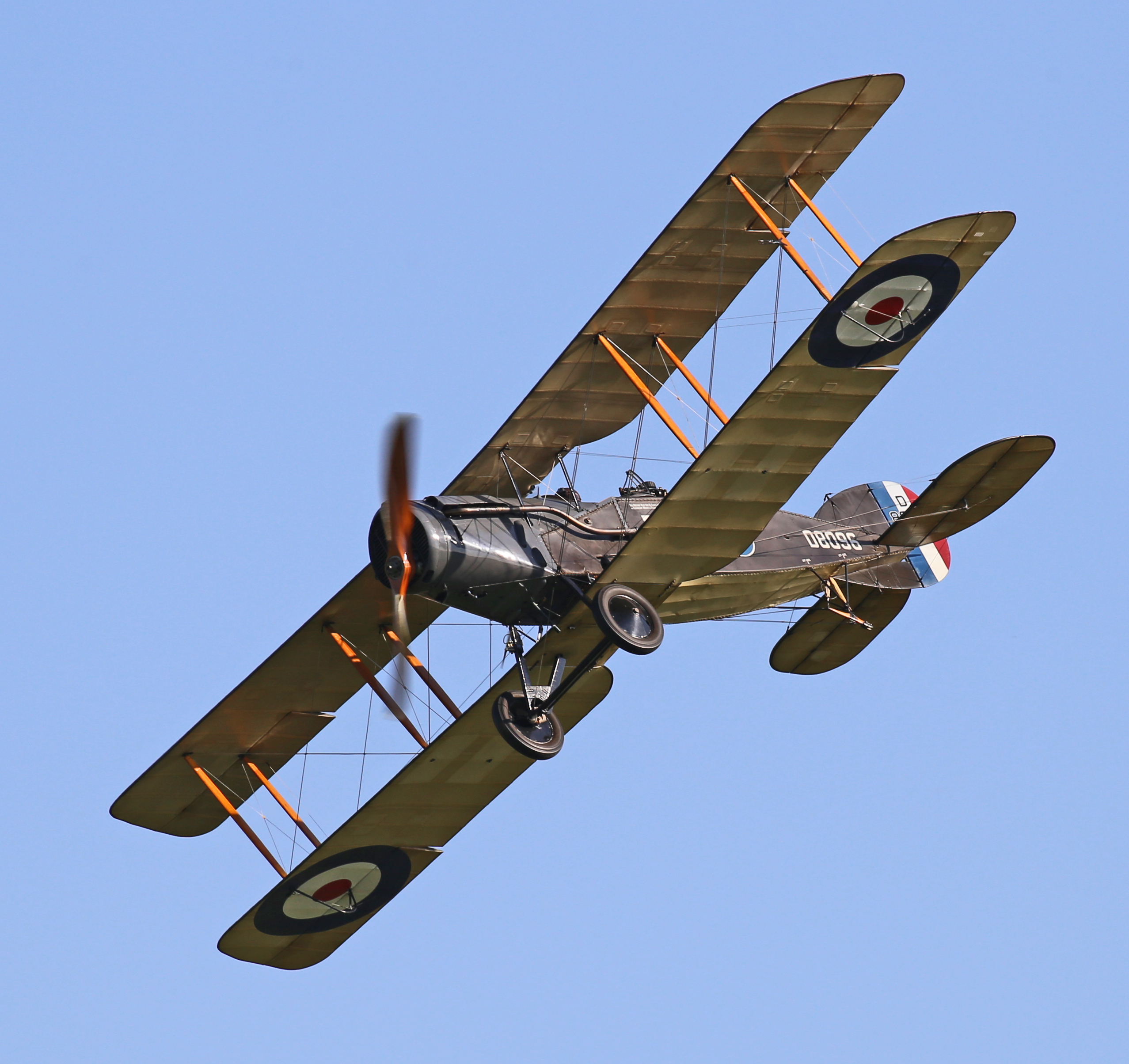
No. 48 Squadron of the Royal Flying Corps was formed at Netheravon, Wiltshire, on 15 April 1916. The squadron was posted to France in March 1917 and became the first fighter squadron to be equipped with the Bristol Fighter. One of the squadron's commanders was Keith Park, then a Major, who later led No. 11 Group of Fighter Command during the Battle of Britain as an Air Vice Marshal. The squadron became part of the Royal Air Force when the Royal Flying Corps merged with the Royal Naval Air Service in 1918. It moved by sea to India during May/June 1919, being based at Quetta. On 1 April 1920 the squadron was disbanded by renumbering it to No. 5 Squadron.
The squadron had 32 aces serve in it. Besides Park, they included: Fred Holliday, John Letts, Brian Edmund Baker, Harold Anthony Oaks, Leonard A. PayneRobert Dodds, John Theobald Milne, Charles Napier, Frank Ransley, Alan Wilkinson, Thomas Percy Middleton, William Price, future Air Marshal Charles Steele, Norman Craig Millman, Thomas G. Rae, Owen Scholte, Harold Johnstone Pratt, Hugh Leslie Owen, Roger Hay, Norman Roberts, Joseph Michael John Moore, Arthur Noss and Maurice Benjamin.
Second World War


The squadron reformed on 25 November 1935 at RAF Bicester, and became a General Reconnaissance unit operating Avro Anson aircraft. It moved into RAF Coastal Command on 14 July 1936. With the outbreak of war in 1939 the squadron was engaged in coastal patrols along the south coast of England. In 1941 the squadron re-equipped with Lockheed Hudson aircraft and took on the role of an anti-submarine squadron, patrolling first the North Sea; in December 1942 the squadron moved to RAF Gibraltar to patrol the Mediterranean.
In 1944 the squadron returned to the UK and was re-equipped with Douglas Dakota aircraft. It remained a transport squadron until being disbanded on 16 January 1946. During this period it operated from Chittagong, Bengal, India on supply operations in the Irrawaddy valley of Burma.
Post war

The squadron reformed again on 15 February 1946 when No. 215 Squadron was renumbered as No. 48. The base was at RAF Changi, Singapore, from April 1946 until October 1967. It was re-equipped with Vickers Valetta transports in January 1951 and these were replaced by Handley Page Hastings four-engine transport aircraft in June 1957. The squadron remained a transport unit for the remainder of its existence, flying the Hastings until it was replaced with the turboprop Lockheed C-130 Hercules in 1968. The squadron returned to the UK on 1 September 1971, continuing to operate the Hercules until disbandment at RAF Lyneham on 7 January 1976.
Badge
The badge of the squadron is "On an equilateral triangle, a Petrel's head erased". In the First World War, airmen would often stick bottle labels to their aircraft and so the Bass red triangle - the first registered UK trademark - was incorporated as the main part of the badge with the head of a petrel – a small seabird.
References
Citations
Bibliography
- Franks, Norman; Guest, Russell; Alegi, Gregory. Above the War Fronts: The British Two-seater Bomber Pilot and Observer Aces, the British Two-seater Fighter Observer Aces, and the Belgian, Italian, Austro-Hungarian and Russian Fighter Aces, 1914–1918: Volume 4 of Fighting Airmen of WWI Series: Volume 4 of Air aces of WWI. Grub Street, 1997. , .
- Halley, J.J., 'The Squadrons of the Royal Air Force & Commonwealth 1919-1988, Air-Britain (Historians) Ltd, 1988, .
- Shores, Christopher; Franks, Norman; Guest, Russell. Above the Trenches: A Complete Record of the Fighter Aces and Units of the British Empire Air Forces 1915–1920. Grub Street, 1990. , .
References
- (1983). "A dictionary of mottoes". Routledge & Kegan Paul.
- Halley, 1988, pp 106-107
- Shores, et al, pp. 116–117, 288–289, 313.
- Franks, et al, p. 40.
- Franks, et al, p. 5.
- "Hercules C130K XV202 Operational History".
- Halley, 1988, p. 107
- (2 May 2016}}{{Dead link). "The story behind the famous Bass red triangle trademark". Burton Mail.
This article was imported from Wikipedia and is available under the Creative Commons Attribution-ShareAlike 4.0 License. Content has been adapted to SurfDoc format. Original contributors can be found on the article history page.
Ask Mako anything about No. 48 Squadron RAF — get instant answers, deeper analysis, and related topics.
Research with MakoFree with your Surf account
Create a free account to save articles, ask Mako questions, and organize your research.
Sign up freeThis content may have been generated or modified by AI. CloudSurf Software LLC is not responsible for the accuracy, completeness, or reliability of AI-generated content. Always verify important information from primary sources.
Report