From Surf Wiki (app.surf) — the open knowledge base
No. 12 Group RAF
Former Royal Air Force operations group

Former Royal Air Force operations group
| Field | Value | |
|---|---|---|
| unit_name | No. 12 Group RAF | |
| image | 12 Group RAF Crest.jpg | |
| caption | No. 12 Group badge | |
| dates | 1 April 1918 - 1 November 1919 | |
| 1 April 1937 - 1 April 1963 | ||
| country | UK United Kingdom | |
| branch | ||
| command_structure | RAF Fighter Command | |
| type | Royal Air Force group | |
| role | Fighter cover for the Midlands and East Anglia | |
| garrison | RAF Watnall, Nottinghamshire, England | |
| motto | We fight to defend | |
| colors | [[File:Ensign of the Royal Air Force.svg | 150px]] |
| colors_label | Royal Air Force Ensign | |
| notable_commanders | Air Chief Marshal Sir Trafford Leigh-Mallory | |
| battles | World War II |
1 April 1937 - 1 April 1963
- European theatre of World War II
- Battle of Britain No. 12 Group RAF (12 Gp) of the Royal Air Force was a group, a military formation, that existed over two separate periods, namely the end of the First World War when it had a training function and from just prior to the Second World War until the early 1960s when it was tasked with an air defence role.
History
First World War
No. 12 Group was first formed on 1 April 1918 at RAF Cranwell, Lincolnshire, within No. 3 Area. It succeeded the Royal Navy's Central Depot and Training Establishment which had been training naval aviators at Cranwell since 1916. The first RAF General Officer Commanding was Brigadier-General Harold Briggs who received the appointment on promotion from Captain in the Royal Navy. On 8 May 1918 the group transferred to Midland Area, and then to Northern Area on 18 October 1919. On 1 November that year the Group ceased to exist when it became the RAF (Cadet) College.
Second World War
The group was reformed on 1 April 1937 in Fighter Command at RAF Uxbridge as No. 12 (Fighter) Group. It was the group responsible for aerial defence of the Midlands, Norfolk, Lincolnshire and North Wales. Construction of a purpose built site at RAF Watnall, a non-flying station in Nottinghamshire, was not completed until late 1940, after which operations were relocated from nearby RAF Hucknall. During the Second World War this group was the second most important group of Fighter Command, and as such, it received its share of attacks from the German Luftwaffe throughout the war.
The commander of 12 Group during the Battle of Britain was Air Vice Marshal Trafford Leigh-Mallory, who was a rather ambitious man. Despite his length of service in the RAF, he was passed over for being named the Air Officer Commanding of the more vital 11 Group in favour of Air Vice Marshal Keith Park. Leigh-Mallory felt himself slighted over this and his relations with Park were poisoned thereafter.
As well as regional defence, 12 Group were also supposed to provide fighter cover for 11 Group airfields during the Battle of Britain, but several times, these fields were left undefended. When Park complained about it, Leigh-Mallory responded that in order to test his Big Wing theory (espoused by Squadron Leader Douglas Bader), more time was needed to get the necessary squadrons airborne.

The Big Wings met with mixed success, enough for the Air Ministry to use it as an excuse to remove Park and Air Chief Marshal Hugh Dowding from their commands on the grounds that they had mismanaged the Battle of Britain.
After Park was ousted, Leigh-Mallory took over 11 Group. 12 Group still continued its assignment of defending the Midlands and supporting both 10 Group and 11 Group.
Post war

Group Headquarters moved to RAF Newton on 20 December 1946 and the operations block at Watnall was closed on 12 December 1946.
| Airfield | Squadron(s) | Aircraft type |
|---|---|---|
| RAF Church Fenton | No. 19 | Gloster Meteor F.4 |
| 23 and 141 | de Havilland Mosquito NF.36 | |
| 41 | de Havilland Hornet F.3 | |
| RAF Horsham St Faith, | 74, 245, 257 and 263 | Gloster Meteor F.4 |
| RAF Linton-on-Ouse | 66 and 92 | Gloster Meteor F.4 |
| 64 and 65 | de Havilland Hornet F.3 | |
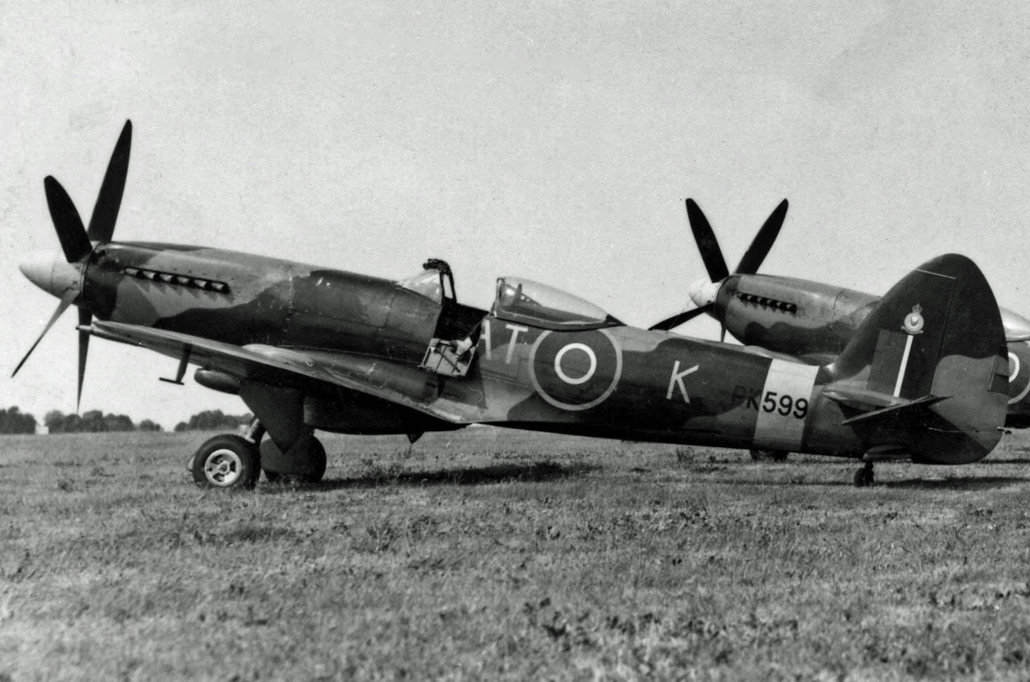
| RAF Hooton Park | 610 RAuxAF | Supermarine Spitfire F.22 |
| 611 RAuxAF | Gloster Meteor F.4 | |
| RAF Acklington | 264 | de Havilland Mosquito NF.36 |
| RAF Leuchars | 222 | Gloster Meteor F.4 |
| RAF Wymeswold | 504 RAuxAF | Gloster Meteor F.4 |
| RAF Aldergrove | 502 RAuxAF | Supermarine Spitfire F.22 |
| RAF Abbotsinch | 602 RAuxAF | Supermarine Spitfire F.22 |
| RAF Turnhouse | 603 RAuxAF | Supermarine Spitfire F.22 |
| RAF Honiley | 605 RAuxAF | de Havilland Vampire FB.5 |
| RAF Ouston | 607 RAuxAF | Supermarine Spitfire F.22 |
| RAF Yeadon | 609 RAuxAF | Supermarine Spitfire LF.16 |
| RAF Dyce | 612 RAuxAF | Supermarine Spitfire LF.16e |
| RAF Middleton St George | 608 RAuxAF | Supermarine Spitfire F.22 |
| RAF Finningley | 616 RAuxAF | Gloster Meteor F.4 |
| RAF Ringway | 613 RAuxAF | Supermarine Spitfire F.22 |
.jpg)
Group HQ then moved again on 14 August 1959 to RAF Horsham St Faith.
Order of Battle: April 1962
- RAF Horsham St. Faith (HQ)
- No. 12 Group Communication Flight RAF - Avro Anson & Meteor
- RAF Coltishall
- No. 23 Squadron RAF - Gloster Javelin
- No. 74 Squadron RAF - English Electric Lightning
- Air Fighting Development Squadron RAF - Lightning
- RAF Woolfox Lodge
- No. 62 Squadron RAF - Bristol Bloodhound SAM
- RAF Warboys
- No. 257 Squadron RAF - Bloodhound SAM
- RAF Old Sarum
- School of Land/Air Warfare - Anson, Vampire & de Havilland Canada DHC-1 Chipmunk
- RAF Wattisham
- No. 41 Squadron RAF - Javelin
- No. 56 Squadron RAF - Lightning
- No. 111 Squadron RAF - Lightning
- RAF Watton
- No. 263 Squadron RAF - Bloodhound SAM
- RAF Marham
- No. 242 Squadron RAF - Bloodhound SAM
- RAF Rattlesden
- No. 266 Squadron RAF - Bloodhound SAM
- RAF West Raynham
- No. 85 Squadron RAF - Javelin
- Central Fighter Establishment - Hawker Hunter & Javelin
It was disbanded on 1 April 1963 and replaced by No. 12 (East Anglian) Sector, it moved to RAF Neatishead, Norfolk on 29 May 1963. On 1 April 1968, 12 Group passed into history when No. 12 Sector became Sector North within No. 11 Group RAF.
Commanders
The following were air officer commanding No. 12 Group:
1918 to 1919
- 1 April 1918 Brigadier-General Harold Briggs
- 1 May 1919 Brigadier-General Francis Scarlett
1937 to 1963
- 1 April 1937 Air Vice-Marshal John Tyssen
- 4 December 1937 Air Vice-Marshal Trafford Leigh-Mallory
- 17 December 1940 Air Vice-Marshal Richard Saul
- 29 November 1942 Air Vice-Marshal John Oliver Andrews
- 1 June 1943 Air Vice-Marshal Roderic Hill
- 22 November 1943 Air Vice-Marshal Malcolm Henderson
- 1 January 1945 Air Vice-Marshal John Baker
- 5 May 1946 Air Vice-Marshal Thomas Traill
- 17 November 1948 Air Vice-Marshal G Harcourt-Smith
- 1 June 1951 Air Vice-Marshal Richard Atcherley
- 13 November 1953 Air Vice-Marshal W J Crisham
- 25 June 1956 Air Vice-Marshal H P Fraser
- 1 August 1958 Air Commodore C H Hartley (Chief of Staff as acting AOC)
- 1 January 1959 Air Vice-Marshal J R A Embling
- 20 July 1959 Air Vice-Marshal Christopher Hartley
- 1 June 1961 Air Vice-Marshal Robert Bateson
References
Citations
Bibliography
References
- (1983). "A dictionary of mottoes". Routledge & Kegan Paul.
- "RAF Watnall : Fighter Command's 12 Group HQ.". Subterranea Britannica.
- "Groups 10-19". RAF WEB - Air of Authority.
- "No. 12 Group RAF". RAF WEB - Air of Authority.
- "Air Vice-Marshal R E Saul". RAF WEB - Air of Authority.
- "Air Vice Marshal T C Traill". RAF WEB - Air of Authority.
This article was imported from Wikipedia and is available under the Creative Commons Attribution-ShareAlike 4.0 License. Content has been adapted to SurfDoc format. Original contributors can be found on the article history page.
Ask Mako anything about No. 12 Group RAF — get instant answers, deeper analysis, and related topics.
Research with MakoFree with your Surf account
Create a free account to save articles, ask Mako questions, and organize your research.
Sign up freeThis content may have been generated or modified by AI. CloudSurf Software LLC is not responsible for the accuracy, completeness, or reliability of AI-generated content. Always verify important information from primary sources.
Report