From Surf Wiki (app.surf) — the open knowledge base
Nizhny Novgorod Oblast
First-level administrative division of Russia
First-level administrative division of Russia
| Field | Value | |
|---|---|---|
| en_name | Nizhny Novgorod Oblast | |
| ru_name | Нижегородская область | |
| image_map | Map of Russia (2014–2022) - Nizhny Novgorod Oblast.svg | |
| coordinates | ||
| image_coa | [[File:Coat of arms of Nizhny Novgorod Region.svg | 80px]] |
| image_flag | Flag of Nizhny Novgorod Region.svg | |
| political_status | Oblast | |
| political_status_link | Oblasts of Russia | |
| federal_district | Volga | |
| economic_region | Volga-Vyatka | |
| adm_ctr_type | Administrative center | |
| adm_ctr_name | Nizhny Novgorod | |
| adm_ctr_ref | ||
| pop_2021census | 3119115 | |
| pop_2010census_rank | 12th | |
| urban_pop_2021census | 79.9% | |
| rural_pop_2021census | 20.1% | |
| pop_2021census_ref | ||
| pop_latest | 3281008 | |
| pop_latest_date | January 2014 | |
| pop_latest_ref | ||
| area_km2 | 76624 | |
| area_km2_rank | 40th | |
| established_date | January 14, 1929 (first), | |
| December 5, 1936 (second) | ||
| established_date_ref | ||
| license_plates | 52, 152, 252 | |
| ISO | RU-NIZ | |
| leader_title | Governor | |
| leader_title_ref | ||
| leader_name | Gleb Nikitin | |
| leader_name_ref | ||
| legislature | Legislative Assembly | |
| legislature_ref | ||
| website | http://www.government-nnov.ru/ |
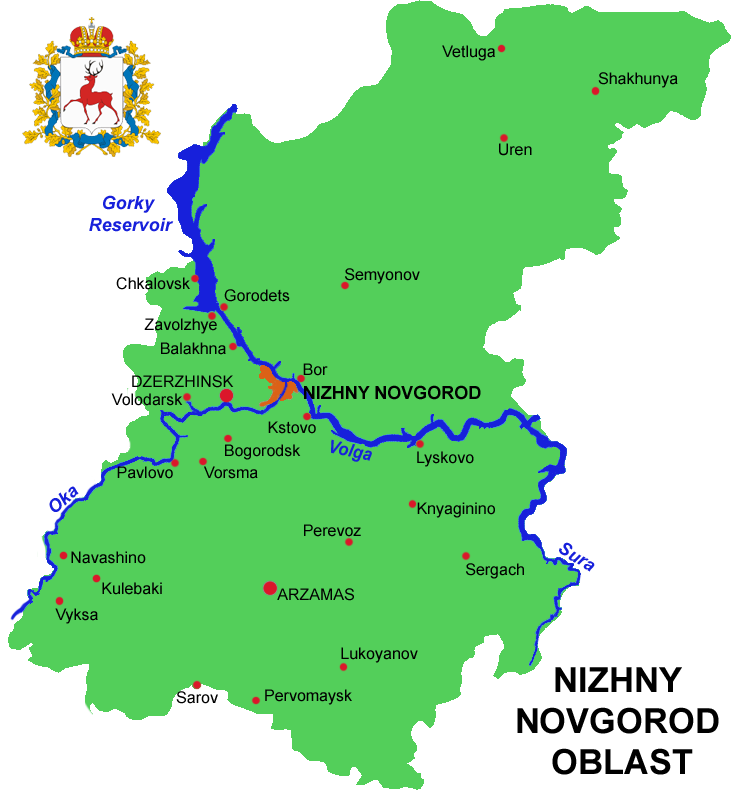
December 5, 1936 (second) Nizhny Novgorod Oblast () is a federal subject of Russia (an oblast). Its administrative center is the city of Nizhny Novgorod. It has a population of 3,119,115 as of the 2021 Census. From 1932 to 1990 it was known as Gorky Oblast ().
The oblast is crossed by the Volga River. Apart from Nizhny Novgorod's metropolitan area (including Dzerzhinsk, Bor and Kstovo) the biggest city is Arzamas. Near the town of Sarov there is the Serafimo-Diveyevsky Monastery, one of the largest convents in Russia, established by Saint Seraphim of Sarov. The Makaryev Monastery opposite of the town of Lyskovo used to be the location of the largest fair in Eastern Europe. Other historic towns include Gorodets and Balakhna, located on the Volga to the north from Nizhny Novgorod.
Geography
The oblast covers an area of 76900 km2. Agricultural land occupies 41% of this area; forests, 48%, lakes and rivers, 2%; and other lands, 9%. Nizhny Novgorod Oblast borders Kostroma Oblast (N), Kirov Oblast (NE), the Mari El Republic (E), the Chuvash Republic (E), the Republic of Mordovia (S), Ryazan Oblast (SW), Vladimir Oblast (W), and Ivanovo Oblast (NW).
Natural resources
Nizhny Novgorod Oblast is not rich in natural resources, which are limited to commercial deposits of sand (including titanium-zirconium sands), clay, gypsum, peat, mineral salt, and timber.
History
The sites of Pustyn I and the settlement of Naumovka I, Krasny Bor 5 and others belong to the Mesolithic era in the Nizhny Novgorod region. Burial grounds of the Fatyanovo culture of the Bronze Age were found in the Chkalovsky, Vetluzhsky and Krasnobakovsky districts.
In the course of the regional reform of Peter I in 1708, Nizhny Novgorod with the surrounding lands was added to the Kazan Governorate. In 1714, the Nizhny Novgorod Governorate was created.
On January 14, 1929, the Nizhny Novgorod Oblast was formed. On July 15 of the same year, it was transformed into the Nizhny Novgorod Territory.
On October 7, 1932, the Nizhny Novgorod Territory was renamed the Gorky Territory (in honor of the writer Maxim Gorky). On December 5, 1936, the Gorky Territory was transformed into the Gorky Oblast (the Mari and Chuvash Republics were taken from the former territory).
On January 7, 1954, the Arzamas Oblast was separated from the Gorky Oblast. On April 23, 1957, the Arzamas Oblast was abolished, and its territory was returned to the Gorky Oblast.
On October 22, 1990, by the Decree of the Presidium of the Supreme Soviet of the RSFSR, the Gorky Oblast was renamed the Nizhny Novgorod Oblast. On April 21, 1992, the Congress of People's Deputies of Russia approved the decision of the presidium of the parliament to rename the region, amending Art. 71 of the Constitution of the RSFSR of 1978, which entered into force on May 16, 1992.
Politics

During the Soviet period, the high authority in the oblast was shared between three persons: the first secretary of the Nizhny Novgorod (then Gorki) CPSU Committee (who in reality had the greatest authority); the chairman of the oblast Soviet (legislative power); and the chairman of the oblast Executive Committee (executive power). After the abolition of Article 6 of the Constitution of the USSR in March 1990, the CPSU lost its monopoly on power. The head of the Oblast administration, and eventually the governor, was appointed/elected alongside the elected regional parliament.
The Charter of Nizhny Novgorod Oblast is the fundamental law of the region. The Legislative Assembly of Nizhny Novgorod Oblast is the province's standing legislative (representative) body. The Legislative Assembly exercises its authority by passing laws, resolutions, and other legal acts and by supervising the implementation and observance of the laws and other legal acts passed by it. The highest executive body is the Oblast Government, which includes territorial executive bodies such as district administrations, committees, and commissions that facilitate development and run the day to day matters of the province. The Oblast administration supports the activities of the Governor who is the highest official and acts as guarantor of the observance of the oblast Charter in accordance with the Constitution of Russia.
Sights

The unique architectural construction—the 128 m steel lattice hyperboloid tower built by the Russian engineer and scientist Vladimir Grigorievich Shukhov in 1929—is located near the town of Dzerzhinsk on the left bank of the Oka River.
Administrative divisions
Main article: Administrative divisions of Nizhny Novgorod Oblast
Demographics
|1897 | 1584774 |1926 | 2743344 |1939 | 3565000 |1959 | 3590274 |1970 | 3682484 |1979 | 3695523 |1989 | 3714322 |2002 | 3524028 |2010 | 3310597 |2021 | 3119115 |2025 | 3037816

According to the 2010 Census, ethnic Russians at 3,109,661 made up 95.1% of the oblast's population. Other ethnic groups included Tatars (44,103, or 1.4%), Mordva (19,138, or 0.6%), Ukrainians (17,657, or 0.5%), and various smaller groups, each accounting for less than 0.5% of the total. Additionally, 42,349 people were registered from administrative databases, and could not declare an ethnicity. It is estimated that the proportion of ethnicities in this group is the same as that of the declared group.
Vital statistics for 2024:
- Births: 21,995 (7.2 per 1,000)
- Deaths: 45,371 (14.9 per 1,000)
Total fertility rate (2024):
1.28 children per woman
Life expectancy (2021):
Total — 68.93 years (male — 63.81, female — 73.97)
According to the Federal Migration Service, 20,450 foreign citizens were registered in the oblast in 2006. The actual number of foreigners residing in the oblast as of June 1, 2006 was estimated to be over 22,000.
;Religion
According to a 2012 survey 69.2% of the population of Nizhny Novgorod Oblast adheres to the Russian Orthodox Church, 2% are unaffiliated generic Christians, 2% are Orthodox Christian believers without belonging to any church or members of other Orthodox churches, and 1% are adherents of the Slavic native faith (Rodnovery). In addition, 15% of the population declares to be "spiritual but not religious", 10% is atheist, and 0.8% follows other religions or did not give an answer to the question.
Economy
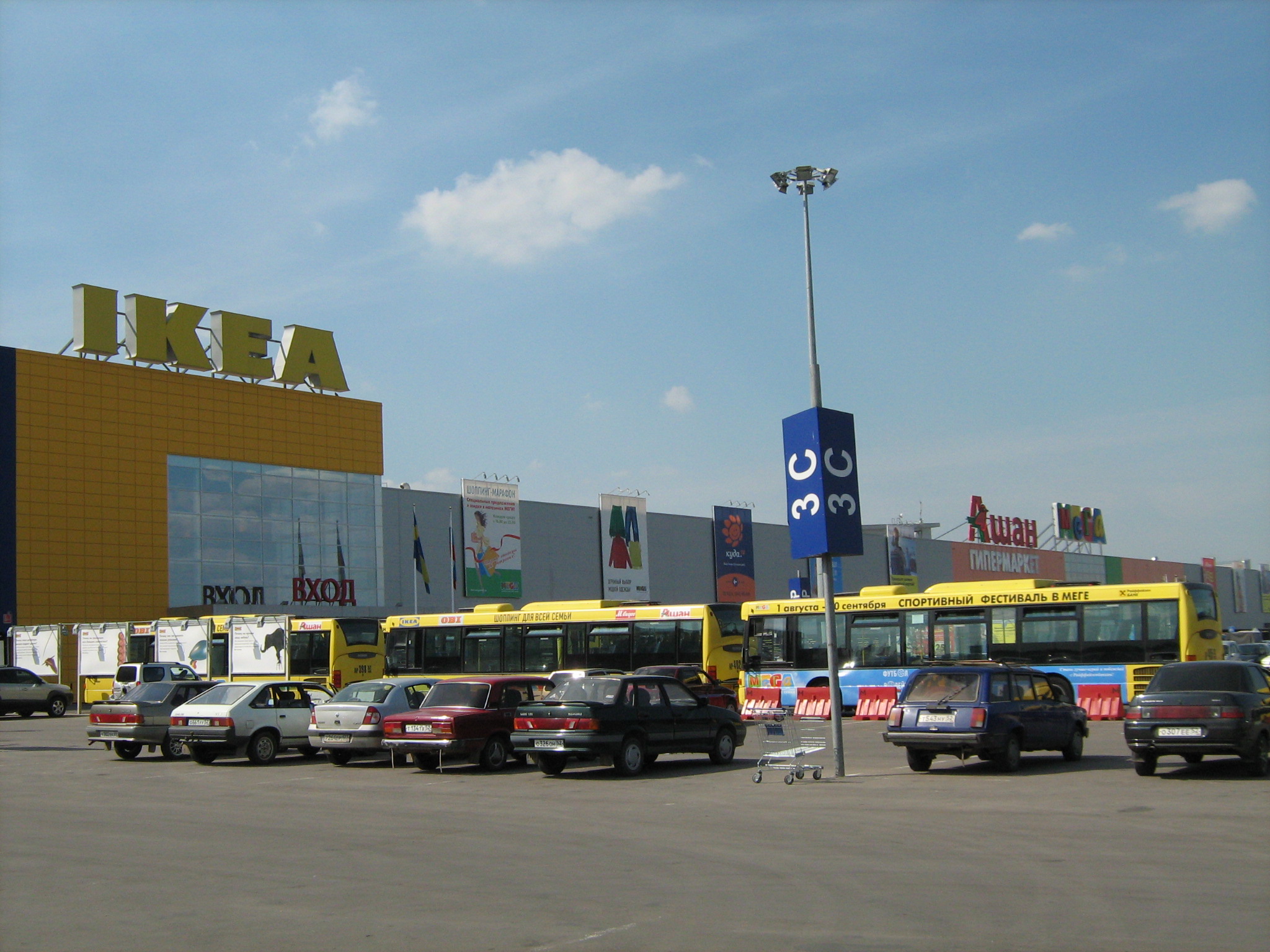

The oblast ranks seventh in Russia in industrial output. Processing industries predominate in the local economy. More than 650 industrial companies employ nearly 700,000 people, or 62% of the workforce involved in material production. Industry generates 83% of the regional GDP and accounts for 89% of all material expenditures. The leading sectors are engineering and metalworking, followed by chemical and petrochemical industries and forestry, woodworking, and paper industries. The first three sectors account for about 75% of all industrial production.
The oblast has traditionally been attractive to investors. In 2002, Moody's rating agency confirmed a Caa1rating based on the region's long-term foreign currency liabilities.

The region maintains trade relations with many countries and has an export surplus. The largest volume of exports goes to Ukraine, Belarus, Switzerland, Kazakhstan, Belgium, and France. Imports come mainly from Ukraine, Germany, Belarus, Kazakhstan, Austria, Netherlands, China, and the United States.
The stock market infrastructure is quite well developed in Nizhny Novgorod, and the exchange business is expanding. Companies and organizations registered in the region include 1153 joint-stock companies, 63 investment institutions, 34 commercial banks, 35 insurance companies, 1 voucher investment fund, 1 investment fund, 17 nongovernmental pension funds, 2 associations of professional stock market dealers, and 3 exchanges (stock, currency, and agricultural). The oblast is noted for having relatively highly developed market relations. Today, the region needs serious partners interested in equitable, long-term, mutually beneficial partnerships.
There are 650+ industrial companies in the region, most of them engaged in the following sectors:
- Machine-building and engineering
- Chemical & petrochemical
- Fuel & energy
- Ferrous and non-ferrous metallurgy
- Construction materials
- Glass
- Wood and paper
- Cloth-making
- Food & food processing
- Medical & pharmaceuticals
- Printing & publishing.
- Peat extraction. These key industries are supplemented by other sectors of the economy such as agriculture, trade, services, communications and transport.
Transportation
- The Altsevo peat narrow gauge railway is located in the work settlement of Pizhma
- The Pizhemskaya narrow gauge railway is located in the work settlement of Pizhma
- The narrow gauge railway of Caprolactam factory is located in Dzerzhinsk
- The Kerzhenets peat narrow gauge railway is located in the Borsky District
- The narrow gauge railway of Decor-1 factory is located in the Arzamassky District Narrow gauge railways in the region: File:Narrow gauge railway of Alcevskoye peat enterprise 2013.jpg| File:Narrow gauge railway of Caprolactam factory.png| File:Narrow gauge railway of Peshelan Gupsym mine.png| File:Narrow gauge railway of Kerzenetsc peat enterprise.png|
References
Notes
Sources
References
- Charter of Nizhny Novgorod Oblast, Article 5.5
- "Оценка численности постоянного населения по субъектам Российской Федерации". [[Federal State Statistics Service (Russia).
- Nizhny Novgorod Oblast Territorial Branch of the [[Russian Federal State Statistics Service. Federal State Statistics Service]]. [http://www.gks.ru/free_doc/new_site/population/demo/PrPopul.xls Оценка численности постоянного населения на 1 января 2014 года и в среднем за 2013 год] {{Webarchive. link. (December 25, 2018 {{in lang). ru
- "Нижегородская область. Административно-территориальное деление на 1 января 1992 г.". ГИПП "Нижполиграф", Нижний Новгород, 1993, стр. 5
- Charter of Nizhny Novgorod Oblast, Article 21
- link. (October 17, 2012)
- (September 26, 2017). "Путин отправил в отставку губернатора Нижегородской области".
- ''Т. Д. Николаенко''. «Археологическая карта России: Нижегородская область» // Москва, 2004.
- [http://www.knowbysight.info/1_RSFSR/00312.asp Нижегородская губерния]
- [http://www.knowbysight.info/1_RSFSR/00063.asp Нижегородская область - Нижегородский - Горьковский край - Горьковская - Нижегородская область]
- "Указ Президиума Верховного Совета РСФСР от 22 октября 1990 года «О переименовании города Горького в город Нижний Новгород и Горьковской области в Нижегородскую область»".
- "Общество | Информация о Нижегородской области | История Нижегородского края | Советский период | Административно-территориальное устройство". Правительство Нижегородской области.
- [http://constitution.garant.ru/history/ussr-rsfsr/1978/zakony/183094/chapter/89300effb84a59912210b23abe10a68f/ Закон Российской Федерации от 21 апреля 1992 года № 2708-I «Об изменениях и дополнениях Конституции (Основного Закона) Российской Советской Федеративной Социалистической Республики»]
- [http://www.politika.su/doc/zak90a.html Законы РСФСР/РФ 1990—1993 и поправки к ним до весны 1995]
- "Предварительная оценка численности постоянного населения на 1 января 2025 года". [[Federal State Statistics Service (Russia).
- {{ru-pop-ref. 2010Census
- (2011-12-19). "Перепись-2010: русских становится больше". Perepis-2010.ru.
- (21 February 2025). "Естественное движение населения в разрезе субъектов российской федерации за декабрь 2024 года".
- (2025-02-25). "Рейтинг рождаемости в регионах: кто в лидерах, а кто в аутсайдерах {{!}} Москва".
- "Демографический ежегодник России". [[Federal State Statistics Service (Russia).
- [http://www.kurs-n.nnov.ru/30.06.2006/rakurs-1.html Дарья ВЛАДИМИРОВА, "Стройки под особым контролем"]{{Dead link. (October 2022)
- [http://sreda.org/en/arena "Arena: Atlas of Religions and Nationalities in Russia"]. Sreda, 2012.
- [http://c2.kommersant.ru/ISSUES.PHOTO/OGONIOK/2012/034/ogcyhjk2.jpg 2012 Arena Atlas Religion Maps]. "Ogonek", № 34 (5243), 27/08/2012. Retrieved 21/04/2017. [https://web.archive.org/web/20170421154615/http://c2.kommersant.ru/ISSUES.PHOTO/OGONIOK/2012/034/ogcyhjk2.jpg Archived].
- [http://sreda.org/arena Arena – Atlas of Religions and Nationalities in Russia]. Sreda.org
- "Nizhegorodskaya oblast, Russia guide".
- "Nizhny Novgorod News Network – NN.NN.RU". Government.nnov.ru.
This article was imported from Wikipedia and is available under the Creative Commons Attribution-ShareAlike 4.0 License. Content has been adapted to SurfDoc format. Original contributors can be found on the article history page.
Ask Mako anything about Nizhny Novgorod Oblast — get instant answers, deeper analysis, and related topics.
Research with MakoFree with your Surf account
Create a free account to save articles, ask Mako questions, and organize your research.
Sign up freeThis content may have been generated or modified by AI. CloudSurf Software LLC is not responsible for the accuracy, completeness, or reliability of AI-generated content. Always verify important information from primary sources.
Report