From Surf Wiki (app.surf) — the open knowledge base
Nitrogen-vacancy center
Point defect in diamonds
Point defect in diamonds
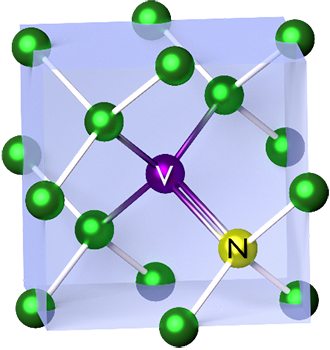
The nitrogen-vacancy center (N-V center or NV center) is one of numerous photoluminescent point defects in diamond. It consists of a nearest-neighbor pair of a nitrogen atom, which substitutes for a carbon atom, and a lattice vacancy.
The most explored and useful properties of an NV center include its spin-dependent photoluminescence (which enables measurement of the electronic spin state using optically detected magnetic resonance), and its relatively long spin coherence at room temperature, lasting up to milliseconds. The NV center energy levels are modified by magnetic fields, electric fields, temperature, and strain, which allow it to serve as a sensor of a variety of physical phenomena. Its atomic size and spin properties can form the basis for useful quantum sensors.
NV centers enable nanoscale measurements of magnetic and electric fields, temperature, and mechanical strain with improved precision. External perturbation sensitivity makes NV centers ideal for applications in biomedicine—such as single-molecule imaging and cellular process modeling. NV centers can also be initialized as qubits and enable the implementation of quantum algorithms and networks. It has also been explored for applications in quantum computing (e.g. for entanglement generation), quantum simulation, and spintronics.
Production
Main article: Crystallographic defects in diamond
Natural NV centers are randomly oriented within a diamond crystal. Ion implantation techniques can enable their artificial creation in predetermined positions, as follows.
Nitrogen-vacancy centers are typically produced from single substitutional nitrogen centers (called C or P1 centers in diamond literature) by irradiation followed by annealing at temperatures above 700 °C. A wide range of high-energy particles is suitable for such irradiation, including electrons, protons, neutrons, ions, and gamma photons. Irradiation produces lattice vacancies, which are a part of NV centers. Those vacancies are immobile at room temperature, and annealing is required to move them. Single substitutional nitrogen produces strain in the diamond lattice; it therefore efficiently captures moving vacancies, producing the NV centers.
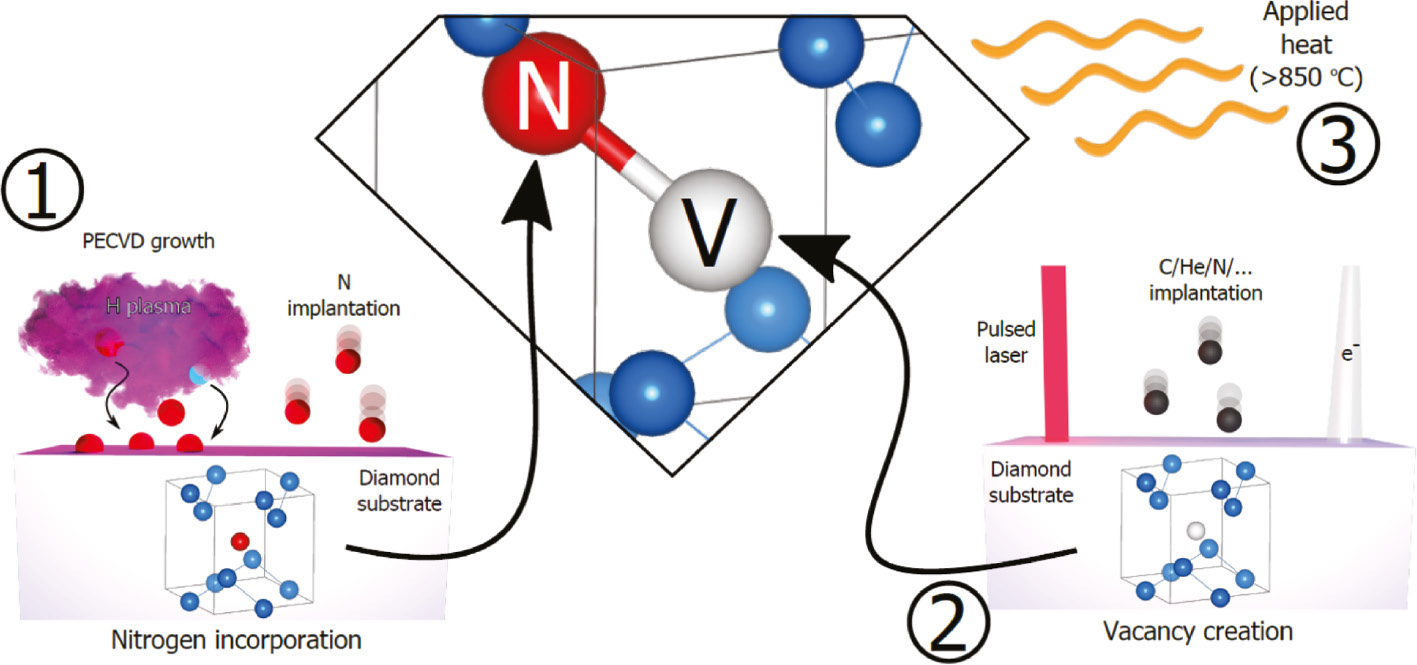
During chemical vapor deposition of diamond, a small fraction of single substitutional nitrogen impurity (typically
Diamond is notorious for having a relatively large lattice strain. Strain splits and shifts optical transitions from individual centers resulting in broad lines in the ensembles of centers. Special care is taken to produce extremely sharp NV lines (line width ~10 MHz) required for most experiments: high-quality, natural (type IIa) diamonds are selected, although synthetic diamonds are preferential. Many of them already have sufficient concentrations of grown-in NV centers and are suitable for applications. If not, they are irradiated by high-energy particles and annealed. Selection of a certain irradiation dose allows tuning the concentration of produced NV centers such that individual NV centers are separated by micrometre-large distances. Then, individual NV centers can be studied with standard optical microscopes or, better, near-field scanning optical microscopes having sub-micrometre resolution.
Structure

The nitrogen-vacancy center is a point defect in the diamond lattice. It consists of a nearest-neighbor pair of a nitrogen atom, which substitutes for a carbon atom, and a lattice vacancy.
Two charge states of this defect, neutral NV0 and negative NV−, exist. The NV0 centers can be converted into NV− by changing the Fermi level position with an external voltage (see ).
On the one hand, the neutral state is not generally used for quantum technology. The NV− state is commonly, and somewhat incorrectly, called "the nitrogen-vacancy center". On the other hand, the modern, detailed structural understanding of the system originates from theoretical considerations and recent electron resonance (EPR) and optically detected magnetic resonance (ODMR) studies on the paramagnetic NV0 state.Several theoretical works have also attempted to treat the system as a molecule and build molecular orbitals using the Linear Combination of Atomic Orbitals (LCAO) approach. Other spectroscopies used to describe the system's general structure include optical absorption and photoluminescence (PL).
In the neutral NV0, the nitrogen atom has five valence electrons. Three are covalently bonded to adjacent lattice carbon atoms, while the other two remain a non-bonded lone pair.
The vacancy carries three valence electrons. Two of them form a quasi covalent bond and one remains unpaired. The overall symmetry, however, is axial (trigonal C3V); one can visualize this by imagining the three unpaired vacancy electrons continuously exchanging their roles in a quantum superposition.
In the negative charge state NV−, an extra electron is located at the vacancy site forming a spin S=1 pair with one of the vacancy electrons. This extra electron induces spin triplet ground states of the form |3A⟩ and excited states of the form |3E⟩. There is an additional metastable state that exists between these spin triplets, that often manifests as a singlet. As in NV0, the vacancy electrons preserve the overall trigonal symmetry. [[File:NV-energy-levels.svg|thumb|298x298px|Schematic energy level structure of the NV center. Electron transitions between the ground 3A and excited 3E states, separated by 1.945 eV (637 nm), produce absorption and luminescence. The 3A state is split by 2.87 GHz and the 3E state by 1.42 GHz. Numbers 0, ±1 indicate spin quantum number ms; splitting due to the orbital degeneracy is not shown.]]
Energy levels
A NV center has a ground-state triplet (3A), an excited-state triplet (3E) and two intermediate-state singlets (1A and 1E). Both 3A and 3E contain ms = ±1 spin states, in which the two electron spins are aligned (either up, such that ms = +1 or down, such that ms = -1), and an ms = 0 spin state where the electron spins are antiparallel. Due to the magnetic interaction, the energy of the ms = ±1 states is higher than that of the ms = 0 state. 1A and 1E only contain a spin state singlet each with ms = 0.Group theory results are used to take into account the symmetry of the diamond crystal, and so the symmetry of the NV itself. Followingly, the energy levels are labeled according to group theory, and in particular are labelled after the irreducible representations of the C3V symmetry group of the defect center, A1, A2, and E. The "3" in 3A2 and 3E as well as the "1" in 1A1 and 1E represent the number of allowable ms spin states, or the spin multiplicity, which range from –S to S for a total of 2S+1 possible states. If S = 1, ms can be −1, 0, or 1.
As discussed below, many properties of the environment affect the precise energy levels and population of the system states:
- Amplitude and orientation of a static magnetic field splits the ms = ±1 levels in the ground and excited states.
- Amplitude and orientation of elastic (strain) or electric fields have a much smaller but also more complex effects on the different levels.
- Continuous-wave microwave radiation (applied in resonance with the transition between ms = 0 and (one of the) ms = ±1 states) changes the population of the sublevels within the ground and excited state.
- A tunable laser can selectively excite certain sublevels of the ground and excited states.
- Surrounding spins and spin–orbit interaction will modulate the magnetic field experienced by the NV center.
- Temperature and pressure affect different parts of the spectrum including the shift between ground and excited states.
Electromagnetic coupling
The Hamiltonian dynamics of a NV center are approximated extremely well by the following sum of interactions with the electromagnetic field:

Each term in the Hamiltonian can be measured under the right conditions.
Optical properties
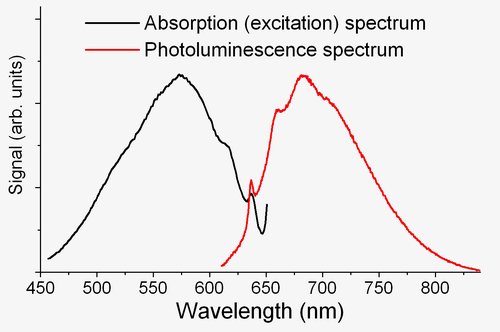
NV centers emit bright red light (3E→3A transitions), if excited off-resonantly by visible green light (3A →3E transitions). This can be done with convenient light sources such as argon or krypton lasers, frequency doubled Nd:YAG lasers, dye lasers, or He-Ne lasers. Excitation can also be achieved at energies below that of zero phonon emission.
As the relaxation time from the excited state is small (~10 ns), the emission happens almost instantly after the excitation. At room temperature the NV center's optical spectrum exhibits no sharp peaks due to thermal broadening. However, cooling the NV centers with liquid nitrogen or liquid helium dramatically narrows the lines down to a width of a few MHz. At low temperature it also becomes possible to specifically address the zero-phonon line (ZPL).
An important property of the luminescence from individual NV centers is its high temporal stability. Whereas many single-molecular emitters bleach (i.e. change their charge state and become dark) after emission of 106–108 photons, bleaching is unlikely for NV centers at room temperature. Strong laser illumination, however, may also convert some NV− into NV0 centers.
Because of these properties, the ideal technique to address the NV centers is confocal microscopy, both at room temperature and at low temperature.
State manipulation
Temperature and pressure directly influence the zero-field term of the NV center leading to a shift between the ground and excited state levels.[File:NV-transitions.svg|thumb|289x289px|Spin dynamics in the NV center in diamond. The primary transition between the ground and excited state triplets is spin conserving. Decay via the intermediate singlets gives rise to spin polarization by converting spin from ms = ±1 to ms = 0. Both absorption and emission wavelengths are indicated, since they differ due to [Stokes shift.{{Cite journal|last1=Rogers|first1=L. J.|last2=Doherty|first2=M. W.|last3=Barson|first3=M. S. J.|last4=Onoda|first4=S.|last5=Ohshima|first5=T.|last6=Manson|first6=N. B.|date=2015-01-01|title=Singlet levels of the NV − centre in diamond|journal=New Journal of Physics| volume=17|issue=1|article-number=013048|doi=10.1088/1367-2630/17/1/013048|arxiv = 1407.6244 |bibcode = 2015NJPh...17a3048R |s2cid=43745993}} Furthermore, the effect of a static magnetic field B0 along the defect axis and the resulting Zeeman shift is indicated. Here, γnv refers to the gyromagnetic ratio of the NV center. In many applications two of the ground-state levels are then used as a qubit. Transitions in this effective two-level system may be induced using a microwave field. 3E-1A and 1E-3A are non-radiative transitions.]]
Radiative and non-radiative transitions
Optical transitions must preserve the total spin and occur only between levels of the same total spin. Specifically, transitions between the ground and excited states (with equal spin) can be induced using a green laser with a wavelength of 546 nm. Transitions 3E→1A and 1E→3A are non-radiative, while 1A →1E has both a non-radiative and infrared decay path.
The non-radiative transition between 3E and 1A is stronger for ms = ±1 and weaker for ms = 0. This asymmetry enables optical spin-polarization, which initializes the quantum state of a qubit for quantum information processing or quantum sensing. To understand the process, first consider an off-resonance excitation which has a higher frequency (typically 2.32 eV (532 nm)) than all transitions and thus couples to each transition through vibron excitation. A pulse of this wavelength will excite all spin states to 3E. Because the transition to 1A is weak for ms = 0, the spin-zero states radiate back to 3A. But states with ms = ±1 often decay nonradiatively to 1A, at which point the system is in a ms = 0 state. Further decay from 1A tends to preserve ms = 0, and after many cycles the system is in the ms = 0 ground state with high probability.
Static external fields
Microwave irradiation
The energy difference between the ms = 0 and ms = ±1 states corresponds to the microwave regime. Population can be transferred between the states by applying a resonant magnetic field perpendicular to the defect axis. Numerous dynamic effects (spin echo, Rabi oscillations, etc.) can be exploited by applying a carefully designed sequence of microwave pulses. Such protocols are rather important for the practical realization of quantum computers. By manipulating the population, it is possible to shift the NV center into a more sensitive or stable state. Its own resulting fluctuating fields may also be used to influence the surrounding nuclei or protect the NV center itself from noise. This is typically done using a wire loop (microwave antenna) which creates an oscillating magnetic field.
Locally constant fields
If a magnetic field is oriented along the defect axis, the Zeeman effect splits the ms = +1 from the ms = -1 states. This technique is used to lift the spin degeneracy and use only two of the spin states (usually the ground states with ms = -1 and ms = 0) as a qubit. In the specific instance that the magnetic field reaches 1028 G (or 508 G) then the ms = –1 and ms = 0 states in the ground (respectively excited) state become equal in energy. In such cases, the spin polarization technique detailed above becomes inefficient.
Zeeman splitting can also be modulated with an external electric field, although the physics of the splitting is somewhat more complex. Crystal strain has a similar effect on the NV center as electric fields.
The hyperfine interactions with nuclear spin (the nuclear Zeeman and quadrupole interactions) also split the ms = ±1 energy levels. Optical pumping can coherently map of the spin states of the nitrogen nucleus to that of the NV center under the application of external magnetic field transverse to the NV symmetry axis. Also the NV center's own spin–orbit interaction and orbital degeneracy leads to additional level splitting in the excited 3E state.
Net charge
It is also possible to switch the charge state of the NV center (i.e. between NV−, NV+ and NV0) by applying a gate voltage. The gate voltage electrically shifts the Fermi level at the diamond surface and changes its surface band bending. Upon varying the gate voltage, individual centers are allowed to switch from an unknown non-fluorescent state to the neutral charge state NV0. The ensemble of centers can be transitioned from NV0 to the qubit state NV−. The diamond surface termination additionally influences the charge state of near-surface NV centers. Oxygen termination is known to stabilize the NV−state by reducing surface conductivity and mitigating band bending. This improves charge state stability and coherence. In a similar capacity, nitrogen termination also affects surface properties and can optimize NV centers for specific sensing applications.
Optical excitation methods additionally play a role in charge state manipulation. Illumination with specific wavelengths can induce transitions between charge states. Near-infrared light at 1064 nm has been shown to convert NV0 to NV−, enhancing photoluminescence. Additionally, it has been demonstrated that NV+ centers can be switched to NV0 by photons with energies \geq 1.23 eV.
Applications

(b) ODMR spectra of the NV center at three temperatures. The line splitting originates from a ~1 mT applied magnetic field.
(c) Thermal conductivity image of a gold letter E on sapphire. White circles indicate features that do not correlate with the AFM topography. (d) PL image of the AFM cantilever end and tip where the diamond nanocrystal appears as the bright spot. (e) Zoomed PL image of the NV center in d.]] The NV energy structure is by no means exceptional for a defect in diamond or other semiconductor. It was not this structure alone, but a combination of several favorable factors (previous knowledge, easy production, biocompatibility, simple initialisation, use at room temperature etc.) which suggested the use of the NV center as a qubit and quantum sensor.
The NV center can have a very long spin coherence time approaching the second regime. This is advantageous for applications in quantum sensing and quantum communication. Disadvantageous for these applications is the long radiative lifetime (~12 ns ) of the NV center and the strong phonon sideband in its emission spectrum. Both issues can be addressed by putting the NV center in an optical cavity.
The spectral shape and intensity of the optical signals from the NV− centers are sensitive to external perturbation, such as temperature, strain, electric and magnetic field. However, the use of spectral shape for sensing those perturbation is impractical, as the diamond would have to be cooled to cryogenic temperatures to sharpen the NV− signals. A more realistic approach is to use luminescence intensity (rather than lineshape), which exhibits a sharp resonance when a microwave frequency is applied to diamond that matches the splitting of the ground-state levels. The resulting optically detected magnetic resonance signals are sharp even at room temperature, and can be used in miniature sensors. Such sensors can detect magnetic fields of a few nanotesla or electric fields of about 10 V/cm at kilohertz frequencies after 100 seconds of averaging. This sensitivity allows detecting a magnetic or electric field produced by a single electron located tens of nanometers away from an NV− center.
Using the same mechanism, the NV− centers were employed in scanning thermal microscopy to measure high-resolution spatial maps of temperature and thermal conductivity (see image).
Because the NV center is sensitive to magnetic fields, it is being actively used in scanning probe measurements to study myriad condensed matter phenomena both through measuring a spatially varying magnetic field or inferring local currents in a device.
Another possible use of the NV− centers is as a detector to measure the full mechanical stress tensor in the bulk of the crystal. For this application, the stress-induced splitting of the zero-phonon-line is exploited, and its polarization properties. A robust frequency-modulated radio receiver using the electron-spin-dependent photoluminescence that operated up to 350 °C demonstrates the possibility for use in extreme conditions.
In addition to the quantum optical applications, luminescence from the NV− centers can be applied for imaging biological processes, such as fluid flow in living cells.{{cite journal |display-authors=etal |access-date=2013-03-04 |archive-url=https://web.archive.org/web/20160304052905/http://aao.sinica.edu.tw/download/publication_list/en/149.pdf |archive-date=2016-03-04
Stimulated emission from the NV− center has been demonstrated, though it could be achieved only from the phonon side-band (i.e. broadband light) and not from the ZPL. For this purpose, the center has to be excited at a wavelength longer than ~650 nm, as higher-energy excitation ionizes the center.
The first continuous-wave room-temperature maser has been demonstrated. It used 532-nm pumped NV− centers held within a high Purcell factor microwave cavity and an external magnetic field of 4300 G. Continuous maser oscillation generated a coherent signal at ~9.2 GHz.
The intermediate metastable states 1A and 1E play a crucial role in enabling ground state depletion (GSD) microscopy.
Historical remarks
The microscopic model and most optical properties of ensembles of the NV− centers have been firmly established in the 1970s based on the optical measurements combined with uniaxial stress and on the electron paramagnetic resonance. However, a minor error in EPR results (it was assumed that illumination is required to observe NV− EPR signals) resulted in the incorrect multiplicity assignments in the energy level structure. In 1991 it was shown that EPR can be observed without illumination, which established the energy level scheme shown above. The magnetic splitting in the excited state has been measured only recently.
The characterization of single NV− centers has become a very competitive field nowadays, with many dozens of papers published in the most prestigious scientific journals. One of the first results was reported back in 1997.{{cite journal |display-authors = etal |access-date = 2017-03-16 |archive-date = 2017-03-16 |archive-url = https://web.archive.org/web/20170316205608/http://sites.fas.harvard.edu/~phys191r/References/d4/Gruber1997.pdf
Despite extensive efforts, electron paramagnetic resonance signals from NV0 avoided detection for decades until 2008. Optical excitation is required to bring the NV0 defect into the EPR-detectable excited state; the signals from the ground state are presumably too broad for EPR detection.
Notes
References
References
- (2006-10-26). "Room-temperature manipulation and decoherence of a single spin in diamond". Physical Review B.
- (October 2008). "Nanoscale magnetic sensing with an individual electronic spin in diamond". Nature.
- (June 2011). "Electric-field sensing using single diamond spins". Nature Physics.
- (August 2013). "Nanometre-scale thermometry in a living cell". Nature.
- (2011-02-28). "Properties of nitrogen-vacancy centers in diamond: the group theoretic approach". New Journal of Physics.
- (2017-07-25). "Quantum sensing". Reviews of Modern Physics.
- Savage, Neil. (2021-03-25). "Quantum diamond sensors". Nature.
- (May 2013). "Heralded entanglement between solid-state qubits separated by three metres". Nature.
- (March 2017). "Observation of discrete time-crystalline order in a disordered dipolar many-body system". Nature.
- (2013-03-08). "Quantum Spintronics: Engineering and Manipulating Atom-Like Spins in Semiconductors". Science.
- (2019-11-01). "Colour centre generation in diamond for quantum technologies". Nanophotonics.
- (2012). "Production of oriented nitrogen-vacancy color centers in synthetic diamond". Physical Review B.
- (2012-09-06). "Enhanced metrology using preferential orientation of nitrogen-vacancy centers in diamond". Physical Review B.
- (2023-02-01). "Two-dimensional spin systems in PECVD-grown diamond with tunable density and long coherence for enhanced quantum sensing and simulation". APL Materials.
- (June 2023). "Probing many-body dynamics in a two-dimensional dipolar spin ensemble". Nature Physics.
- (2014). "Quantum Information Processing with Diamond". Elsevier.
- (2015). "Active charge state control of single N-V centres in diamond by in-plane Al-Schottky junctions". Scientific Reports.
- (2000). "Photochromism of vacancy-related centres in diamond". [[Journal of Physics: Condensed Matter]].
- Ho, Kin On. (2021-06-28). "Recent developments of quantum sensing under pressurized environment using the nitrogen vacancy (NV) center in diamond". Journal of Applied Physics.
- Han, Kyu Young. (2010-08-11). "Metastable Dark States Enable Ground State Depletion Microscopy of Nitrogen Vacancy Centers in Diamond with Diffraction-Unlimited Resolution". Nano Letters.
- (1977). "Electron Spin Resonance in Annealed Type 1b Diamond". Diamond Research.
- (1978). "Electron spin resonance in the study of diamond". [[Reports on Progress in Physics]].
- (2008). "Excited-State Spectroscopy Using Single Spin Manipulation in Diamond". [[Physical Review Letters]].
- (2006-09-21). "Nitrogen-vacancy center in diamond: Model of the electronic structure and associated dynamics". Physical Review B.
- Gali, Ádám. (2019-11-01). "Ab initio theory of the nitrogen-vacancy center in diamond". Nanophotonics.
- (2006). "Stark Shift Control of Single Optical Centers in Diamond". [[Physical Review Letters]].
- (2008). "Spin-flip and spin-conserving optical transitions of the nitrogen-vacancy centre in diamond". [[New Journal of Physics]].
- (2006). "Coherent Population Trapping of Single Spins in Diamond under Optical Excitation". [[Physical Review Letters]].
- (2005). "Sub-threshold excitation of luminescene of defects in diamonds". [[Journal of Physics: Condensed Matter]].
- (1983). "Luminescence decay time of the 1.945 eV centre in type Ib diamond". [[Journal of Physics C]].
- (1997). "Measurement of decay time for the NV centre in Ib diamond with a picosecond laser pulse". [[Diamond and Related Materials]].
- (1997). "Scanning Confocal Optical Microscopy and Magnetic Resonance on Single Defect Centers". [[Science (journal).
- (2013-07-01). "The nitrogen-vacancy colour centre in diamond". Physics Reports.
- (2013-10-01). "Quantum computing with defects". MRS Bulletin.
- (2008). "Infrared emission of the NV centre in diamond: Zeeman and uniaxial stress studies". New Journal of Physics.
- (July 2013). "The nitrogen-vacancy colour centre in diamond". Physics Reports.
- (2011-01-01). "Spin dynamics in the optical cycle of single nitrogen-vacancy centres in diamond". New Journal of Physics.
- Choi, SangKook. (2012-01-01). "Mechanism for optical initialization of spin in NV". Physical Review B.
- (2006). "Room-temperature manipulation and decoherence of a single spin in diamond". Physical Review B.
- (2007). "Quantum Register Based on Individual Electronic and Nuclear Spin Qubits in Diamond". [[Science (journal).
- (2006). "Coherent Dynamics of Coupled Electron and Nuclear Spin Qubits in Diamond". Science.
- (2008). "Temporal Coherence of Photons Emitted by Single Nitrogen-Vacancy Defect Centers in Diamond Using Optical Rabi-Oscillations". [[Physical Review Letters]].
- (2004). "Observation of Coherent Oscillations in a Single Electron Spin". [[Physical Review Letters]].
- (October 2008). "Nanoscale magnetic sensing with an individual electronic spin in diamond". Nature.
- (2017-07-25). "Quantum sensing". Reviews of Modern Physics.
- (February 2014). "Quantum error correction in a solid-state hybrid spin register". Nature.
- (2015-12-14). "Continuous dynamical decoupling of a single diamond nitrogen-vacancy center spin with a mechanical resonator". Physical Review B.
- (2016-05-01). "Broadband, large-area microwave antenna for optically detected magnetic resonance of nitrogen-vacancy centers in diamond". Review of Scientific Instruments.
- (2014-07-10). "Strain Coupling of a Nitrogen-Vacancy Center Spin to a Diamond Mechanical Oscillator". Physical Review Letters.
- Bürgler, B.. (2023-06-10). "All-optical nuclear quantum sensing using nitrogen-vacancy centers in diamond". npj Quantum Information.
- Jarmola, A.. (2020-04-28). "Robust optical readout and characterization of nuclear spin transitions in nitrogen-vacancy ensembles in diamond". Physical Review Research.
- (2012). "Charge state manipulation of qubits in diamond". Nature Communications.
- Neethirajan, Jeffrey Neethi. (2023-04-12). "Controlled Surface Modification to Revive Shallow NV – Centers". Nano Letters.
- Ji, Peng. (2016-07-05). "Charge state dynamics of the nitrogen vacancy center in diamond under 1064-nm laser excitation". Physical Review B.
- M. Dickmann, L. Mathes, R. Helm, V. V. Burwitz, W. Egger, J. Mitteneder, C. Hugenschmidt, P. Sperr, M. Butterling, M. O. Liedke, A. Wagner, J. Dorner, T. Schwarz-Selinger, G. Dollinger. (2024). "Identification and Reversible Optical Switching of NV+ Centers in Diamond". Advanced Functional Materials.
- (2015). "Imaging thermal conductivity with nanoscale resolution using a scanning spin probe". Nature Communications.
- (2009). "Enhanced single-photon emission in the near infrared from a diamond color center". [[Physical Review B]].
- (2012). "Solid-state electronic spin coherence time approaching one second". Nature Communications.
- (2013). "Nanoscale Nuclear Magnetic Resonance with a Nitrogen-Vacancy Spin Sensor". Science.
- (2015). "Loophole-free Bell inequality violation using electron spins separated by 1.3 kilometres". Nature.
- (2018). "Material platforms for spin-based photonic quantum technologies". Nature Reviews Materials.
- (2016). "Determining the internal quantum efficiency of shallow-implanted nitrogen-vacancy defects in bulk diamond". Optics Express.
- (2013). "Coupling of a Single Nitrogen-Vacancy Center in Diamond to a Fiber-Based Microcavity". Physical Review Letters.
- (2008). "Nanoscale magnetic sensing with an individual electronic spin in diamond". Nature.
- (2011). "Electric-field sensing using single diamond spins". Nature Physics.
- (2018-07-13). "Magnetostatic twists in room-temperature skyrmions explored by nitrogen-vacancy center spin texture reconstruction". Nature Communications.
- (2022-08-17). "Imaging the Breakdown of Ohmic Transport in Graphene". Physical Review Letters.
- (2022-05-30). "Scanning nitrogen-vacancy magnetometry down to 350 mK". Applied Physics Letters.
- (2021-07-22). "Multiangle Reconstruction of Domain Morphology with All-Optical Diamond Magnetometry". Physical Review Applied.
- (2017-10-16). "Scanning diamond NV center probes compatible with conventional AFM technology". Applied Physics Letters.
- (2013). "Measurement of the full stress tensor in a crystal using photoluminescence from point defects: The example of nitrogen vacancy centers in diamond". Applied Physics Letters.
- (15 December 2016). "Diamond Radio Receiver: Nitrogen-Vacancy Centers as Fluorescent Transducers of Microwave Signals". Physical Review Applied.
- (2022-03-01). "Beauty beyond the Eye: Color Centers in Diamond Particles for Imaging and Quantum Sensing Applications". Reviews and Advances in Chemistry.
- (12 November 2018). "Fluorescent Nanodiamonds". Wiley.
- (May 2008). "Mass Production and Dynamic Imaging of Fluorescent Nanodiamonds". Nature Nanotechnology.
- (2011). "Diamond photonics". Nature Photonics.
- (2017). "Stimulated emission from nitrogen-vacancy centres in diamond". Nature Communications.
- (2018-03-21). "Continuous-wave room-temperature diamond maser". Nature.
- (22 March 2018). "A diamond age of masers". Nature.
This article was imported from Wikipedia and is available under the Creative Commons Attribution-ShareAlike 4.0 License. Content has been adapted to SurfDoc format. Original contributors can be found on the article history page.
Ask Mako anything about Nitrogen-vacancy center — get instant answers, deeper analysis, and related topics.
Research with MakoFree with your Surf account
Create a free account to save articles, ask Mako questions, and organize your research.
Sign up freeThis content may have been generated or modified by AI. CloudSurf Software LLC is not responsible for the accuracy, completeness, or reliability of AI-generated content. Always verify important information from primary sources.
Report