From Surf Wiki (app.surf) — the open knowledge base
Nissan VG engine

| Field | Value |
|---|---|
| name | Nissan VG engine |
| image | Nissan VG30E engine (1987 300ZX GL-L).jpg |
| caption | VG30E engine in a 1987 300ZX GL |
| manufacturer | Nissan (Nissan Machinery) |
| production | 1983–2004 |
| predecessor | Nissan L engine (Straight-six) |
| successor | Nissan VQ engine |
| configuration | 60° V6 |
| displacement | 1998 cc |
| 2960 cc | |
| 3275 cc | |
| bore | 78 mm |
| 87 mm | |
| 91.5 mm | |
| stroke | 69.7 mm |
| 83 mm | |
| block | Cast iron |
| head | Aluminum |
| valvetrain | SOHC 2 valves x cyl. |
| DOHC 4 valves x cyl. with NVTCS | |
| timing | Timing belt |
| supercharger | Single Eaton Roots-type M62 (2001-2004 VG33ER) |
| turbocharger | Single Garrett T3 (1983–1987 VG30ET; all VG30DET) |
| Single Garrett T25 (1988-1989 VG30ET) | |
| Twin Garrett/Mitsubishi T22/TB02 (1989-2000 VG30DETT) | |
| fueltype | Gasoline |
| oilsystem | Wet sump |
| coolingsystem | Water-cooled |
| power | 99-330 PS |
| torque | 149-388 Nm |
2960 cc 3275 cc 87 mm 91.5 mm 83 mm DOHC 4 valves x cyl. with NVTCS Single Garrett T25 (1988-1989 VG30ET) Twin Garrett/Mitsubishi T22/TB02 (1989-2000 VG30DETT) The VG engine is a family of V6 engines designed and produced by Nissan between 1983 and 2004. It was added to a new engine family name PLASMA (Powerful & Economic, Lightweight, Accurate, Silent, Mighty, Advanced).
Produced as Japan's (as well as Nissan's) first mass-produced V6 engines, the iron block/aluminum head 60° VG engine was produced in displacements between 2.0 and 3.3 liters. Early versions used SOHC cylinder heads with two valves per cylinder; later models featured DOHC cylinder heads, four valves per cylinder, a slightly different engine block and N-VCT, Nissan's own version of variable valve timing, delivering a smoother idle and more torque at low to medium engine speeds.
Both production blocks and head castings were used successfully in the Nissan GTP ZX-Turbo and NPT-90 race cars which won the IMSA GT Championship three years in a row.
Origins
Development of the VG series began in 1979 by Nissan Machinery, a former member of the Nissan Group keiretsu. The objective was to replace the inline 6 L engine, which traces its roots back to the Mercedes-Benz M180 engine introduced in 1951, with an all-new V6 engine.
Nissan engineers wanted the VG to have improved performance, fuel economy, reliability, and refinement, while being both lighter and more compact than its predecessor. The resulting engine was designed from scratch, sharing little to no mechanical components with its predecessor or any other automaker. Extensive computer design techniques were used during development, which made the VG series one of the most advanced and high-tech engines of its day.
The VG engine series featured a sequential multi-port fuel injection system, and Nissan's Electronic Concentrated Control System (ECCS). ECCS used a microprocessor and an oxygen sensor to control fuel delivery, spark timing, exhaust gas recirculation rate, and engine idle speed, depending on the current operating conditions of the engine. This system reduced carbon emissions, improved fuel economy, and improved engine performance during cold-start and warm-up conditions.
The advantages of the VG engine over its inline 6 predecessor was that its V6 configuration would have greater torsional rigidity for higher performance potential, and its shorter length would give Nissan designers and engineers more freedom for vehicle design, allowing for both more frontal crush zone space and transverse mounting for front-wheel-drive vehicles.
All VG engines use a timing belt to synchronize the camshafts with the crankshaft rather than a timing chain. The VG series engine was put into thousands of Nissan vehicles, debuting in Japan in the 1983 Nissan Gloria/Nissan Cedric and in the US and other markets in the 1984 Nissan 300ZX, making it the first V6 engines made by a Japanese manufacturer to be produced in mass-production.
After the introduction of the VQ engine in 1994, the VG engine was slowly phased out in Nissan cars, and after 2002 it was only available in the Nissan Frontier and Nissan Xterra. The VG engine was retired in 2004, by which time all V6-powered Nissans had switched to the VQ. The last vehicle powered by a VG series engine was the Y31 Nissan Cedric for fleet use, which kept use of the VG20P engine for more than 20 years until it was retired in 2007.
VG20E
The VG20E is a 1998 cc SOHC engine produced from 1983 on. It produces between 115 PS and 125 PS net. In the earlier gross rating system, early eighties' models claim 130 PS.
Applications:
- 1983–1987 Nissan Gloria/Nissan Cedric Y30
- 1987–1999 Nissan Gloria/Nissan Cedric Wagon/Van Y30
- 1986-1988 Nissan Bluebird Maxima U11
- 1986-1992 Nissan Leopard F31
- 1987–2002 Nissan Gloria/Nissan Cedric Y31
- 1991–1995 Nissan Gloria/Nissan Cedric Y32
- 1996–2002 Nissan Gloria/Nissan Cedric Y33
- 1997-1999 Nissan Leopard JY33
- 2000–2005 Hongqi Century Star - based on Hongqi CA7180 and 7202 Audi 100 based
VG20ET
The VG20ET was based on the VG20E, but with an added variable-geometry turbocharger. The VG20ET produces 170 hp. This SOHC motor debuted after the VG20E in 1984. Also coming with the Y30, this motor was known as the "Jet Turbo", and came with the Nissan Leopard models XS, and XS-II Grand Selection. Contrary to the VG30ET that came out in the US, the VG20ET came with an intercooler in certain models to push the horsepower output to 155 PS, a great jump from the normally aspirated VG20E. The turbo included with the VG20ET had two different settings. At low speeds, the turbo's wastegate would stay closed improving the response at low rpm. At high speeds, the flap would stay open, decreasing resistance and increasing exhaust flow. At its maximum flow, the flap would open at an angle of 27 degrees, while the A/R ranged from 0.21–0.77. Being that the VG20ET had a short stroke 78x69.7 mm, it was thought to have insufficient low end torque. Nevertheless, the VG20ET was a great improvement over the VG20E.
Applications:
- 1984–1989 Nissan 200Z (Z31)
- 1984–1989 Nissan 200ZG (Z31)
- 1984–1989 Nissan 200ZS (Z31)
- 1984–1989 Nissan Laurel Medallist (C32)
- 1986–1988 Nissan Leopard (F31)
- 1984–1990 Nissan Bluebird (PU11)
VG20DET
The VG20DET is an DOHC 1998 cc engine with a ceramic turbocharger and intercooler. It has a bore and a stroke of 78x69.7 mm and produces 210 PS. This engine features NVTCS (Nissan's Valve Timing Control System).
Applications:
- 1987—1999 Nissan Gloria/Nissan Cedric (Y31)
- 1988.08—1992.06 Nissan Leopard (F31)
VG20P
The VG20P is the Autogas (Liquified petroleum gas) version of the VG20. It produces 99 PS at 5,600 rpm and 149 Nm at 2,400 rpm. Later versions (2004–2005) produce 105 PS at 6,000 rpm and 152 Nm at 2,400 rpm. It is an overhead cam, twelve-valve engine.
Applications:
- 1987–2005 Nissan Cedric Y31
VG30S
The VG30S is a 2960 cc SOHC twelve-valve engine with an electronic carburettor which produces 148 PS at 4,800 rpm and 234 Nm at 3,600 rpm. This engine was mainly offered in export markets with more lenient environmental regulations, such as the Middle East and Africa.
Applications:
- Nissan Cedric Y31
- Nissan Laurel C32
VG30i
The VG30i is a 2960 cc engine produced from 1986 through 1989. It features a throttle body fuel injection system. It has a long crank snout, a cylinder head temperature sensor positioned behind the timing belt cover, and a knock sensor in the cylinder valley (on California models only). It produces 140 PS at 4,800 rpm and 226 Nm at 2,800 rpm.
Applications:
- 1986–1989 D21 Hardbody Truck
- 1986–1989 Nissan Pathfinder/Nissan Terrano
VG30E
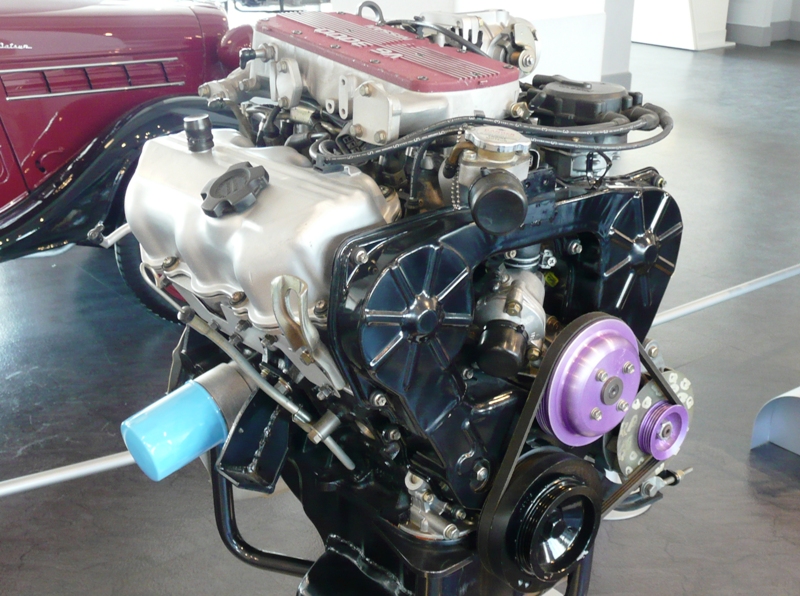
The 2960 cc VG30E produced 153 hp and 182 lbft. Bore and stroke is 87x83 mm. In the 300ZX, it produced 160 hp and 173 lbft of torque. In April 1987 the "W" series VG30 was released, adding 5 horsepower but leaving torque unchanged. In 1989, the Maxima received the 160 hp rating, but also used a variable intake plenum improving torque to 182 lbft at 3200 rpm.
Applications:
- 1984–1989 Nissan 300ZX 160 / 9.0:1 compression ratio for NA
- 1984–1989 Nissan Laurel
- 1985–1994 Nissan Maxima 160 hp
- 1987–1988 Nissan 200SX SE
- 1988–1996 Nissan Homy & Caravan series E24
- 1990–1992 Infiniti M30/Nissan Leopard
- 1990–1995 D21 Hardbody Truck
- 1990–1996 Nissan Pathfinder/Nissan Terrano
- 1992–1999 Nissan Gloria/Nissan Cedric 179 hp
- 1993–1998 Nissan Quest/Mercury Villager (modified to become a non-interference design)
- 2004-2006 Derways Cowboy
- Langley Speedway Pro 6
VG30ET
.jpg)
The 2960 cc VG30ET was available in early production with a single Garrett T3 turbocharger at 6.8 psi and a 7.8:1 compression ratio. The USDM and JDM version produced 200 PS and 227 lbft. European versions produced 230 hp and 252 lbft. When "W"-Series VG30 was released in April 1987, horsepower was increased to 205 PS. All 1987 models featured a T3 turbocharger at 6.8 psi. In 1988 the compression ratio was changed to 8.3:1 and turbocharged with a single Garrett T25 turbocharger at 4.5 psi to reduce turbo lag.
The engine specified as the VG30ET engine in the Nissan GTP ZX-Turbo Racecar, was a heavily modified VG30ET producing over 551 kW at 8,000 rpm, and over 686 Nm at 5,500 rpm.
Applications:
- 1984–1989 Nissan 300ZX Turbo (Z31)
- 1984–1986 Nissan Leopard F30
- 1984–1991 Nissan Cedric/Nissan Gloria
- 1985–1990 Nissan GTP ZX-Turbo (non-production)
- 1986 Nissan R86V Racecar (non-production)
VG30DE

The first DOHC 24 valve VG30DE engine was developed for the 1985 MID4 concept. The 2960 cc VG30DE produces 190 to and 198 lbft. Bore and stroke is 87x83 mm. Original Japanese market units claimed 185 PS. There are two versions of the VG30DE. The first was introduced in 1986 and was never sold in North America or other countries, and was exclusively offered on the Japanese 300ZR (Z31) and Nissan Leopard F31. The second was introduced in 1989, this time being sold outside of Japan and into North America and other countries in the 300ZX (Z32) and the Japan-only Cima. The VG30DE has two throttle bodies facing the front of the vehicle (Nissan 300ZX and Fairlady Z) or two throttle bodies to the left (sedans and 300ZR). It was also installed with N-VCT, an early form of variable valve timing.
Early VG30DEs used large oval intake ports, and round exhaust ports, though the flange was similar to the SOHC VG engine, bolt spacing was slightly different. Late VG30DE's used slightly smaller oval intake ports, and oval exhaust ports. The bolt spacing was shared with the round-port variant from earlier years.
Applications:
| Years | Model | Power output |
|---|---|---|
| 1985 | Nissan MID4 | Concept (Not-Production) |
| 1986–1989 | Nissan 300ZX Z31 (300ZR only) | 190 hp |
| 1990–1997 | Nissan 300ZX Z32 | 222 hp |
| 1989–2000 | Nissan Fairlady Z Z32 | 222 hp |
| 1986–1992 | Nissan Leopard F31 | 190 hp |
| 1992–1998 | Infiniti J30/Nissan Leopard J Ferie | 210 hp |
| 1992–1995 | Nissan Gloria and Cedric | 190 hp |
| 1989–1991 | Nissan Cima | 190 hp |
VG30DET
The VG30DET is a 2960 cc, 24-valve, DOHC, VTC-equipped engine equipped with a non-intercooled T3 (Nissan N1 Type) 4-bolt Garrett Turbo running between 7.5 and. Generating up to 255 PS and measuring 236 lbft depending on the production year and application, it is a single-turbo engine that was used from 1987 through 1995 in the Japanese market, and the predecessor to the VG30DETT engine.
While this engine is similar to the VG30DE, it used different heads and inlet manifold. Contrary to popular belief, it was not available in the Nissan 300ZR model - the 300ZR only had an early version of the (non-turbo) VG30DE. The engine was available in the Cedric, Gloria, Cima and Leopard chassis.
Applications:
- Nissan Cedric Y32 (1991–1994)
- Nissan Gloria Y32 (1991–1994)
- Nissan Cima FY31, FY32 (1988–1995)
- Nissan Leopard F31
- Autech Zagato Stelvio (based on the F31 Leopard) used a modified version with 280 PS @ 6000 rpm.
VG30DETT==
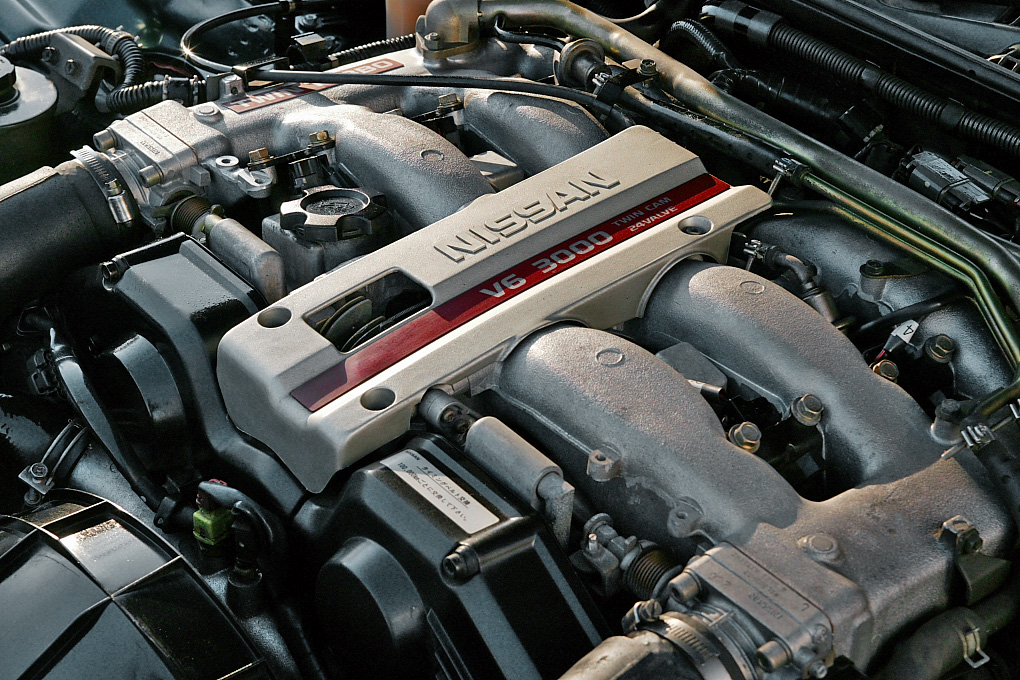
The VG30DETT is an iron block/aluminum head twin-turbo, twin intercooler 2960 cc version first seen in the 1987 MID4-II concept. Producing 330 PS in the MID-4 and coming in at a weight of 523 lb, it was the last of Nissan's DOHC belt-driven 4 valve per cylinder turbocharged engines put into production, following the CA18DET and RB20DET.
The engine's hybrid T22/TB02 twin-turbos were developed exclusively for Nissan, and it came with Nissan's NVTCS valve timing control system).
The production engine as used in the 1989–2000 300ZX (Z32) develops 304 PS at 6400 rpm and 283 lbft at 3600 rpm with a five-speed manual transmission, and 284 PS and 283 lbft of torque with a four-speed automatic transmission. JDM cars claimed 280 PS, due to a gentlemen's agreement by Japanese automobile manufacturers that was in effect at the time until 2005.
Applications:
- 1987 Nissan MID4-II Concept (non-production)
- 1989–2000 Nissan 300ZX/Fairlady Z32
- 1990–1993 Nissan NPT-90/NPT-91 racecars (non-production)
- 1997 BRM P301 (non-production)
VG33E
The VG33E is a 3275 cc cast iron block, aluminum head, SOHC version produced between 1996 and 2004. It has sequential fuel injection, two valves per cylinder with self-adjusting hydraulic followers, forged steel connecting rods, one-piece cast camshafts, and a cast aluminum lower intake manifold, with either a cast aluminum or plastic/composite upper intake manifold plenum.
Bore and stroke are 91.5x83 mm. Compression ratio is 8.9:1. Output is 170 or at 4,800 rpm, depending on year/vehicle, with 202 lbft of torque at 2,800 rpm.
The VG33E was built in Smyrna, Tennessee, and used in SUVs, pickups, and minivans.
Applications:
- 1996–2000 Nissan Pathfinder
- 1996–2004 Nissan Pathfinder In Australian Models
- 2003–2006 Nissan Navara In Australian Models
- 1997–2000 Infiniti QX4
- 1999–2004 Nissan Frontier
- 2000–2004 Nissan Xterra
- 1997–2002 Nissan Elgrand
- 1999–2002 Nissan Quest/Mercury Villager
- 1999–2004 Nissan Paladin
The VG33E reportedly remained in production in the Nissan Paladin (rebadged as Dongfeng Oting) as an optional engine for the Chinese market until 2015.
VG33ER
The 3275 cc VG33ER is a supercharged version of the VG33 only sold in North America. It produces 210 hp at 4,800 rpm with 246 lbft of torque at 2,800 rpm.
Applications:
- 2001–2004 Nissan Frontier SC
- 2002–2004 Nissan Xterra SC
References
References
- [https://nissan-heritage-collection.com/DETAIL/index.php?id=107] Nissan Heritage Collection - November 2019
- (1987-02-01). "Nissan V6 3.0 Litre, 4-Cam 24-Valve High Performance Engine". SAE Technical Paper.
- (2007). "別冊CG: 自動車アーカイヴ 80年代の日本". Nigensha.
- [https://web.archive.org/web/20070704180046/http://www.nissanperformancemag.com/september03/ask_sarah/ Answers to Readers Questions] By: Sarah Forst NissanPerformanceMag.com - September 2003
- {{usurped
This article was imported from Wikipedia and is available under the Creative Commons Attribution-ShareAlike 4.0 License. Content has been adapted to SurfDoc format. Original contributors can be found on the article history page.
Ask Mako anything about Nissan VG engine — get instant answers, deeper analysis, and related topics.
Research with MakoFree with your Surf account
Create a free account to save articles, ask Mako questions, and organize your research.
Sign up freeThis content may have been generated or modified by AI. CloudSurf Software LLC is not responsible for the accuracy, completeness, or reliability of AI-generated content. Always verify important information from primary sources.
Report