From Surf Wiki (app.surf) — the open knowledge base
Nissan Figaro
| Field | Value |
|---|---|
| image | Nissan Figaro.jpg |
| name | Nissan Figaro (E-FK10) |
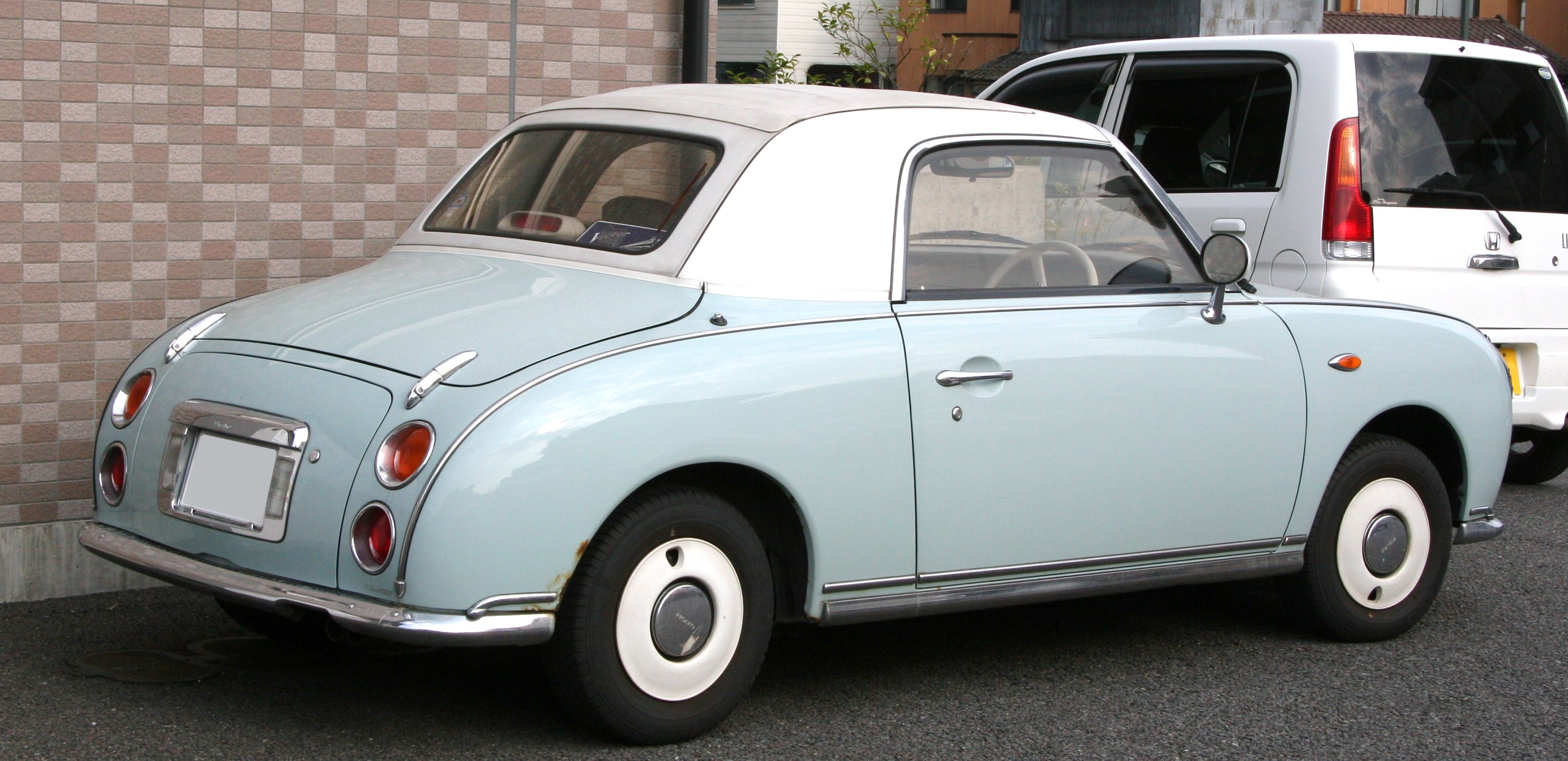
| caption | Nissan Figaro finished in Pale Aqua (summer). |
| manufacturer | Nissan |
| production | 1991 |
| 20,073 produced | |
| assembly | Oppama Plant, Yokosuka, Kanagawa, Japan |
| class | City car |
| body_style | 2-door fixed-profile convertible |
| layout | FF layout |
| engine | 987 cc MA10ET turbo I4 |
| transmission | 3-speed automatic |
| wheelbase | 2300 mm |
| length | 3740 mm |
| width | 1630 mm |
| height | 1365 mm |
| weight | 810 kg |
| related | |
| designer | Naoki Sakai and Shoji Takahashi |
20,073 produced
The Nissan Figaro is a two-door car manufactured by Nissan in 1991 for the Japanese market. Based on the original Nissan March/Micra, the Figaro is a fixed-profile convertible with a 2+2 seating arrangement. It shares the March's front-engine, front-wheel-drive layout. When new, it was sold only through Nissan Cherry Stores.
A total of 20,073 Figaros were produced by Nissan in the convertible's single year of series production, all with right-hand drive; at least several thousand have been grey imported to Great Britain and Ireland. There are a few examples of left-hand drive conversions for countries that have right-hand traffic.
Because of its origins at Pike Factory, Nissan's special project group, the Figaro (along with the Nissan Pao, Be-1, and S-Cargo) is one of Nissan's "Pike cars," and represented a design strategy that adapted "design and marketing strategies from other industries like personal electronics".
In 2011, design critic Phil Patton, writing for the New York Times, called the Pike cars "the height of postmodernism" and "unabashedly retro, promiscuously combining elements of the Citroën 2CV, Renault 4, Mini, and Fiat 500".
Design
Nissan introduced the Figaro at the 1989 Tokyo Motor Show, using "Back to the Future" as its marketing tagline. Based on the first-generation Nissan Micra, the Figaro was manufactured at Aichi Machine Industry, a special projects group that Nissan would later call "Pike Factory", which also produced three other niche vehicles: the Be-1, Pao, and S-Cargo. Aichi had originally built independent kei cars like the Cony 360 until Nissan assumed operations in 1966, and was also the original manufacturing location for the first generation Nissan Sunny.
Based on the Nissan March (Micra) platform, the Figaro uses a 1.0-liter (987 cc) turbocharged engine generating 76 PS and 78 lbft of torque through a three-speed automatic transmission, front MacPherson struts, rear four-link coil spring suspension, rack and pinion steering, and front ventilated disc and rear drum brakes. The Figaro can reach a top speed of 106 mph. It also featured front fenders made from thermoplastic resin to reduce weight.
The Figaro features a retro style design on both the interior and exterior, taking inspiration from cars of the 1950s such as the Renault Dauphine, as well as from elements of 1930s Art Deco design. Notable retro exterior design elements include the round headlights and taillights, chrome trim, fixed-profile convertible body style, and wheels designed to mimic whitewall tires.
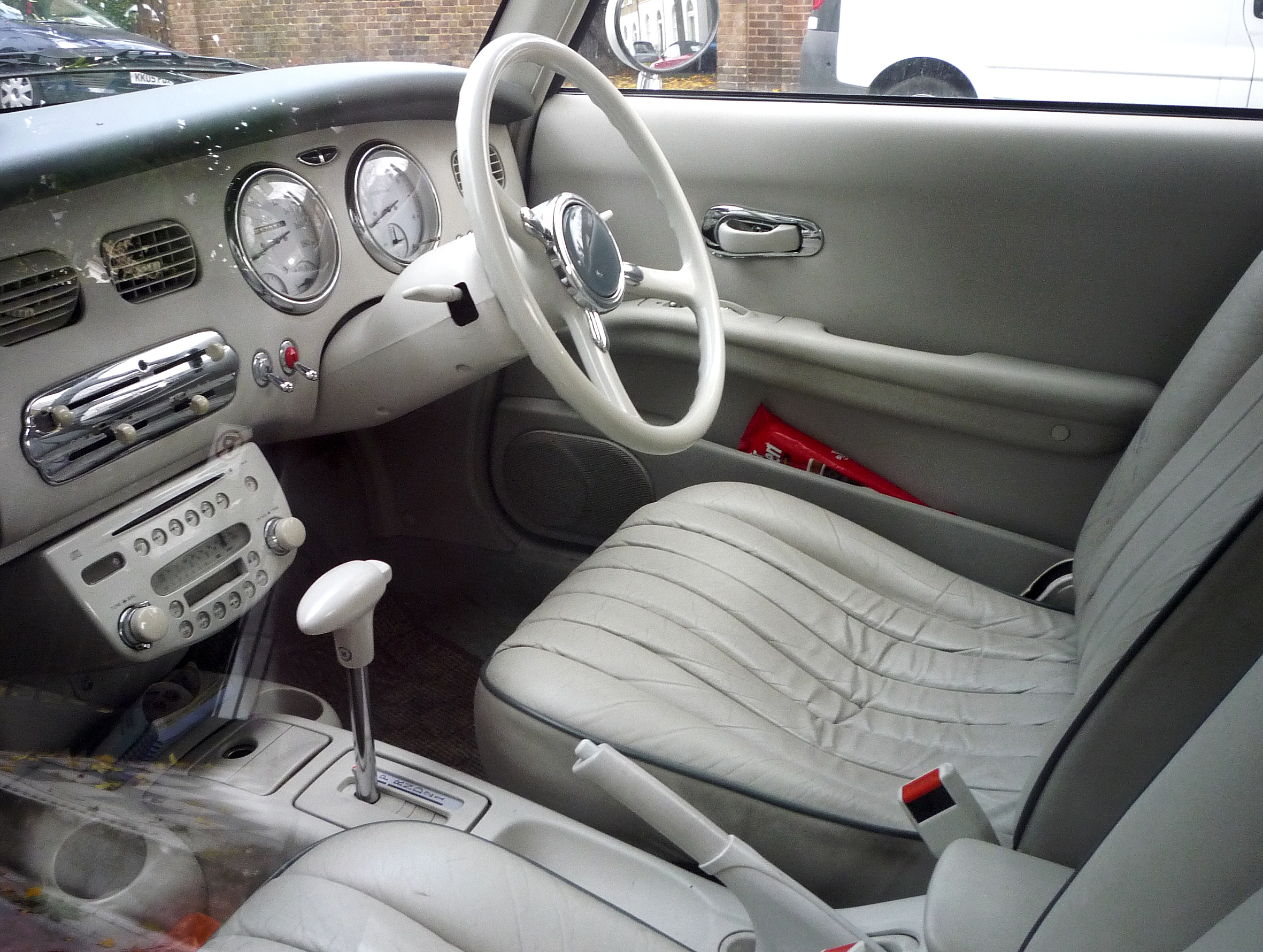
Standard equipment on the interior included ivory leather seats with contrasting piping, air conditioning, CD player, cassette tape player, chrome and Bakelite-style knobs, soft-feel paint on the dashboard top, chrome-trimmed speedometer with smaller inset gauges for fuel and engine temperature, and chrome-trimmed tachometer with inset clock.
As a fixed-profile convertible, the upper side elements of the Figaro's bodywork remain fixed while its fabric soft top retracts in conjunction with a solid panel with a defroster-equipped glass rear window—as seen in other fixed-profile convertibles, including the original 1957 Fiat 500 and the Citroën 2CV.
Exterior paint colors represented the four seasons: Topaz Mist (autumn), Emerald Green (spring), Pale Aqua (summer) and Lapis Grey (winter).
At first, 8,000 Figaros were manufactured, and then an additional 12,000 to meet demand. Prospective purchasers entered a lottery to acquire a Figaro. Limited edition cars came with passenger side baskets and cup holders.
References
References
- Saarinen, Martin. (6 July 2016). "Cult classic: celebrating 25 years of the Nissan Figaro". [[Auto Express]].
- Dodd, Mark. (April 15, 2017). "Nissan Figaro FK10 VIN Table". GTR-Registry.com.
- Baime, A.J.. (April 19, 2016). "How a Nissan Figaro Became an Instant Classic in the U.S.". The Wall Street Journal.
- "Nissan Figaro at 30: plotting the retro roadster's history".
- "Buying a used Nissan Figaro". The Irish Times.
- McAleer, Brendan. (2021-08-23). "This left-hand-drive Figaro proves nothing is impossible".
- "LHD – A look a left hand drive Nissan Figaros – LHD – A look a left hand drive Nissan Figaros – Figaro Owners Club".
- Patton, Phil. (March 18, 2011). "Nissan's Cartoon Cars, Once So Hip". The New York Times.
- McAleer, Brendan. (July 28, 2015). "No matter how you slice it, the pint-sized Nissan Figaro is just plain fun".
- Printz, Larry. (June 21, 2018). "Why you should want the adorable Nissan Figaro". Hagerty.com.
- "Nissan Figaro for Sale 1991".
- Pérez-Peña, Richard. (2019-01-11). "This Quirky Car Is Japanese. But There's 'Something Very British' About It.". The New York Times.
This article was imported from Wikipedia and is available under the Creative Commons Attribution-ShareAlike 4.0 License. Content has been adapted to SurfDoc format. Original contributors can be found on the article history page.
Ask Mako anything about Nissan Figaro — get instant answers, deeper analysis, and related topics.
Research with MakoFree with your Surf account
Create a free account to save articles, ask Mako questions, and organize your research.
Sign up freeThis content may have been generated or modified by AI. CloudSurf Software LLC is not responsible for the accuracy, completeness, or reliability of AI-generated content. Always verify important information from primary sources.
Report