From Surf Wiki (app.surf) — the open knowledge base
Nirvana
Liberation from repeated rebirth in saṃsāra

Liberation from repeated rebirth in saṃsāra
| Field | Value | ||||
|---|---|---|---|---|---|
| title | Nirvana | ||||
| AR | نيرفانا | ||||
| en | freedom, liberation, enlightenment | ||||
| sa | निर्वाण | ||||
| sa-Latn | nirvāṇa | ||||
| or | ନିର୍ବାଣ | ||||
| bn | নির্বাণ | ||||
| bn-Latn | nirbanô | ||||
| gu | નિર્વાણ | ||||
| gu-Latn | nirvāṇa | ||||
| hi | निर्वाण | ||||
| hi-Latn | nirvāṇa | ||||
| jv | ꦤꦶꦂꦮꦤ | ||||
| jv-Latn | nirwana | ||||
| ml | നിർവാണം | ||||
| ml-Latn | nirvanam | ||||
| kn | ನಿರ್ವಾಣ | ||||
| kn-Latn | nirvāṇa | ||||
| ne | निर्वाण | ||||
| ne-Latn | nirvāṇa | ||||
| pa | ਨਿਰਬਾਣ / | ||||
| pa-Latn | nirbāṇa | ||||
| or-Latn | nirbaana | ||||
| te | నిర్వాణం | ||||
| te-Latn | nirvanam | ||||
| ta | நிர்வாணம் | ||||
| ta-Latn | nirvanam | ||||
| mr-Latn | nirvāṇa | ||||
| mr | निर्वाण | ||||
| ur | |||||
| ur-Latn | nirvān | ban=ᬡᬶᬭ᭄ᬯᬵᬦᬵ | ban-Latn=Nirwānā | ks=نِروان | ks-Latn=nirvān |
the religious concept
|pi-Latn = |si-Latn = nivana |sa-Latn = nirvāṇa |zh-Latn = nièpán |mn-Latn = nirvaan dür |hi-Latn = nirvāṇa |mnw-Latn= nìppàn |my-Latn = neɪʔbàɰ̃ |ja-Latn = nehan |km-Latn = nĭpvéan |ko-Latn = yeolban |shn-Latn= nik3paan2 |th-Latn = nipphan |bo-Latn = mya ngan las 'das pa | sa-Latn = nirvāṇa | bn-Latn = nirbanô | gu-Latn = nirvāṇa | hi-Latn = nirvāṇa | jv-Latn = nirwana | ml-Latn = nirvanam | kn-Latn = nirvāṇa | ne-Latn = nirvāṇa | pa-Latn = nirbāṇa | or-Latn = nirbaana | te-Latn = nirvanam | ta-Latn = nirvanam | mr-Latn = nirvāṇa | ur-Latn = nirvān|ban=ᬡᬶᬭ᭄ᬯᬵᬦᬵ|ban-Latn=Nirwānā|ks=نِروان|ks-Latn=nirvān}}
Nirvana, in the Indian religions (Jainism, Hinduism, Buddhism, and Sikhism), is the concept of an individual's passions being extinguished as the ultimate state of salvation, release, or liberation from suffering (duḥkha) and from the cycle of birth and rebirth (saṃsāra).
In Indian religions, nirvana is sometimes used as a synonym of moksha and mukti. All Indian religions assert it to be a state of perfect quietude, freedom, and highest happiness; liberation from attachment and worldly suffering; and the ending of samsara, the cycle of existence. However, non-Buddhist and Buddhist traditions describe these terms for liberation differently. In Hindu philosophy, it is the union of or the realization of the identity of Atman with Brahman, depending on the Hindu tradition. In Jainism, nirvana is also the soteriological goal, representing the release of a soul from karmic bondage and samsara. The Buddhist concept of nirvana is the abandonment of the 10 fetters, marking the end of rebirth by stilling the "fires" that keep the process of rebirth going.
Etymology
The ideas of spiritual liberation, with the concept of soul and Brahman, appear in Vedic texts and Upanishads, such as in verse 4.4.6 of the Brihadaranyaka Upanishad.
The term nirvana in the soteriological sense of "blown out, extinguished" state of liberation appears at many places in the Vedas and even more in the post-Buddhist Bhagavata Purana, however populist opinion does not give credit to either the Vedas or the Upanishads. Collins states, "the Buddhists seem to have been the first to call it nirvana." This may have been deliberate use of words in early Buddhism, suggests Collins, since Atman and Brahman were described in Vedic texts and Upanishads with the imagery of fire, as something good, desirable and liberating. Collins says the word nirvāṇa is from the verbal root sa "blow" in the form of past participle sa "blown", prefixed with the preverb sa meaning "out". Hence the original meaning of the word is "blown out, extinguished". (Sandhi changes the sounds: the v of sa causes sa to become sa, and then the r of sa causes retroflexion of the following n: sa+sa nirvāṇa). However the Buddhist meaning of nirvana also has other interpretations.
L. S. Cousins said that in popular usage nirvana was "the goal of Buddhist discipline,... the final removal of the disturbing mental elements which obstruct a peaceful and clear state of mind, together with a state of awakening from the mental sleep which they induce."
Overview
Nirvāṇa is a term found in the texts of all major Indian religions – Hinduism, Jainism, Buddhism, and Sikhism. It refers to the profound peace of mind that is acquired with moksha, liberation from samsara, or release from a state of suffering, after respective spiritual practice or sādhanā.
The liberation from Saṃsāra developed as an ultimate goal and soteriological value in the Indian culture, and called by different terms such as nirvana, moksha, mukti and kaivalya. This basic scheme underlies Hinduism, Jainism and Buddhism, where "the ultimate aim is the timeless state of moksa, or, as the Buddhists first seem to have called it, nirvana." Although the term occurs in the literatures of a number of ancient Indian traditions, the concept is most commonly associated with Buddhism. Some writers believe the concept was adopted by other Indian religions after it became established in Buddhism, but with different meanings and description, for instance the use of (Moksha) in the Hindu text Bhagavad Gita of the Mahabharata.
The idea of moksha is connected to the Vedic culture, where it conveyed a notion of amrtam, "immortality", and also a notion of a timeless, "unborn", or "the still point of the turning world of time". It was also its timeless structure, the whole underlying "the spokes of the invariable but incessant wheel of time". The hope for life after death started with notions of going to the worlds of the Fathers or Ancestors and/or the world of the Gods or Heaven.
The earliest Vedic texts incorporate the concept of life, followed by an afterlife in heaven and hell based on cumulative virtues (merit) or vices (demerit). However, the ancient Vedic Rishis challenged this idea of afterlife as simplistic, because people do not live an equally moral or immoral life. Between generally virtuous lives, some are more virtuous; while evil too has degrees, and either permanent heaven or permanent hell is disproportionate. The Vedic thinkers introduced the idea of an afterlife in heaven or hell in proportion to one's merit, and when this runs out, one returns and is reborn. The idea of rebirth following "running out of merit" appears in Buddhist texts as well. This idea appears in many ancient and medieval texts, as Saṃsāra, or the endless cycle of life, death, rebirth and redeath, such as section 6:31 of the Mahabharata and verse 9.21 of the Bhagavad Gita. The Saṃsara, the life after death, and what impacts rebirth came to be seen as dependent on karma.
Buddhism
Main article: Nirvana (Buddhism)
Nirvana (nibbana) literally means "blowing out" or "quenching". It is the most used as well as the earliest term to describe the soteriological goal in Buddhism: the extinguishing of the passions, which also gives release from the cycle of rebirth (saṃsāra). Nirvana is part of the Third Truth on "cessation of dukkha" in the Four Noble Truths doctrine of Buddhism. It is the goal of the Noble Eightfold Path.
The Buddha is believed in the Buddhist scholastic tradition to have realized two types of nirvana, one at awakening, and another at his death. The first is called sa (nirvana with a remainder), the second parinirvana or sa (nirvana without remainder, or final nirvana).
In the Buddhist tradition, nirvana is described as the extinguishing of the fires, which are also said to cause rebirths and associated suffering. The Buddhist texts identify these "three fires" or "three poisons" as raga (greed, sensuality), dvesha (aversion, hate) and avidyā or moha (ignorance, delusion).
The state of nirvana is also described in Buddhism as cessation of all afflictions, cessation of all actions, cessation of rebirths and suffering that are a consequence of afflictions and actions, a fire going out for lack of fuel, abandoning weaving (vana) together of life after life, and the elimination of desire.
Liberation is described as identical to anatta (sa, non-self, lack of any self). In Buddhism, liberation is achieved when all things and beings are understood to be with no Self. Nirvana is also described as identical to achieving sunyata (emptiness), where there is no essence or fundamental nature in anything, and everything is empty. Yet, in Theravada Buddhism it is also seen as the only unconditioned existent,{{cite book|author=John J. Makransky|url=https://books.google.com/books?id=I4qmkptncxQC|title=Buddhahood Embodied: Sources of Controversy in India and Tibet|date=1997|publisher=State University of NYP
Hinduism
Although the most ancient texts of Hinduism, such as the Vedas and early Upanishads, discuss a very closely related and borderline equivalent concept, with the soteriological term Moksha, they do not mention the soteriological term Nirvana. The earliest attestation of the term 'Nirvana' is found in texts such as the Bhagavad Gita and the Nirvana Upanishad, likely composed in the post-Buddha era. However, the earliest attestation of the term Nirvana in Buddhist texts is attributed to the Nikayas of the Sutta Pitaka, whose claim of First Buddhist Council origin has been questioned by several historians. Several modern scholars doubt whether the entire canon was really recited during the First Council, because the early texts contain different accounts on important subjects such as meditation. Most scholars, from the late 19th century onward, have considered even the historicity of the First Council improbable. Some scholars, such as orientalists Louis de La Vallée-Poussin and D.P. Minayeff, thought there must have been assemblies after the Buddha's death but considered only the main characters and some events before or after the First Council historical.
The concept of Nirvana is described differently in Buddhist and Hindu literature. Hinduism has the concept of Atman – the soul, self – asserted to exist in every living being, while Buddhism asserts through its anatman doctrine that there is no Atman in any being. Nirvana in Buddhism is "stilling mind, cessation of desires, and action" unto emptiness, states Jeaneane Fowler, while nirvana in post-Buddhist Hindu texts is also "stilling mind but not inaction" and "not emptiness"; rather it is infiniteness, the knowledge of true Self (Atman) and the acceptance of its universality and unity with Brahman.
Moksha
Main article: Moksha
The ancient soteriological concept in Hinduism is moksha, described as the liberation from the cycle of birth and death through self-knowledge and the eternal connection of Atman (soul, self) and metaphysical Brahman. Moksha is derived from the root sa () which means free, let go, release, liberate; Moksha means "liberation, freedom, emancipation of the soul". In the Vedas and early Upanishads, the word mucyate () appears, which means to be set free or release – such as of a horse from its harness.
The traditions within Hinduism state that there are multiple paths () to moksha: sa, the path of knowledge; sa, the path of devotion; and sa, the path of action.
Brahma-nirvana in the ''Bhagavad Gita''
The term Brahma-nirvana appears in verses 2.72 and 5.24-26 of the Bhagavad Gita. It is the state of release or liberation; the union with the Brahman. According to Easwaran, it is an experience of blissful egolessness.
According to Zaehner, Johnson and other scholars, nirvana in the Gita is a Buddhist term adopted by the Hindus. Zaehner states it was used in Hindu texts for the first time in the Bhagavad Gita, and that the idea therein in verse 2.71–72 to "suppress one's desires and ego" is also Buddhist. According to Johnson the term nirvana is borrowed from the Buddhists to confuse the Buddhists, by linking the Buddhist nirvana state to the pre-Buddhist Vedic tradition of metaphysical absolute called Brahman.
According to Mahatma Gandhi, the Hindu and Buddhist understanding of nirvana are different because the nirvana of the Buddhists is shunyata, emptiness, but the nirvana of the Gita means peace and that is why it is described as brahma-nirvana (oneness with Brahman).
Jainism
Main article: Moksha (Jainism)

The terms moksa and nirvana are often used interchangeably in the Jain texts.
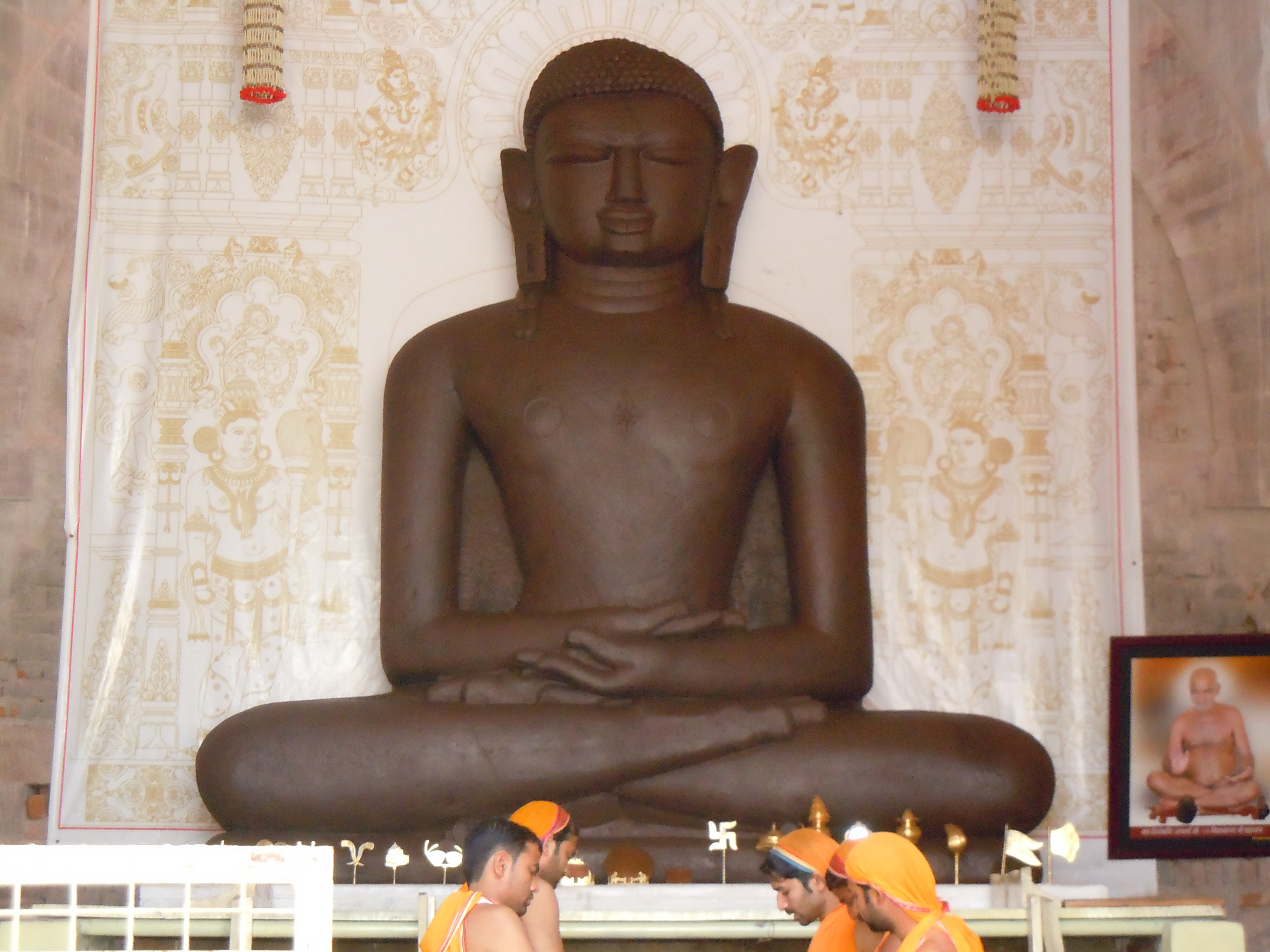
Uttaradhyana Sutra provides an account of Sudharman – also called Gautama, and one of the disciples of Mahavira – explaining the meaning of nirvana to Kesi, a disciple of Parshva.
Sikhism
The concept of liberation as "extinction of suffering", along with the idea of sansara as the "cycle of rebirth" is also part of Sikhism. Nirvana appears in Sikh texts as the term Nirban. However, the more common term is Mukti or Moksh, a salvation concept wherein loving devotion to God is emphasized for liberation from endless cycle of rebirths. In Sikhism Nirvana is not an after life concept but a goal for the living. Furthermore, Sikh nirvana/mukti is achieved through devotion to satguru/truth who sets you free from reincarnation bharam/superstition/false belief.
Manichaenism
The term Nirvana (also mentioned is parinirvana) is in the 13th or 14th century Manichaean work "The great song to Mani" and "The story of the Death of Mani", referring to the realm of light.
References
Notes
Citations
Works cited
References
- [http://dictionary.reference.com/browse/nirvana "nirvana"] {{Webarchive. link. (8 March 2016 . ''[[Random House Webster's Unabridged Dictionary]]''.)
- [[Richard Gombrich]], ''Theravada Buddhism: A Social History from Ancient Benāres to Modern Colombo.'' Routledge
- Chad Meister. (2009). "Introducing Philosophy of Religion". Routledge.
- (29 September 2023). "Donald S. lopez Jr., ''Nirvana'', Encyclopædia Britannica".
- Kristin Johnston Largen. (18 February 2009). "What Christians Can Learn from Buddhism: Rethinking Salvation". Fortress Press.
- "IN THE PRESENCE OF NIBBANA:Developing Faith in the Buddhist Path to Enlightenment". What-Buddha-Taught.net.
- "The Soka Gakkai Dictionary of Buddhism, ''vimoksha''".
- Gavin Flood, ''Nirvana''. In: John Bowker (ed.), '' Oxford Dictionary of World Religions''
- Anindita N. Balslev. (2014). "On World Religions: Diversity, Not Dissension". SAGE Publications.
- Loy, David. (1982). "Enlightenment in Buddhism and Advaita Vedanta". Philosophy Documentation Center.
- Brian Morris. (2006). "Religion and Anthropology: A Critical Introduction". Cambridge University Press.
- Gwinyai H. Muzorewa. (2000). "The Great Being". Wipf.
- John E. Cort (1990), MODELS OF AND FOR THE STUDY OF THE JAINS, Method & Theory in the Study of Religion, Vol. 2, No. 1, Brill Academic, pages 42–71
- Peter Harvey. (2001). "Buddhism". Bloomsbury Academic.
- Max Müller. (2011). "Theosophy Or Psychological Religion". Cambridge University Press.
- (2000). "The Concise Routledge Encyclopedia of Philosophy".
- Helmuth von Glasenapp. (1999). "Jainism: An Indian Religion of Salvation". Motilal Banarsidass.
- Pali Text Society. (1921–1925). "Bhāvanā". Chipstead.
- Monier-Williams. (1899). "Bhāvana" and "Bhāvanā".
- (1922). "Encyclopædia of Religion and Ethics". T. & T. Clark.
- Atsushi Hayakawa. (2014). "Circulation of Fire in the Veda". LIT Verlag Münster.
- (1997). "The Doctrine of Karma: Its Origin and Development in Brāhmaṇical, Buddhist, and Jaina Traditions". Bharatiya Vidya Bhavan.
- Patrul Rinpoche. (1998). "The Words of My Perfect Teacher". Shambhala.
- (2010). "The Bhagavad Gita: Twenty-fifth–Anniversary Edition". State University of New York Press.
- Yuvraj Krishan (1988), Is Karma Evolutionary?, Journal of Indian Council of Philosophical Research, Volume 6, pages 24–26
- Surendranath Dasgupta. (1956). "A History of Indian Philosophy". Cambridge University Press.
- Paul Deussen. (2015). "The System of the Vedanta: According to Badarayana's Brahma-Sutras and Shankara's Commentary thereon". KB Classics.
- "nirvana".
- Charles S. Prebish. (2010). "Buddhism: A Modern Perspective". Penn State Press.
- {{harvnb. Collins. 1990
- Sue Hamilton. (2000). "Early Buddhism: A New Approach : the I of the Beholder". Routledge.
- (2000). "Buddhist Thought". Routledge.
- Mun-Keat Choong. (1999). "The Notion of Emptiness in Early Buddhism". Motilal Banarsidass.
- Ray Billington. (2002). "Understanding Eastern Philosophy". Routledge.
- Max Müller. (2011). "Theosophy Or Psychological Religion". Cambridge University Press.
- Harvey, Peter (2013). ''An Introduction to Buddhism: Teachings, History and Practices''. 2nd ed. New York: Cambridge University Press. p. 88. ISBN 978-0-521-85942-4. [https://toleratedindividuality.files.wordpress.com/2015/10/an-introduction-to-buddhism-teachings-history-and-practices.pdf Online version]
- Gombrich, Richard (2006). ''How Buddhism Began: The Conditioned Genesis of the Early Teachings''. 2nd ed. Routledge. pp. 96–97. ISBN 978-0-415-37123-0.
- Prebish, Charles S. (2005) [1974]. "Review of Scholarship on Buddhist Councils". In Williams, Paul (ed.). ''Buddhism: Critical Concepts in Religious Studies, Vol. 1: Early History in South and Southeast Asia''. Routledge. p. 226. ISBN 0-415-33227-3.
- Mukherjee, B. (1994). "The Riddle of the First Buddhist Council – A Retrospection". ''Chung-Hwa Buddhist Journal'', vol. 7, pp. 453. [http://buddhism.lib.ntu.edu.tw/FULLTEXT/JR-BJ001/07_15.htm Online version] {{Webarchive. link. (17 September 2018)
- (2012). "Atman (in Oxford Dictionaries)". Oxford University Press.
- (2006). "Encyclopedia of Hinduism". Infobase.
- David Lorenzen. (2004). "The Hindu World". Routledge.
- '''[a]''' [https://www.britannica.com/topic/anatta Anatta] {{Webarchive. link. (22 January 2021 , Encyclopædia Britannica (2013), Quote: "Anatta in Buddhism, the doctrine that there is in humans no permanent, underlying soul. The concept of anatta, or anatman, is a departure from the Hindu belief in atman ("the self").";
'''[b]''' Steven Collins (1994), Religion and Practical Reason (Editors: Frank Reynolds, David Tracy), State Univ of New York Press, {{ISBN). 978-0791422175, page 64; "Central to Buddhist soteriology is the doctrine of not-self (Pali: anattā, Sanskrit: anātman, the opposed doctrine of ātman is central to Brahmanical thought). Put very briefly, this is the [Buddhist] doctrine that human beings have no soul, no self, no unchanging essence.";
'''[c]''' John C. Plott et al (2000), Global History of Philosophy: The Axial Age, Volume 1, Motilal Banarsidass, {{ISBN. 978-8120801585, page 63, Quote: "The Buddhist schools reject any Ātman concept. As we have already observed, this is the basic and ineradicable distinction between Hinduism and Buddhism";
'''[d]''' Katie Javanaud (2013), [https://philosophynow.org/issues/97/Is_The_Buddhist_No-Self_Doctrine_Compatible_With_Pursuing_Nirvana Is The Buddhist 'No-Self' Doctrine Compatible With Pursuing Nirvana?] {{Webarchive. link. (6 February 2015 , Philosophy Now;
'''[e]''' David Loy (1982), Enlightenment in Buddhism and Advaita Vedanta: Are Nirvana and Moksha the Same?, International Philosophical Quarterly, Volume 23, Issue 1, pages 65–74) - Christmas Humphreys. (2012). "Exploring Buddhism". Routledge.
- [http://www.ibiblio.org/sripedia/ebooks/mw/0800/mw__0853.html मुच] {{Webarchive. link. (27 December 2019 Monier-Williams Sanskrit English Dictionary, Germany (2008))
- Heinrich Robert Zimmer. (1951). "Philosophies of India". Princeton University Press.
- Chad Meister. (2009). "Introducing Philosophy of Religion". Routledge.
- (2010). "The Bhagavad Gita: Twenty-fifth–Anniversary Edition". State University of New York Press.
- Mahatma Gandhi. (2009). "The Bhagavad Gita – According to Gandhi". North Atlantic Books.
- Jaini, Padmanabh. (2000). "Collected Papers on Jaina Studies". Motilal Banarsidass Publ..
- Michael Carrithers, Caroline Humphrey (1991) ''The Assembly of listeners: Jains in society'' Cambridge University Press. {{ISBN. 0521365058: ''"Nirvana: A synonym for liberation, release, moksa."'' p. 297
- Jacobi, Hermann. (1895). "Uttaradhyayana Sutra, Jain Sutras Part II, Sacred Books of the East, Vol. 45". The Clarendon Press.
- (1995). "The Sikhs: Their Religious Beliefs and Practices". Sussex Academic Press.
- Arvind-Pal Singh Mandair. (2013). "Sikhism: A Guide for the Perplexed". Bloomsbury Academic.
- H. S. Singha. (2000). "The Encyclopedia of Sikhism". Hemkunt Press.
- W. H. McLeod. (2009). "The A to Z of Sikhism". Scarecrow.
- "NIRVAANA".
- Willis Barnstone, Marvin Meyer ''The Gnostic Bible: Revised and Expanded Edition'' Shambhala Publications 2009 {{ISBN. 978-0-834-82414-0 page 669
This article was imported from Wikipedia and is available under the Creative Commons Attribution-ShareAlike 4.0 License. Content has been adapted to SurfDoc format. Original contributors can be found on the article history page.
Ask Mako anything about Nirvana — get instant answers, deeper analysis, and related topics.
Research with MakoFree with your Surf account
Create a free account to save articles, ask Mako questions, and organize your research.
Sign up freeThis content may have been generated or modified by AI. CloudSurf Software LLC is not responsible for the accuracy, completeness, or reliability of AI-generated content. Always verify important information from primary sources.
Report