From Surf Wiki (app.surf) — the open knowledge base
Ningbo
Prefecture-level & sub-provincial city in China

Prefecture-level & sub-provincial city in China
| Field | Value |
|---|---|
| name | Ningbo |
| native_name | 宁波市 |
| native_name_lang | zh-Hans |
| other_name | Ningpo |
| settlement_type | Prefecture-level and sub-provincial city |
| image_skyline | {{multiple image |
| border | infobox |
| total_width | 280 |
| image_style | border:1; |
| perrow | 1/2/2/ |
| image1 | Ningbo City God Temple, 2021-10-23 06.jpg |
| image2 | Ningbo - Tianyi Pavilion Museum 04.jpg |
| image3 | Yinzhou District Government of Ningbo 24-09-2018.jpg |
| image4 | Moon Lake, Ningbo, 2009-05-01.jpg |
| image5 | Tianfeng Pagoda in Ningbo.jpg |
| image_caption | Clockwise: Ningbo city god temple, Yinzhou District Government of Ningbo, Tianfeng Pagoda, Dongqian Lake, Tianyi Pavilion Museum |
| image_map | |
| image_map1 | Location map of Ningbo, Zhejiang.png |
| map_caption1 | Ningbo City in Zhejiang |
| pushpin_map | China |
| pushpin_label_position | right |
| pushpin_map_caption | Location in China |
| coor_pinpoint | Tianyi Square |
| coordinates | |
| subdivision_type | Country |
| subdivision_name | China |
| subdivision_type1 | Province |
| subdivision_name1 | Zhejiang |
| subdivision_type2 | County-level divisions |
| subdivision_name2 | 11 |
| subdivision_type3 | Township divisions |
| subdivision_name3 | 148 |
| seat_type | Municipal seat |
| seat | Yinzhou |
| total_type | City |
| demographics2_title1 | City |
| government_type | Sub-provincial city |
| governing_body | Ningbo Municipal People's Congress |
| leader_title | CCP Secretary |
| leader_name | Peng Jiaxue |
| leader_title1 | Congress Chairman |
| leader_name1 | Yu Hongyi |
| leader_title2 | Mayor |
| leader_name2 | Qiu Dongyao |
| leader_title3 | CPPCC Chairman |
| leader_name3 | Xu Yuning |
| area_total_km2 | 9816.23 |
| area_urban_km2 | 2461.8 |
| area_metro_km2 | 2461.8 |
| elevation_m | 150 |
| elevation_ft | 488 |
| population_total | 9618000 |
| population_as_of | 2022 census |
| population_density_km2 | auto |
| population_urban | 7585000 |
| population_density_urban_km2 | auto |
| population_metro | 2033000 |
| population_density_metro_km2 | auto |
| population_footnotes | |
| demographics_type2 | GDP |
| demographics2_info1 | CN¥ 1.570 trillion |
| US$ 233.5 billion | |
| demographics2_title2 | Per capita |
| demographics2_info2 | CN¥ 163,911 |
| US$ 24,369 | |
| timezone | China Standard |
| utc_offset | +8 |
| postal_code_type | Postal code |
| postal_code | 315000 |
| area_code | 574 |
| iso_code | CN-ZJ-02 |
| registration_plate | 浙B |
| blank1_name_sec1 | City trees |
| blank1_info_sec1 | Camphor Laurel |
| Cinnamomum camphora (L.) Sieb. | |
| blank2_name_sec1 | City flowers |
| blank2_info_sec1 | Camellia |
| website |
US$ 233.5 billion US$ 24,369 Cinnamomum camphora (L.) Sieb. Ningbo is a sub-provincial city in northeastern Zhejiang province, People's Republic of China. It comprises six urban districts, two satellite county-level cities, and two rural counties, including several islands in Hangzhou Bay and the East China Sea. Ningbo is the southern economic center of the Yangtze Delta megalopolis, which includes Shanghai among other cities. The port of Ningbo–Zhoushan, spread across several locations, is the world's busiest port by cargo tonnage and the world's third-busiest container port since 2010.
Ningbo is the core city and center of the Ningbo Metropolitan Area. To the north, Hangzhou Bay separates Ningbo from Shanghai; to the east lies Zhoushan in the East China Sea; on the west and south, Ningbo borders Shaoxing and Taizhou respectively. As of the 2020 Chinese national census, the entire administrated area of Ningbo City had a population of 9.4 million (9,404,283).
Ningbo is one of the 15 sub-provincial cities in China, and is one of the five separate state-planning cities in China (the other four being Dalian, Qingdao, Xiamen, and Shenzhen), with the municipality possessing a separate state-planning status in many economic departments, rather than being governed by Zhejiang Province. Therefore, Ningbo has provincial-level autonomy in making economic and financial policies.
In 2022, the GDP of Ningbo was CNY 1570,43 billion (US$233.479 billion), and it was ranked 12th among 293 cities in China. Moreover, Ningbo is among the wealthiest cities in China; it ranked 8th in terms of average yearly disposable income in the year of 2020. As of 2020, Ningbo has global headquarters and registered offices of over 100 listed companies, and many regional business headquarters. In 2021, Ningbo featured the seventh most listed companies of all cities in China. Furthermore, Ningbo was among the top 10 Chinese cities in the Urban Business Environment Report released by the Chinese state media China Central Television (CCTV) in 2019.
As a city with rich culture and a long history dating back to the Jingtou Mountain Culture in 6300 BCE and the Hemudu culture in 4800 BCE, Ningbo was awarded "City of Culture in East Asia" by the governments of China, Japan, and Korea in 2016. From 1842, Ningbo was one of the first five treaty ports opened up to the West. Ningbo is one of the top 100 cities in the world by scientific research as tracked by the Nature Index.
Etymology
The first character in the city's name ning ( or 寧) means "serene", while its second character bo () translates to "wave". The city is abbreviated "" () for the eponymous "Yong Hill" (甬山), a prominent coastal hill near the city, and the Yong River that flows through Ningbo city.
Formerly known as Mingzhou (明州; Míngzhōu), Ningbo boasts a rich historical background. The name Mingzhou is derived from the characters "明" (Míng), which symbolizes the presence of two lakes within the city walls: the Sun Lake (日湖) and the Moon Lake (月湖). This nomenclature traces its roots back to the Tang dynasty in 636 CE. While the original Sun Lake dried up during the 19th century, the Ningbo government embarked on its restoration in 2002.
History
Main article: History of Ningbo
Ningbo is one of China's oldest cities, with a history dating back to the Jingtou Mountain Culture in 6300 BCE and Hemudu culture in 4800 BCE. Ningbo was known as a trade city on the Silk Road at least two thousand years ago, and later as a major port for foreign trade. According to Erik Zürcher, among the nineteen Ashokan stupas in China, those at Changgan Temple in Nanjing and Ayuwang (Ashoka) Temple near Ningbo were particularly venerated, highlighting their importance in the early spread of Buddhism in China.
Ancient to Sui dynasty
As of 2020, the earliest relics of human activity discovered in Ningbo City are from the Jingtou Mountain site in Yuyao. These relics date back to 6300 BCE, evidencing early human consumption of seafood and rice. A large number of cultivated rice, farming tools, remains of dry-fence buildings, remains of domestic livestock, and primitive religious items have been unearthed from related sites of the Hemudu culture (5000–4500 BCE), evidencing human settlement and culture in the eastern part of the Ningshao Plain, where modern-day Ningbo city is located.
Before the Han dynasty, the area where Ningbo City is located today was sparsely populated. In the Xia dynasty, the location of Ningbo was called "Yin". In the Spring and Autumn period, the area where Ningbo to which Ningbo belonged was the Yue State. At that time, the Yue King Goujian built Juzhang City in the present-day Cicheng Town, which became the earliest city in Ningbo. In the latter half of the Warring States period, the area of Ningbo became the jurisdiction of Chu State. In 221 BCE, Qin unified the six states and the Ningbo area was delegated to Kuaiji Commandery, with three counties of Yin, Yin, and Juzhang (some studies assert there were four counties: Yin, Yin, Juzhang, and Yuyao). In the early years of the Western Han dynasty, Kuaiji Commandery belonged to the Kingdom of Jing and Wu. After the Seven Kingdoms was settled, Kuaiji Commandery was restored. In 589 CE (Sui Kai Huang nine years), the counties were merged under the Wu kingdom.
Tang and Song dynasty

Since the Tang dynasty, Ningbo has been an important commercial port. Arab traders lived in Ningbo during the Song dynasty when it was known as Mingzhou or Siming, since the ocean-going trade passages took precedence over land trade during this time. |access-date=17 July 2011 |archive-url=https://web.archive.org/web/20130527074939/http://books.google.com/books?id=drGGEsi1fFEC&pg=PA210&dq=mosque+ningbo&hl=en&ei=dAbcTebnL8bx0gH3w-zqDw&sa=X&oi=book_result&ct=result&resnum=2&ved=0CC4Q6AEwAQ#v=onepage&q=mosque%20ningbo&f=false |archive-date=27 May 2013 |url-status=live |access-date=17 July 2011 |archive-url=https://web.archive.org/web/20130527003628/http://books.google.com/books?id=__Q1gOeoJZcC&pg=PA228&dq=mosque+ningpo&hl=en&ei=fwncTbrtFce90AG2uM3GDw&sa=X&oi=book_result&ct=result&resnum=2&ved=0CC0Q6AEwATge#v=onepage&q=mosque%20ningpo&f=false |archive-date=27 May 2013 |url-status=live It was a well known center of ocean-going commerce with the foreign world. |access-date=17 July 2011 |archive-url=https://web.archive.org/web/20131212044454/http://books.google.com/books?id=HAnqAAAAMAAJ&q=mosque+ningbo&dq=mosque+ningbo&hl=en&ei=BAfcTd25Nqb30gHN2bzXDw&sa=X&oi=book_result&ct=result&resnum=2&ved=0CC0Q6AEwATgU |archive-date=12 December 2013 |url-status=live These merchants did not intermingle with native Chinese, instead practicing their own customs and religion and inhabiting ghettos. They did not try to proselytize Islam to the Chinese. |access-date=17 July 2011 |archive-url=https://web.archive.org/web/20131212044645/http://books.google.com/books?id=vIUmU2ytmIIC&pg=PA94&dq=mosque+ningpo&hl=en&ei=VwrcTdTRPOLf0QG_7tC5Dw&sa=X&oi=book_result&ct=result&resnum=4&ved=0CDgQ6AEwAzgy |archive-date=12 December 2013 |url-status=live There was also a large Jewish community in Ningbo, as evidenced by the fact that, after a major flood destroyed Torah scrolls in Kaifeng in 1642, a replacement was sent to the Kaifeng Jews by the Jews at Ningbo.
From the Tang to the late Ming dynasty, the ports of Ningbo and Hangzhou saw the most direct trade between China and Japan.
Ming dynasty
The city of Ningbo was known in Europe for a long time under the name of Liampó. This was the usual spelling used, for example in the standard Portuguese history, João de Barros's Décadas da Ásia, although Barros explained that Liampó was a Portuguese "corruption" of the more correct Nimpó. The spelling Liampó is also attested to in the Peregrination (Peregrinação) by Fernão Mendes Pinto, a (so-called) autobiography written in Portuguese during the 16th century. For the mid-16th-century Portuguese, the nearby promontory, which they called the cape of Liampó after the nearby "illustrious city", was the easternmost known point of the mainland Asia. The Portuguese began trading in Ningbo around 1522. By 1542, the Portuguese had a sizable community in Ningbo (or, more likely, on nearby small islands such as Shuangyu). Portuguese activities from their Ningbo base included pillaging and attacking multiple Chinese port cities around Ningbo. They also enslaved people during their raids.{{cite book
In May 1523, a brawl between trade representatives from rival Japanese clans escalated into pillaging and piracy, an event known as the Ningbo incident.
Qing dynasty

Ningbo was one of the five Chinese treaty ports opened by the Treaty of Nanjing signed in 1842 at the end of the First Opium War between the United Kingdom of Great Britain and Ireland and China. During the war, British forces briefly took possession of the walled city of Ningbo after storming the fortified town of Zhenhai at the mouth of the Yong River on October 10, 1841. The British subsequently repulsed a Chinese attempt to retake the city in the Battle of Ningpo on 10 March 1842. In 1861, the forces of the Taiping Kingdom took the city relatively unopposed as the defending garrison and all Ningbo residents fled except for the Jews and Persians; they held the town for six months. In March 1885, during the Sino-French War, Admiral Courbet's naval squadron blockaded several Chinese warships in Zhenhai Bay and exchanged fire with the shore defenses.
Ningbo was also once famed for traditional Chinese furniture production, and western encyclopedias described Ningbo as a center of craftsmanship and industry.
During the 19th century Ningbo authorities contracted Cantonese pirates to exterminate Portuguese pirates who had raided Canton shipping around Ningbo. The massacre was "successful", with 40 Portuguese dead and only 2 Cantonese dead. It was dubbed "The Ningpo Massacre" by an English correspondent, who noted that the Portuguese pirates had behaved savagely towards the Cantonese Chinese, and that the Portuguese authorities at Macau should have reined in the pirates.
During the late Qing era, Western missionaries set up a Presbyterian Church in Ningbo. Li Veng-eing was a Reverend of the Ningpo Church. The Ningpo College was managed by Rev. Robert F. Fitch. The four trustees were natives of Ningbo, and three of them had Taotai rank. Rev. George Evans Moule, B.A., was appointed as a missionary to China by the Church of England Missionary Society, and arrived at Ningpo with Mrs. Moule in February 1858. His time was chiefly divided between Ningpo and another mission station he began at Hang-chow. He wrote Christian publications in the Ningbo dialect.
World War II
During World War II in 1940, between 80% and 90% of Ningbo's population fled Ningbo, leaving primarily the elderly behind. The Japanese bombed Ningbo with ceramic bombs full of fleas carrying bubonic plague. An outbreak of bubonic plague followed. Bacteriologist Huang Ketai reported that at least 109 people died from the plague in Ningbo in November and December 1940. According to Daniel Barenblatt, imperial planes loading germ bombs for bubonic dissemination over Ningbo were recorded on film in 1940.
Geography
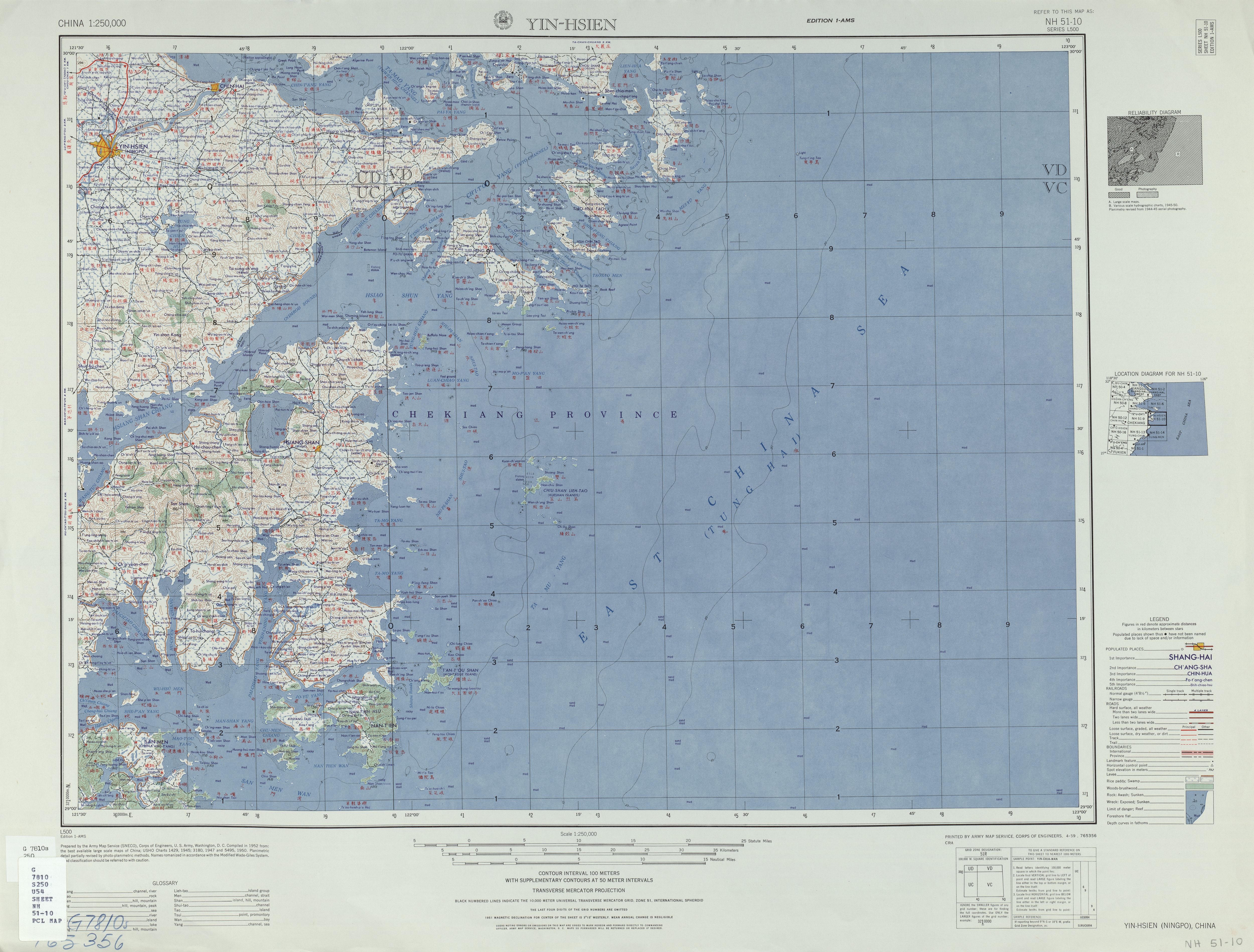

Ningbo ranges in latitude from 28° 51' to 30° 33' N and in longitude from 120° 55' to 122° 16' E, bounded on the east by the East China Sea and Zhoushan Archipelago; on the north by Hangzhou Bay, across which it faces Jiaxing and Shanghai; on the west by Shaoxing; and on the south by Taizhou. Its land area is 9816 km2, while its oceanic territory amounts to 9758 km2; there is a total 1562 km of coastline, including 788 km of mainland coastline and 774 km of island coastline that together accounting for one-third of the entire provincial coastline. There are 531 islands accounting for 524 km2 under the city's administration.
Ningbo's city proper is sandwiched between the ocean and low-lying mountains to the southwest, with coastal plain and valleys in between. Its central business district is bisected by the Yongjiang River. Important peninsulas include the Chuanshan Peninsula (穿山半岛), located in Beilun District and containing mainland Zhejiang's easternmost point, and the Xiangshan Peninsula (象山半岛) in Xiangshan County. The Siming Mountains (四明山) run north from Mount Tiantai and within Ningbo City, traversing Yuyao City, Haishu District, and Fenghua District, and reaching a height of 979 m.
Tidal flat ecosystems occur adjacent to the city, however, large areas have been reclaimed for agricultural purposes.
Climate
Ningbo has a humid subtropical climate (Köppen Cfa) with four distinctive seasons, characterized by hot, humid summers and chilly, cloudy and dry winters (with occasional snow). The mean annual temperature is 17.6 °C, with monthly daily averages ranging from 5.8 °C in January to 29.1 °C in July. Extremes since 1951 have ranged from −8.8 °C on 12 January 1955 to 42.1 °C on 8 August 2013. The city receives an average annual rainfall of 1430 mm and is affected by the plum rains of the Asian monsoon in June, when average relative humidity also peaks. From August to October, Ningbo experiences the effects of typhoons, and is affected by an average 1.8 storms annually, though the city is not often struck directly by these systems. A 2012 OECD study lists Ningbo among the top 20 cities worldwide most at risk of flooding due to anthropogenic climate change.
Ningbo is among the cities in China which are implementing sponge city strategies to mitigate the impacts of climate change.
| Jan record high C = 24.4 | Feb record high C = 30.0 | Mar record high C = 34.0 | Apr record high C = 34.9 | May record high C = 36.3 | Jun record high C = 38.9 | Jul record high C = 41.3 | Aug record high C = 42.1 | Sep record high C = 38.8 | Oct record high C = 36.6 | Nov record high C = 31.0 | Dec record high C = 27.0 | Jan record low C = −8.8 | Feb record low C = −7.2 | Mar record low C = −3.7 | Apr record low C = -0.2 | May record low C = 7.4 | Jun record low C = 12.7 | Jul record low C = 18.2 | Aug record low C = 18.4 | Sep record low C = 11.0 | Oct record low C = 1.1 | Nov record low C = -3.7 | Dec record low C = −8.5 |script-title = zh:CMA台站气候标准值(1991-2020) |access-date = 2023-05-07 |archive-date = 2023-04-04 |archive-url = https://web.archive.org/web/20230404092524/https://experience.arcgis.com/template/e724038fda394e9d9b7921f10fd1aa55/page/%E7%BA%AF%E8%A1%A8%E6%A0%BC%E7%BB%9F%E8%AE%A1-(%E5%AF%B9%E6%AF%948110%E5%8F%98%E5%8C%96)/?org=UQmaps |url-status = live |archive-date= 8 December 2024 |archive-url= all-time extreme temperature |access-date= 13 September 2024 |archive-date= 15 September 2024 |archive-url= https://web.archive.org/web/20240915082858/https://weibo.com/ttarticle/p/show?id=2309404203050792315805 |url-status= live}} All-time October high
Administrative divisions
Local officers of Ningbo
- The Secretary of Party in Ningbo is Peng Jiaxue, who is first-in-charge of the city.
- The Mayor of Ningbo is Qiu Dongyao, who is second-in command of the city, and the Vice Secretary of Party in Ningbo.
Administrative divisions of Ningbo
The sub-provincial city of Ningbo is as whole an urban group with one central group, one northern group, and one southern group.
It has direct jurisdiction over the following:
- Six districts (central group): Haishu District, Yinzhou District, Jiangbei District, Beilun District, Zhenhai District, Fenghua District
- Two county-level cities (northern group): Yuyao, Cixi
- Two counties (southern group): Xiangshan, Ninghai
| Map | Subdivision | Simplified Chinese | Pinyin | Population (2022) | Area (km2) | Density | Urbanization Rate(%) | Sum | 9,618,000 | 9,816.23 | 979.80 | 78.9 |
|---|---|---|---|---|---|---|---|---|---|---|---|---|
| 6 Central Urban Districts | ||||||||||||
| Haishu District | 海曙区 | zh | 1,058,000 | 595.03 | 1,748.29 | 88.1 | ||||||
| Yinzhou District | 鄞州区 | zh | 1,662,000 | 799.09 | 2,079.86 | 83.0 | ||||||
| Jiangbei District | 江北区 | zh | 503,000 | 208.14 | 2,416.64 | 84.7 | ||||||
| Beilun District | 北仑区 | zh | 879,000 | 597.76 | 1,470.48 | 77.8 | ||||||
| Zhenhai District | 镇海区 | zh | 516,000 | 244.28 | 2,112.33 | 91.1 | ||||||
| Fenghua District | 奉化区 | zh | 586,000 | 1,267.60 | 462.29 | 61.2 | ||||||
| 2 Southern Counties | ||||||||||||
| Xiangshan County | 象山县 | zh | 576,000 | 1,382.18 | 416.73 | 62.5 | ||||||
| Ninghai County | 宁海县 | zh | 709,000 | 1,843.26 | 384.64 | 63.7 | ||||||
| 2 Northern County-Level Cities | ||||||||||||
| Yuyao | 余姚市 | zh | 1,264,000 | 1,500.80 | 842.21 | 81.4 | ||||||
| Cixi | 慈溪市 | zh | 1,865,000 | 1,360.63 | 1,370.68 | 80.1 |
- Defunct: Jiangdong District
Economy
Ningbo is an important port city located 220 km south of Shanghai. The city's export industry dates back to the 7th century. Today, Ningbo is a major exporter of electrical products, textiles, food, and industrial tools. The city's private sector is especially well-developed, contributing 80 percent of total GDP in 2013.
Historically, Ningbo was somewhat geographically isolated from other major cities. In 2007 the Hangzhou Bay Bridge was built, cutting highway transit time between Ningbo and Shanghai from four hours to two and a half. The city now serves as the economic center for the southern Yangtze River Delta and has been ranked among the most competitive cities in China.
In 2009, Ningbo's economic activity reached US$60.8 billion, down 10.4 percent from 2008. The exports totaled US$38.65 billion, down 16.6 percent from the previous year. In addition, Ningbo imported US$22.16 billion of goods, up 3.1 percent from the previous year.
Ningbo's economy grew 9.26 percent in 2013 to 712.89 billion yuan (US$115.12 billion). In 2009, the city's per capita output was US$10,833, about three times the national average.
Foreign investment
With several important development zones established in or around Ningbo, the city has received considerable foreign investment. Over 60 domestic and foreign-invested financial institutions have established operations in the city, which has also attracted more than 10,000 foreigners. The municipal government offers preferential policies designed to encourage investment in international trade, new strategic industries, manufacturing, information services, and creative industries.
Economic and technological development zones
Ningbo Economic & Technological Development Zone
Located in the north-east of Ningbo, behind Beilun Port, NETD is 27 km away from the city center. With more than 20 years of great effort, NETD has already formed the general framework for large scale construction and development, and established the perfect investment environment. It is situated close to the Ningbo Port and Ningbo Lishe International Airport. Major Investors include ExxonMobil, Dupont and Dow Chemical.
Ningbo Daxie Development Zone
The Ningbo Daxie Development Zone was approved in 1993 and covers an area of 5.92 km2. Over more than ten years of development and construction, industrial and logistical foundations have been established in the zone for the transshipment of energy, liquid chemicals and containers.
Ningbo National Hi-Tech Industrial Development Zone
Ningbo National Hi-Tech Industrial Development Zone was founded in 1999 and was upgraded to a national level zone in January 2007. It is 10 km from Ningbo International Airport and 18 km away from Ningbo Port. The zone serves as the important technical innovation base of Yangtze River Delta. Industries encouraged include chemicals production and processing, biotechnology and pharmaceuticals, raw material processing, Research and Development.
Ningbo Free Trade Zone
Ningbo Free Trade Zone is one of the 15 free trade zones authorized by the State Council of China and is the only free trade zone in Zhejiang Province. It was established by State Council in 1992, covering the area of 2.3 km2. It lies in the middle of the coastline of mainland China, at the south of Yangtze River Delta. In 2008, its industrial output value was RMB 53.33 billion and grew at 19.8 percent as compared to 2007.
Nordic Industrial Park
The Nordic Industrial Park Co. Ltd. (NIP) is one of the first wholly foreign-owned industrial parks in China located in Ningbo, Zhejiang Province. NIP is managed and operated by a Scandinavian management team.
Ningbo Advertising Park
The Ningbo Advertising Park is a national level pilot park located in the Ningbo Southern Business District. The financial incentives have attracted over 300 relevant firms to establish operations.
Ningbo port

Main article: Port of Ningbo
Unlike other Chinese cities, Ningbo has the same authority as provincial governments for economic administration and is the largest port in the world in terms of annual cargo throughput. In contrast to Shanghai, the port is deep-water and capable of handling 300,000-ton vessels. The port is located mainly in Beilun District and Zhenhai District.
In 2006, Ningbo Port started its expansion towards the neighboring island city of Zhoushan to build an even larger port with higher capacity to compete with neighboring ports in the region, such as Shanghai's Yangshan a deep-water port. Statistics in 2010 showed that total cargo throughput was 627,000,000 tonnes and container throughput was 13,144,000 TEUs. In 2021, total cargo throughput was 1,224,050,000 tonnes, including 31,080,000 TEUs. Ningbo proper saw 623,400,000 tonnes and 29,370,000 TEUs, while Zhoushan saw 600,650,000 tonnes and 1,710 000 TEUs.
Thus, with bulk container breakdowns, hugely improved logistics, and massive chemical and foodstuff processing developments, Ningbo is outcompeting Shanghai for the preeminent Chinese east coast port.
Ningbo is part of the 21st Century Maritime Silk Road that runs from the Chinese coast to the south, via Singapore towards the southern tip of India, via Mombasa to the Mediterranean, and from there via Athens to the Upper Adriatic region, to the northern Italian hub of Trieste, with its rail connections to Central Europe and Eastern Europe.
Tourism
Due to its long history and economic prosperity, Ningbo is a city with very rich tourist resources. The following is a list of the main tourist attractions authorized by the Ningbo Municipal Bureau of Culture, Radio, Television and Tourism in each subdivision of Ningbo city.
Haishu District
- Moon Lake Park (Yuehu Park): A reservoir excavated in the Tang dynasty (636 CE) at the center of Haishu District. The park includes the lake itself, some small islands on the lake, and many ancient Chinese architectures and historical sites, such as:
- Tianyi Pavilion (or Tianyi Chamber): One of Ningbo's most popular and famous tourist attractions. Built in 1516 CE, it is the oldest library existent in Asia and is one of the 3 oldest private libraries in the world. The collection dates back to the 11th century and includes woodblock and handwritten copies of the Confucian classics, rare local histories, and lists of the candidates successful in imperial examinations. The currently Tianyi Pavilion refers to the whole museum complex that includes:
- Tianyi Pavilion-related buildings such as:
- The ancient Chinese mansion of the library's first owner, Fan Qing, built during the Ming dynasty (1516 CE)
- A traditional Chinese Garden as part of Fan's mansion
- An ancient private theater of Chinese plays as part of Fan's mansion
- A Mahjong (麻將) museum, since Ningbo is regarded as the birthplace of Mahjong
- He Ancestral Temple (賀祕監祠): A cultural built in honor of the Chinese poet He Zhizhang (賀知章, 659 CE – 744 CE) during the Tang dynasty who called himself the "Siming Crazy Guest", where "Siming" is the name of a mountain in Ningbo. The building was completed during the Song dynasty (1144 CE) and repaired during the Qing dynasty (1865 CE).
- Ancient Korean Embassy: Built during the Northern Song dynasty to welcome Korean envoys and business groups. Destroyed by war in 1130 CE, the site was announced as a cultural relics protection unit in 1984. It is now a showroom for the history of relations between Ningbo and Korea.
- Central Lake Temple, Central Lake East Bridge, Zhenming Ridge, and Xuanmiao Temple: A Ningbo-born novelist Qu You wrote a fiction called Peony Dengji (牡丹燈記, Janpanese: Botan Dōrō also known as 怪談牡丹燈籠 Tales of the Peony Lantern) (in the collection of Jiandeng Xinhua). It describes a love story between ghost and a man during Fang Guozhen period. The story took place at the Moon Lake. Japanese scholar Koyama Issei identified many of the locations, including Central Lake Temple, Central Lake East Bridge, Zhenming Ridge, and Xuanmiao temple, that would fit geographically and architecturally of the places mentioned in the story. The story was adapted as one of three Kaidan tales in Japan.
- Tianyi Pavilion (or Tianyi Chamber): One of Ningbo's most popular and famous tourist attractions. Built in 1516 CE, it is the oldest library existent in Asia and is one of the 3 oldest private libraries in the world. The collection dates back to the 11th century and includes woodblock and handwritten copies of the Confucian classics, rare local histories, and lists of the candidates successful in imperial examinations. The currently Tianyi Pavilion refers to the whole museum complex that includes:
- Drum Tower Complex (Haishu Tower): The only remaining ruin of an old city gate tower constructed during the Tang dynasty. At the top, there is a six-meter-high Romanesque bell tower added in the Republic period. Around the base of the tower is a commercial area where all the buildings are reconstructed in the traditional style.
- Chenghuang Temple (Ningbo County Temple): An ancient temple of the City God at commercial center in downtown Ningbo.
- Tianfeng Pagoda: This national cultural relics protection site is a typical Song-style loft-style brickwood structure tower unique to Jiangnan. This hexagonal building is a landmark and the tallest ancient structure in the city. It appears as a seven-story tower with another seven stories underground, and is renowned for its long history, architectural value, and ancient artifacts. The tower was first built in 695 CE during the Tang dynasty (618–907 CE).
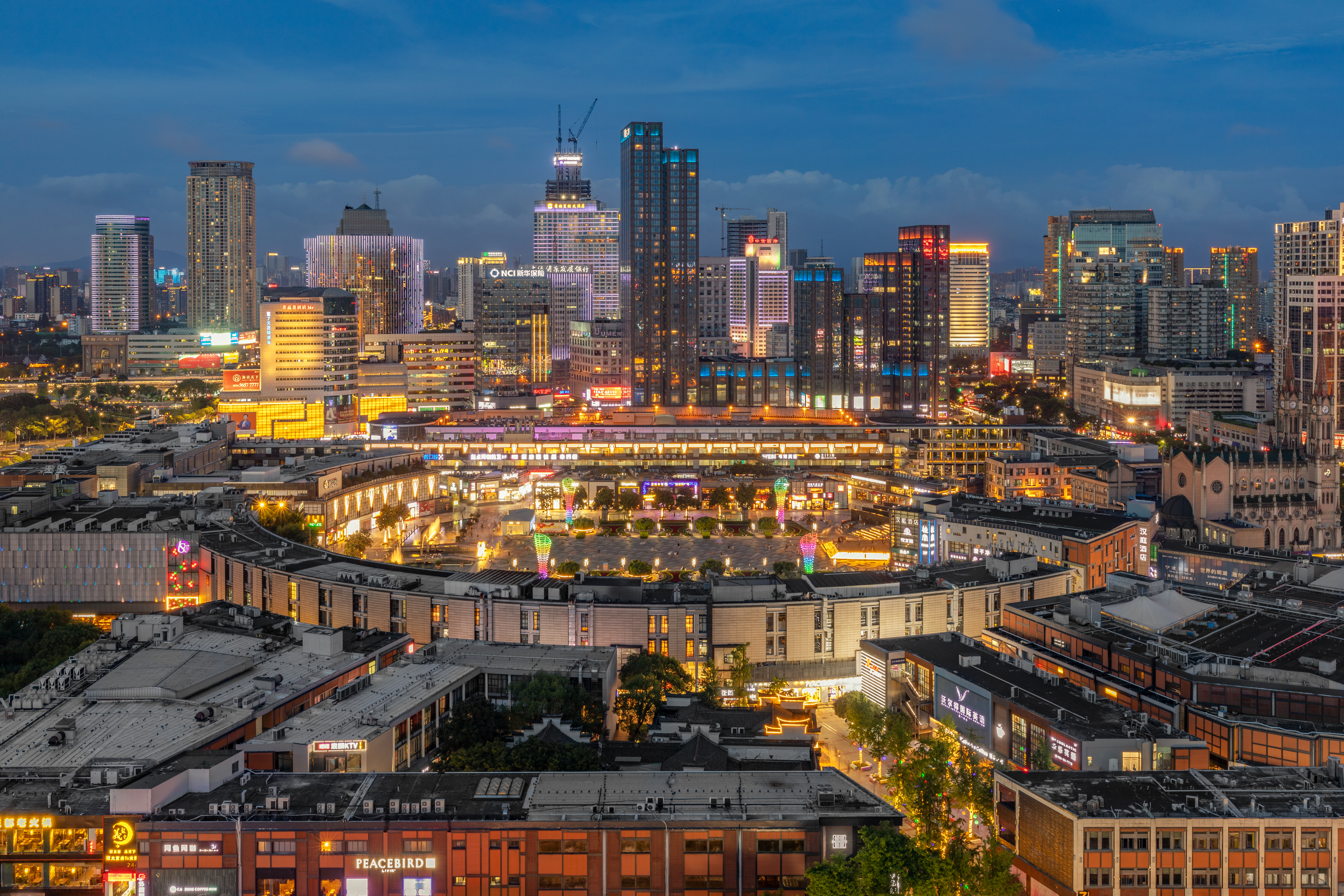
- Tianyi Square: Located in the bustling old downtown of Ningbo City with the nationwide famous shopping complex, named after the Tianyi Ge (Chamber), the oldest private library in Asia.
- Nantang Old Street: An old commercial street by the river with many folk arts and crafts shops, souvenir stores, and small restaurants. Previously, Nantang Street was a place for local fairs and flea markets. In 2013, the street was renovated to become a tourist site.
- Liangzhu Cultural Park: A theme park dedicated to the story of the Butterfly Lovers, one of the four folklores in China. The Butterfly Lovers is reputed as the oriental version of Romeo and Juliet.
- Baiyun Manor: An ancient academy where Huang Zongxi (黃宗羲) gave lectures. Huang, whose style name is Taichong, was a distinguished thinker, writer, and historian of the late Ming and early Qing.
- Tashan Weir: An ancient dam erected during the Tang dynasty.
- Ningbo Wulongtan Scenic Scenic Resort: Also called Five-dragon Pools Scenic Resort, it is one of the Ten New Sceneries in Ningbo, and a National AAAA rated scenic area.
Yinzhou District
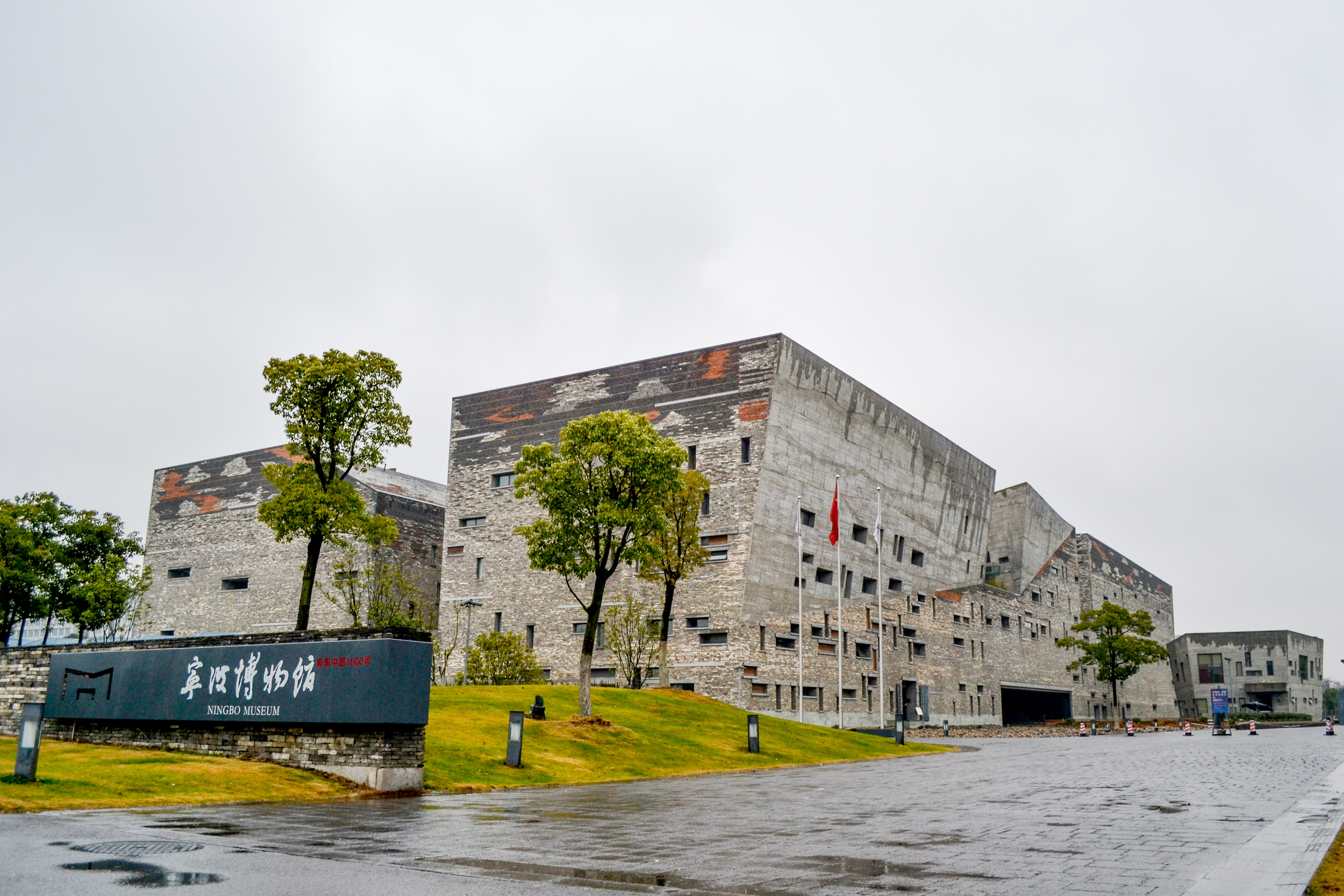
- Ningbo Museum (Yinzhou Museum, or Ningbo Historic Museum): A museum focused on Ningbo area history and traditional customs, considered the masterwork of Wang Shu, the first Chinese citizen to win the Pritzker Architecture Prize in 2012. The Ningbo Museum is also the main filming location for the 2023 TV series adaptation of scifi author Liu Cixin's novel of the same name, Three Bodies.
- Romon U-Park: One of the largest urban indoor theme parks in the world.
- Ningbo Eastern New Town: A newly developed area of Ningbo City, with a well-designed CBD (including two 400m skyscrapers and other headquarters of many listed company and government offices), several museums, galleries, and shopping centers, including:
- Ningbo Urban Planning Exhibition Center
- Ningbo Hankyu Commercial Complex: Opened in 2021, it is the first overseas outlet of Hankyu, the famous Japanese department store.
- Ningbo New Library
- Yinzhou Park and Ningbo Southern CBD
- Dongqian Lake: The largest natural freshwater lake in Zhejiang Province. The earliest historical record of the lake dates back to the West Jin dynasty, and there are several natural sceneries and historical attractions around the lake:
- Little Putuo: An island on the lake with several temples built during the Song dynasty by a prime minister called Shihao.
- Yuefei Temple: A temple built during the Song dynasty in memory of Yuefei.
- Taogong Island: The place where Fanli and Xishi once lived according to folklore.
- Southern Song Dynasty Rock Carving Park: won the "National Cultural Relics Conservation Best Project Award" awarded by the China National Architecture Research Association and the China Cultural Relics Conservation Foundation
- Fuquan Mountain: a mountain with a Chinese tea theme park
- Ningbo Hanling Old Street: an ancient street with a history thousands of years. It was once called Hanling City. The 'city' here means bazaar.
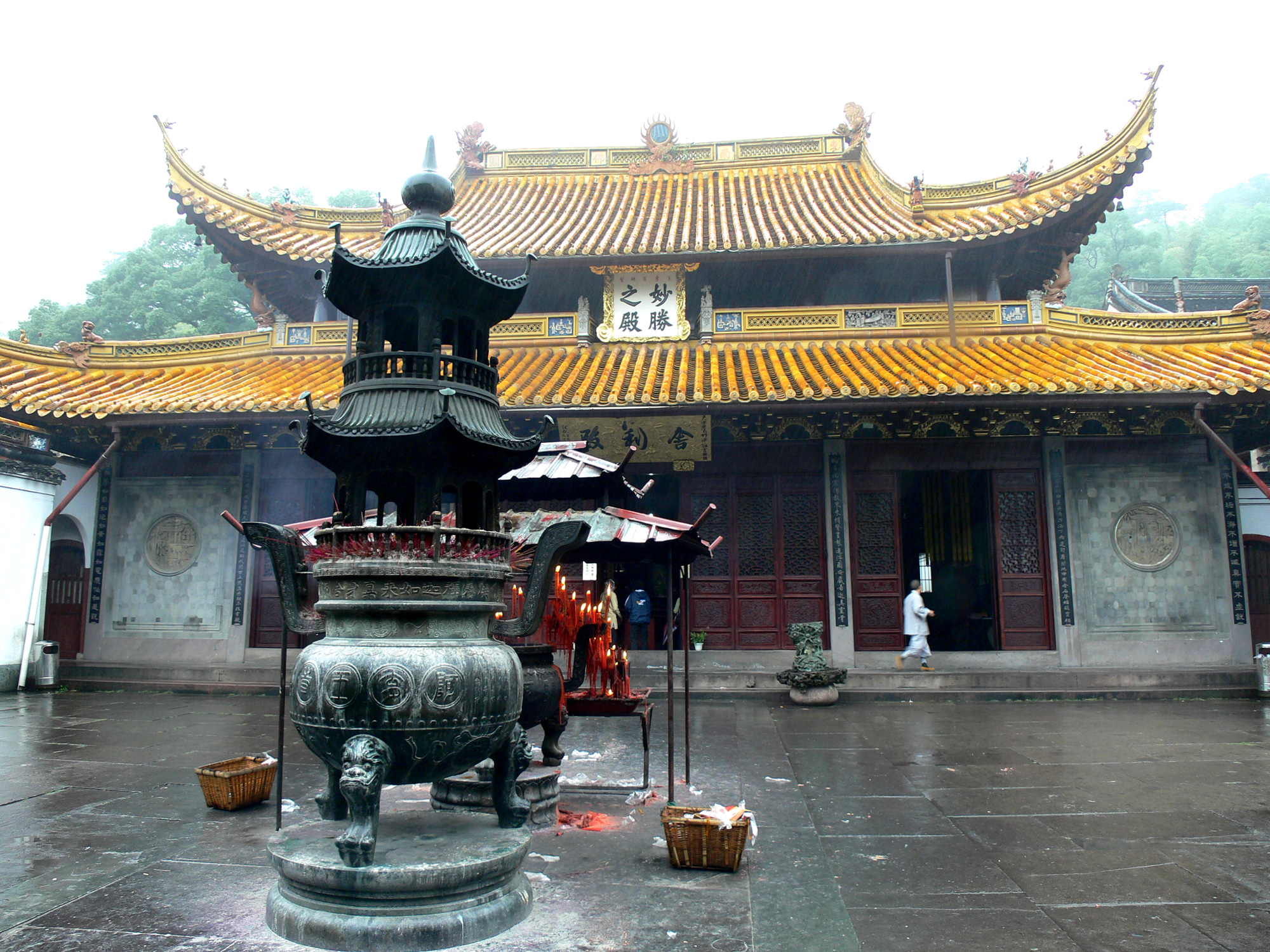
- Qita Temple: A Zen Buddhist temple complex first consecrated during the Tang dynasty in the downtown area of Ningbo city.
- Tianhou Temple: A former temple of Mazu as the "Empress of Heaven" once used by Fujianese merchants as their guild hall (Qing'an Huiguan). In the 19th century, it was accounted by S. Wells Williams as the most beautiful place in Ningbo and by John Thomson as one of the most beautiful temples in China, but that structure was destroyed during the Chinese Civil War. It has been reconstructed with many of its original works of art, however, to form the East Zhejiang Maritime Affairs and Folk Customs Museum.
- Temple of King Ashoka: a Buddhist temple first established during the Western Jin dynasty (282 AD).
- Tiantong Temple: One of the "Five Chan Buddhism Temples". Tiantong Temple is the cradle of the Sōtō school (曹洞宗, Sōtō-shū) of Japanese Buddhism.
- Ningbo Ocean World: An aquarium with an ocean theater
- Ningbo Youngor Zoo
- Ningbo Sakura Park (Zhongxing Sakura Park): A sakura park built to commemorate the friendship city between Ningbo City and Nagaoka City, Japan
Jiangbei District

- Sanjiangkou: The place where the Yong River, Yaojiang River, and Fenghua River meet, and the heart of old Ningbo city where the borders of 3 urban districts of Ningbo city meet.
- Old Bund (Old Waitan): A waterfront area and protected historical district in the center of Ningbo, built earlier than the Bund of Shanghai, with lots of early 19th century architectures, stores and restaurants.
- Baoguo Temple: The oldest intact wooden structure in eastern China. It is in the first batch of National Key Cultural Relics Protection Sites in China. Currently, it is the Baoguo Temple Ancient Architecture Museum, and has become a teaching and research base for many top architectural universities.
- Ningbo Museum of Art
- Ningbo Museum of Garden (寧波園林博物館)
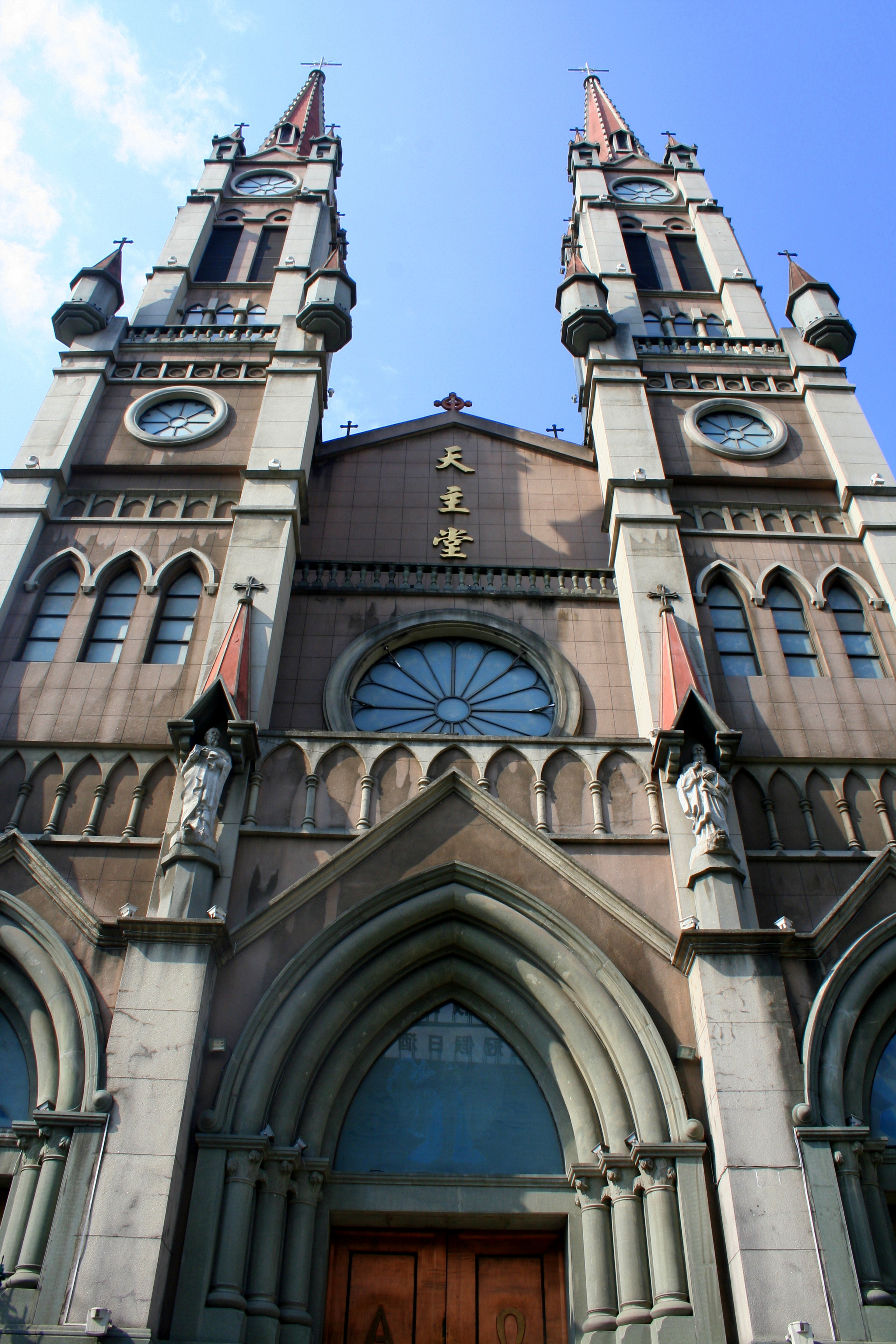
- Sacred Heart Cathedral, Ningbo
- Cicheng Ancient Town: A very well-maintained ancient Chinese ancient walled city built in the 8th century, including ancient-time schools, courts, temples, houses, commercial areas. In December 2009, the ancient buildings in Cicheng received the honorary award of the UNESCO Asia-Pacific Heritage Awards for Culture Heritage Conservation by UNESCO.
- Yaojiang Park
Zhenhai District

- Jiulong Lake
- Zhaobao Mountain
- The Seventeen Houses of Zheng's: The seventeen Houses of Zheng exemplify the classical style of residences during the Ming and Qing dynasties in the south part of Yangtze River Basin.
- Ningbo Bang Museum and Culture Park : Displays exhibits related to the Ningbo Gang (Ningbo Merchants Group), and the development history of the business gang. It was one of the ten largest commercial groups during the Ming and Qing dynasties, and became the biggest commercial regional group of China in the late Qing dynasty.
- Yugang Bao's Old House
Beilun District
- Port Museum of China
Fenghua District
- Xuedou Temple
Xiangshan County
- Yushan Islands
- Nantian Island
- Xiangshan Global Studios
Ninghai County
- The Zhedong Grand Canyon
- Nanxi Hot Spring
- Qiantong Old Town
Yuyao City (County)
- Hemudu Culture Relics Site and Museum: The relic site and museum of a Neolithic culture that flourished just south of Hangzhou Bay.
Cixi City (County)
- Dapeng Mountain
People
;People in mainland China
- Zhang Jianhong, freelance writer, playwright, poet, and democracy activist
- Pan Tianshou, an artist in Chinese painting
- Zhou Xinfang, an artist in Peking opera
- Yu Lina, a violinist
- Sha Menghai, a master calligrapher
- Pang Lijuan, an educator and politician
- Tu Youyou, a scientist awarded the Nobel Prize in Physiology or Medicine
- Sang Lan, an advocate for improved conditions for the disabled in China
- Shen Yueyue, a senior politician
- Shi Xiaolin, a politician
- Wang Xingxing, roboticist, entrepreneur and founder of Unitree Robotics
;People in Hong Kong
- Run Run Shaw
- Tung Chee Hwa
- Tung Chao Yung
- Chen Din Hwa
- Stephen Chow
- Sammo Hung
- Yue-Kong Pao
;People in Taiwan
- Chiang Kai-shek, former President of the Republic of China
- Chiang Ching-kuo, Chiang Kai-shek's son
- Morris Chang
;People overseas
- Shien Biau Woo
- Yo Yo Ma
- Kin Yamei
- Yuan Yang (politician)
Transportation

Bridge
The Hangzhou Bay Bridge, a combination cable-stayed bridge and causeway across Hangzhou Bay, opened to the public on 1 May 2008. This bridge connects the municipalities of Shanghai and Ningbo and is considered the longest trans-oceanic bridge in the world. It is the world's second-longest bridge, after the Lake Pontchartrain Causeway in Louisiana, United States.
The Jintang Bridge, a four-lane sea crossing bridge linking Jintang Island of Zhoushan and Zhenhai district, is a 27 km long opened on December 26, 2009.
The Xiangshan Harbor Bridge opened to traffic on December 29, 2012, connecting Ningbo with Xiangshan. The 47 km long project includes 22 km as the main body of the bridge and an 8 kilometer long tunnel.
Sea port
The port of Ningbo is the world's busiest port. It was ranked number 1 in total Cargo Volume (1.22 billion tonnes in 2021) and number 3 in total container traffic (31.1 million TEUs in 2021) since 2019.
Airport
Ningbo Lishe International Airport connects Ningbo by air to the rest of China, with regularly scheduled domestic and international flights.
Railway

Three railway lines intersect in Ningbo: the Xiaoshan–Ningbo Railway (Xiaoyong Line), which runs west to Hangzhou; the Ningbo–Taizhou–Wenzhou (Yongtaiwen) Railway, which runs south to Wenzhou; and the Hangzhou–Ningbo High-Speed Railway, which runs parallel to the Xiaoyong Line providing high-speed railway service.
With the booming economy in the region, the Xiaoyong Railway, a conventional railway built in the 1950s, could not meet the demand for railway travel between Zhejiang's two largest cities, so construction of a new high-speed railway line between Hangzhou and Ningbo started in 2009. The new railway line was finished in 2013 and reduced travel time between Ningbo and Hangzhou to 50 minutes.
The Ningbo–Taizhou–Wenzhou Railway is a high-speed railway that opened in September 2009. It connects Ningbo with cities along the coast to the south to Fujian Province. High-speed trains on this line operate at speeds of up to 250 km/h.
Ningbo re-opened the Ningbo railway station after three years of construction on 28 December 2013. With a construction area of more than 120,000 m2, it is one of the largest railway stations in China.
Expressway
Seven expressways connect Ningbo with its surrounding cities:
- The Hangyong expressway, built in the 1990s, connects Hangzhou and Ningbo, and is now part of Hangzhou Bay ring expressway (G9211).
- The Yongtaiwen expressway (G15), opened in 2000, connects Ningbo with Taizhou and Wenzhou.
- The Yongjin expressway (G1512) connects Ningbo and Jinhua.
- The Huyong expressway (G15) connects Ningbo and Shanghai via the Hangzhou Bay bridge.
- The Yongzhou expressway (G9211) via Jintang Bridge.
- The G1504 Ningbo Ring Expressway
- The G1523 Ningbo–Dongguan Expressway
_en.svg)

Rapid rail transit and subway
Main article: Ningbo Rail Transit
Ningbo has multiple metro lines in service, under construction, and under authorized planning:
| Lines | Length in Kilometers (km) | Number of Stations | In-Service Year | Lines in Service | Lines Under Construction | Constructing Plans That Will be Completed by 2026 |
|---|---|---|---|---|---|---|
| Line 1 | 46.17 | 29 | 2014 | |||
| Line 2 | 33.95 | 27 | 2015 | |||
| Line 3 | 38.63 | 27 | 2019 | |||
| Line 4 | 36.11 | 25 | 2020 | |||
| Line 2 Extension | 2.9 | 2 | 2021 | |||
| Line 5 | 27.5 | 22 | 2021 | |||
| Line 3 Extension | 9.5 | 5 | 2023 | |||
| Line 4 East Extension | 2.5 | 1 | Construction Began in 2021 | |||
| Line 1 West Extension | 1.5 | 1 | by 2026 | |||
| Line 4 West Extension | 2.5 | 1 | by 2026 | |||
| Line 6 | 38.6 | 24 | by 2026 | |||
| Line 7 | 38.8 | 25 | by 2026 | |||
| Line 8 | 22.6 | 18 | by 2026 |
Since the Metro lines above mainly serve the six urban districts of Ningbo, the Ningbo government announced several future plans to build further rapid transit to connect the six urban districts with the county-level cities and counties.
Military
Ningbo serves as the headquarters of the East Sea Fleet of the Chinese People's Liberation Army Navy.
Language
Ningbo speech is a dialect of Wu Chinese that has preserved many aspects of ancient Chinese phonology. Its original wording mode can be found in classical reference books. After the unequal treaty port opening, western culture gradually permeated Ningbo. Thus, the prefix " yang", meaning ocean or Western, before the nouns of imported goods is a special language phenomenon of Ningbo dialect.
Food
Ningbo is known for Ningbo Tangyuan, small stuffed buns which are boiled. The stuffing is usually ground sesame mixed with sugar or pork fat. The stuffing is then wrapped with sticky rice powder. Ningbo is even more well known throughout China for its seafood. Seafood markets are abundant, carrying extensive varieties of fish, shellfish, snails, jellyfish and other invertebrates, and sea vegetables in all stages of preparation from "still swimming," to cleaned and ready to cook, to fully cooked.
Education
At the end of 2020, there were 1,896 schools of all levels and types in the city, with a total of 1,418,000 students. Among them, there are 15 colleges and universities in Ningbo with 177,000 full-time students; 86 regular high schools with 93,000 students; 35 vocational schools with 69,000 students; 230 junior high schools with 217,000 students; and 427 primary schools with 517,000 students. There were also 838 full-time private primary and secondary schools (including kindergartens) in the city, with 258,000 students, accounting for 21.7% of the city's full-time primary and secondary school students. In the compulsory education section, there were 288,000 children of migrant workers who went to schools in Ningbo.
Ningbo is one of the top 100 cities in the world by scientific research as tracked by the Nature Index.
In the whole year of 2020, the city attracted 1,372 more workers with doctoral degrees, for a total of 9,265; 67,000 highly skilled talents, for a total of 551,000; 35 postdoctoral research stations, for a total of 224; and 166,000 graduates, a year-on-year increase of 20.5%. There are 10 offices, totaling 100. Throughout the year, 327,000 skilled personnel were trained in the city.
Higher-Educational institutions
Ningbo has 15 universities and colleges as of May 2021, as well as many research institutions that offer graduate degree programs. The following is a list of current universities and colleges in Ningbo.
| English name | Chinese name | Degree Program | Website | Note |
|---|---|---|---|---|
| Ningbo University | 宁波大学 | bachelor's degree, master's degree, doctoral degree | https://www.nbu.edu.cn/en/ | A Double First-Class Construction university, with Double First Class status in certain disciplines |
| University of Nottingham, Ningbo China | 宁波诺丁汉大学 | bachelor's degree, master's degree, doctoral degree | https://www.nottingham.edu.cn/en/ | Affiliated with the University of Nottingham in the United Kingdom (UK) and the first Sino-foreign university in China |
| Ningbo Institute of Technology, Zhejiang University | 浙大宁波理工学院 | bachelor's degree, master's degree, doctoral degree | http://www.nit.zju.edu.cn/en/ | |
| Zhejiang Wanli University | 浙江万里学院 | bachelor's degree, master's degree | http://en.zwu.edu.cn/ | |
| Ningbo University of Technology | 宁波工程学院 | bachelor's degree, master's degree | http://www.nbut.cn/ | |
| Ningbo University of Finance and Economics | 宁波财经学院 | bachelor's degree | http://www.nbut.cn/ | |
| College of Science and Technology, Ningbo University | 宁波大学科学技术学院 | bachelor's degree | https://www.ndky.edu.cn/ | An independent college of Ningbo University |
| China Coast Guard Academy | 中国人民武装警察部队海警学院 | bachelor's degree | ||
| Zhejiang University of Pharmacy | 浙江药科职业大学 | associate degree, bachelor's degree | https://www.zjpc.net.cn/ | |
| Zhejiang Business Technology Institute | 浙江工商职业技术学院 | associate degree | https://www.zjbti.net.cn/ | |
| Zhejiang Pharmaceutical College | 宁波职业技术学院 | associate degree | https://en.nbpt.edu.cn/ | |
| Zhejiang Fashion Institute of Technology | 浙江纺织服装职业技术学院 | associate degree | http://www.zjff.edu.cn/ | |
| Ningbo City College of Vocational Technology | 宁波城市职业技术学院 | associate degree | https://www.nbcc.cn/ | |
| Ningbo College of Health Sciences | 宁波卫生职业技术学院 | associate degree | http://www.nbchs.net/ | |
| Ningbo Childhood Education College | 宁波幼儿师范高等专科学校 | associate degree | https://www.nbei.net/ |
As of 2020, many famous universities and research institutions have an operating campus or institutes in Ningbo, most of them offering graduate degree programs.
| English name | Chinese name |
|---|---|
| Ningbo Institute of Materials Technology & Engineering, Chinese Academy of Sciences | 中国科学院宁波材料技术与工程研究所 |
| Ningbo Institute of Technology, BeihangUniversity | 北京航空航天大学宁波创新研究院 |
| Zhejiang University, Ningbo | 浙江大学宁波校区 |
| Harbin Institute of Technology, Ningbo | 哈尔滨工业大学宁波智能装备研究院 |
| Dalian University of Technology, Ningbo | 大连理工大学宁波研究院 |
| Tianjin University, Ningbo | 天津大学浙江研究院 |
| Ningbo Institute of Marine-Derived Pharmaceutical, Peking University | 北京大学宁波海洋药物研究院 |
| Northwestern Polytechnical University, Ningbo | 西北工业大学宁波研究院 |
Compared to the other 14 sub-provincial cities in China, Ningbo has the fewest higher-educational institutions.
Secondary and primary education
Compulsory education is from the ages 6 to 15. Students are catered to in a variety of state and private schools. Studying for the Gaokao (高考), a cumulative test taken at the end of high school, is optional. At the end of 2020, there were 86 regular high schools with 93,000 students in Ningbo; 35 vocational schools with 69,000 students; 230 junior high schools with 21.7 students; and 427 primary schools with 517,000 students. There were also 838 full-time private primary and secondary schools (including kindergartens) in the city, with 258,000 students, accounting for 21.7% of the city's full-time primary and secondary school students. In the compulsory education section, there were 288,000 children of migrant workers who went to schools in Ningbo.
International education
Several schools are permitted to operate foreign educational programs as an alternative to the Chinese National curriculum and to accept international students.
Access International Academy Ningbo (AIAN) and Ningbo Zhicheng School International (NZSI) both offer the American AERO (American Education Reaches Out) curriculum with the College Board Advanced Placement examinations. Ningbo International School (NBIS) delivers the Cambridge International Primary and Secondary Curricula leading to iGCSE Examinations and A-Levels. Huamao Multicultural Education Academy is an IB World School and offers an international curriculum through the IB Primary Years Program for students ages 3–12 and the IB Diploma Program for students ages 16–19.
Twin towns – sister cities
Ningbo is twinned with:
| City | Country | Since | |
|---|---|---|---|
| Nagaokakyō, Kyoto | Japan | 1983 | |
| Aachen | Germany | 1986 | |
| Wilmington, Delaware | United States | 1988 | |
| Waitakere City | New Zealand | 1998 | |
| Rouen | France | 1990 | |
| Santos, São Paulo | Brazil | 2002 | |
| Uitenhage | South Africa | 2003 | |
| Veszprém | Hungary | 2003 | |
| Stavanger | Norway | 2004 | |
| Varna | Bulgaria | 2004 | |
| Bydgoszcz | Poland | 2005 | |
| Nottingham | United Kingdom | 2005 | |
| Florence | Italy | 2008 | |
| Daegu | South Korea | 2013 | |
| Bitola | North Macedonia | 2014 | |
| Kapan | Armenia | 2016 | |
| Heraklion | Greece | 2019 | |
| Marrakesh | Morocco | 2019 | |
| Alor Setar | Malaysia | 2023 |
Notes
References
References
- link
- Ningbo Bureau of Statistics. (28 February 2022). link
- "Ningbo as southern economic center of Yangtze Delta Megalopolis (宁波是我国东南沿海重要的港口城市、长江三角洲南翼经济中心、国家历史文化名城)".
- "宁波都市区建设行动方案印发".
- (2021-01-26). "Ningbo-Zhoushan retains world's busiest cargo handling port crown in 2020".
- "宁波常住人口超940万".
- link. (1995-02-19)
- "国务院关于宁波市实行计划单列的批复(国函〔1987〕37号)_政府信息公开专栏".
- Ningbo Bureau of Statistics. (28 February 2022). link
- "宁波GDP总量跃居内地城市第12位--浙江频道--人民网".
- 网易. (2021-03-31). "2020年全国城市人均可支配收入排名20强,北方仅一城入围".
- "公牛集团挂牌上交所 宁波上市公司总数"破百"-新闻中心-中国宁波网".
- "宁波A股上市公司数量位居全国第7!哪些行业是全国"顶流"?-新闻中心-中国宁波网".
- 程祥. "2019中国城市营商环境报告发布 北京综合排名第一".
- (2015-10-02). "Ningbo is East Asia's new 'City of Culture'".
- "Leading 200 science cities {{!}} {{!}} Supplements {{!}} Nature Index".
- (2004). "Ars Orientalis". Freer Gallery of Art, University of Michigan.
- (2022-11-01). "The Excavation of a Neolithic site at Jingtoushan in Yuyao, Zhejiang: Zhejiang Provincial Institute of Cultural Relics and Archaeology; Ningbo Municipal Institute of Cultural Heritage Management; The Hemudu Site Museum of Yuyao City". Chinese Archaeology.
- Hagras, Hamada Muhammed. (2017-06-20). "An Ancient Mosque In Ningbo, China "Historical And Architectural Study"". Journal of Islamic Architecture.
- [[Xu Xin (Judaic scholar). Xu Xin]], ''The Jews of Kaifeng'', Ktav Publishing House c 2003
- [[João de Barros]], ''Décadas da Ásia''; 1st Decade, Book IX, Chapter VII. Lisbon, 1552 (e.g., pp. 336–337, in the 1988 reprint)
- [[João de Barros]], ''Décadas da Ásia'', 3rd Decade, Book II, Chapter VII. Lisbon, 1563 (folio 44 in the original edition and the 1992 facsimile reprint)
- (1910). "Appleton's new practical cyclopedia: a new work of reference based upon the best authorities, and systematically arranged for use in home and school". D. Appleton and company.
- Presbyterian Church in the U.S.A.. (1867). "The Home and foreign record of the Presbyterian Church in the United States of America, Volume 18". Presbyterian Board of Publication.
- (27 April 1905). "New-York observer, Volume 83". Morse, Hallock & Co..
- (21 May 2008). "Wuhan, 1938: War, Refugees, and the Making of Modern China". University of California Press.
- (25 January 2001). "Japan bombed China with plague-fleas".
- Daniel Barenblatt, ''A Plague upon Humanity'', 2004, p. 32
- (2014). "Tracking the rapid loss of tidal wetlands in the Yellow Sea". Frontiers in Ecology and the Environment.
- "无标题文档".
- "Ranking of the world's cities most exposed to coastal flooding today and in the future. Executive Summary".
- "The Belt and Road City: Geopolitics, Urbanization, and China's Search for a New International Order". [[Yale University Press]].
- link. [[China Meteorological Administration]]
- "Sina Visitor System". weatherman_信欣 on [[Weibo]].
- "Monthly weather forecast and climate - Singapore, Singapore". Weather Atlas.
- "2022年宁波市人口主要数据公报".
- "宁波市第七次全国人口普查主要数据公报-鄞州新闻网-中国宁波网".
- [http://www.china-briefing.com/news/2014/05/16/investment-opportunities-ningbo-china.html "Investment Opportunities in Ningbo, China"] {{Webarchive. link. (2014-05-17 , ''China Briefing'', Shanghai, 16 May 2014.)
- "Market Profiles on Chinese Cities and Provinces (hktdc.com)".
- Chiang, Langi. (9 July 2007). "Bridge to Shanghai should give Ningbo's economy a lift". [[International Herald Tribune]].
- "CORPORATE SERVICE_Reindeer Station Ningbo – Expat Services for Easy Relocation to Ningbo".
- "Ningbo Economic & Technological Development Zone". RightSite.asia.
- "Ningbo National Hi-Tech Industrial Development Zone". RightSite.asia.
- "Ningbo Free Trade Zone". RightSite.asia.
- "Nordic Industrial Park". RightSite.asia.
- "Ningbo Advertising Industry Park begins to show its cluster effect".
- "China Briefing Developing Cities: Ningbo". China-briefing.com.
- "2021年12月全国港口货物、集装箱吞吐量-政府信息公开-交通运输部".
- (1 June 2021). "Ningbo city branding and public diplomacy under the belt and road initiative in China". Place Branding and Public Diplomacy.
- "Can The New Silk Road Compete With The Maritime Silk Road? | Hellenic Shipping News Worldwide".
- Liehui WANG "The evolution of China's international maritime network based on the "21st Century Maritime Silk Road"" In: Acta Geographica Sinica ›› 2017, Vol. 72 ›› Issue (12): 2265–2280
- (2019-12-25). "Ningbo Urban Planning Exhibition Center / Playze + Schmidhuber".
- "Hangzhou Bay Bridge, China - The Longest Ocean-Crossing Bridge in the World - Verdict Traffic".
- "Hangzhou Bay Bridge is the longest ocean-crossing bridge".
- "Xiangshan Harbor Bridge to boost Ningbo development".
- "Ports & World Trade".
- Straughan, David. "New Year, New Beginnings {{!}} New Railway Station Opens Its Doors". Ningbo Focus.
- [[Jintang Bridge]]
- link
- "2020年宁波市国民经济和社会发展统计公报".
- Wang, Libing. (2010). "Basic education in China". Zhejiang University Press; Homa & Sekey Books.
- "Mea-international.com".
- link. Ningbo Foreign Affairs Office
This article was imported from Wikipedia and is available under the Creative Commons Attribution-ShareAlike 4.0 License. Content has been adapted to SurfDoc format. Original contributors can be found on the article history page.
Ask Mako anything about Ningbo — get instant answers, deeper analysis, and related topics.
Research with MakoFree with your Surf account
Create a free account to save articles, ask Mako questions, and organize your research.
Sign up freeThis content may have been generated or modified by AI. CloudSurf Software LLC is not responsible for the accuracy, completeness, or reliability of AI-generated content. Always verify important information from primary sources.
Report