From Surf Wiki (app.surf) — the open knowledge base
Nigerian Army
Land warfare branch of Nigeria's military

Land warfare branch of Nigeria's military
| Field | Value | ||||
|---|---|---|---|---|---|
| unit_name | Nigerian Army | ||||
| image | Emblem of the Nigerian Army.svg | ||||
| caption | Emblem of the Nigerian Army | ||||
| country | Nigeria | ||||
| type | Army | ||||
| role | Land warfare | ||||
| command_structure | Flag of the Nigerian Armed Forces.svg Nigerian Armed Forces | ||||
| size | 160,000 (2020) and a reserve 1.8million | ||||
| garrison | Nigerian Army Headquarters, | ||||
| Armed Forces Complex, | |||||
| Muhammadu Buhari Way, | |||||
| Garki, | |||||
| Abuja, FCT. | |||||
| garrison_label | Headquarters | ||||
| motto | "Victory is from God alone!" | ||||
| anniversaries | Nigerian Army Day (6 July) | ||||
| battles | Congo Crisis | ||||
| Nigerian Civil War | |||||
| First Liberian Civil War | |||||
| Sierra Leone Civil War | |||||
| Conflict in the Niger Delta | |||||
| Boko Haram insurgency | |||||
| Northern Mali War | |||||
| Invasion of the Gambia | |||||
| Insurgency in Southeastern Nigeria | |||||
| Nigerian bandit conflict | |||||
| website | |||||
| commander1 | President Bola Tinubu | ||||
| commander1_label | Commander-in-Chief | ||||
| commander2 | Christopher Gwabin Musa | ||||
| commander2_label | Minister of Defence | ||||
| commander3 | Bello Matawalle | ||||
| commander3_label | Minister of State, Defence | ||||
| commander4 | General Olufemi Oluyede | ||||
| commander4_label | Chief of Defence Staff | ||||
| commander5 | Lieutenant General Waidi Shaibu | ||||
| commander5_label | Chief of Army Staff | ||||
| notable_commanders | Thomas Aguiyi-Ironsi | ||||
| Yakubu Gowon | |||||
| Murtala Muhammed | |||||
| Olusegun Obasanjo | |||||
| Muhammadu Buhari | |||||
| Ibrahim Babangida | |||||
| Sani Abacha | |||||
| Abdulsalami Abubakar | |||||
| Theophilus Danjuma | |||||
| Maxwell Khobe | |||||
| Tukur Buratai | |||||
| identification_symbol | [[File:Nigerian Army Flag.png | 200px | border | center]] | |
| identification_symbol_label | Flag | ||||
| aircraft_helicopter | Bell UH-1 Iroquois | ||||
| aircraft_general | TB II Armed RPA | ||||
| start_date | (in current form) | ||||
| {{Start date and age | df | yes | 1863 | 07 | 06}} (as Glover Hausas) |
| ceremonial_chief | General Christopher Musa | ||||
| ceremonial_chief_label | Chief of Defence Staff |
Armed Forces Complex, Muhammadu Buhari Way, Garki, Abuja, FCT. Nigerian Civil War First Liberian Civil War Sierra Leone Civil War Conflict in the Niger Delta Boko Haram insurgency Northern Mali War Invasion of the Gambia Insurgency in Southeastern Nigeria Nigerian bandit conflict Yakubu Gowon Murtala Muhammed Olusegun Obasanjo Muhammadu Buhari Ibrahim Babangida Sani Abacha Abdulsalami Abubakar Theophilus Danjuma Maxwell Khobe Tukur Buratai
(as Glover Hausas)
The Nigerian Army (NA) is the land force of the Nigerian Armed Forces. It is the largest component of the Nigerian Armed Forces. The President of Nigeria is the Commander-in-Chief of the Nigerian Army, and its professional head is the Chief of Army Staff, who is the highest ranking military officer of the Nigerian Army. It is governed by the Nigerian Army Council (NAC). The Nigerian Army is operationally and geographically divided into ten divisions, the basic field formation. The army has been involved in operations throughout the country, most especially during the Nigerian Civil War, and has undertaken major operations abroad. Nigerian Army officers have served as chiefs of defence in other countries, with Brigadier General Maxwell Khobe serving as Sierra Leone chief of staff in 1998–1999, and Nigerian officers acting as Command Officer-in-Charge of the Armed Forces of Liberia from at least 2007.
History
Formation
The Nigerian Army traces its history to Lieutenant John Hawley Glover's Constabulary Force, which was largely composed of freed Hausa slaves in 1863. The Constabulary Force was established with the primary goal of protecting the Royal Niger Company and its assets from constant military incursions by the neighboring Ashanti Empire. This policing force would slowly grow in size and capability to meet the needs of the British Empire in its West African territories, and would later form the nucleus of both the Gold Coast and the Hausa Constabulary, both of which would become the Ghana Regiment and Southern Nigeria Regiment respectively by 1879. These regiments would be incorporated into the Royal West African Frontier Force (RWAFF) in 1900 by the British Colonial Office, following British military experiences in the Benin Expedition of 1897, as well as wider British efforts of complete reorganization of its African colonial units such as that of the Egyptian Army earlier in the year. During the Second World War, British-trained Nigerian troops saw action with the 1st (West Africa) Infantry Brigade, the 81st and the 82nd (West Africa) Divisions which fought in the East African Campaign (World War II) and in the Far East.
Independence
The roots of the ethnic cleavages which started to rip through the army after independence had some of their origins in colonial recruiting practices, with line infantry and the artillery being raised from the North, but during the expansion of the force during the Second World War a large proportion of more educated southerners being brought in to take up posts that required more technical training. Like in Ghana, there was significant pressure to "Nigerianize" the armed forces, with, for example, two officers being promoted to Brigadier as a concession to public opinion on the occasion of the last British commander arriving in Lagos. From a force of 8,000 in five infantry battalions and supporting units, strength rose to around 120,000 in three divisions by the end of the Nigerian Civil War in 1970. In terms of doctrine, the task of the Federal Nigerian army did not fundamentally change: its task remained to close with and defeat an organized enemy.
Civil War
The rapid expansion of the Nigerian Army in the wake of the civil war witnessed a severe decline in troop quality. The expansion process overseen by the Nigerian army command staff led to an extreme shortage of commissioned officers, with newly created lieutenant-colonels commanding brigades, and platoons and companies often commanded by sergeants and warrant officers. This resulted in tentative command-and-control and in rudimentary staff work by Nigerian army personnel. One result of the weak direction was that the federal government's three field divisions fought independently, and competed for men and material. Writing in a 1984 study, Major Michael Stafford of the United States Marine Corps noted the following: "Inexperienced, poorly trained and ineptly led soldiers manifested their lack of professionalism and indiscipline by massacres of innocent civilians and a failure to effectively execute infantry tactics." Among the results of this failure of command experience and professionalism was the 1967 Asaba massacre, resulting in the deaths of some one thousand civilians and individuals of Igbo descent.
In November 1970, the U.S. intelligence community concluded the following: "The Nigerian Civil War ended with surprisingly little rancor. The defeated Igbos are accepted as fellow citizens in many parts of Nigeria, but not in some areas of former Biafra where they were once dominant. [Iboland] is an overpoperated, economically depressed area, where massive unemployment is likely to prevail for some years." Furthermore, U.S. analysts would go on to state that: "Nigeria is still very much a tribal society, in which clan, tribal and regional jealousies, hostilities and interests count for more than national attachment. General Gowon, Head of the Federal Military Government (FMG), is the accepted national leader and his popularity has grown since the end of the war. The FMG is neither very efficient nor dynamic, but the recent announcement that it intends to retain power for six more years has generated little opposition so far. The Nigerian Army, vastly expanded during the war, is both the main support to the FMG and the chief threat to it. The troops are poorly trained and disciplined and some of the officers are turning to conspiracies and plotting. We think Gowon will have great difficulty in staying in office through the period which he said is necessary before the turnover of power to civilians. His sudden removal would dim the prospects for Nigerian stability."
The influence of individual personalities is generally greater in the armies of developing states, as they tend to have weaker institutional frameworks. Key personalities involved in Nigeria included then-Colonel Olusegun Obasanjo. Obasanjo was particularly important due to his efforts to reorganize his command, 3 Division, during the civil war to improve its logistics and administration. The reorganization he instituted permitted 3 Division to successfully conduct the offensive operations that would ultimately lead to the end the civil war in Nigeria. The Nigerian Army fought the Civil War significantly under-resourced; Obasanjo's memoirs chronicle the lack of any stocks of extra equipment for mobilisation and the "haphazard and unreliable system of procurement and provisioning" which lasted for the entire period of the war. Arms embargoes imposed by several Western countries made the situation more difficult.
Post-war
At the end of the Civil War, the three divisions of the Army were reorganised into four divisions, with each controlling territories running from North to South in order to deemphasise the former regional structure. Each division thus had access to the sea thereby making triservice cooperation and logistic support easier. This deployment formula was later abandoned in favour of the present assignment of sectors to the divisions. Thus 1 Division with HQ at Kaduna is allocated the North West sector; 2 Division with HQ at Ibadan South West sector, 3 Division with HQ at Jos North East sector and 82 Division with HQ at Enugu South East sector.
Recent history
Its formations include the 1 Division, headquartered in Kaduna in the north-west, and 2 Division (HQ Ibadan in the South-West, which includes 32 Artillery Brigade at Abeokuta). 2nd Division also possibly includes 4 Brigade at Benin City, with 19 Battalion at Okitipupa and 195 Battalion at Agenebode. 52 Signal Regiment may be the divisional signals unit. 3 Division's headquarters is at Rukuba Cantonment, Jos, in the North-East, and includes 21 Armoured Brigade Maiduguri, 23 Brigade Yola, and 33 Artillery Brigades. 81st Division (Amphibious) HQ in Lagos, which includes the 9 Brigade, based at Ikeja Cantonment in northern Lagos, 82nd Division (Airborne and Amphibious) HQ in Enugu in the South-East, which includes the 2 Brigade at Port Harcourt, 13 Brigade at Calabar and the 34th Artillery Brigade at Obinze/Owerri. The Composite Division at Enugu was formed in 1964 as 4 Division, in 1975 became Lagos Garrison Organization; in 1981 became 4 Composite Division; became a Composite Division in May 2002. 3rd Armoured Division was responsible in 1983 for the security of areas bordering Chad.
Lagos and Abuja have garrison commands, with the Lagos garrison as large as a division. 81st Division was previously the youngest division, formed on 26 May 2002 when the Lagos Garrison Command (as it then was) was upgraded to divisional status. The Division, therefore, inherited the security roles hitherto performed by the defunct Lagos Garrison Command. However a later undated article in a Nigerian online newspaper says the 81st Division was later again renamed the Lagos Garrison Command. In the 1980s, the Army's brigades included the 7th Infantry Brigade in Sokoto. There are also Divisional Artillery Brigades, among which are the 32 and 34 Artillery Brigades, ordnance corps units as well as Combat Engineer Regiments, and many other service support units spread across the country.
The 7th Division (also known as JTF-RO) was established in August 2013 for the war against Boko Haram. The creation of the new division brought to six the number of divisions. The 7th division is headquartered in Maiduguri. The division includes a combat motorcycle unit as part of its 25th Task Force Brigade. The purpose of this unit is stated as securing roads in Yobe and serving as a force multiplier in combat operations. Training and Doctrine Command formed in 1981, and is located at Minna. It supervises the Army's schools, including the Depot.
On 27 April 2023, the Nigerian Army conducted the largest Presentation of Colours in the Commonwealth on Eagle Square, Abuja, issuing 53 new colors to preexisting units and 28 colors to newly established units (81 colours being issued in total).
Organisation
The Nigerian Army as of 2016 consisted of some 6,000 officers, 400,000 Reserve personnel and 150,000 enlisted personnel.
Leadership
The army itself is governed by the Nigerian Army Council (NAC). It members include:
| Post | Current Holder |
|---|---|
| Chief of the Army Staff | Lieutenant General Waidi Shaibu |
Departments
- Department of Army Policy and Plans
- Department of Army Administration
- Department of Army Training
- Department of Army Operations
- Department of Special Services and Programs
- Department of Civil-Military Affairs
- Welfare Limited/Guarantee
- Army Transformation and Innovation Centre
- Department of Army Logistics
- Directorate of Army Public Relations
- Cyber Warfare Command
Personnel corps
Main article: Nigerian Army personnel corps
The Nigerian Army is functionally organized into combat arms, which are infantry and armoured; the combat support arms, which are artillery, engineers, signals, and intelligence.
Formations
| Name | Headquarters | Subunits | |||
|---|---|---|---|---|---|
| 1st Mechanized Division | Kaduna | ||||
| 2nd Mechanized Division | Ibadan | ||||
| 3rd Armoured Division | Jos | ||||
| 6th Amphibious Division | date=19 November 2016 | title=Why we created new Nigerian Army division in Niger Delta – Major General – Premium Times Nigeria | url=http://www.premiumtimesng.com/regional/south-south-regional/215772-created-new-nigerian-army-division-niger-delta-major-general.html | website=Premiumtimesng.com}} | |
| 7th Infantry Division | Maiduguri | ||||
| 8th Division | Sokoto | ||||
| 81st Division (Amphibious) | Lagos | ||||
| 82nd Composite Division (Airborne and Amphibious) | Enugu | ||||
| Presidential Guards Brigade | Abuja, Federal Capital Territory |
Army locations
The following are installations owned by the Nigerian Army:
- Ribadu Cantonment (Kaduna)
- Adaka Boro Barracks (Elele)
- Giwa Barracks (Maiduguri)
- Maimalari Barracks (Maiduguri)
- Fort Nagwamatse (Kontagora)
- Obienu Barracks (Bauchi)
- Ejoor Barracks (Effurun)
- Camp Wu Bassey (Abuja)
- Niger Barracks (Formerly Fort IBB) (formerly Fort Obasanjo) in Abuja
- Mogadishu Cantonment (Formerly Sani Abacha Barracks) (Abuja)
- Mambilla Barracks (Formerly Yakubu Gowon Barracks) (Abuja)
- Aguiyi-Ironsi Barracks (Abuja)
- Lungi Barracks (Formerly Gado Nasko Barracks) (Abuja)
Personnel
Training
The Training and Doctrine Command (TRADOC) located in Minna is responsible for doctrinal, training and combat development, and supervises training centers. There are 17 Corps Training Schools and the Nigerian Army College of Logistics (NACOL). The Army sponsors the Nigerian Military School at Zaria and Command Secondary Schools all over the federation.
Military forces abroad
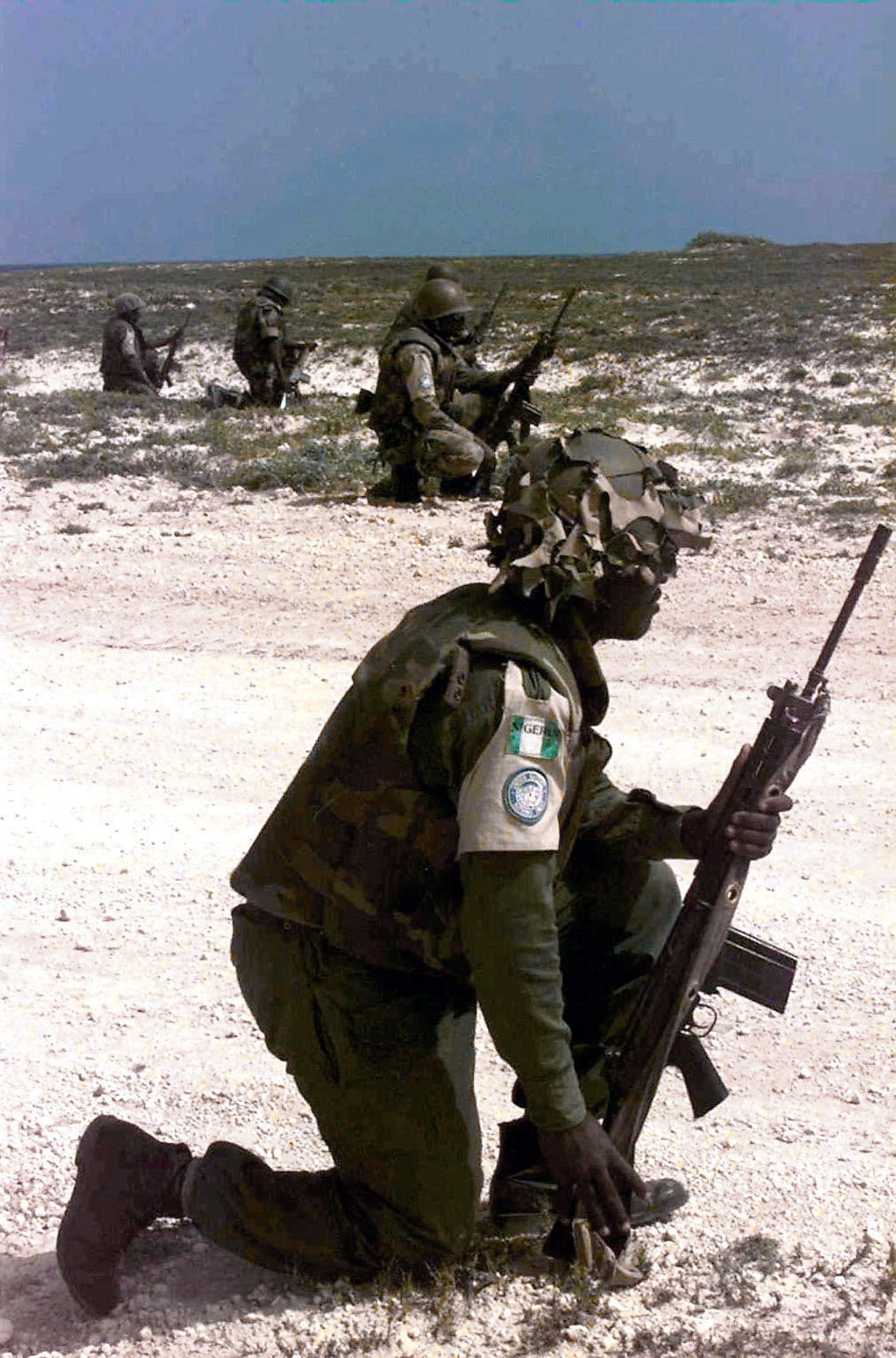
In December 1983 the new régime of the Head of State of Nigeria, Major General Muhammadu Buhari, announced that Nigeria could no longer afford an activist anti-colonial role in Africa. Anglophone members of the Economic Community of West African States (ECOWAS) established ECOMOG, dominated by the Nigerian Army, in 1990 to intervene in the civil war in Liberia. Smaller army forces had previously carried out UN and ECOWAS deployments in the former Yugoslavia, Angola, Rwanda, Somalia, and Sierra Leone.
The anti-colonial policy statement did not deter Nigeria under Generals Ibrahim Babangida in 1990 and Sani Abacha in 1997 from sending peacekeeping troops as part of ECOMOG under the auspices of ECOWAS into Liberia and later into Sierra Leone when civil wars broke out in those countries. President Olusegun Obasanjo in August 2003 committed Nigerian troops once again into Liberia, at the urging of the United States, to provide an interim presence until the UN's force UNMIL arrived. Charles Taylor was subsequently eased out of power by U.S. pressure and exiled to Nigeria.
In October 2004, Nigerian troops were deployed into Darfur, Sudan to spearhead an African Union force to protect civilians there.
In January 2013, Nigeria began to deploy troops to Mali as part of the African-led International Support Mission to Mali.
Nigeria claimed to have contributed more than twenty thousand troops and police officers to various UN missions since 1960. The Nigeria Police Force and troops have served in places like UNIPOM (UN India-Pakistan Observer mission) 1965, UNIFIL in Lebanon 1978, the UN observer mission, UNIIMOG supervising the Iran-Iraq ceasefire in 1988, former Yugoslavia 1998, East Timor 1999, and in the Democratic Republic of the Congo (MONUC) 2004.
Equipment
Main article: List of equipment of the Nigerian Army
Despite a disproportionate emphasis on the materiel and sophistication of the Nigerian Armed Forces, and despite possessing some formidable hardware, the Army has been hamstrung by technical deficiency and an exceptionally poor standard of maintenance. Its overabundance of foreign suppliers, including Austria, Brazil, France, Germany, Italy, Sweden, Switzerland, Romania, Turkey, Ukraine, the former Soviet Union, the United States and the United Kingdom, has also complicated logistics. Calculating the size and scope of replacement inventories alone is impossible given the menagerie of equipment in use.
The Nigerian Army maintains at least eighty-two different weapon systems and 194 types of ammunition, of sixty-two different categories, from fourteen manufacturers.
Aviation
The Nigerian Army achieved a historic milestone after it activated its Aviation Corps in 2024 when it took delivery of two Bell UH-1H, "Huey" helicopters. The Nigerian Army Aviation Corps has over 60 aircraft on order which includes:
- Bell UH-1H (36 ordered)
- Cayuse Warrior Scout
- Bell 412Ep
- Eurocopter EC135
- Bell UH-1D
- MF212 (20 units ordered)
- HAL Prachand (4 units planned)
About $3.2 million was allocated for the development of a hangar to accommodate these incoming fleet at the Bola Ahmed Tinubu International Airport, Minna, Niger State.
After reports indicated their purchase of 4 units HAL Prachand helicopters, it was revealed that Nigerian pilots were being trained in India on helicopters like HAL Dhruv for operating the HAL Prachand.
References
References
- The International Institute of Strategic Studies. (14 February 2020). "The Military Balance 2020". Routledge, Chapman & Hall, Incorporated.
- "Nigeria's President Goodluck Jonathan sacks military chiefs". BBC News.
- "The Nigerian Army - Chronicle of Command".
- Parliament of Nigeria. "Nigerian Armed Forces Act, 1994". International Red Cross.
- "Account Suspended".
- "History of the Nigerian Army".
- "celebrating nigerian army at 152". Thisdaylive.
- Gutteridge, Military in African Politics, 1969, 97.
- Scott report, ''Sunday Telegraph'', 11 January 1970, via N.J. Miners, ''The Nigerian Army 1956–65'', Methuen and Co. Ltd, London, 1971, p. 229
- Sieff, Kevin. (10 May 2015). "The Nigerian military is so broken, its soldiers are refusing to fight". Washington Post.
- Neville Brown, "The Nigerian Civil War," Military Review, vol. 48, October 1968, p. 28, cited in Major Michael Stafford, Quick Kill in Slow Motion, Marine Corps CSC, 1984, at http://www.globalsecurity.org/military/library/report/1984/SMR.htm
- Stafford study, 1984
- Central Intelligence Agency. (2 November 1970). "National Intelligence Estimate 64.2–70: Prospects for Postwar Nigeria". [[United States Department of State]].
- Olusegun Obasanjo, ''My Command: An Account of the Nigerian Civil War'', Heinemann, Ibadan/London/Nairobi, 1980, p. 61
- "Nigerian Army Logbaby".
- "Home".
- "The Nigerian Army - 3 Division".
- Orbat.com, [https://web.archive.org/web/20060316181350/http://www.ordersofbattle.darkscape.net/site/cwa_2006/display%20version.htm#_ftnref54 Concise World Armies 2006]
- Jimi Peters, The Nigerian military and the state, I.B. Tauris, 1997, p. 174, via [[Google Books]]
- "Nigerian Army".
- link. (3 March 2016 , Guardian, Kaduna, 13 October 2008)
- John Pike. "Nigeria – 7th Infantry Division".
- (29 February 2016). "Nigerian Army Inducts Combat Motorbikes Battalion To Fight Boko Haram". Defense World.
- Onyedinefu, Godsgift. (27 April 2023). "Nigerian Army unveils new regimental colours". [[BusinessDay (Nigeria).
- "Nigerian Army plans to double in size | IHS Jane's 360".
- "Nigerian Army Order of Battle".
- "Soldiering as a Career". Nigerian Army.
- "Nigerian Army- Official Website".
- "Nigerian Army Order of Battle".
- (19 November 2016). "Why we created new Nigerian Army division in Niger Delta – Major General – Premium Times Nigeria".
- Emmanuel, Ankeli. (28 November 2016). "Nigeria: Army Council Approves 8 Division for Sokoto". AllAfrica.
- "Preventing Coups in Nigeria".
- "Barracks".
- "Waging War to Keep the Peace: The ECOMOG Intervention and Human Rights (Human Rights Watch Report, June 1993)".
- "Nigerian Army Order of Battle".
- "Nigerian troops off to Liberia". News24.
- (10 July 2003). "Nigeria would shield Taylor from trial".
- (15 August 2004). "BBC NEWS {{!}} Africa {{!}} Rwandan soldiers arrive in Sudan".
- (30 January 2013). "Nigeria expends N7bn on troops, logistics to Mali – Jonathan – Vanguard News". Vanguard News.
- (23 January 2017). "U.S., Africa say Mali action counters growing Islamist threat". Reuters.
- John Olukayode Fayemi. "NThreats, Military Expenditure and National Security: Analysis of Trends in Nigeria's Defence Planning, 1970 – 1990". University of London.
- "Nigerian Army Uses Trump's Words to Justify Fatal Shooting of Rock-Throwing Protesters".
- (29 May 2022). "Army better equipped, motivated under Buhari – Army Chief".
- https://dsm.forecastinternational.com/2024/07/18/nigeria-expands-army-aviation-amid-regional-security/
- (2024-09-17). "Nigeria poised for historic helicopter purchase: What HAL’s LCH could mean for military power!".
This article was imported from Wikipedia and is available under the Creative Commons Attribution-ShareAlike 4.0 License. Content has been adapted to SurfDoc format. Original contributors can be found on the article history page.
Ask Mako anything about Nigerian Army — get instant answers, deeper analysis, and related topics.
Research with MakoFree with your Surf account
Create a free account to save articles, ask Mako questions, and organize your research.
Sign up freeThis content may have been generated or modified by AI. CloudSurf Software LLC is not responsible for the accuracy, completeness, or reliability of AI-generated content. Always verify important information from primary sources.
Report