From Surf Wiki (app.surf) — the open knowledge base
Nigella damascena
Species of flowering plant in the buttercup family Ranunculaceae
Species of flowering plant in the buttercup family Ranunculaceae
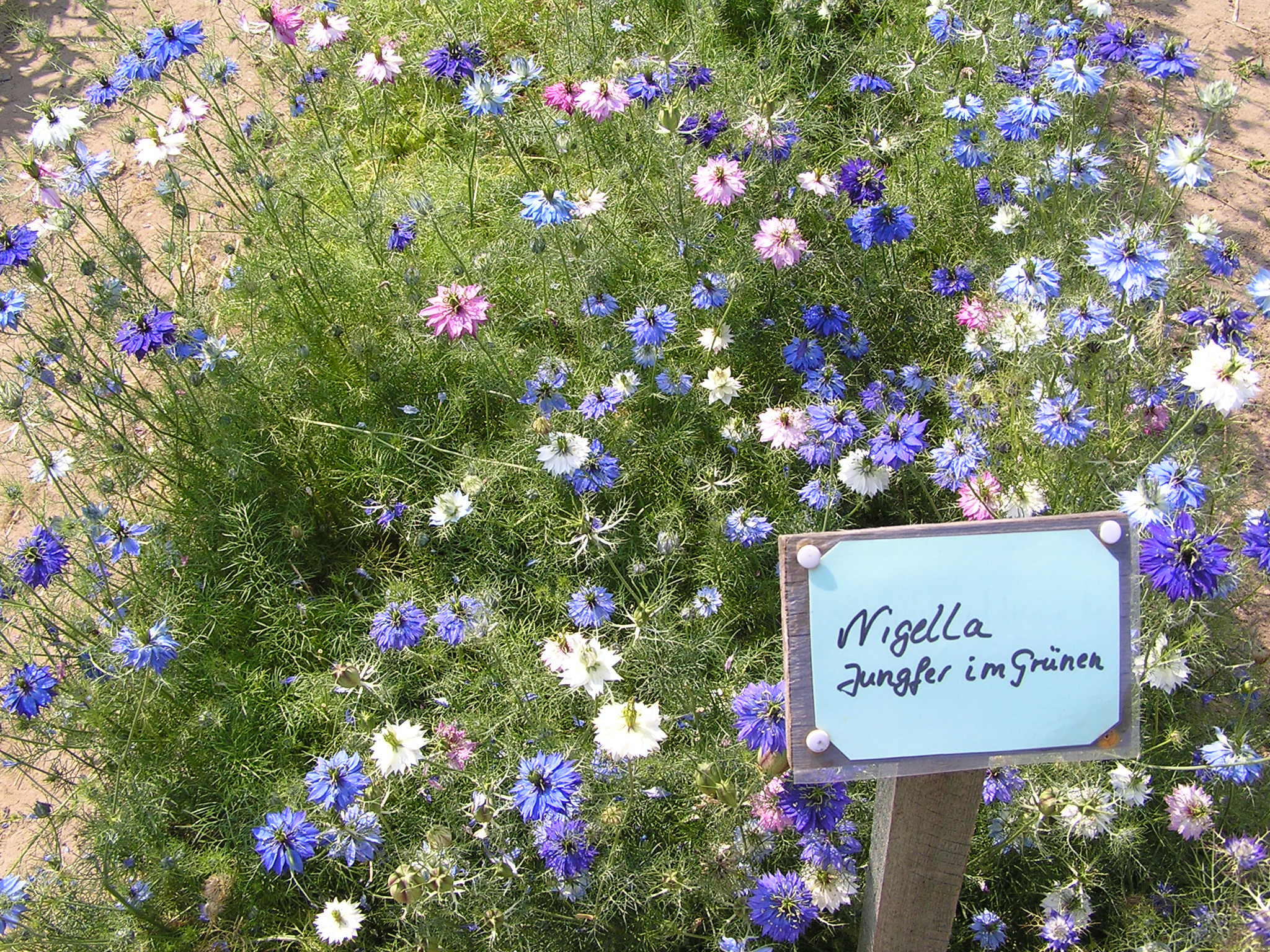
Nigella damascena, love-in-a-mist, or devil in the bush, is an annual garden flowering plant, belonging to the buttercup family Ranunculaceae. It is native to southern Europe (but adventive in more northern countries of Europe), north Africa and southwest Asia, where it is found on neglected, damp patches of land.
The specific epithet damascena relates to Damascus in Syria. The plant's common name "love-in-a-mist" comes from the flower being nestled in a ring of multifid, lacy bracts.
Description
It grows to 20 - tall, with pinnately divided, thread-like, alternate leaves. The flowers, blooming in early summer, are most commonly different shades of blue, but can be white, pink, or pale purple, with 5 to 25 sepals. The actual petals are located at the base of the stamens and are minute and clawed. The sepals are the only colored part of the perianth. The four to five carpels of the compound pistil have each an erect style.
The fruit is a large and inflated capsule, growing from a compound ovary, and is composed of several united follicles, each containing numerous seeds. This is rather exceptional for a member of the buttercup family. The capsule becomes brown in late summer. The plant self-seeds, growing on the same spot year after year.{{cite web File:Jungfer im Grünen.JPG|Double form File:Jungfer im Grünen (Nigella damascena) Samenkapseln-20220613-RM-175240.jpg|Seed capsule File:Nigella damascena MHNT.BOT.2007.40.38.jpg|Dried seed-heads with seeds File:N.damascena-seeds-1.jpg|Seeds File:Nigella damascena Dark Blue.jpg File:Love-in-a-mist (Nigella Damascena) Inflorescence.jpg|While and blue inflorescence variant
Cultivation
This easily grown plant has been a familiar subject in English cottage gardens since Elizabethan times, admired for its ferny foliage, spiky flowers and bulbous seed-heads. It is now widely cultivated throughout the temperate world, and numerous cultivars have been developed for garden use. 'Persian Jewels' is a mixture of white, pink, lavender and blue flowers. 'Persian Rose' is pale pink. Other cultivars are 'Albion', 'Blue Midget', 'Cambridge Blue', 'Mulberry Rose', and 'Oxford Blue'. 'Dwarf Moody Blue' is around 15 cm high. The pale blue ‘Miss Jekyll’{{cite web
Toxicity
Damascenine is a toxic alkaloid found in Nigella damascena seed.
However, an in vivo study in mice and in vitro assessment on human cell lines has not shown any toxicity.
References
References
- {{BSBI 2007
- {{PLANTS
- Harrison, Lorraine. (2012). "RHS Latin for gardeners". Mitchell Beazley.
- (2008). "The Royal Horticultural Society A-Z Encyclopedia of Garden Plants". Dorling Kindersley.
- "RHS Plant Selector - ''Nigella damascena'' 'Miss Jekyll Alba'".
- (July 2017). "AGM Plants - Ornamental". Royal Horticultural Society.
- (2013). "Morphological, microscopic and chemical comparison between Nigella sativa L. cv (black cumin) and Nigella damascena L. cv". Journal of Food, Agriculture and Environment.
- (September 2, 2015). "Damascenine induced hepatotoxicity and nephrotoxicity in mice and in vitro assessed human erythrocyte toxicity". Interdisciplinary Toxicology.
This article was imported from Wikipedia and is available under the Creative Commons Attribution-ShareAlike 4.0 License. Content has been adapted to SurfDoc format. Original contributors can be found on the article history page.
Ask Mako anything about Nigella damascena — get instant answers, deeper analysis, and related topics.
Research with MakoFree with your Surf account
Create a free account to save articles, ask Mako questions, and organize your research.
Sign up freeThis content may have been generated or modified by AI. CloudSurf Software LLC is not responsible for the accuracy, completeness, or reliability of AI-generated content. Always verify important information from primary sources.
Report