From Surf Wiki (app.surf) — the open knowledge base
Nicotine dependence
Chronic disease
Chronic disease
| Field | Value |
|---|---|
| name | Nicotine dependence |
| synonyms | Nicotine addiction; tobacco dependence; tobacco use disorder; cigarette dependence |
| image | Tobacco dependence 1.webm |
| alt | Video with visual medical explanation of nicotine dependence and its health effects |
| caption | Video of medical explanation of nicotine dependence and its health effects |
| complications | Health effects of tobacco |
| prognosis | 10-year shorter lifespan |
| prevalence | 1.2 billion tobacco users globally (2022) |
| deaths | 8 million per year (2023) |
Nicotine dependence{{#tag:ref|Nicotine dependence is also variously known as cigarette dependence, tobacco dependence, Tolerance is another component of drug dependence. Nicotine dependence is a serious public health problem because it leads to continued tobacco use and the associated negative health effects. Tobacco use is one of the leading preventable causes of death worldwide, causing more than 8 million deaths per year and killing half of its users who do not quit. Current smokers are estimated to die an average of 10 years earlier than non-smokers.
According to the World Health Organization, "Greater nicotine dependence has been shown to be associated with lower motivation to quit, difficulty in trying to quit, and failure to quit, as well as with smoking the first cigarette earlier in the day and smoking more cigarettes per day." The WHO estimates that there were 1.24 billion tobacco users globally , with the number projected to decline to 1.20 billion in 2025. Of the 34 million smokers in the United States in 2018, 74.6% smoked every day, indicating the potential for some level of nicotine dependence. There is an increased incidence of nicotine dependence in individuals with psychiatric disorders, such as anxiety disorders and substance use disorders.
Various methods exist for measuring nicotine dependence. Common assessment scales for cigarette smokers include the Fagerström Test for Nicotine Dependence, the Diagnostic and Statistical Manual of Mental Disorders criteria, the Cigarette Dependence Scale, the Nicotine Dependence Syndrome Scale, and the Wisconsin Inventory of Smoking Dependence Motives.
Nicotine is a parasympathomimetic stimulant Genetic risk factors contribute to the development of dependence. For instance, genetic markers for specific types of nicotinic receptors (the α5–α3–β4 nicotinic receptors) have been linked to an increased risk of dependence. Evidence-based treatments—including medications such as nicotine replacement therapy, bupropion, varenicline, or cytisine, and behavioral counseling—can double or triple a smoker's chances of successfully quitting.
Definition
Nicotine dependence is defined as a neurobiological adaptation to repeated drug exposure that is manifested by highly controlled or compulsive use, the development of tolerance, experiencing withdrawal symptoms upon cessation including cravings, and an inability to quit despite harmful effects. Nicotine dependence has also been conceptualized as a chronic, relapsing disease. A 1988 Surgeon General report states, "Tolerance" is another aspect of drug addiction [dependence] whereby a given dose of a drug produces less effect or increasing doses are required to achieve a specified intensity of response. Physical dependence on the drug can also occur, and is characterized by a withdrawal syndrome that usually accompanies drug abstinence. After cessation of drug use, there is a strong tendency to relapse."
Nicotine dependence leads to heavy smoking and causes severe withdrawal symptoms and relapse back to smoking. Relapse should not frustrate the nicotine user from trying to quit again. A 2015 review found "Avoiding withdrawal symptoms is one of the causes of continued smoking or relapses during attempts at cessation, and the severity and duration of nicotine withdrawal symptoms predict relapse." Symptoms of nicotine dependence include irritability, anger, impatience, and problems in concentrating.
Diagnosis
There are different ways of measuring nicotine dependence. The five common dependence assessment scales are the Fagerström Test for Nicotine Dependence, the Diagnostic and Statistical Manual of Mental Disorders, the Cigarette Dependence Scale, the Nicotine Dependence Syndrome Scale, and the Wisconsin Inventory of Smoking Dependence Motives.
The Fagerström Test for Nicotine Dependence focuses on measuring physical dependence which is defined "as a state produced by chronic drug administration, which is revealed by the occurrence of signs of physiological dysfunction when the drug is withdrawn; further, this dysfunction can be reversed by the administration of drug". The long use of Fagerström Test for Nicotine Dependence is supported by the existence of significant preexisting research, and its conciseness.
The 4th edition of the American Psychiatric Association Diagnostic and Statistical Manual of Mental Disorder (DSM-IV) had a nicotine dependence diagnosis which was defined as "...a cluster of cognitive, behavioral, and physiological symptoms..."
The Cigarette Dependence Scale was developed "to index dependence outcomes and not dependence mechanisms". The Nicotine Dependence Syndrome Scale, "a 19-item self-report measure, was developed as a multidimensional scale to assess nicotine dependence". The Wisconsin Inventory of Smoking Dependence Motives "is a 68-item measure developed to assess dependence as a motivational state".
Mechanisms
Traditional cigarettes are the most common delivery device for nicotine. However, electronic cigarettes are becoming more popular. Nicotine can also be delivered via other tobacco products such as chewing tobacco, snus, pipe tobacco, hookah, all of which can produce nicotine dependence.
Biomolecular
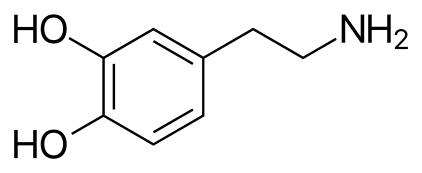
Pre-existing cognitive and mood disorders may influence the development and maintenance of nicotine dependence. Nicotine is a parasympathomimetic stimulant that binds to and activates nicotinic acetylcholine receptors in the brain, and several neuropeptides. Repeated exposure to nicotine can cause an increase in the number of nicotinic receptors, which is believed to be a result of receptor desensitization and subsequent receptor upregulation. Nicotine also stimulates nicotinic acetylcholine receptors in the adrenal medulla, resulting in increased levels of adrenaline and beta-endorphin. Chronic nicotinic acetylcholine receptor activation from repeated nicotine exposure can induce strong effects on the brain, including changes in the brain's physiology, that result from the stimulation of regions of the brain associated with reward, pleasure, and anxiety. These complex effects of nicotine on the brain are still not well understood.
When these receptors are not occupied by nicotine, they are believed to produce withdrawal symptoms. These symptoms can include cravings for nicotine, anger, irritability, anxiety, depression, impatience, trouble sleeping, restlessness, hunger, weight gain, and difficulty concentrating.
Neuroplasticity within the brain's reward system occurs as a result of long-term nicotine use, leading to nicotine dependence. There are genetic risk factors for developing dependence. The most well-known hereditary influence related to nicotine dependence is a mutation at rs16969968 in the nicotinic acetylcholine receptor CHRNA5, resulting in an amino acid alteration from aspartic acid to asparagine. The single-nucleotide polymorphisms (SNPs) rs6474413 and rs10958726 in CHRNB3 are highly correlated with nicotine dependence. There is a relationship between CHRNA5-CHRNA3-CHRNB4 nicotinic acetylcholine receptors and complete smoking cessation.
Psychosocial
In addition to the specific neurological changes in nicotinic receptors, there are other changes that occur as dependence develops. Through various conditioning mechanisms (operant and cue/classical), smoking comes to be associated with different mood and cognitive states as well as external contexts and cues.
Treatment
There are treatments for nicotine dependence, although the majority of the evidence focuses on treatments for cigarette smokers rather than people who use other forms of tobacco (e.g., chew, snus, pipes, hookah, e-cigarettes). Evidence-based medicine can double or triple a smoker's chances of quitting successfully.
Medication
There are eight major evidence-based medications for treating nicotine dependence: bupropion, cytisine (not approved for use in some countries, including the US), nicotine gum, nicotine inhaler, nicotine lozenge/mini-lozenge, nicotine nasal spray, nicotine patch, and varenicline.
Vaccine
TA-NIC is a proprietary vaccine in development similar to TA-CD but being used to create human anti-nicotine antibodies in a person to destroy nicotine in the human body so that it is no longer effective.
Psychosocial
Psychosocial interventions delivered in-person (individually or in a group) or over the phone (including mobile phone interventions) have been shown to effectively treat nicotine dependence. These interventions focus on providing support for quitting and helping with smokers with problem-solving and developing healthy responses for coping with cravings, negative moods, and other situations that typically lead to relapse. The combination of pharmacotherapy and psychosocial interventions has been shown to be especially effective.
Emerging Medical Treatment
A non-invasive, brain-based therapy called rTMS (repetitive transcranial magnetic stimulation) gained FDA approval in 2020 for treating nicotine addiction and aiding the quitting process. Studies have found patients who undergo rTMS have reduced cigarette cravings and number of cigarettes smoked, as well as greater long term success with cessation. While this therapy is relevantly new for treating nicotine additions, it has a longer history as a therapeutic treatment for Major depressive disorder, Obsessive-compulsive disorder, and migraines. Side effects of this therapy are relatively mild because of the noninvasive nature of the treatment.
Epidemiology
First-time nicotine users develop a dependence about 32% of the time. There are approximately 976 million smokers in the world. Estimates are that half of smokers (and one-third of former smokers) are dependent based on DSM criteria, regardless of age, gender or country of origin, but this could be higher if different definitions of dependence were used. Recent data suggest that, in the United States, the rates of daily smoking and the number of cigarettes smoked per day are declining, suggesting a reduction in population-wide dependence among current smokers. However, there are different groups of people who are more likely to smoke than the average population, such as those with low education or low socio-economic status and those with mental illness. There is an increased frequency of nicotine dependence in people with anxiety disorders. 6% of smokers who want to quit smoking each year are successful at quitting. Nicotine withdrawal is the main factor hindering smoking cessation. A 2010 World Health Organization report states, "Greater nicotine dependence has been shown to be associated with lower motivation to quit, difficulty in trying to quit, and failure to quit, as well as with smoking the first cigarette earlier in the day and smoking more cigarettes per day." E-cigarettes may result in starting nicotine dependence again. Like tobacco companies did in the last century, there is a possibility that e-cigarettes could result in a new form of dependency on nicotine across the world.
Concerns
Nicotine dependence results in substantial mortality, morbidity, and socio-economic impacts. There is strong evidence that vaping induces symptoms of dependence in users. Many organizations such the World Health Organization, American Lung Association, and Australian Medical Association do not approve of vaping for quitting smoking in youth, making reference to concerns about their safety and the potential that experimenting with vaping may result in nicotine dependence and later tobacco use.
Notes
Bibliography
References
References
- (2015). "Translational Neuropsychopharmacology".
- (2024-07-31). "Tobacco".
- (2019-06-27). "E-Cigarettes are More Addictive than Traditional Cigarettes-A Study in Highly Educated Young People". International Journal of Environmental Research and Public Health.
- (2004-06-22). "Mortality in relation to smoking: 50 years' observations on male British doctors". BMJ.
- (2015-02-24). "Tobacco smoking and all-cause mortality in a large Australian cohort study: findings from a mature epidemic with current low smoking prevalence". BMC Medicine.
- "WHO {{!}} Gender, women, and the tobacco epidemic".
- World Health Organization. (2024-01-16). "WHO global report on trends in prevalence of tobacco use 2000–2030". World Health Organization.
- Creamer, MeLisa R.. (2019). "Tobacco Product Use and Cessation Indicators Among Adults — United States, 2018". MMWR. Morbidity and Mortality Weekly Report.
- (2024-09-11). "Nicotine dependence and incident psychiatric disorders: prospective evidence from US national study". Molecular Psychiatry.
- (2019). "[Substance Abuse and White Matter: Findings, Limitations, and Future of Diffusion Tensor Imaging Research]". Drug and Alcohol Dependence.
- (July 2015). "Anyone Can Become Addicted to Drugs". [[National Institute on Drug Abuse]].
- (1988). "The health consequences of smoking: Nicotine addiction: A report of the Surgeon General". U.S. Department of Health and Human Services, Public Health Service, Centers for Disease Control, Center for Health Promotion and Education, Office on Smoking and Health. DHHS Publication No. (CDC) 88-8406.
- (2008). "Treating tobacco use and dependence: 2008 update". U.S. Department of Health and Human Services, U.S. Public Health Service.
- (2015). "Nicotinic, glutamatergic and dopaminergic synaptic transmission and plasticity in the mesocorticolimbic system: Focus on nicotine effects". Progress in Neurobiology.
- (2016). "Tobacco Use Cessation and Prevention – A Review". Journal of Clinical and Diagnostic Research.
- (2006). "Assessing tobacco dependence: A guide to measure evaluation and selection". Nicotine & Tobacco Research.
- "Exploring The Prevalence Of Smoking In The UK {{!}} News {{!}} Vaping Guides {{!}} IndeJuice (UK)".
- (2016). "Electronic cigarettes in the media.". Proc (Bayl Univ Med Cent)..
- Publishing, Harvard Health. "Breaking free from nicotine dependence".
- (2016). "Cognitive Dysfunction, Affective States, and Vulnerability to Nicotine Addiction: A Multifactorial Perspective". Frontiers in Psychiatry.
- (19 July 2012). "Professional Paramedic, Volume I: Foundations of Paramedic Care". Cengage Learning.
- (2014). "Republished: Nicotine and health". BMJ.
- (1 January 2005). "Frontiers in Medicinal Chemistry". Bentham Science Publishers.
- (2014). "Electronic Cigarettes for Smoking Cessation". Current Cardiology Reports.
- (2015). "Will Chronic E-Cigarette Use Cause Lung Disease?". American Journal of Physiology. Lung Cellular and Molecular Physiology.
- (17 June 2010). "Nicotine addiction.". The New England Journal of Medicine.
- (7 June 2016). "Nicotine and Tobacco".
- (5 August 2010). "Multiple independent loci at chromosome 15q25.1 affect smoking quantity: a meta-analysis and comparison with lung cancer and COPD.". [[PLOS Genetics]].
- (2011). "Association of the CHRNA5-A3-B4 gene cluster with heaviness of smoking: a meta-analysis.". Nicotine & Tobacco Research.
- (2016). "Genetics of Substance Use Disorders". Child and Adolescent Psychiatric Clinics of North America.
- (2016). "Crucial roles of the CHRNB3–CHRNA6 gene cluster on chromosome 8 in nicotine dependence: update and subjects for future research". Translational Psychiatry.
- (2018). "Pathways to precision medicine in smoking cessation treatments". Neuroscience Letters.
- (2013). "Neuroadaptive Changes Associated with Smoking: Structural and Functional Neural Changes in Nicotine Dependence". Brain Sciences.
- Mental health conditions, especially Major depressive disorder, may also impact the success of attempts to quit smoking.Kaprio, J., Kinnunen, T. H., Korhonen, T., Latvala, A., Ranjit, A., Depressive symptoms predict smoking cessation in a 20-year longitudinal study of adult twins, Addictive Behaviors, 2020 https://doi.org/10.1016/j.addbeh.2020.106427
- (October 2018}} There is no consensus for remedies for tobacco use disorder among pregnant smokers who also use [[alcohol (drug)). "Treating Tobacco Use Disorder in Pregnant Women in Medication-Assisted Treatment for an Opioid Use Disorder: A Systematic Review". Journal of Substance Abuse Treatment.
- "CelticPharma: TA-NIC Nicotine Dependence.".
- (October 2013). "Efficacy of interventions to combat tobacco addiction: Cochrane update of 2012 reviews.". Addiction.
- Jordan, T., Apostol, M. R., Nomi, J., & Petersen, N, Unraveling neural complexity: Exploring brain entropy to yield mechanistic insight in neuromodulation therapies for tobacco use disorder, Imaging Neuroscience, 2024, https://doi-org.libaccess.sjlibrary.org/10.1162/imag_a_00061
- Barnea-Ygael, N., Bystritsky, T., Casuto, L., Deutsch, F., Duffy, W., Feifel, D., George, M. S., Iosifescu, D. V., Li, X., Lipkinsky Grosz, M., Martinez, D., Morales, O., Moshe, H., Nunes, E. V., Roth, Y., Stein, A., Toder, D., Tendler, A., Winston, J., Ward, H., Wirecki, T., Vapnik, A. Zangen, A., Repetitive transcranial magnetic stimulation for smoking cessation: A pivotal multicenter double‐blind randomized controlled trial, World Psychiatry, 2021, https://doi.org/10.1002/wps.20905
- (April 2016). "WHY NOT POT?: A Review of the Brain-based Risks of Cannabis". Innov Clin Neurosci.
- (8 January 2014). "Smoking prevalence and cigarette consumption in 187 countries, 1980-2012.". JAMA.
- (8 November 2006). "Prevalence of DSM/ICD-defined nicotine dependence.". Drug and Alcohol Dependence.
- (2014). "Current Cigarette Smoking Among Adults — United States, 2005–2013". Centers for Disease Control and Prevention.
- (October 2018}} Men smoke at higher rates than do women and score higher on dependence indices; however, women may be less likely to be successful in [[smoking cessation). "Stability of smoking status in the US population: a longitudinal investigation.". Addiction.
- (2012). "Cigarette smoking, nicotine dependence and anxiety disorders: a systematic review of population-based, epidemiological studies". BMC Medicine.
- (2016). "Neurostimulation techniques in the treatment of nicotine dependence: A review". The American Journal on Addictions.
- (2016). "Nicotine Replacement Therapy: An Overview.". International Journal of Health Sciences.
- (2010). "Gender, women, and the tobacco epidemic". World Health Organization.
- (2017). "E-cigarettes: Impact of E-Liquid Components and Device Characteristics on Nicotine Exposure". Current Neuropharmacology.
- (2015). "Electronic Cigarettes: Vulnerability of Youth". Pediatric Allergy, Immunology, and Pulmonology.
- (November 2013). "Electronic cigarettes and vaping: a new challenge in clinical medicine and public health. A literature review.". Frontiers in Public Health.
- (2018). "Prevalence of electronic nicotine delivery systems (ENDS) use among youth globally: a systematic review and meta-analysis of country level data". Australian and New Zealand Journal of Public Health.
This article was imported from Wikipedia and is available under the Creative Commons Attribution-ShareAlike 4.0 License. Content has been adapted to SurfDoc format. Original contributors can be found on the article history page.
Ask Mako anything about Nicotine dependence — get instant answers, deeper analysis, and related topics.
Research with MakoFree with your Surf account
Create a free account to save articles, ask Mako questions, and organize your research.
Sign up freeThis content may have been generated or modified by AI. CloudSurf Software LLC is not responsible for the accuracy, completeness, or reliability of AI-generated content. Always verify important information from primary sources.
Report