From Surf Wiki (app.surf) — the open knowledge base
Nickernut
Plant seeds
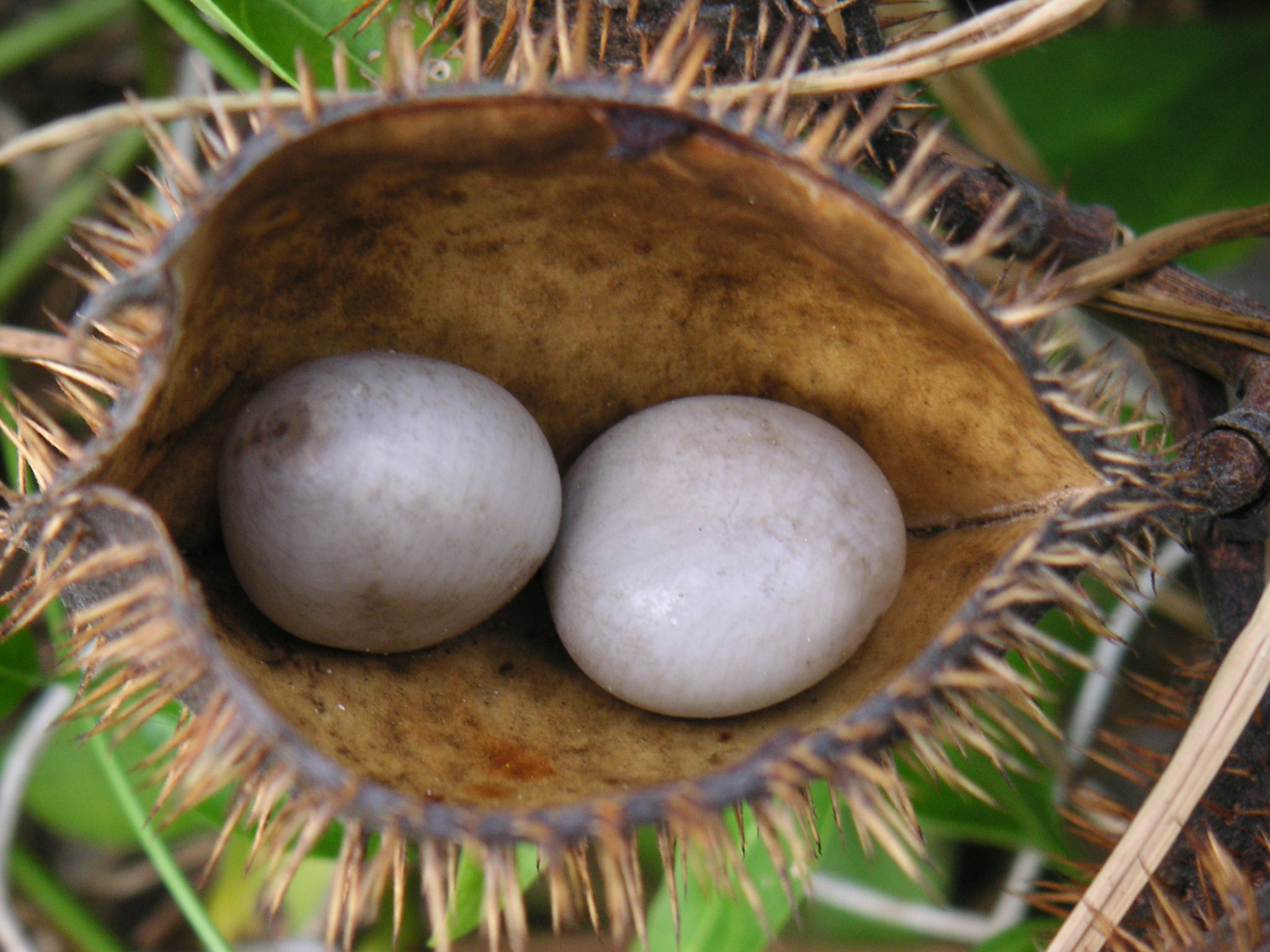
Plant seeds
Nickernuts or nickar nuts are smooth, shiny seeds from tropical leguminous shrubs, particularly Guilandina bonduc and Guilandina major, both known by the common name warri tree. C. bonduc produces gray nickernuts, and C. major produces yellow. Accordingly, these species are locally known in the Caribbean as "grey nickers" and "yellow nickers".
The word nicker probably derives from the Dutch word "knikker", meaning marble.
In the Caribbean, nickernuts are used to play mancala games such as oware. The nickernut is marble-like and good for other uses, such as for jewellery; it is also sometimes ground up to make a medicinal tea.
The seeds are often found on the beach, and are also known as sea pearls or eaglestones.
Guilandina and Merremia seeds sometimes drift long distances. In 1693 James Wallace referred to them being often found in Orkney: "After Storms of Westerly Wind amongst the Sea-weed, they find commonly in places expos'd to the Western-Ocean these Phaseoli . . . . [F]rom the West-Indies, where they commonly grow, they may be thrown in on Ireland, the Western parts of Scotland and Orkney". In 1751 Erich Pontoppidan described one found on the coast of Norway: "It is of the size of a chestnut, orbicular, yet flat, or as it were compressed on both sides. Its colour is a dark brown yet in the middle, at the junction of the shells, it is varied with a circle of shining-black, and close by that another of a lively red, which have a very pretty effect". They were known as 'sea beans' in Scandinavia, where one has been found fossilised in a Swedish bog, and 'Molucca beans' in the Hebrides, where a visitor to Islay in 1772 wrote of them as seeds of "Dolichos wrens, Guilandina bonduc, G. bonducetta, and Mimosa scandens…natives of Jamaica". The 1797 Edition of the Encyclopædia Britannica said that they were used only for "the making of snuff-boxes out of them"; however, there is a long tradition of using them as amulets for good luck, or to ease childbirth.
Gallery
File:Caesalpinia bonduc seeds W IMG 6944.jpg|Guilandina bonduc seeds in Krishna Wildlife Sanctuary, Andhra Pradesh, India. File:Caesalpinia bonduc leaves W IMG 6706.jpg|Guilandina bonduc leaves in Krishna Wildlife Sanctuary, Andhra Pradesh, India. File:Caesalpinia bonduc fruit W IMG 6946.jpg|Guilandina bonduc fruit in Krishna Wildlife Sanctuary, Andhra Pradesh, India. File:Caesalpinia bonduc fruit W IMG 6698.jpg|Guilandina bonduc fruit in Krishna Wildlife Sanctuary, Andhra Pradesh, India. File:Caesalpinia bonduc flowers W IMG 6708.jpg|Guilandina bonduc flowers in Krishna Wildlife Sanctuary, Andhra Pradesh, India. File:Caesalpinia bonduc flowers W IMG 6707.jpg|Guilandina bonduc flowers in Krishna Wildlife Sanctuary, Andhra Pradesh, India. File:Nickernut Seed Pods.jpg|Guilandina bonduc Unripe nickernut seed pods at Port Canaveral, Florida.
References
Sources
- E. Charles Nelson and P. H. Oswald. Ed. Wendy Walsh. Sea Beans and Nickar Nuts: A Handbook of Exotic Seeds and Fruits Stranded on Beaches in North-Western Europe. Botanical Society of the British Isles, 2000. B.S.B.I. Handbooks for Physical Identification 10.
References
- "The Fabulous Nickernuts". Wayne's Word.
- ''West Word'' [http://www.road-to-the-isles.org.uk/westword/march2002.html March 2002], retrieved 1 June 2010.
- "Gray Nickarbean or Sea Pearl". A Sea-Bean Guide.
- "Nickarbeans and Sea Pearls". Beachbeans.com.
- James Wallace, ''A Description of the Isles of Orkney'', 1693, 2nd ed. ed. John Small, Edinburgh: William Brown, 1883, OCLC 4383160, [https://books.google.com/books?id=kM8BAAAAYAAJ&dq=Wallace+Descriptions+of+the+Isles+of+Orkney+molucca+beans&pg=PA183 p. 183].
- Cited in Jack D. Forbes, ''The American Discovery of Europe'', Urbana: University of Illinois, 2007, {{ISBN
- Forbes, [https://books.google.com/books?id=cd8yZn7MfSQC&q=Pontoppidan&pg=PA29 p. 30].
- Forbes, [https://books.google.com/books?id=cd8yZn7MfSQC&q=Molucca+beans&pg=PA29 p. 30].
- "Orkney", [https://books.google.com/books?id=mXxBAAAAcAAJ&q=Molucca+beans&pg=PA500 vol. 13, p. 500].
- banishment of ill luckForbes, [https://books.google.com/books?id=cd8yZn7MfSQC&q=Amulets+against+Witchcraft&pg=PA29 pp. 29-30]: tied around children's necks in the Hebrides around 1700, the white ones used as talismans as late as 1948 and called "St. Mary's beans".
- Audrey Meaney, "Drift Seeds and the Brísingamen", ''Folklore'' 94.1 (1983) 33-39, [https://www.jstor.org/pss/1260165 p. 33]. In addition to 'sea-beans' they are called ''lausnarsteinar'', 'birth stones', in [[Iceland]] and ''vettenyrer'', '[[wight]] kidneys', in the [[Faroes]] and Norway.
This article was imported from Wikipedia and is available under the Creative Commons Attribution-ShareAlike 4.0 License. Content has been adapted to SurfDoc format. Original contributors can be found on the article history page.
Ask Mako anything about Nickernut — get instant answers, deeper analysis, and related topics.
Research with MakoFree with your Surf account
Create a free account to save articles, ask Mako questions, and organize your research.
Sign up freeThis content may have been generated or modified by AI. CloudSurf Software LLC is not responsible for the accuracy, completeness, or reliability of AI-generated content. Always verify important information from primary sources.
Report