From Surf Wiki (app.surf) — the open knowledge base
NGC 6357
Emission nebula in the constellation Scorpius
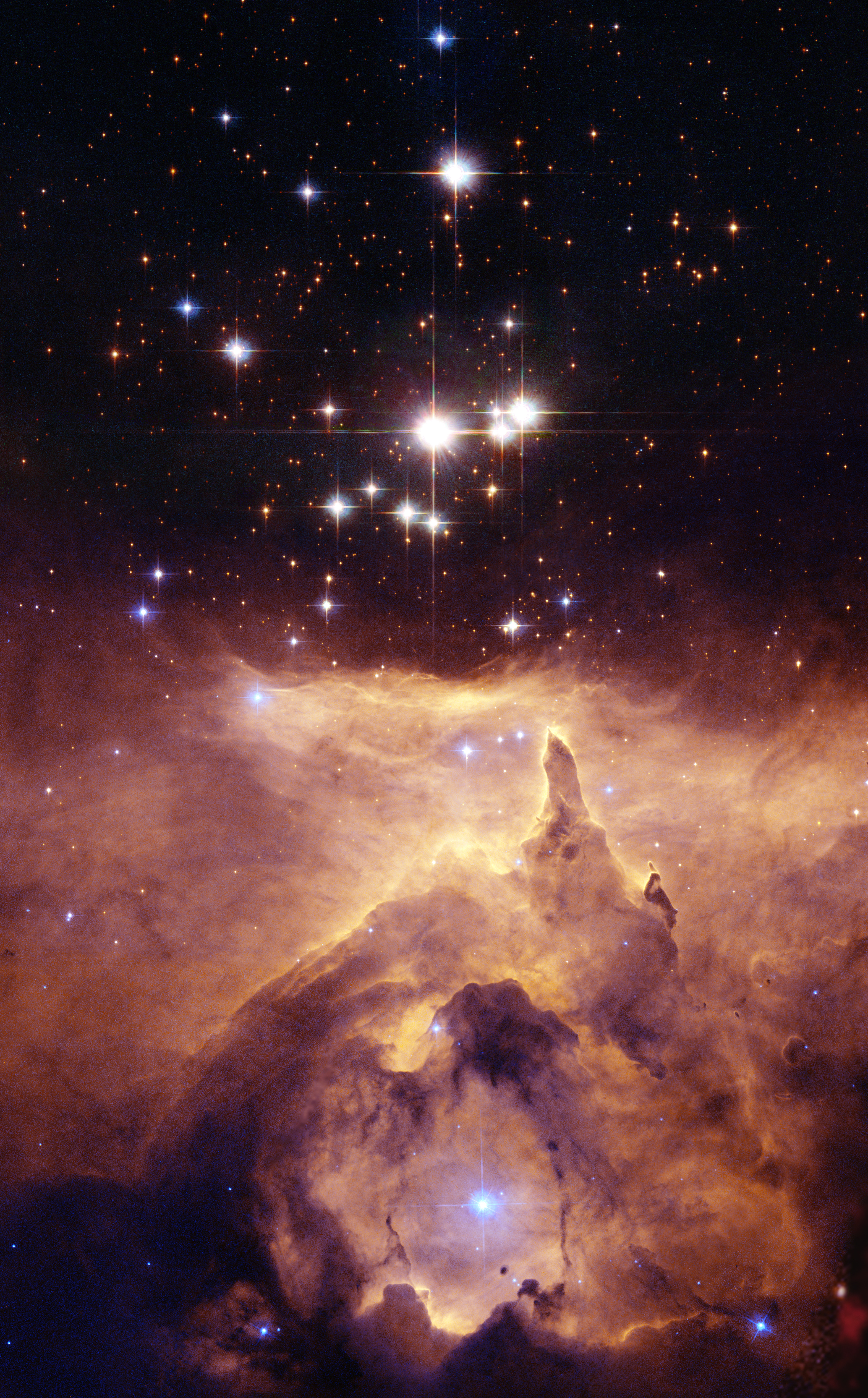
Emission nebula in the constellation Scorpius
| Field | Value | |||
|---|---|---|---|---|
| name | NGC 6357 | |||
| image | Cosmic ‘Winter’ Wonderland.jpg | |||
| caption | NGC 6357 composite image | |||
| credit | X-ray: NASA/CXC/PSU/L.Townsley et al.; Optical: UKIRT; Infrared: NASA/JPL-Caltech | |||
| type | H II REGION | |||
| epoch | J2000 | |||
| ra | {{cite simbad | |||
| title | NGC 6357 | |||
| access-date | 2007-05-03}} | |||
| dec | ||||
| constellation | Scorpius{{cite book | |||
| editor | R. W. Sinnott | |||
| title | The Complete New General Catalogue and Index Catalogue of Nebulae and Star Clusters by J. L. E. Dreyer | |||
| date | 1988 | |||
| publisher | Sky Publishing Corporation and Cambridge University Press | |||
| isbn | 978-0-933346-51-2}} | |||
| dist_ly | ~5900±450 | |||
| title | Kinematics in Young Star Clusters and Associations with Gaia DR2 | |||
| journal | The Astrophysical Journal | |||
| volume | 870 | issue=1 | pages=32 | year=2018 |
| arxiv | 1807.02115 | bibcode = 2019ApJ...870...32K | doi = 10.3847/1538-4357/aaef8c | last1=Kuhn |
| first1 | Michael A. | |||
| last2 | Hillenbrand | |||
| first2 | Lynne A. | |||
| last3 | Sills | |||
| first3 | Alison | |||
| last4 | Feigelson | |||
| first4 | Eric D. | |||
| last5 | Getman | |||
| first5 | Konstantin V. | |||
| s2cid | 119328315 | |||
| doi-access | free | |||
| dist_pc | 1800±140 | |||
| names | War and Peace Nebula, Lobster Nebula Sharpless 11, RCW 131, Gum 66, Madokami |
| access-date=2007-05-03}} | doi-access=free
NGC 6357 is a diffuse nebula near NGC 6334 in the constellation Scorpius. The nebula contains many proto-stars shielded by dark discs of gas, and young stars wrapped in expanding "cocoons" or expanding gases surrounding these small stars. It is also known as the Lobster Nebula. This nebula was given the name War and Peace Nebula by the Midcourse Space Experiment scientists because of its appearance, which, in infrared images the bright, western part resembles a dove, while the eastern part looks like a skull. A petition by anime fans to rename it as the Madokami nebula, due to resemblance with a character, was unsuccessful.
It is located about 5,500 light years away from Earth. NGC 6357 is connected by a filamentary structure to NGC 6334, and the two may form a single complex.{{cite journal | display-authors=1 | last1=Russeil | first1=D.
Associated open clusters
Pismis 24

This nebula includes the open cluster Pismis 24, which is home to several massive stars. One of the brightest stars in the cluster, Pismis 24-1, was thought possibly to be the most massive on record, approaching 300 solar masses, until it was discovered to be a multiple system of at least three stars; component stars would still remain near 100 solar masses each, making them among the more massive stars on record.{{cite web |access-date = 2007-04-11 |url-status = dead |archive-url = https://web.archive.org/web/20070404011712/http://www.spacetelescope.org/images/html/heic0619a.html |archive-date = 2007-04-04
G353.2+0.7
The young stellar cluster G353.2+0.7 lies east of Pismis 24 and was revealed by a Chandra X-ray image showing approximately 800 stars.
G353.1+0.6
The young stellar cluster G353.1+0.6 lies southeast of Pismis 24 and also contains approximately 800 stars detected by X-ray.
Massive stars
NGC 6357 is one of the most prominent sites of massive-star formation in our neighborhood of the Milky Way. A variety of early O-type stars reside in this nebula, blowing the bubbles around the star clusters that can be seen in the molecular cloud.
| Star name | Spectral type | Magnitude | |||
|---|---|---|---|---|---|
| (Mbol) | Temperature | ||||
| (K) | Radius | ||||
| () | Mass | ||||
| () | |||||
| WR 93 (HD 157504) | WC7 | -11.2 | 71,000 | 10 | 120 |
| Pismis 24-1NE | O3.5 If* | −10.0 | 42,000 | 17 | 74 |
| Pismis 24-1SW | O4 III | −9.8 | 41,500 | 16 | 66 |
| Pismis 24-2 | O5.5 V(f) | −8.9 | 40,000 | 12 | 43 |
| Pismis 24-3 | O8 V | −7.7 | 33,400 | 9 | 25 |
| Pismis 24-10 | O9 V | −7.2 | 31,500 | 8 | 20 |
| Pismis 24-12 | B1 V | −5.3 | 30,000 | 4 | 11 |
| Pismis 24-13 | O6.5 III((f)) | −8.6 | 35,600 | 12 | 35 |
| Pismis 24-15 | O8 V | −7.8 | 33,400 | 10 | 25 |
| Pismis 24-16 | O7.5 V | −9.0 | 34,000 | 16 | 38 |
| Pismis 24-17 | O3.5 III | −10.1 | 42,700 | 17 | 78 |
| Pismis 24-18 | B0.5 V | −6.4 | 30,000 | 6 | 15 |
| Pismis 24-19 | B0.5 V | −5.4 | 30,000 | 4 | 11 |
References
References
- Sample, Ian. (20 February 2013). "Lobster Nebula – birthplace of stars – revealed in infrared".
- (25 February 2013). "Lobster Nebula Seen with ESO's VISTA Telescope Space Wallpaper".
- "2MASS Picture of the Week Archive Captions".
- "There Is A New Petition To Name A Nebula After "Ultimate Madoka"". crunchyroll.com.
- "NGC 6357. The Lobster Nebula". astrodrudis.com.
- (20 December 2016). "Winter Wonderland' Glows in Space as Nebula Is Wreathed in Wintry Colors". [[Space.com]].
- (19 December 2006). "NASA: Massive Stars in Open Cluster Pismis 24".
- Townsley, L. K.. (2014). "The Massive Star-Forming Regions Omnibus X-Ray Catalog". Astrophysical Journal Supplement.
- Damke, G.. (2006). "The open cluster G353.1+0.7 in NGC6357". Revista Mexicana de Astronomía y Astrofísica.
- (2012). "Star formation and disk properties in Pismis 24". Astronomy & Astrophysics.
- (2005). "A new calibration of stellar parameters of Galactic O stars". Astronomy and Astrophysics.
This article was imported from Wikipedia and is available under the Creative Commons Attribution-ShareAlike 4.0 License. Content has been adapted to SurfDoc format. Original contributors can be found on the article history page.
Ask Mako anything about NGC 6357 — get instant answers, deeper analysis, and related topics.
Research with MakoFree with your Surf account
Create a free account to save articles, ask Mako questions, and organize your research.
Sign up freeThis content may have been generated or modified by AI. CloudSurf Software LLC is not responsible for the accuracy, completeness, or reliability of AI-generated content. Always verify important information from primary sources.
Report